-
Producer
Yelland & Papps -
Region
Barossa Valley
-
RRP
$54
-
Vintage
2025
-
Variety/Varieties
Shiraz (Syrah)
-
Alc./Vol.
13.3%
Black cherry, ripe plum and blackberry, with a cooling herbal edge and a savoury dash of white pepper and tobacco running underneath. The tannins are fine and so silky. The wine feels refreshing on the palate, but delivered with substance to the fruit. From the warm climes of Barossa, this is something that will please cool climate wine lovers.
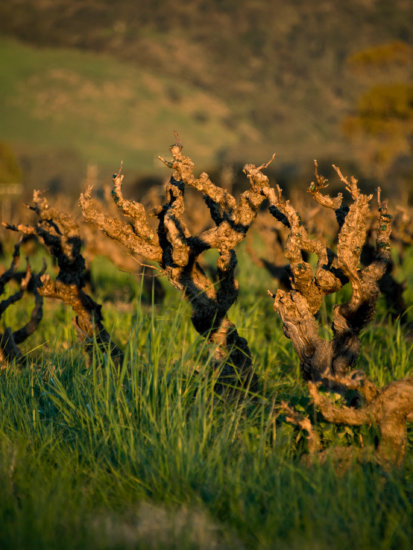
Yelland & Papps has become one of the defining names of new-wave Barossa, the loose movement of producers reworking a region long associated with big, ripe, oak-driven shiraz into something fresher, lighter-framed and more site-specific. This single-vineyard release comes from grower Pete Sonntag’s block in Stone Well, planted in 2000 on heavy loam over red clay scattered with quartz — a small, half-hectare parcel.
The fruit is entirely hand-picked and fermented with a healthy portion of whole clusters, then left on skins for a patient thirteen days before ageing for ten months in seasoned French oak — oak chosen deliberately for its neutrality, so it frames the wine rather than flavours it. The result leans into restraint over power: gentle handling throughout, aimed at letting the Stone Well site speak clearly rather than layering the wine with winemaking artifice. Production is tiny, at just 540 cases.
Tasting note
Inky, earthy aromas sit beneath black cherry, perfectly ripe black plum and blackberry leaf, with a savoury edge of white pepper and tobacco leaf running through the middle. The gentle handling in the winery is obvious from the first sip — tannin is coating and fine, giving real lift and mouthfeel alongside blackcurrant, raspberry and plum on the palate, all grounded by a earthy, mineral thread. It’s a wine that trades power for precision, svelte and composed where so much Barossa shiraz reaches for size. You’ll be forgiven for forgetting this wine is from the Barossa at all.
When to drink
This wine offers good cause to slowly contemplate over the course of an afternoon, as it challenges your prejudices about the Barossa. Or maybe you’ve spent the whole bloody weekend making that short rib ragu, and your folks are on their way. Relax. Open this wine. The gnocchi’s done, the house is passably clean, and they’re going to love every mouthful — and you too, for spoiling them.
Themes of this wine
Syrah, or shiraz
Same grape, two names — syrah in its French homeland and much of the world, shiraz in Australia and South Africa, where it built its reputation on power, ripeness and generous oak. Increasingly, Australian producers making leaner, fresher, more site-driven versions of the variety are choosing to label it syrah instead, a small but deliberate signal that the wine inside is reaching for something different to the Barossa blockbuster stereotype.
Barossa Valley
The Barossa Valley is Australia’s most famous red wine region, built on old vines, a warm continental climate and a long tradition of powerful, full-bodied shiraz. Some of the country’s oldest producing vineyards, planted well over a century ago, still bear fruit here, giving the region a depth of vinous history few places in the world can match.
New-wave Barossa
Alongside its old guard, the Barossa has in recent years become home to a growing cohort of producers rethinking what the region’s wines can be — favouring earlier picking, whole-bunch ferments, neutral oak and single-vineyard sites over ripeness and power. The movement doesn’t reject the Barossa’s history so much as widen it, proving the region can produce wines of real freshness and finesse alongside its more traditional style.
Whole-bunch fermentation
Rather than removing every grape from its stem before fermentation, some winemakers choose to ferment a portion of the fruit as whole clusters, stems included. Handled well, this technique lifts savoury, peppery and herbal characters and lends a fine, textural grip to the tannins, adding a layer of complexity beyond straightforward fruit. Here, a healthy portion of whole clusters plays directly into the wine’s white pepper and tobacco leaf character, and its notably fine, coating tannin.
Explore Further

GET FIRST ACCESS TO THE NEXT WINE ICONS – DELIVERED
Find out moreEach month, get 3 bottles of our freshest discoveries. We taste thousands to bring you the best.
Join us and support emerging winemakers, sustainable vineyards, and the development of young professionals.
— Max Allen, Wine Writer
— Broadsheet
— The Australian