-
Producer
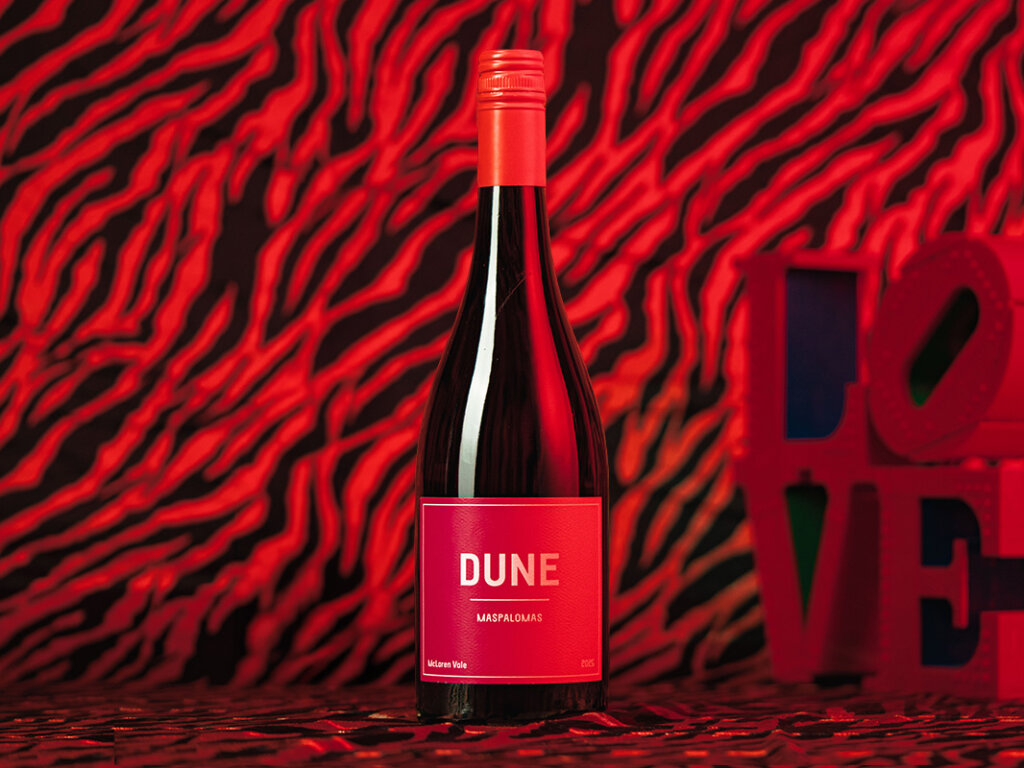
Dune -
Region
McLaren Vale
-
RRP
$32
-
Vintage
2025
-
Variety/Varieties
Grenache Grenache blanc
-
Alc./Vol.
13%
Spain’s traditional ‘clarete’ wines might be pink in hue, but they are not rosés. The colour in rosé comes from taking red grapes and giving their skins only brief contact with the juice before whisking them away; the colour in clarete comes from mixing red and white grapes in the ferment, and giving both components equal amounts of skin-contact time. The resulting wines land at the centre of the Venn diagram of a lot of the current moment’s drinking trends – they look like rosé, drink like a chilled red, and have some of the texture of skin-contact whites. They were also practically extinct in Spain – made only for local consumption – until 2016, when Scott Wasley, an Australian importer of Spanish wine, collaborated with Rioja producer Alegre y Valgañón to reintroduce the style commercially. Not long afterwards, in 2022, brothers Duncan and Peter Lloyd made Australia’s first take on the style, ‘Maspalomas’, co-fermenting whole bunches of grenache with crushed grenache blanc from Blewitt Springs in McLaren Vale. This, the fourth vintage of ‘Maspalomas’, shows why they’re onto a winner with the style.
Tasting Note
Deep pink in the glass, with a slight tinge of burnt orange tone – pitched somewhere between ‘dark rosé’ and ‘ultra-light red’. The nose of this wine opens with delicate and slightly unusual aromatics – dried rose petals, freshly-grated mace, the high-toned boozy funk of kirschwasser. On the palate, the fruit character becomes clearer – juicy tart cranberries, crunchy pomegranate arils, the white tops of just-ripe strawberries. There’s an appealing vibrancy to the wine, despite the fact that it doesn’t have high acidity, with lightly grippy tannins (reminiscent of a good skin-contact white), a touch of phenolic bitterness, and a pop of salinity to keep everything fresh. The texture is juicy and generous, with glossy fruit that doesn’t veer into the realms of ‘overripe’ or ‘slick’. An interesting hint of watermelon rind character emerges on the finish – and draws you back for another sip. Serve lightly chilled.
Themes of this wine
McLaren Vale
While it couldn’t feel any more removed from city life, the McLaren Vale wine region is actually inside Adelaide’s metropolitan area. And although the township itself is only forty minutes by car from central Adelaide and vineyards brush up against ever-encroaching housing, McLaren Vale remains unaffected by the urban sprawl. With deeply etched history, the Vale has a slow-paced sense of calm and an extraordinary wealth of untrammelled beauty. It is home to some of this country’s most beautifully pristine beaches, as well as some of the world’s most forward-thinking grape-growers and winemakers. And with over eighty cellar doors, it is an essential destination for wine lovers – and anyone else, for that matter.
Grenache
The great variety of the Southern Rhône, grenache actually hails from Spain, where it’s called garnacha – but it has found many other homes around the world, from Italy to California. Australia has its own special relationship with the variety – we’re home to the world’s oldest productive grenache vines, planted in 1948. Today, a renaissance is seeing the variety championed, with makers in McLaren Vale arguably turning out the most compelling examples.
Grenache blanc
As its name suggests, grenache blanc is a colour mutation of grenache – the raspberry-scented red variety from Spain that is more famous in its Southern French guise. As with the dark-skinned original, grenache blanc likely originated in Spain, with the colour mutation probably occurring in the Terra Alta region of Catalunya, not far from Barcelona. While there isn’t much grenache blanc currently in the ground in Australia, it’s a variety that has attracted some attention as a climate-apt variety for warmer regions, particularly in South Australia, given its natural tolerance to both drought and heat. It produces rich, unctuous white wines that, while not overly high in acid, can age well if carefully made.

GET FIRST ACCESS TO THE NEXT WINE ICONS – DELIVERED
Find out moreEach month, get 3 bottles of our freshest discoveries. We taste thousands to bring you the best.
Join us and support emerging winemakers, sustainable vineyards, and the development of young professionals.
— Max Allen, Wine Writer
— Broadsheet
— The Australian