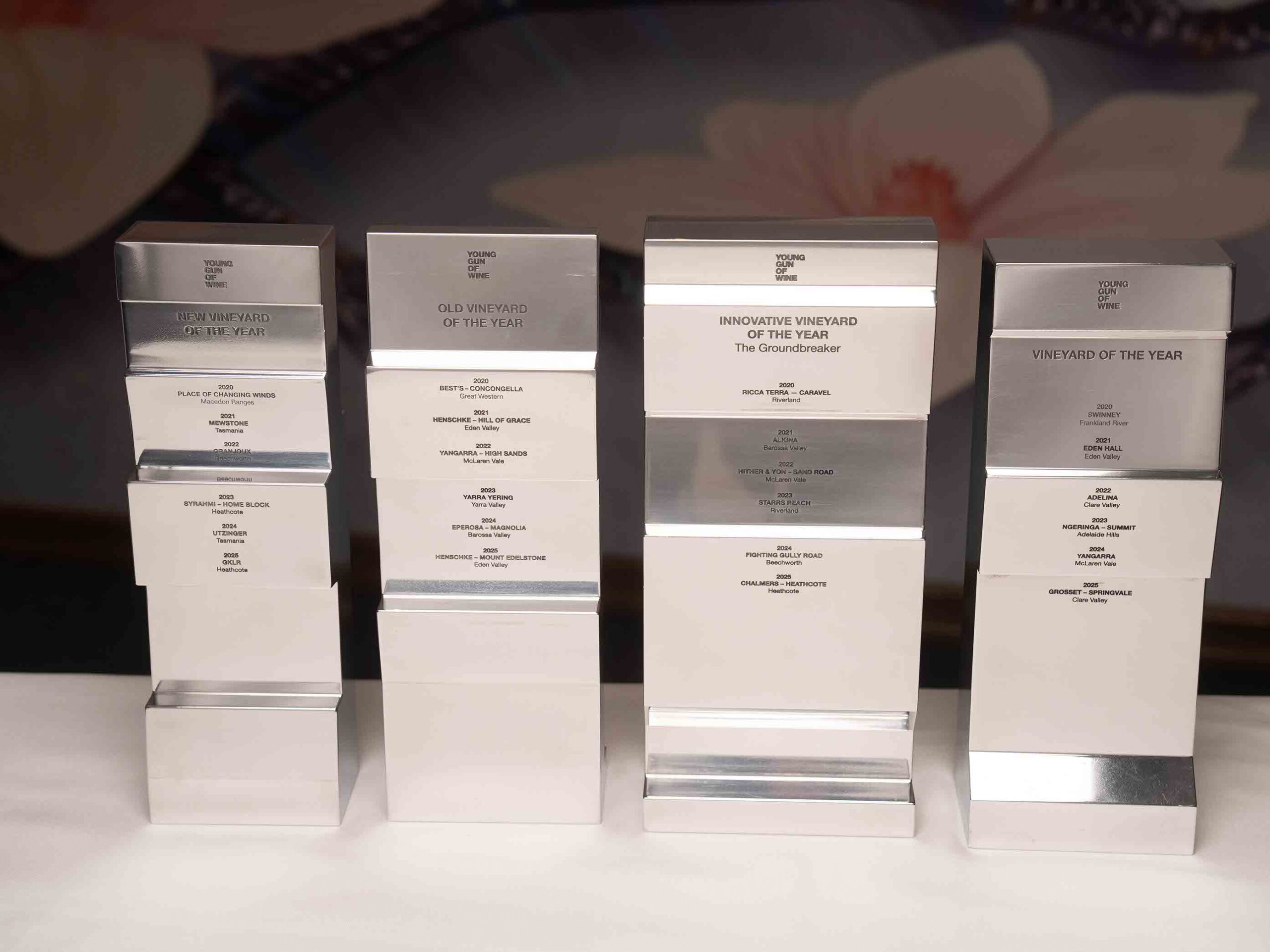
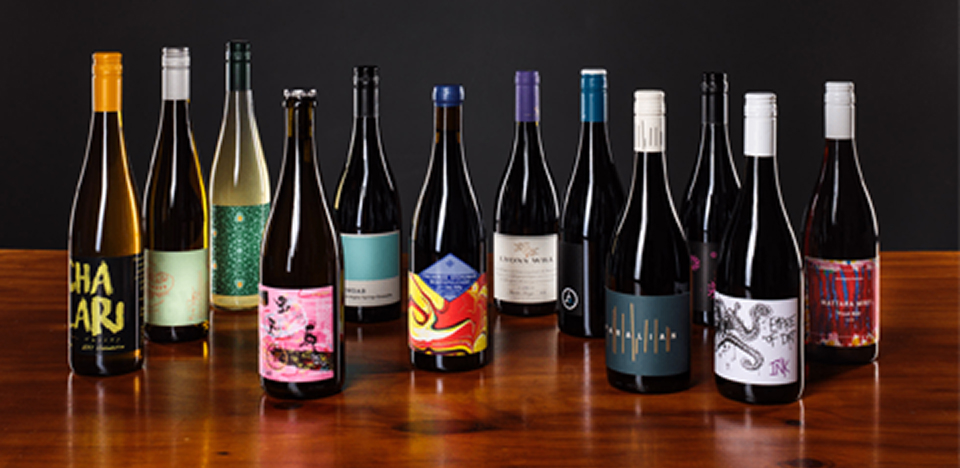
Four trophies. Forty-five vineyards. One argument: that the future of Australian wine is being grown, right now, by people who understand that what happens in the soil determines what ends up in the glass – and that getting that right is the most important work in the industry.
The Vineyard of the Year Awards exist to make that argument loudly, and to back it up with evidence. Six years in, the evidence keeps getting stronger.
“These awards are here to advance the regional identity of Australian wine and promote leading-edge sustainability and innovation in winegrowing,” said Young Gun of Wine founder Rory Kent. “And there has never been a more important moment to celebrate a group like this.”
That importance is not abstract. The Australian wine industry is navigating a genuinely difficult economic landscape – one in which the growers who are farming smarter, building healthier soils, and forging deeper connections to place are not just making better wine, but building the kind of resilience that the industry’s future depends on. The Vineyard of the Year Awards don’t just recognise that work. They amplify it, connect the people doing it, and make the case – to the industry, to consumers, to the world – that Australian wine’s sense of place is as profound as anywhere on earth.
“Place is Everything” — Max Allen
“Anything we can do to remind people everywhere that the sense of place is as profound here as it is in any other wine-producing nation on earth – the awards really, at their heart, are a way of reminding everybody that place is everything.”
“Internationally, Australia has struggled because it doesn’t have that sense of the perceived importance of place that the old world does – particularly France and Italy,” said wine writer and author Max Allen, who has judged these awards since their inception. “So anything we can do to remind people everywhere that the sense of place is as profound here as it is in any other wine-producing nation on earth – the awards really, at their heart, are a way of reminding everybody that place is everything.”
What unites this year’s 45 finalists – trophy winners and shortlisted vineyards alike – is an understanding that sustainability is not a marketing position. It is a survival strategy. The environmental, economic and social pillars of sustainability don’t compete; they reinforce each other. And it is through this collective of growers, sharing knowledge and raising the bar together, that Australian viticulture moves forward.
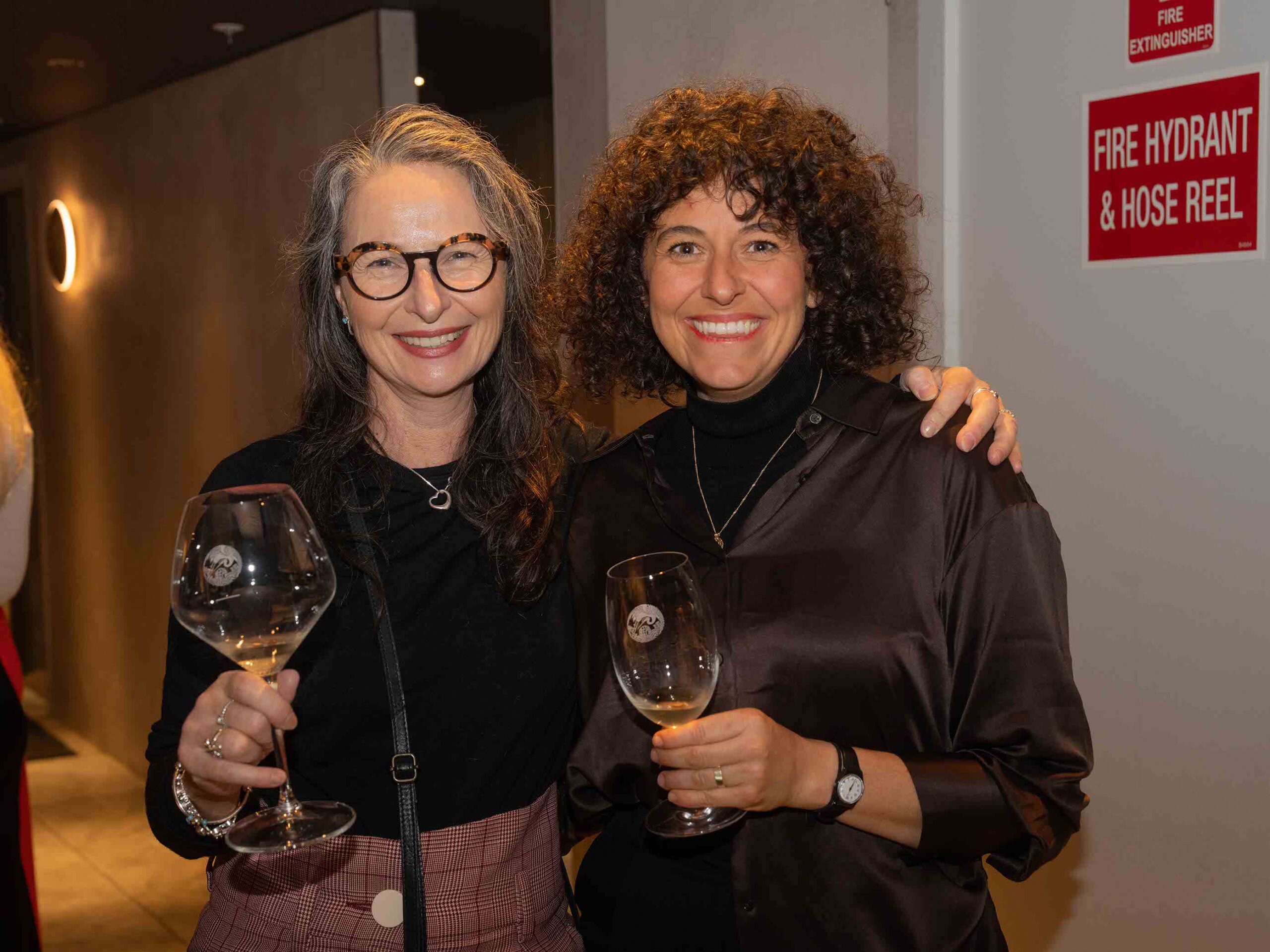
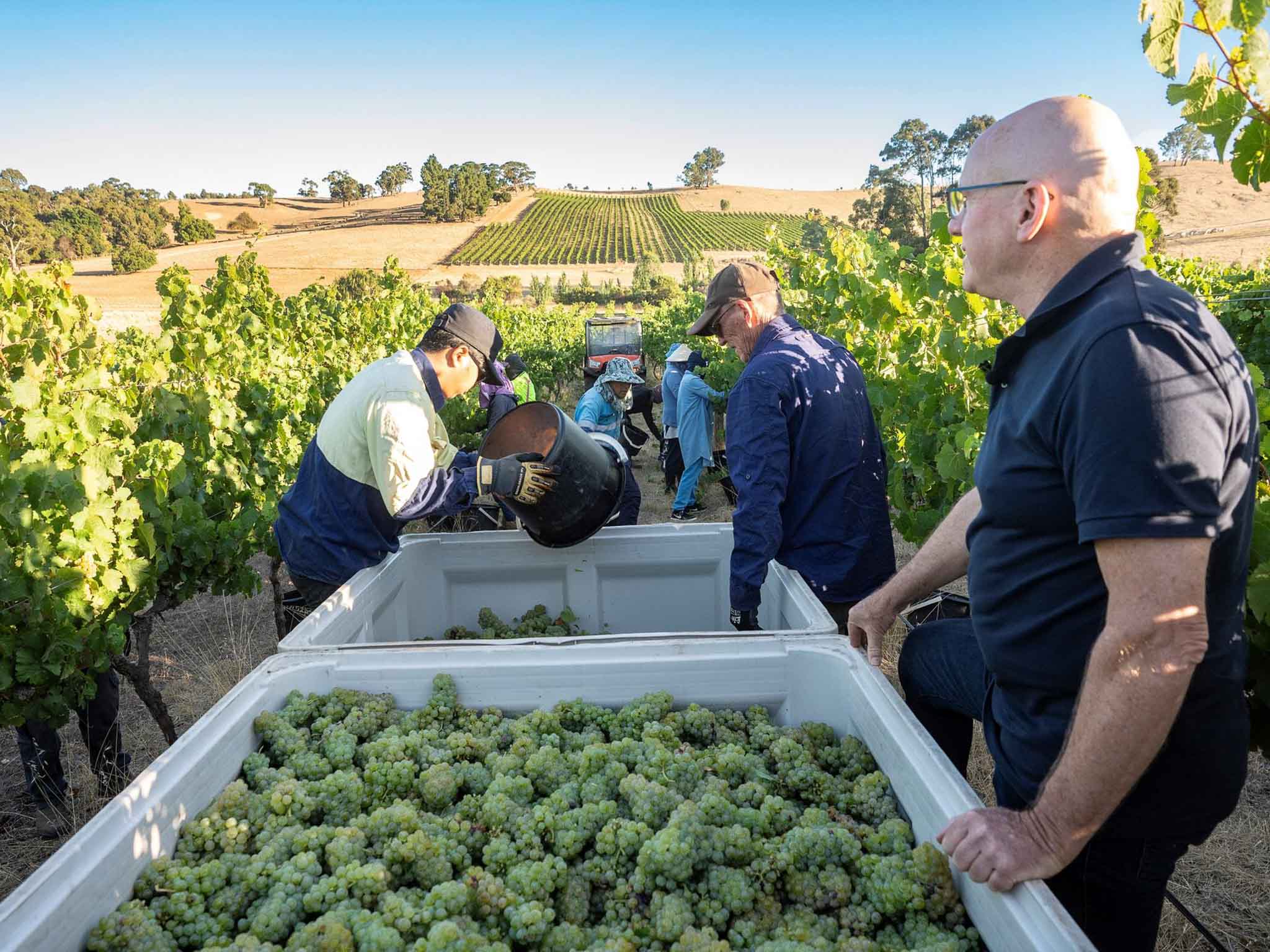
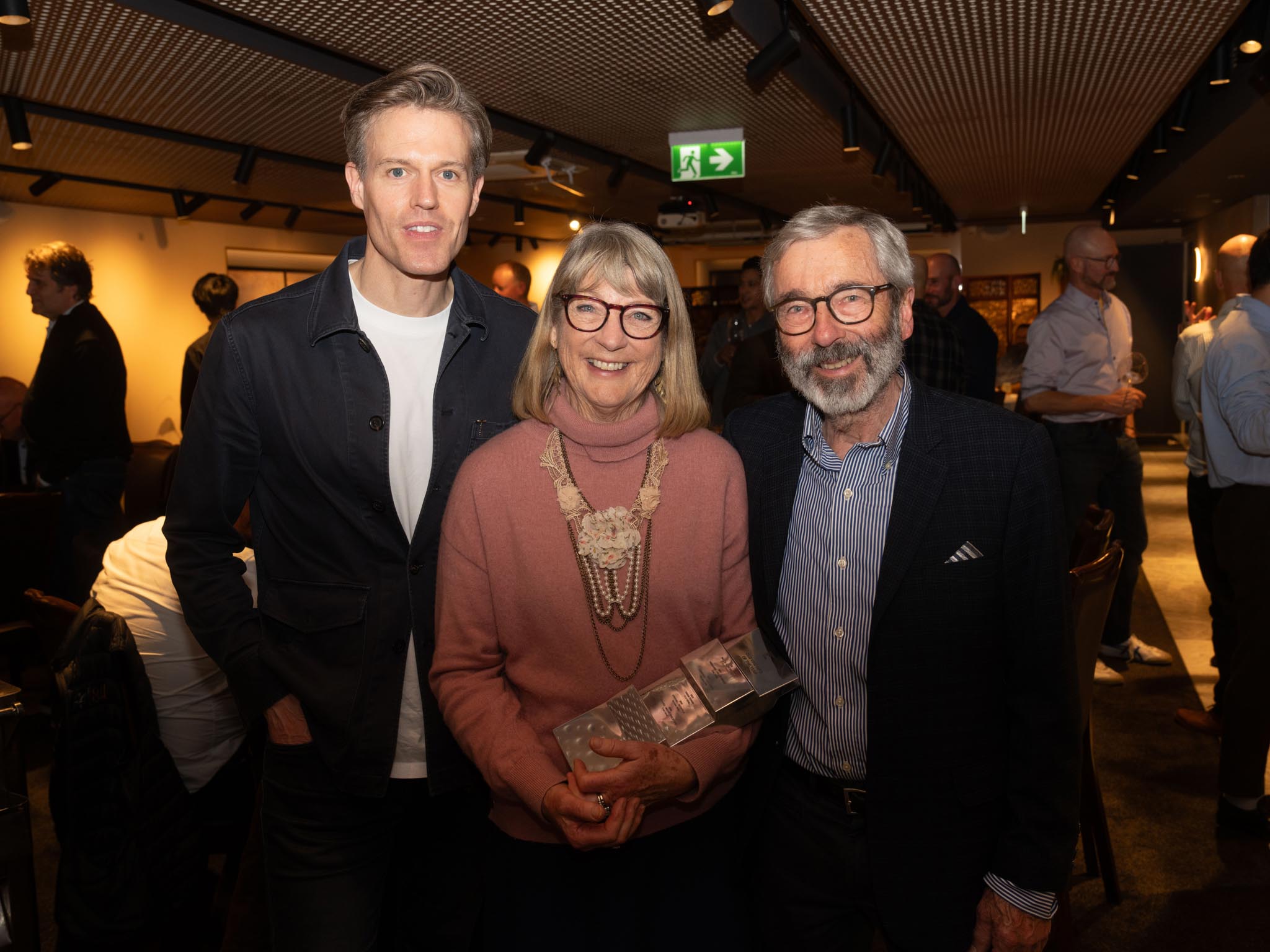
Above: Stephen Henschke, Lee Haselgrove (former Swinney viticulturist, 2020 Vineyard of the Year, who is now growing wine at a singular site under the Lirica banner in Margaret River), and James Hook (DJs Growers). Opposite: Kim White (Circulus Wines, Geelong) and Sarah Marrocco (Vinteloper, Adelaide Hills).
“The Vineyard of the Year Awards bring together winegrowers and facilitate the exchange of crucial information. The more knowledge our winegrowers can glean from each other’s experience, the more tools they will have to respond to the unique and sometimes challenging conditions of their own sites. The networks forged by these awards are a genuine source of encouragement and support.”
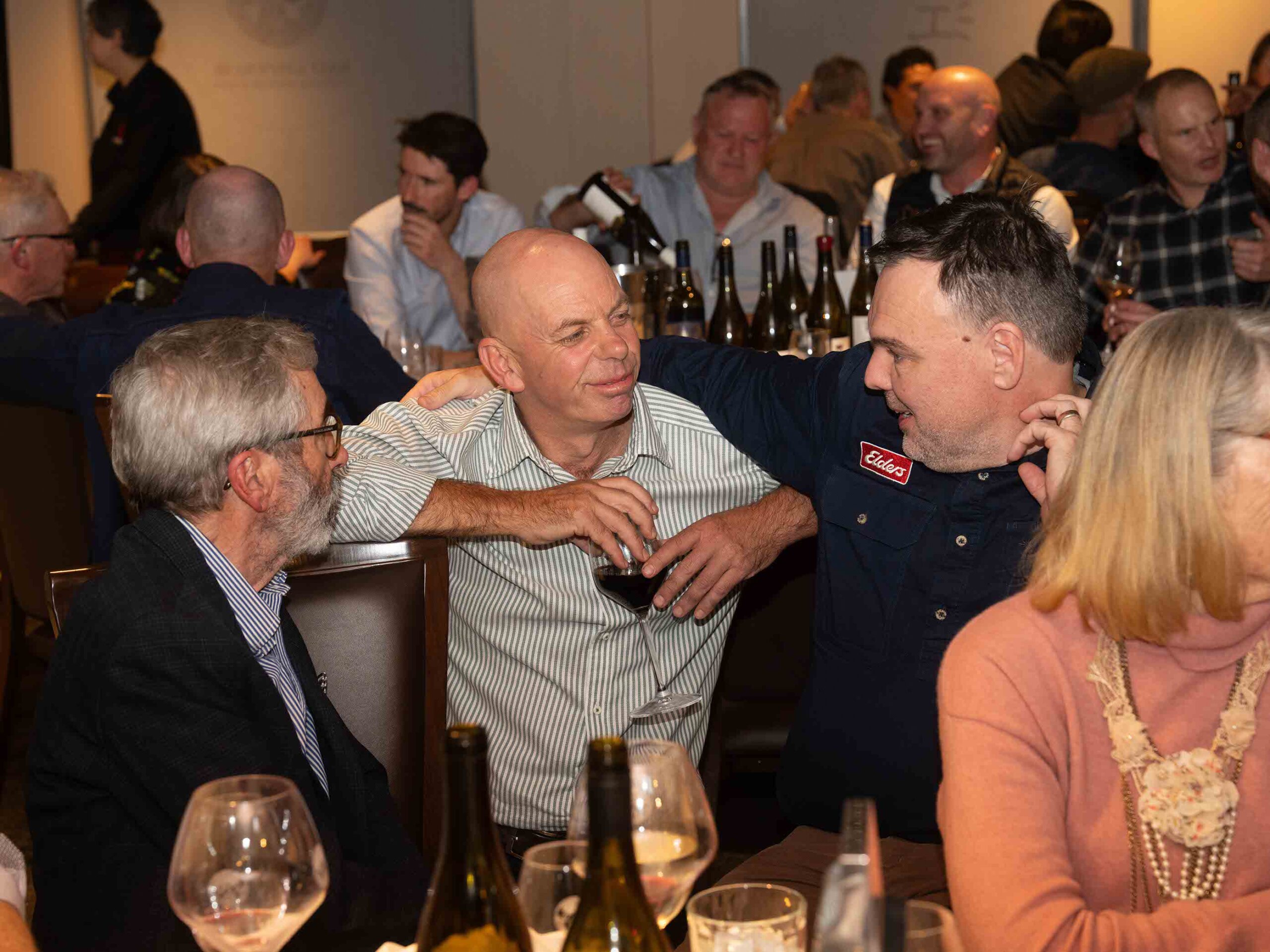
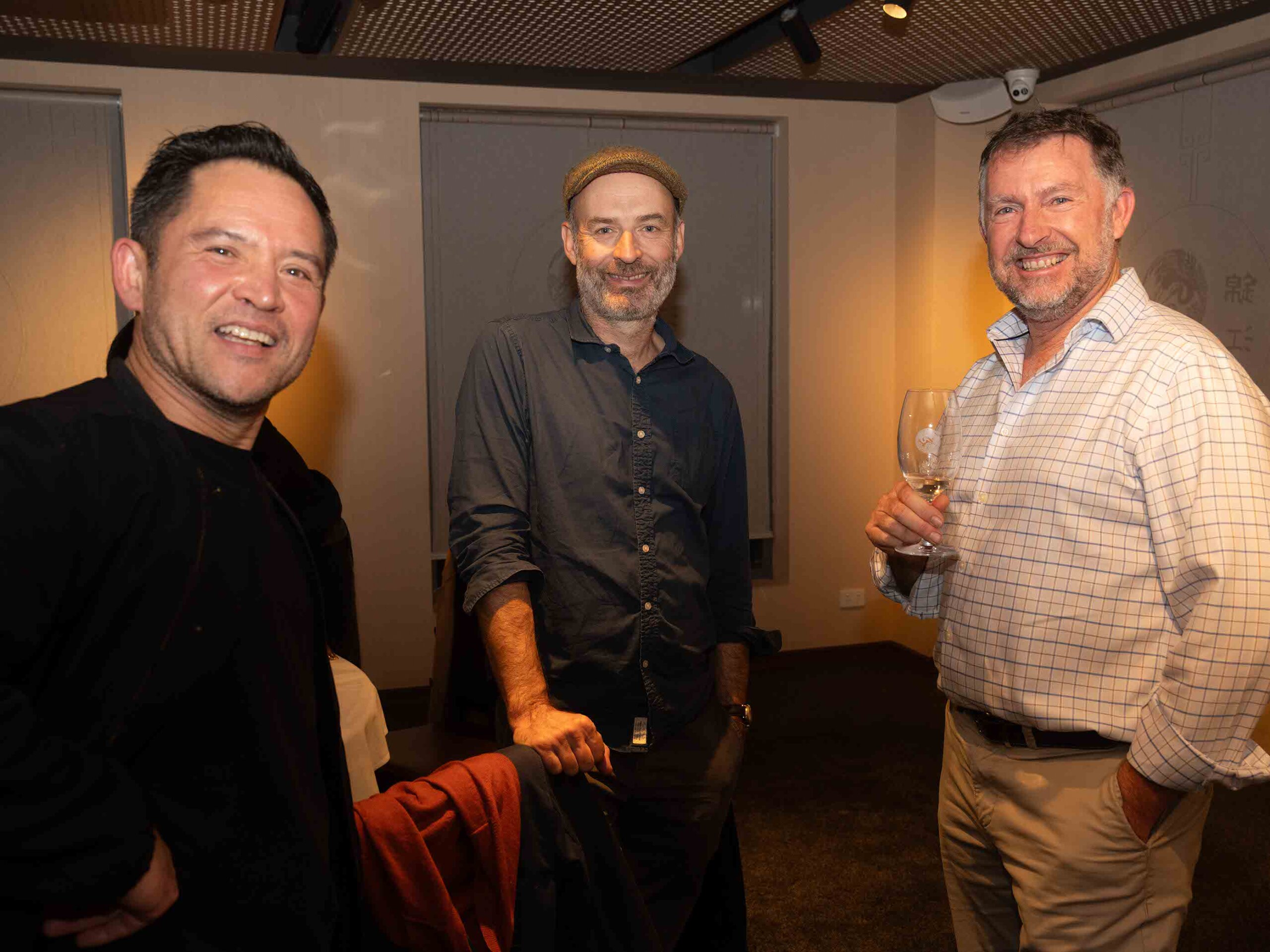
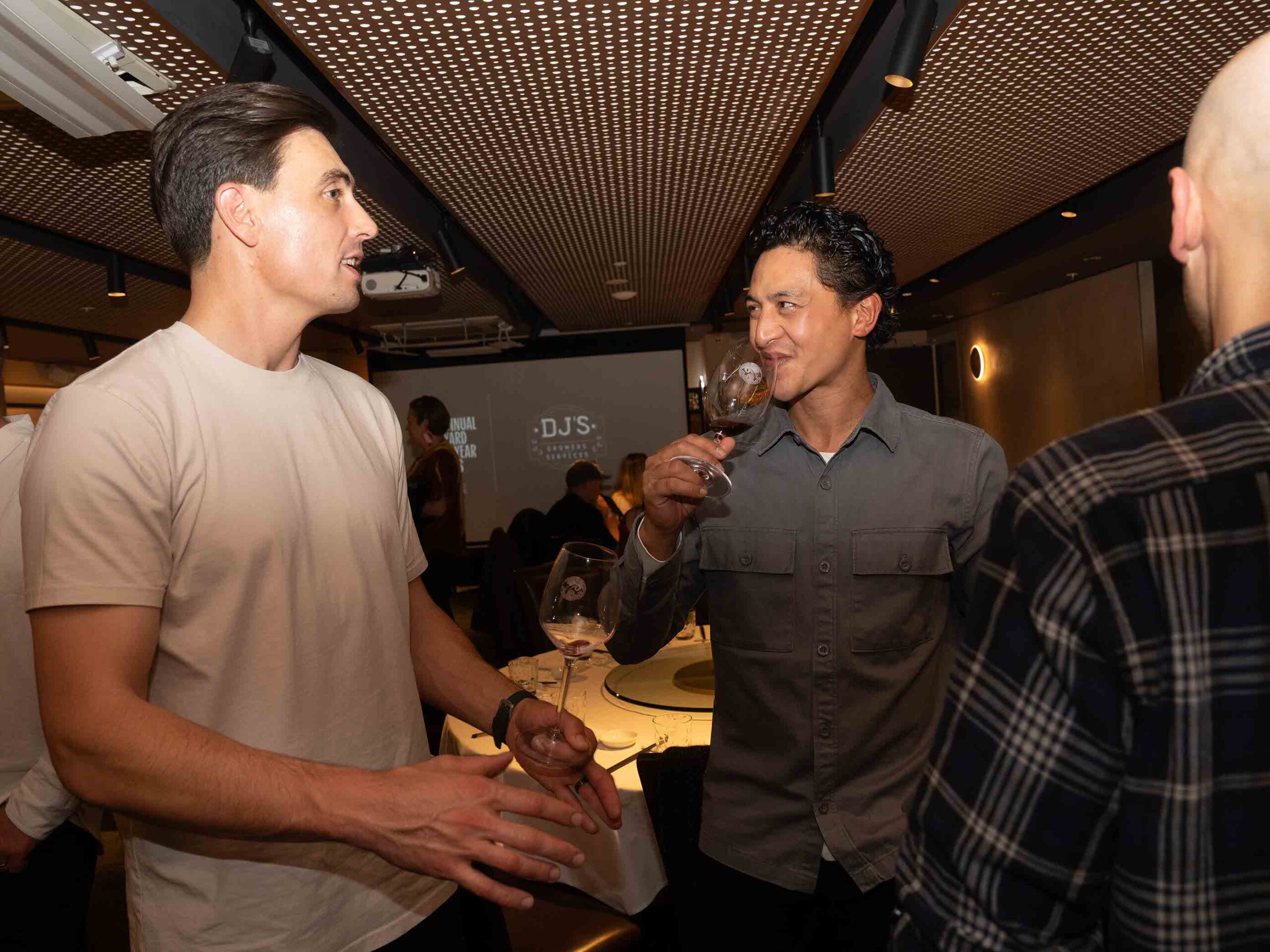
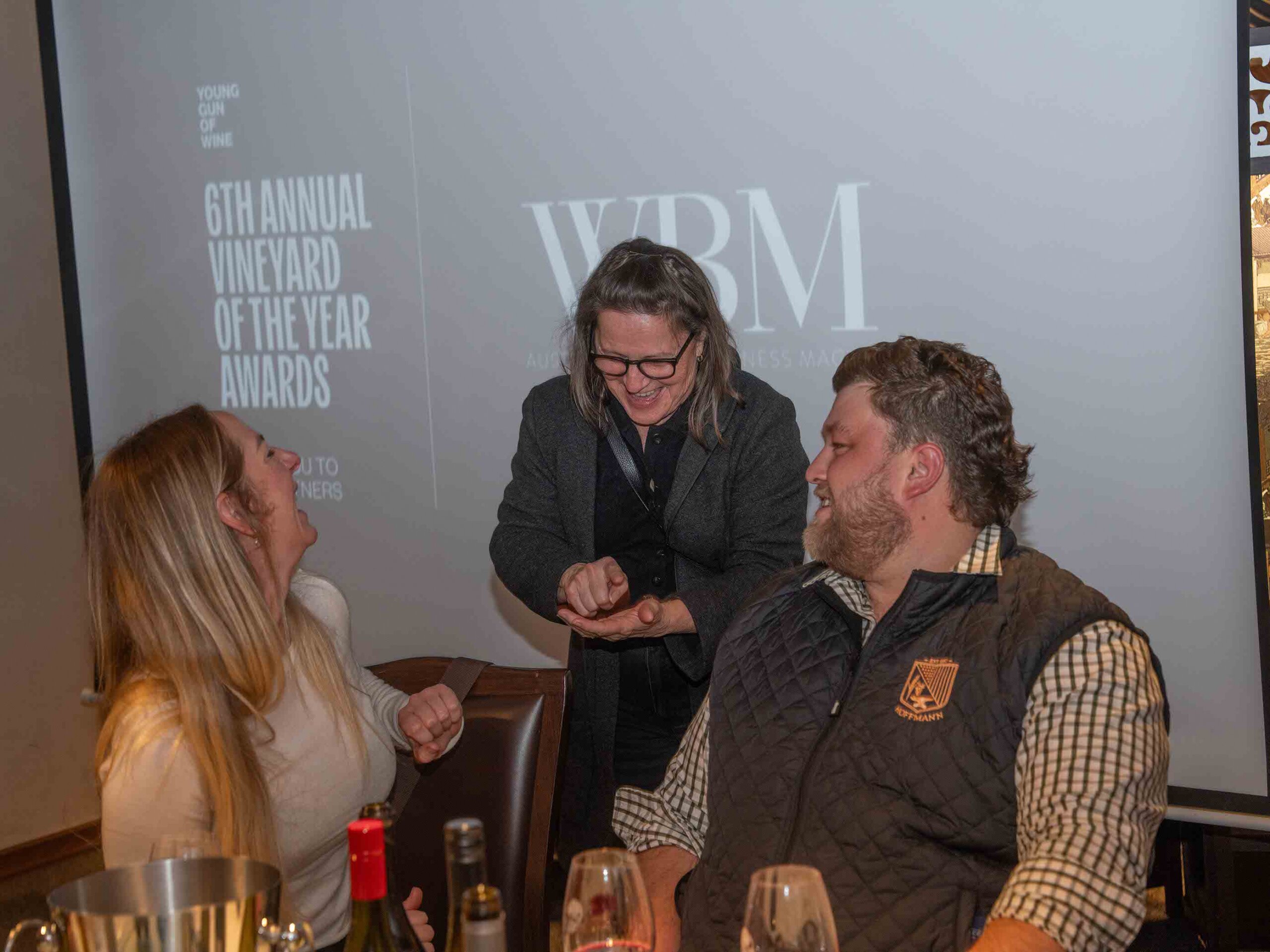
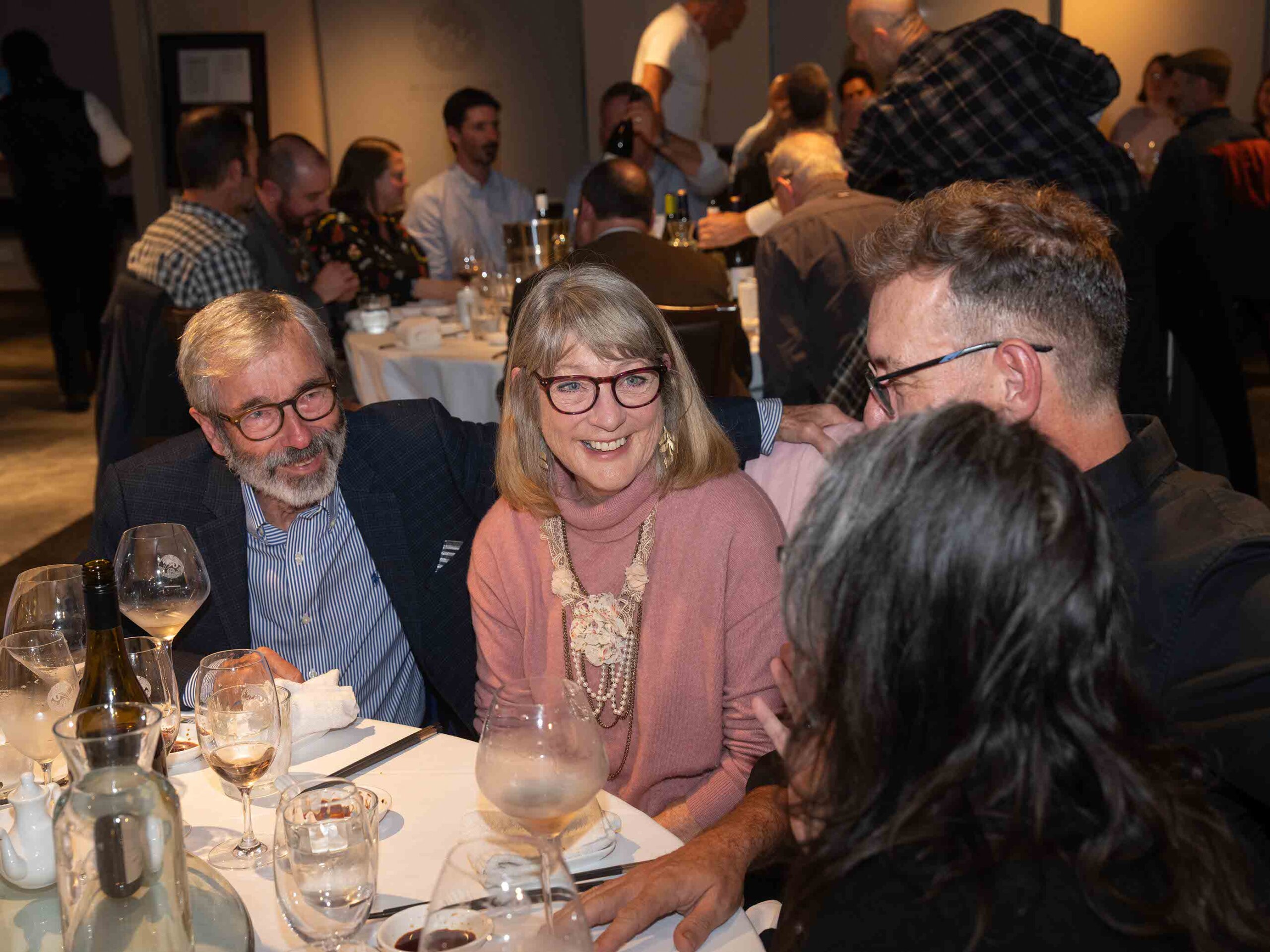
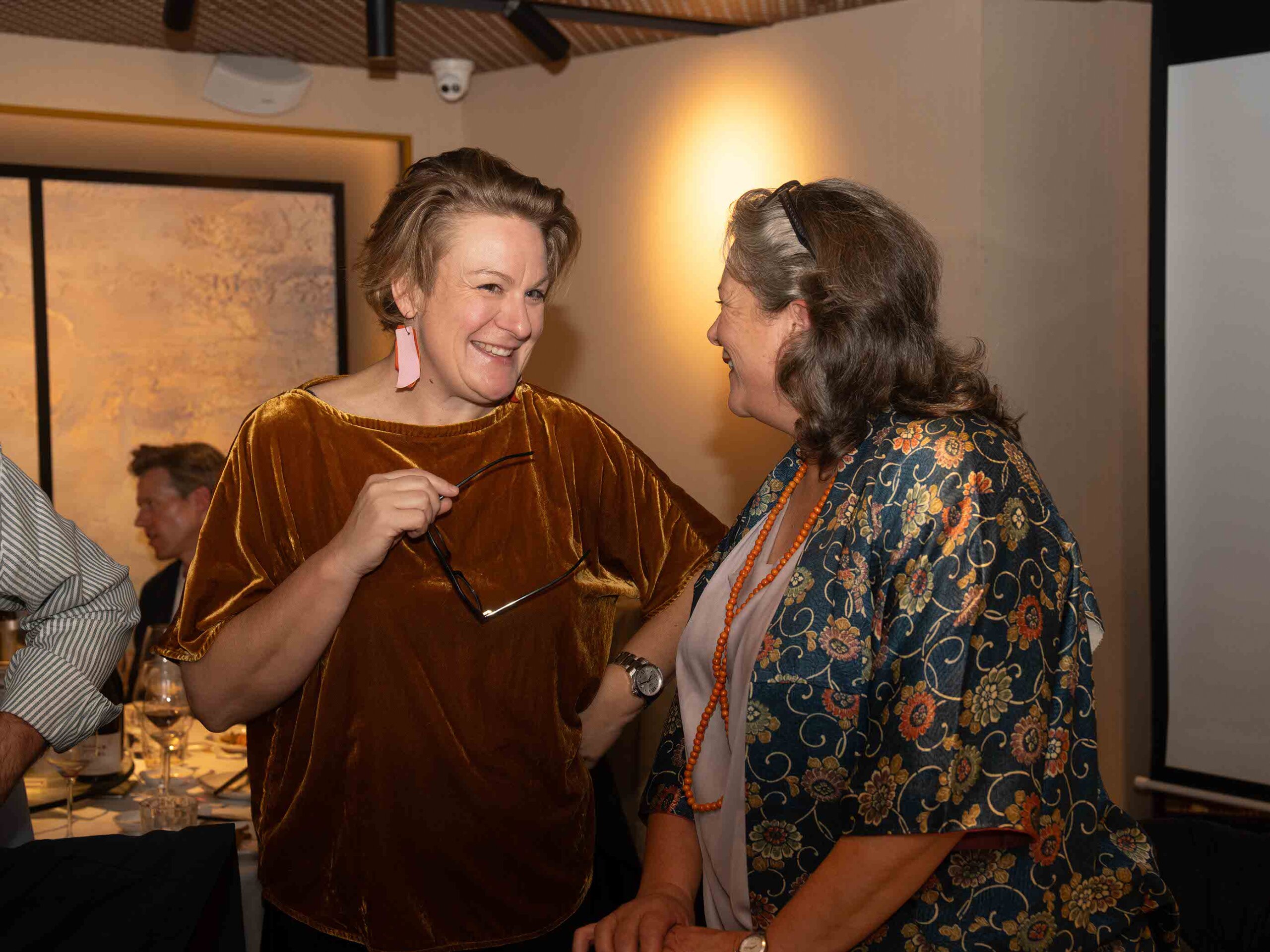
Above: Jayden Ong, Andrew Marks (Gembrook Hill) and Mark Pengilly (Tamburlaine Organic Wines). Opposite: Scenes from the 6th Annual Vineyard of the Year Awards, held as a dinner presentation in Melbourne.
Viticulturists and representatives for this year’s 45 shortlisted vineyards gathered in Melbourne after a trade event tour that took them to Sydney and Brisbane over the preceding weeks. After a long day connecting with Melbourne’s hospitality trade – communicating how work in the vineyard translates to the finished wine in the glass – the assembled growers sat down together for a dinner celebration, and for the trophy recipients to be revealed.
“I am especially honoured by the way in which the Vineyard of the Year Awards bring together winegrowers and facilitate the exchange of crucial information,” Kent said. “There are no one-size-fits-all solutions in viticulture, but the more knowledge our winegrowers can glean from each other’s experience, the more tools they will have to respond to the unique and sometimes challenging conditions of their own sites. The networks forged by these awards are a genuine source of encouragement and support.”
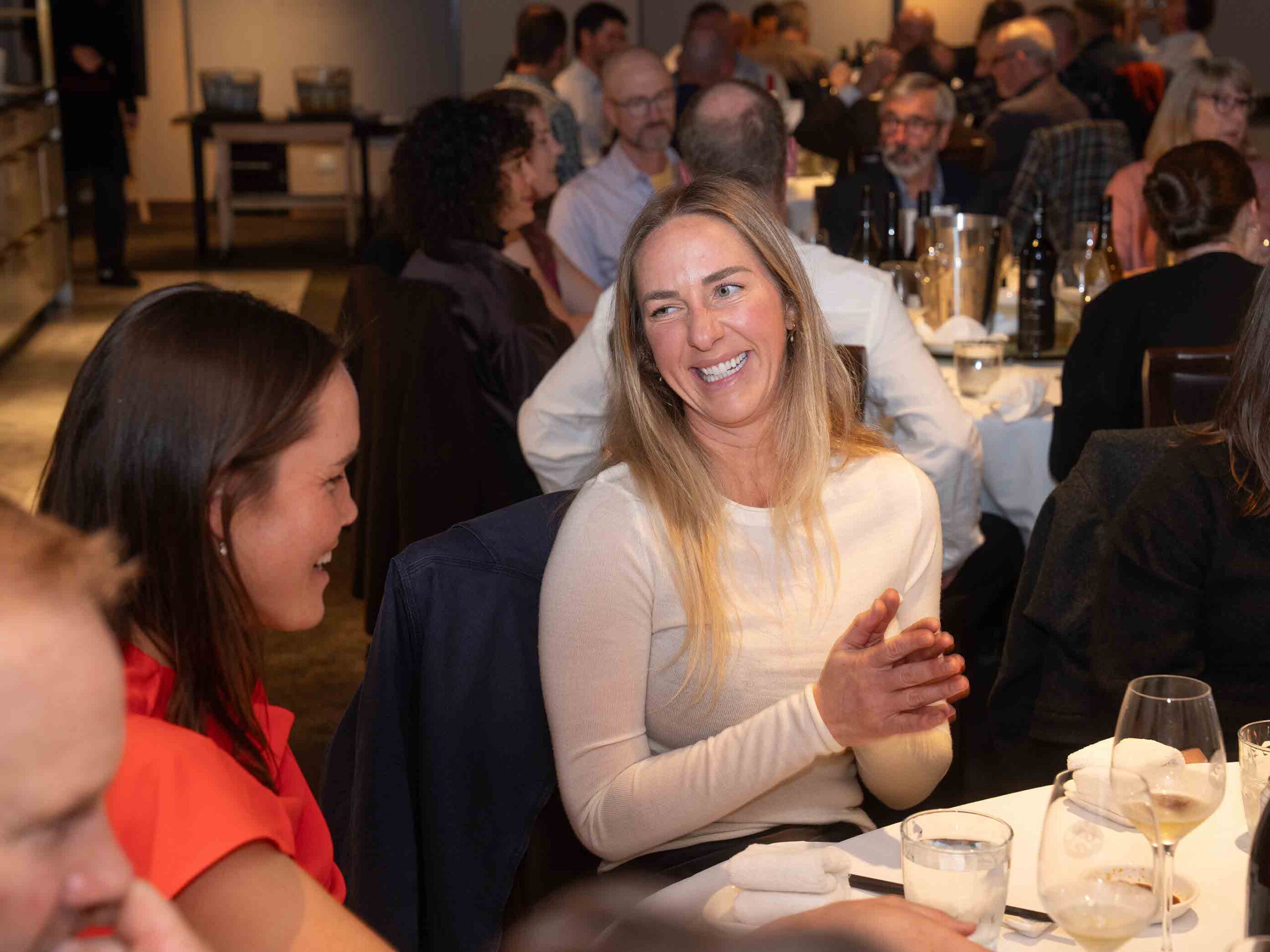
Opposite: Turon White (Turon Lenswood Vineyard, Adelaide Hills) and Justin Folloso (Caledon Estate, Tasmania) at the 6th Annual Vineyard of the Year Awards. Above: Paula Pipan (Pipan Steel, Alpine Valleys) and Byron Hoffmann (Hoffmann Family Vineyards, Barossa Vallley) at the dinner presentation event in Melbourne.
Allen put it simply: “Unlike other wine shows or competitions, where it’s pretty much all judged on what’s in the glass, we judge everything else that goes into putting what’s in the glass in the glass. It’s bringing everything back to the soil, and the connection between the people and the soil, that is really fundamentally at the heart of what we do. This award has helped to build a network of like-minded growers who want to do the best for their vineyard and their land. When the growers from all over the country get together and share innovation, share knowledge – we will see the effect of that in improvements and innovations to come.”
The 2026 judging panel consisted of Dianne Davidson AM, viticulturist, Davidson Consulting; Max Allen, wine writer and author; Richard Leask, viticulturist, Leask Agri and winemaker, Hither & Yon; and Dr. Colin McBryde, vigneron, Adelina. The judging process also included an industry-leading random site inspection program for rigour and accountability, conducted by James Hook and Matthew Wilson of DJ’s Growers Services.
Our heartfelt congratulations to all the finalists – a collection of leading vineyards tended by a cohort of passionate and inspiring viticulturists and vineyard teams. Here are the winners of the 6th annual Vineyard of the Year Awards:
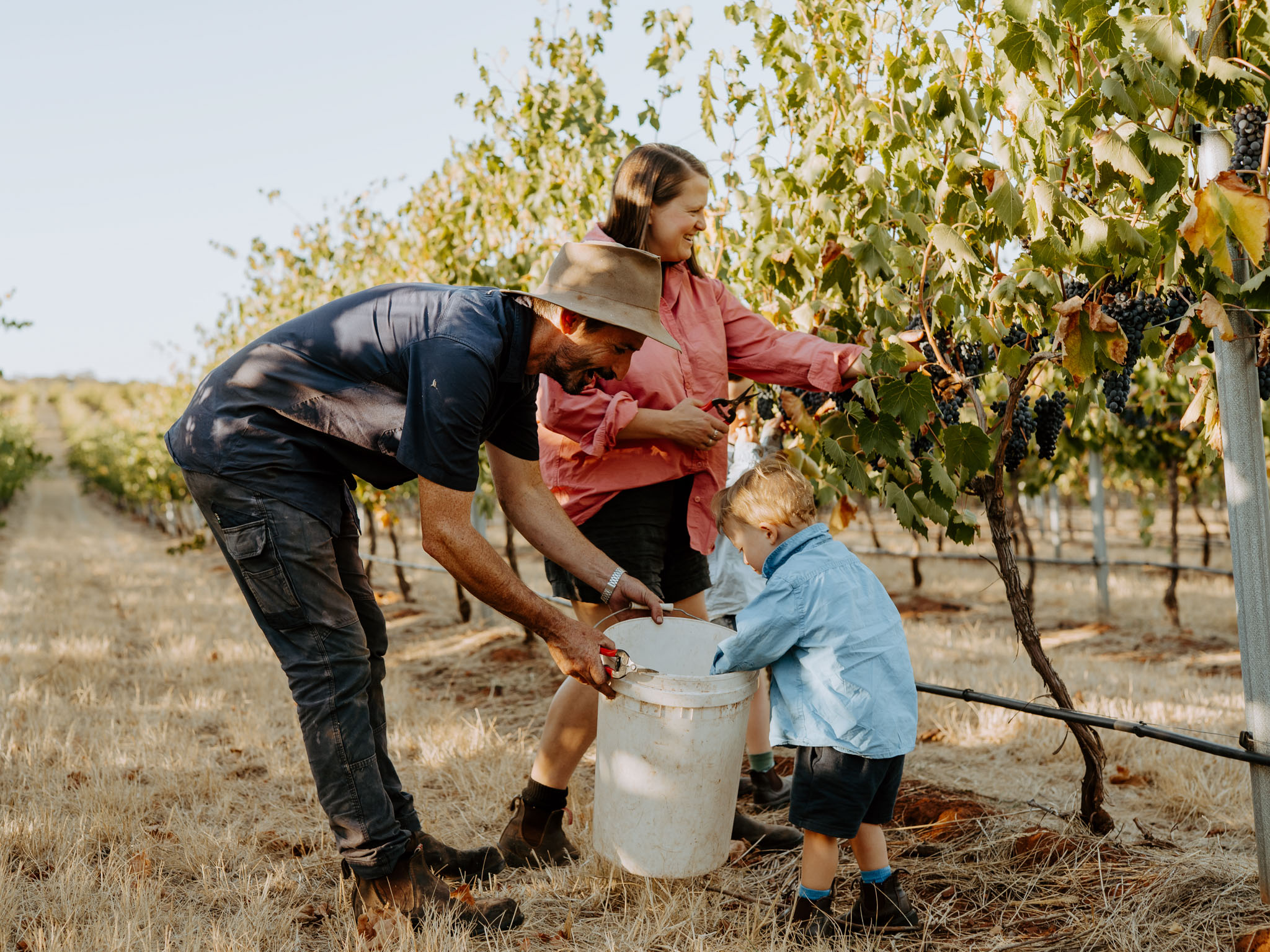
Opposite: the GKLR vineyard. Above: Lucy Runnalls and Gerard Kennedy New Vineyard of the Year Winners
New Vineyard of the Year: GKLR Vineyard (Heathcote, Victoria)
The New Vineyard of the Year award goes to a recently-established vineyard that is rewriting the possibilities for viticulture in Australia.
Behind every great vineyard is a great partnership. ‘GKLR’ stands for Gerard Kennedy and Lucy Runnalls – and this 32-hectare Heathcote property is, in every sense, a family project built from the ground up. Before planting a single vine, Kennedy – a trained geologist – commissioned electromagnetic surveys and grid soil sampling across the entire site. Rootstocks were then matched to what the data revealed; varieties chosen for where the climate is heading, not where it has been.
GKLR Vineyard sits on a narrow strip of 550-million-year-old Cambrian geology in Heathcote – one of the most geologically distinctive soils in the country. Here Kennedy and co-grower Barney Tuohey tend shiraz, fiano, sangiovese, nero d’avola, nebbiolo and piedirosso across 32 hectares, managed at the level of the individual row. There are six clones of sangiovese alone, across three blocks on three soil types. East-west row orientation was introduced in 2023 to shield fruit from harsh afternoon sun – during a recent three-day stretch above 40 degrees, the difference was immediately apparent.
The project has evolved across four separate plantings since 2018, each informed by what the previous one revealed, and by ongoing conversations with the winemakers who purchase fruit from the site. “We’ve had the privilege of working with so many wonderful small wine producers,” Kennedy said. “To understand what they need, what they desire, and how we can fulfil that – we’ve been able to experiment with different clones, different rootstocks, work out what grows well and what winemakers like. It’s been a process, but it’s been great.”
The blank-canvas nature of the project – building something meaningful from bare paddock – is not lost on Kennedy and Tuohey. “We’ve had the privilege of being able to go: right, blank sheet. What are we going to do? What’s going to work for Heathcote, for this area, for this block?” Four plantings in, the answer continues to sharpen.
“We practice precision viticulture to grow better quality fruit at the row level, not the vineyard level,” says Kennedy. Recognising that precision – across geology, variety and clone, and technology – is exactly why the Vineyard of the Year Awards exist.
Opposite: Stephen and Prue Henschke at the Awards night. Opposite: Henschke – Mount Edelstone vineyard.
The Old Vineyard of the Year award goes to a viticultural treasure of Australia whose management impresses with its sensitivity and reverence.
Mount Edelstone is home to 113-year-old shiraz vines on deep red clay soils over Cambrian schist – soils shaped, it turns out, by a meteorite impact more than 500 million years ago. Those weathered vines are a viticultural treasure in and of themselves. But their significance is multiplied many times over by the wine they produce: Henschke’s Mount Edelstone Shiraz, a landmark in the development of Australian table wine since its first vintage in 1952. This year marks the wine’s 70th consecutive vintage – one of the longest-running single-vineyard wines in Australian history, first produced at a time when multi-region blending was very much the norm. Lifted and perfumed, defined by bay leaf and black pepper complexity, Mount Edelstone Shiraz remains one of the most coveted single-vineyard expressions in the country.
Maintaining these precious vines is a labour of love. Viticulturist and botanist Prue Henschke has spent four decades transforming the vineyard’s health – building organic matter in the soil from 1% to 4%, running a 30-year vine selection program across 11,500 individual plants to identify the finest genetic material for future replanting, and establishing native Wallaby grass between rows alongside winter sheep grazing and habitat for the 49 bird species recorded on the property.
What makes Mount Edelstone so singular goes beyond age and history. “Someone in 1912 worked out that that soil would match the shiraz and grow really good wine,” Stephen Henschke reflected. “After the neglect of World War II, his father took it over – and it was still really performing.” By 1956, that first vintage was winning prizes across Australia. By 1958, its success was the direct inspiration for the first release of Hill of Grace. Two different vineyards, the same variety, expressing entirely different aspects of the same vision.
Prue Henschke’s contribution over four decades has quietly elevated the site to what Stephen describes as “the crown of our vineyards in terms of quality – such definitive Eden Valley flavours. That beautiful spice of sage and pepper and bay leaf, lovely velvety tannins, beautiful dark fruit. Heaven in a vineyard, really.”
“My philosophy is a holistic one,” Prue says, “to ensure our created environment sits in a healthy balance with the natural landscape so the next generation inherits fertile, sustainable land.” Here’s to at least 70 more consecutive vintages.
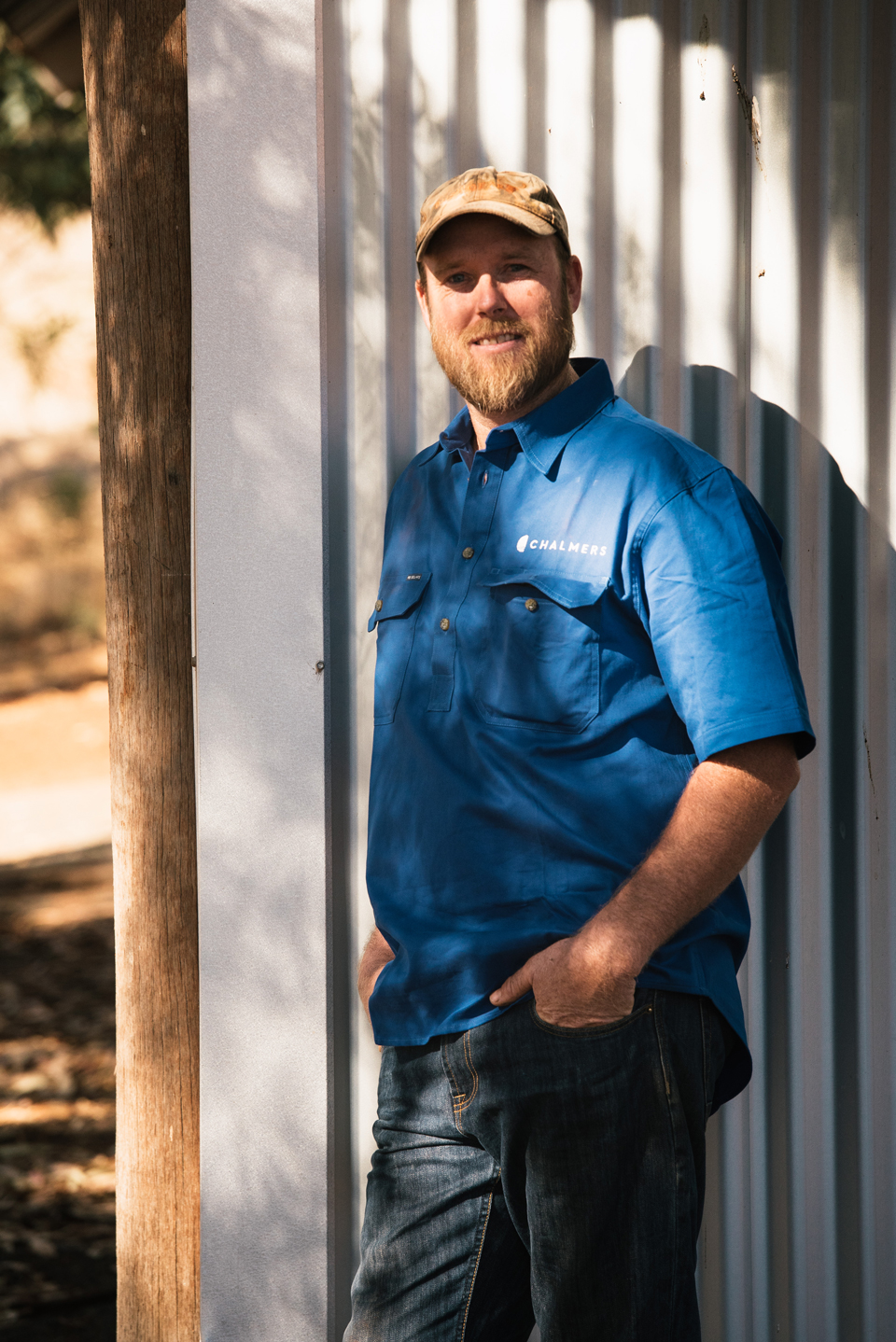
Above: Kim Chalmers with Cynthea Semmens (Marion’s Vineyard) at the Awards night. Opposite: Chalmers’ viticulturist Troy McInnes.
Innovative Vineyard of the Year: Chalmers Vineyard (Heathcote, Victoria)
The Innovative Vineyard of the Year award – dubbed ‘The Groundbreaker’ – rewards forward-thinking viticulture.
The Chalmers family began importing lesser-known Italian varieties in 1998 – not for novelty, but out of a genuine conviction that varieties which had thrived for centuries in hot, dry Mediterranean conditions were simply better suited to Australia’s climate than the French varieties the industry had planted by default. They were right. Across 37 hectares of ancient red Cambrian soils in Heathcote, their vineyard now showcases the potential of aglianico, fiano, nero d’avola, sagrantino, carricante, nerello mascalese, falanghina, teroldego, and vermentino – alongside 18 more Italian and alternative varieties. The fact that many of these names are now well-known within Australian wine is testament to how far ahead of the curve that 1998 decision was.
Today, under the management of viticulturist Troy McInnes, the vineyard runs entirely on solar power, generates more energy than it consumes, and operates on organic inputs only – building soil biology and vine resilience season by season. The fruit goes to some of the country’s most exciting independent makers, including Momento Mori, Minim, Little Reddie, Pat Underwood, Lo Stesso and Jamsheed, as well as the family’s own acclaimed label.
Kim Chalmers was fulsome in her tribute to McInnes when accepting the award. “We couldn’t do any of what we do without the beautiful history and geology of that site in Heathcote,” she said, “but most of all, Troy – the manager there – who coaxes the best out of that site and every variety, every rootstock, every little portion of grapes that he handles so carefully. Dealing with 30 or 40 different winemakers every season, making sure that everyone absolutely gets exactly what they’re looking for – that’s a real craft. And to do that in such a humble and honest way is something we are incredibly grateful for. He puts up with all my crazy ideas when I fling new varieties and rootstocks and plantings his way – he takes them on bravely, gets his head around them, and always delivers results.”
This recognition is nearly three decades in the making. “We are cultivating wine grape varieties that are more suited to the changing climate,” says McInnes, “requiring less chemicals, less irrigation water – which is all beneficial – and we base our future decisions around opening the eyes of the Australian wine industry. The market is always looking for something new, and that’s what we do, and will continue to do.”
Opposite and above: Grosset – Springvale vineyard.
The Vineyard of the Year Award goes to Australia’s most outstanding vineyard – one that exemplifies patient, purposeful, and sustainable stewardship.
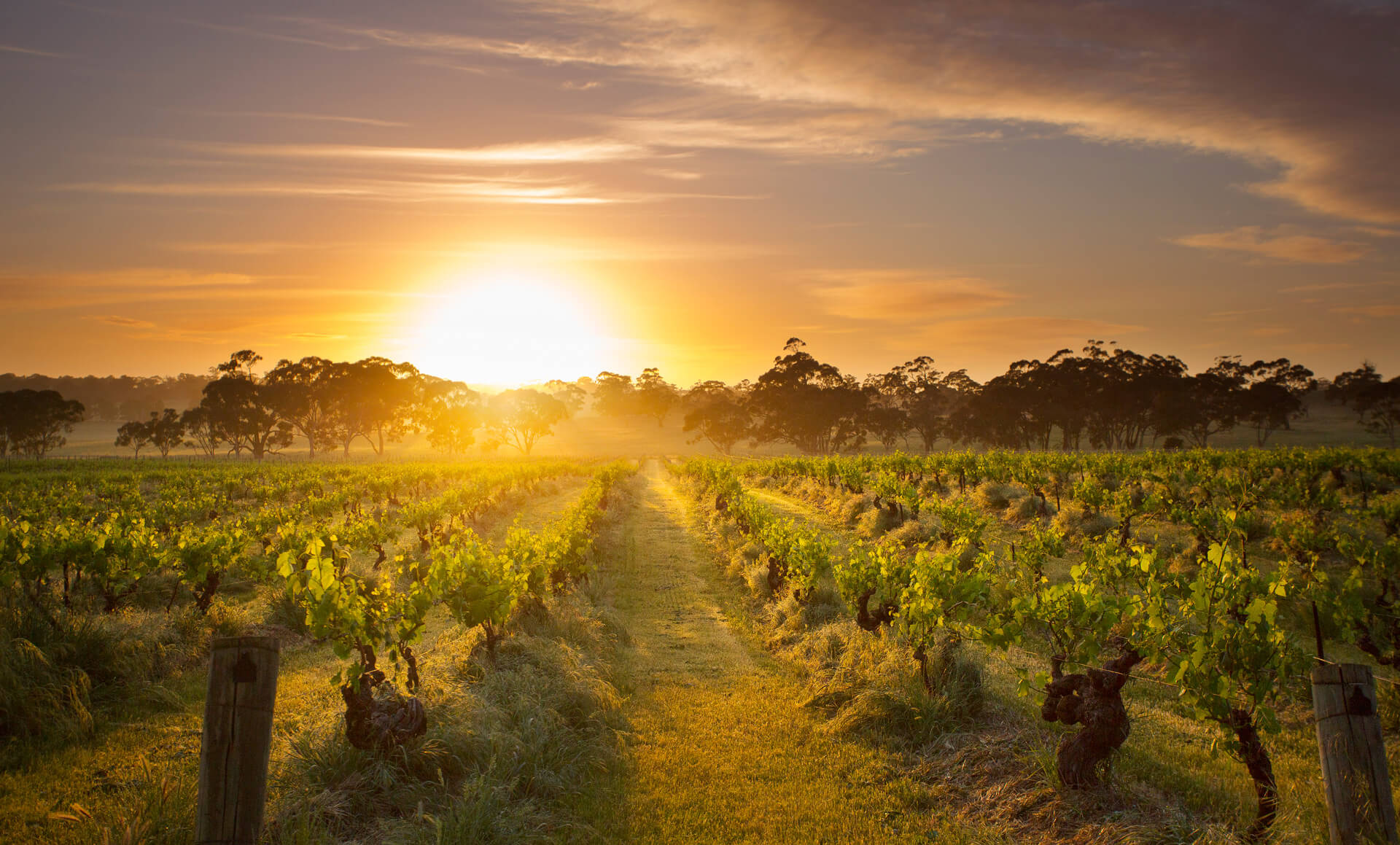
A 6.12-hectare site planted to riesling in the Clare’s Watervale district. One variety. Three clones. Five blocks. And a geological secret that wasn’t fully understood until after the vines were in the ground.
Springvale sits above a layer of blue slate – a barrier to vine roots that concentrates mineral uptake into a more defined profile, and imparts a persistence and character that distinguishes these wines from even the finest Watervale rieslings. Certified organic since 2014, and biodynamic since 2019, the vineyard is managed by Matthew O’Rourke – who has tended this site since 2011 – with every precision operation completed by hand.
The numbers behind the site tell their own story. Organic carbon levels in the soil have tripled since the vineyard’s establishment. Water use is down 30 per cent thanks to a technologically focused irrigation program. The vines show measurably less heat stress than neighbouring conventionally managed sites – resilience that was tested during a recent season of 46 to 48 degree days. More than 8,000 native trees and shrubs now surround the vines. The whole operation is certified carbon-negative, sequestering approximately 15 tonnes of CO₂ annually.
“The Springvale fruit has developed a silky, almost phenolic texture that wasn’t noticed in the first decade,” Jeffrey Grosset says. “The vines are expressing their environment in ways they weren’t 20 years ago.” That evolution has been observable in the most elemental of ways: in the early years, walking the rows before harvest always meant a small compromise – pick now for freshness, or wait for more flavour. Now he walks the same rows and the fruit is intense, flavoursome, and balanced – ready, with no adjustment necessary. Healthy land. Better wine.
In a statement on receiving the award, Grosset put the significance of this kind of recognition plainly: “Wine drinkers in Australia and around the world need to know there are many of us keenly focused on our vineyards – and that this focus is the key to cementing Australia’s reputation as a world class wine producer.”
Being able to observe and respond to a vineyard’s changes over decades – while also safeguarding its vines for the future – is what patient, considered stewardship looks like in practice. And this kind of relationship to the place in which wine is grown is exactly what the Vineyard of the Year Awards exists to celebrate.
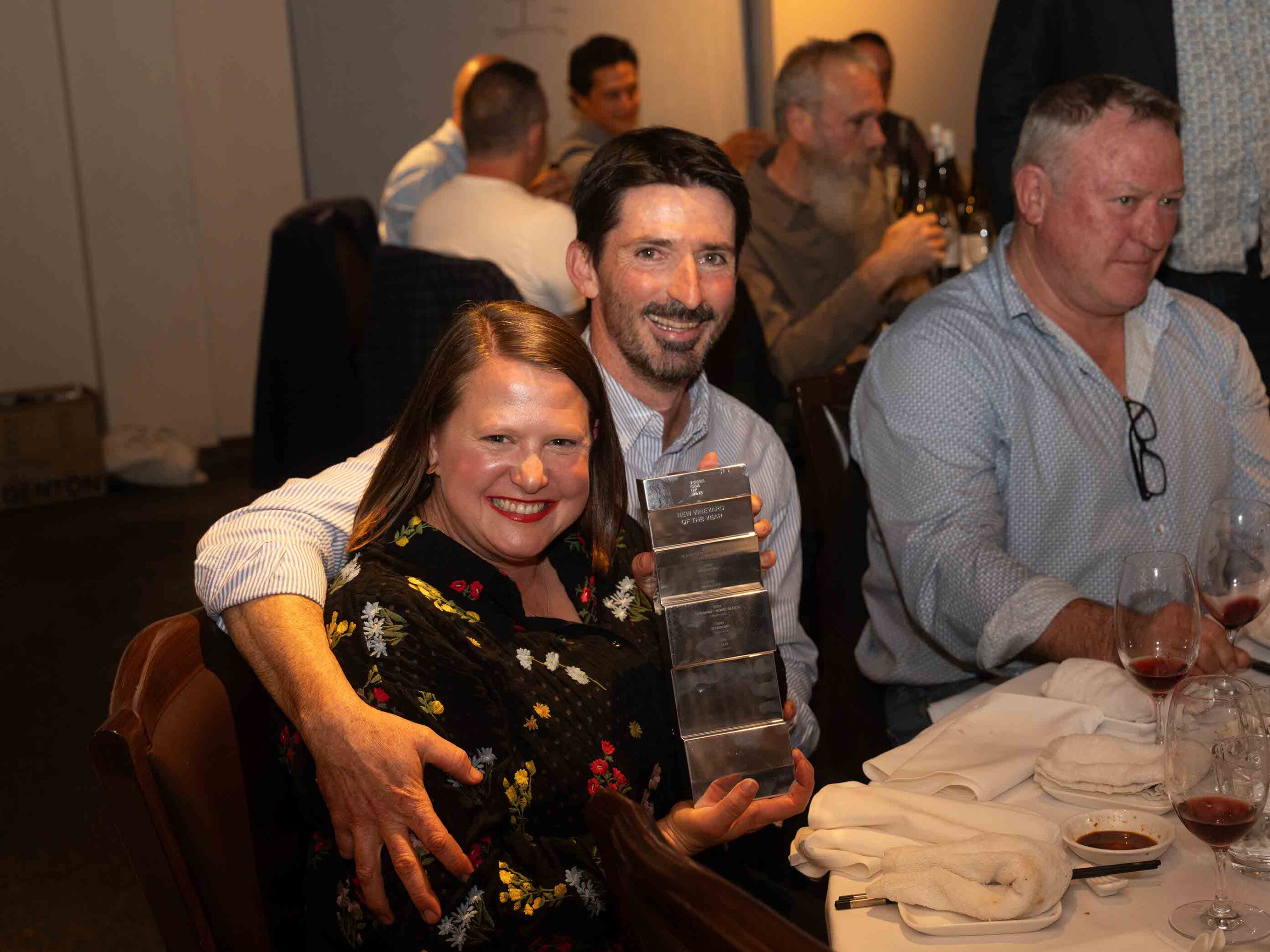
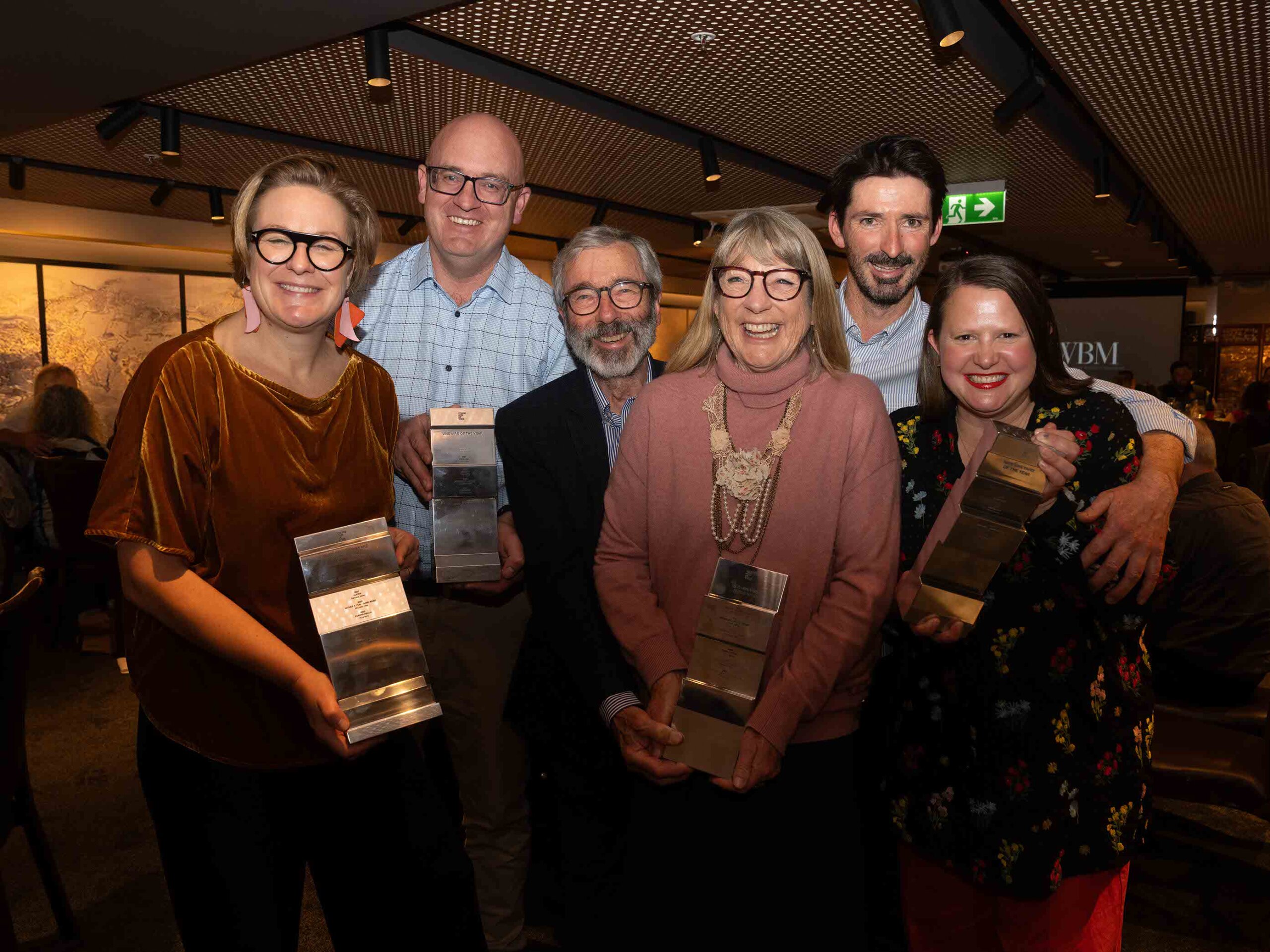
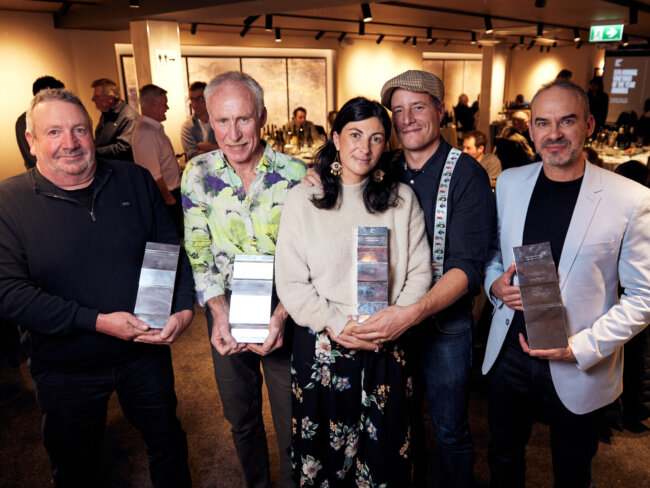
Above: YGOW & VOTY Awards founder, Rory Kent, with Prue and Stephen Henschke. Opposite: the winners of the 6th Annual Vineyard of the Year Awards. “While there are currently four trophies awarded at the Vineyard of the Year Awards, the awards are about much more than who takes home which piece of silverware,” said Kent. “They’re about championing viticulture and the concept of provenance in Australian wine – and this is best achieved through celebrating the work of all 45 outstanding finalists this year.”
Six years in, the Vineyard of the Year Awards remain what they have always been: a celebration of place, a platform for the patient and the pioneering, and a reminder that the best Australian wine begins long before it reaches the winery. The next time you pick up a bottle, think past the label, past the glass, back through the hands that tended the vines, back into the soil. That’s where it starts. That’s what this is all about.
The Young Gun of Wine Vineyard of the Year Awards is presented with thanks to Amorim Cork, DJ’s Growers Services, and WBM – Australia’s Wine Business Magazine.
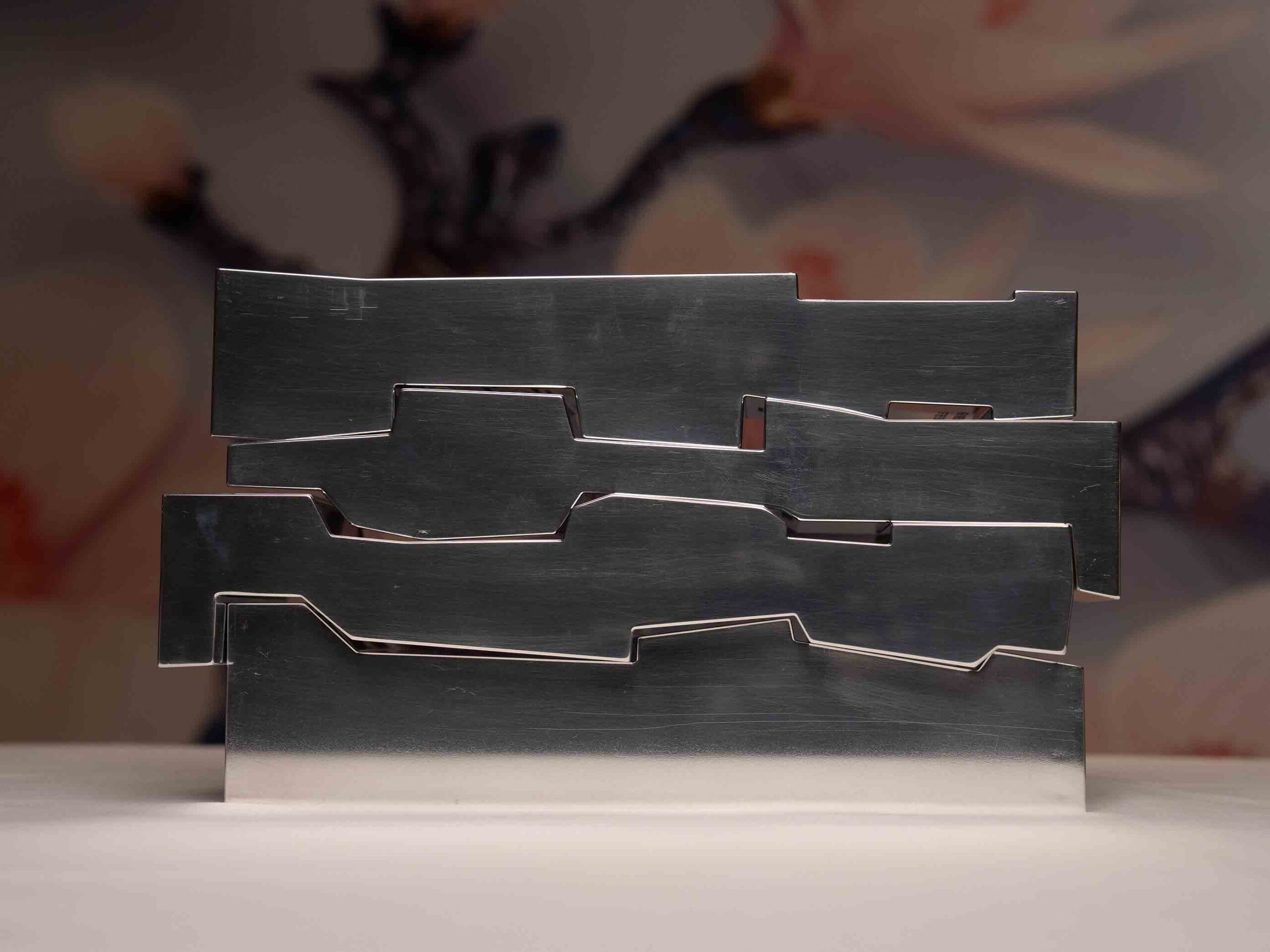
Together, the four Vineyard of the Year trophies are a sculpture representing the soil layers (horizons) of a vineyard.
GET FIRST ACCESS TO THE NEXT WINE ICONS – DELIVERED
Designed to place vineyards and growers across the nation at the heart of the Australian wine story, and the heart of the Australian wine community, the 6th Annual Vineyard of the Year Awards is now open for registrations.
The third instalment of the annual Vineyard of the Year Awards has been decided following a six month process that included site inspections of shortlisted finalists, with the judging panel reaching a consensus on the winners of the four trophies: New Vineyard of the Year; Old Vineyard of the Year; Innovative Vineyard of the Year, dubbed ‘The Groundbreaker’; and Vineyard of the Year.
The Vineyard of the Year Awards in 2019 in order to place vineyards and griowers across the nation at the heart of the Australian wine story – and at the heart of the Australian wine community. We wanted to reconnect the whole idea of wine to the place it comes from and the manner in which the grapes are grown. Five years on, and the mission of the Vineyard of the Year Awards remains the same. Read on to discover the New Vineyard of the Year; Old Vineyard of the Year; Innovative Vineyard of the Year, dubbed ‘The Groundbreaker’; and Vineyard of the Year.
Subscribe to our newsletter
Young Gun of Wine is your shortcut to cutting edge wines, the places to go, and the people behind it all.
Subscribe to be amongst the first to know of our latest discoveries in wine.
We'll bring you the inside running from the growers, the makers, the wholesalers, the retailers and the sommeliers, too.