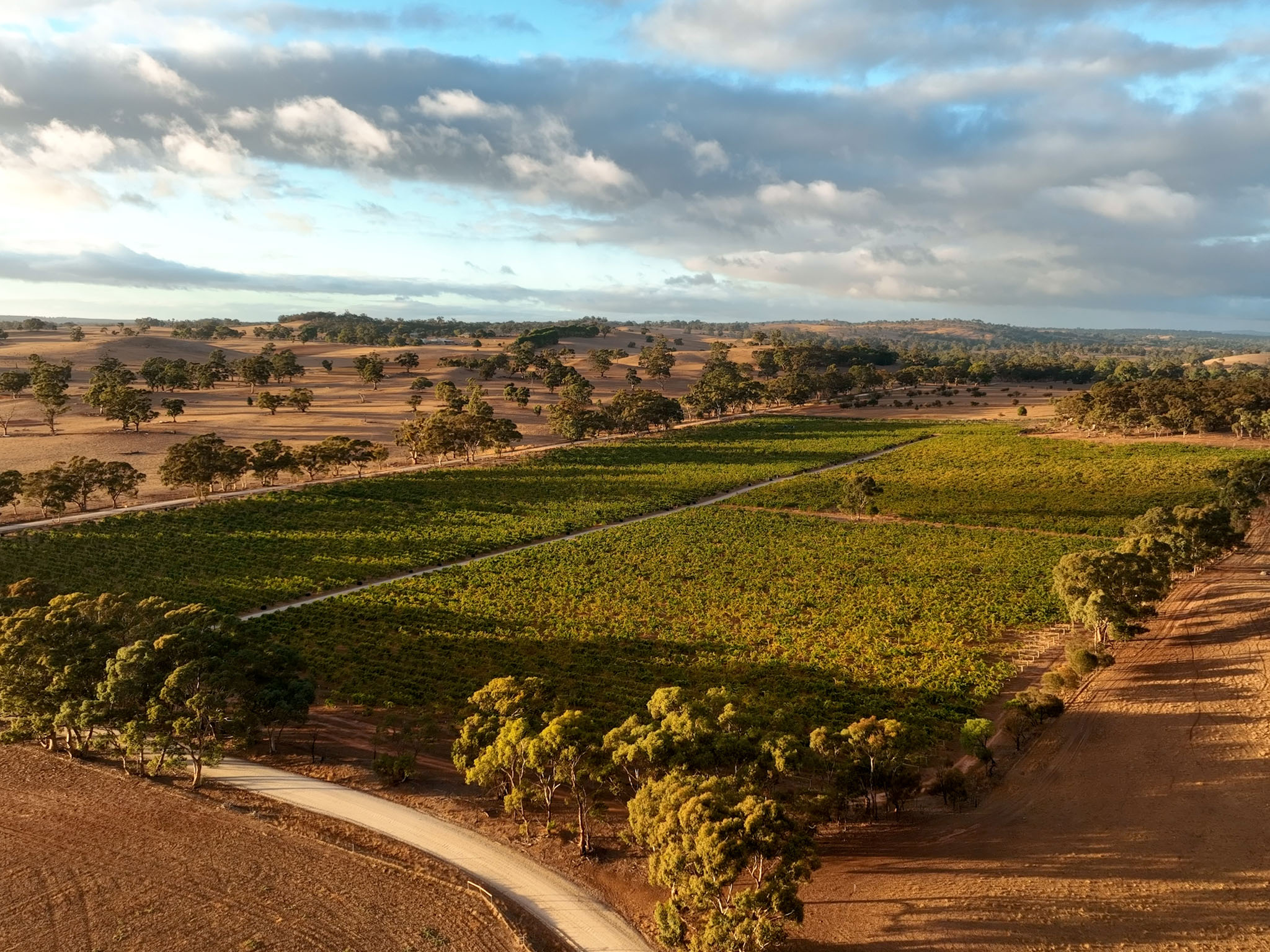
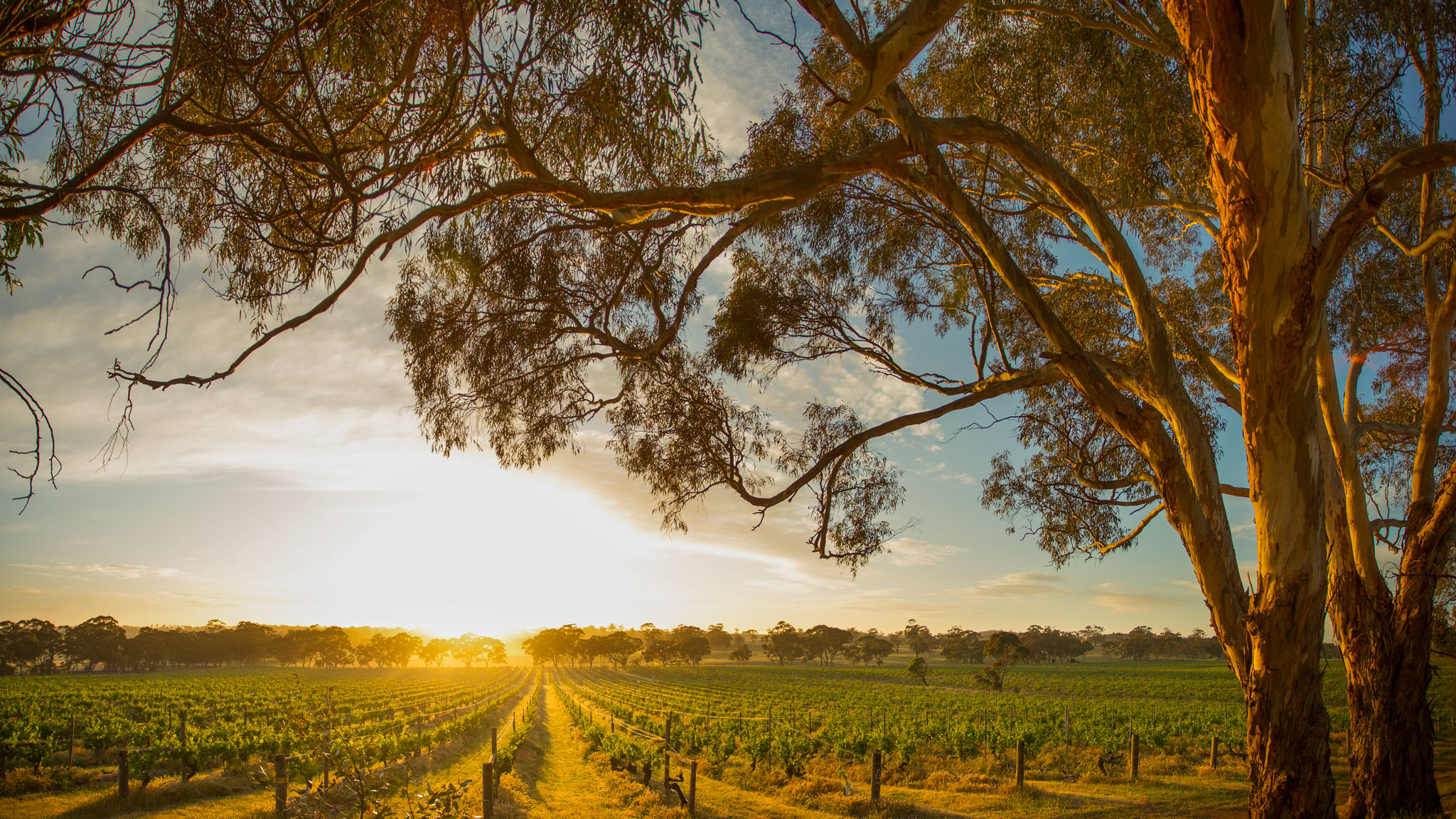
Planted in 1912 by Ronald Angas – a descendant of one of South Australia’s founding families – the Mount Edelstone Vineyard is home to 114-year-old centenarian shiraz vines that are, by any measure, among the most significant in the country. Situated in the southern Mount Lofty Ranges at 400 to 600 metres elevation, the 16.76-hectare Eden Valley site produces a single wine: Mount Edelstone Shiraz, one of the longest consecutively produced single-vineyard wines in Australia, with the current 2022 release marking its 70th vintage. At its heart is a grape-growing philosophy built on organic and biodynamic principles (not certified), guided for the past four decades by viticulturist and botanist Prue Henschke. Working with deep, mineral-rich red clay soils and the site’s naturally high-vigour old vines, Henschke has steadily transformed the vineyard’s health and fruit quality through a layered program of regenerative farming, native biodiversity, and meticulous vine selection – all in service of a wine whose character is inseparable from the ground it grows in.
The site sits in the southern Mount Lofty Ranges, ranging from 400 to 600 metres in elevation – high enough to push ripening one to two weeks later than the Barossa floor below. That altitude, combined with a marked diurnal temperature range, is what gives Mount Edelstone Shiraz its signature: lifted, perfumed, with the bay leaf and black pepper complexity that has made the wine internationally recognised and – at $300 a bottle for the current 2022 release – one of the most coveted single-vineyard shiraz wines in the country. In 2026, Henschke celebrates 70th anniversary of the wine with the 2022 vintage, making it one of the longest consecutively produced single-vineyard wines in Australian history.
The soils beneath those old vines are as unusual as the wine they produce. Deep, gravelly red clay loams overlie laminated siltstones of the Tapley Hill Formation – Cambrian schists, metamorphosed mineral-rich sediments once deposited in a shallow sea, buried deep, and pushed back to the surface over hundreds of millions of years. More typical of the northern Barossa than the sandy loams common at southern Eden Valley sites, these deep, structured soils give the wine its density and aromatic persistence. And, as it turns out, the soils are stranger still: site inspections have confirmed the area was shaped by a meteorite impact more than 500 million years ago, which pushed the earth upward to form Mount Edelstone itself and created the unusually deep soil profiles that help explain the old vines’ extraordinary vigour.
“My philosophy is a holistic one – to ensure our created environment sits in a healthy balance with the natural landscape so the next generation inherits fertile, sustainable land.”
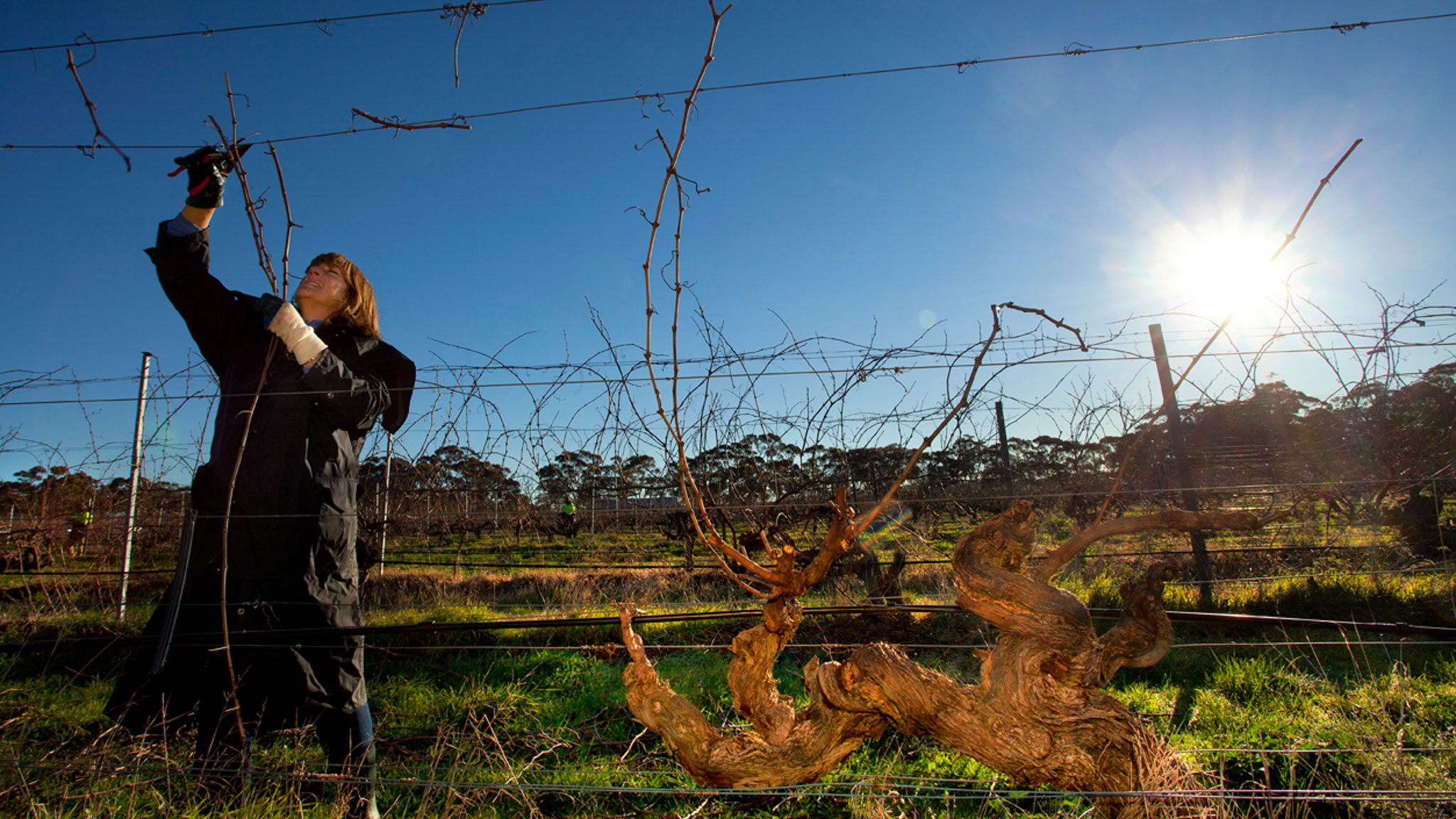
The 16 hectares of shiraz are wide-spaced at 3.66 metres each way – a layout that reflects the intuition of early viticulturists who understood, without soil science to back them up, that these vines would grow large. “I often think about how carefully the vineyard was laid out,” says Henschke, “possibly even worked by horses, and how intuitive that early understanding of vine balance was.” Each vine now occupies around 13 square metres of that rich red clay, with root systems that reach deep into fractured bedrock – systems that Henschke’s farming has worked hard to keep alive and active.
The most visible of her interventions over the past four decades has been the conversion of the entire vineyard to a Scott Henry trellis system – a shift she began trialling in 1989 and that wasn’t completed until 2023. It is a long game, and it is exactly the kind of thinking that defines her approach. “Calvin Scott Henry didn’t start out in viticulture,” she explains. “He was actually a rocket scientist from Oregon working on engines for the US space program. He eventually returned home to run the family farm, planted pinot noir and invented a trellis to help control the vigour of his vines.” By splitting the canopy into two layers – shoots trained upward and downward from four fruiting canes – Scott Henry increased light exposure and airflow while managing the vigour that Mount Edelstone’s deep soils encourage.
The results are measurable and they show up in the glass. Henschke ran formal trials against the original single-wire sprawling canopy across multiple trellis configurations, analysing colour, ripeness, pH, tannin and berry size. Scott Henry won decisively. “Comparing ferments from each block revealed the impact of Scott Henry: a richer, more structured shiraz with ripe tannins, black pepper and bay leaf complexity – a style unique to Mount Edelstone,” she says. A small control block on the original trellis was maintained for reference for 35 years, producing what Henschke describes as “a softer, lighter-weight shiraz with gentle spice” – useful as a benchmark, but consistently outperformed. The final block was converted in 2023.
The soils tell a parallel story. When Henschke took over, organic matter sat at around 1 per cent. Four decades of organic and biodynamic management – compost made from Adelaide’s green waste layered beneath straw mulch under-vine, biodynamic soil preparations sprayed monthly during spring, permanent swards of native Wallaby grass between rows, sheep from Hutton Vale Farm grazing through winter – have pushed that figure to 4 per cent, with a target of 5. The practical consequences are significant. Yeast assimilable nitrogen in the musts now consistently reads at 250–300 units: a direct signal of unstressed, microbiologically healthy vines. “One of my ‘Aha!’ moments came while experimenting in the Mass Selection nursery block,” Henschke recalls. “We noticed YAN levels in the younger block without compost and straw were much lower than in the older blocks. I realised just how crucial regular compost and mulch applications are for supporting vine health and ‘clean’ ferments.”
The mass selection program is its own extraordinary chapter. Beginning in 1986, Henschke and fellow Geisenheim graduate Uschi Linssen systematically evaluated more than 11,500 vines across Mount Edelstone, assessing budburst uniformity, disease absence, bunch structure, flowering and veraison consistency, and berry chemistry at maturity. Ribbons in different colours were tied to vines meeting different criteria – creating, briefly, a kind of rainbow across the vineyard. From that process, 154 vines were selected; cuttings were planted in a nursery block within the vineyard in 2017. The study took thirty years to validate the seventeen top selections. That nursery block now quietly supplies replacement vines – one or two per year – ensuring that when centenarian vines need replacing, they are replaced with material that carries the precise genetic character of the 1912 pre-phylloxera population.
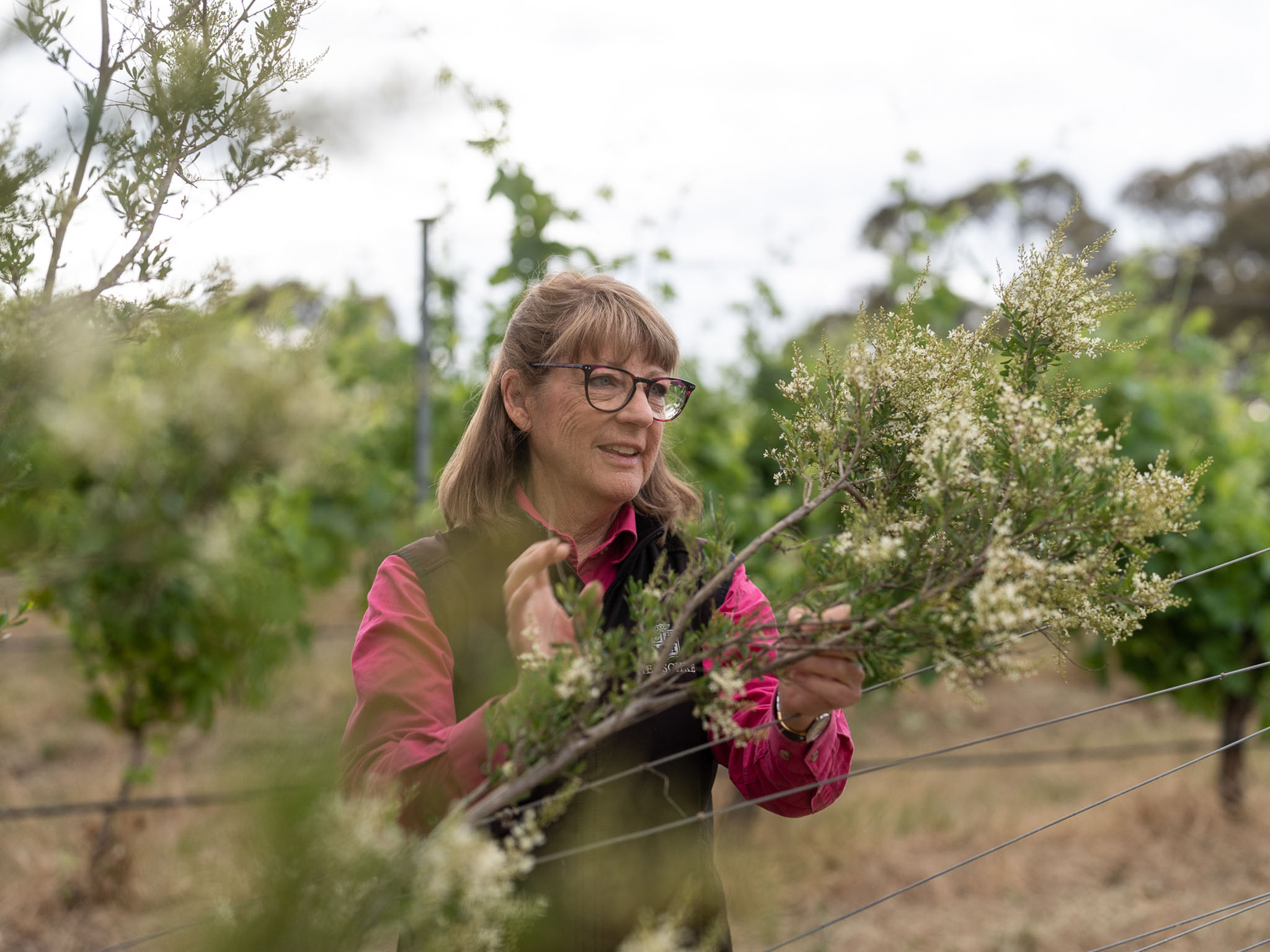
It is an investment measured in generations. And it sits alongside other long-term commitments: 32 hectares of native trees as part of a carbon offset program, 150 hectares of bushland under conservation, and a 32-hectare agroforestry block of eucalypts, acacias and native pines planted at the top of the catchment to buffer against wind and flood. Native Christmas bushes and iron grasses are planted along fencelines and against vineyard posts, providing nectar-rich flowers and habitat for beneficial insects – a bird count survey recorded 49 species across the Henschke vineyards. Two frost fans have been erected to combat increasing frost frequency, and infrared frost-mitigation systems are being trialled, alongside a recently connected mains water pipeline that allowed targeted irrigation during the extreme heat of January 2026, when temperatures exceeded 46°C.
“My philosophy is a holistic one,” says Henschke. “To ensure our created environment sits in a healthy balance with the natural landscape so the next generation inherits fertile, sustainable land.” That sustainability extends to the human ecosystem too. A dedicated local team manages each Henschke vineyard, avoiding external contractors, preserving skills and supporting local employment. And the Vino Camino walk – held each year as part of the Tasting Australia festival – takes visitors from Hill of Grace through to the original Angas property and up onto Mount Edelstone itself, threading wine into the landscape and landscape into community.
The wine produced here is austere in its focus: one wine, one variety, one site. Mount Edelstone Shiraz – hallmarked by bay leaf, sage and cracked black pepper – is picked in mid-to-late April, with individual blocks harvested across one to two weeks depending on ripeness, then vinified separately and combined to build depth and complexity. It is a wine that has earned its reputation over seven decades. But Henschke is clear about where that reputation comes from. “Mount Edelstone Shiraz is a unique Eden Valley expression,” she says. “Its higher altitude, red clay soils and greater diurnal temperature range give the wine distinctive varietal flavours of bay leaf and black pepper, higher acidity and a lifted, perfumed style that reflects the vineyard’s character – something we don’t see in our other shiraz wines.”
The vineyard is the star. Prue Henschke has spent forty years making sure it has every reason to shine.
GET FIRST ACCESS TO THE NEXT WINE ICONS – DELIVERED