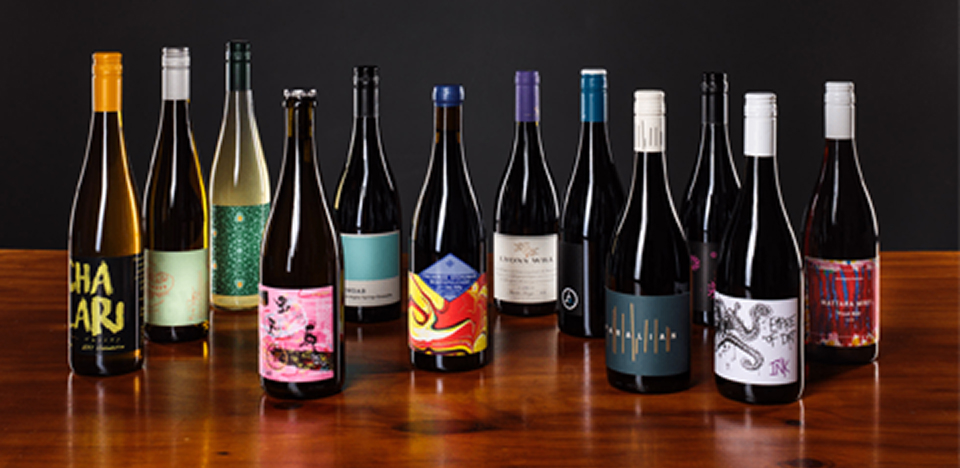
For centuries, grape varieties grew together in the same vineyard for one simple reason: farmers couldn’t control the vintage. A frost, a drought, a rogue heatwave – any of it could wipe out a single crop, so growers hedged their bets across many. Then modern viticulture came along and pulled it all apart, variety by variety, block by block – because now, suddenly, it could. Control replaced chance. And for the best part of a century, that felt like progress.
Now the pendulum is swinging back. Winemakers are deliberately putting varieties back together in the same row, the same pick, the same ferment – chasing something modernisation may have quietly engineered out of the vineyard: resilience, complexity, a rawer, less curated sense of place. But there’s a catch. As ‘field blend’ has drifted from agricultural necessity to bona fide desirable wine style, the term itself has stretched to fit almost anything a marketer wants it to mean. Which leaves one deceptively simple question: what, exactly, is a field blend? We took a Deep Dive to find out …
We gathered every Australian field blend we could find – multiple varieties from the same vineyard, fermented together – and set our expert panel the task of finding the most compelling wines among them. All wines were tasted blind, and each panellist named their top six wines. Below are the wines that made the panellists’ top-six selections from the tasting.
Our panel: Tom McCarthy, vigneron, Quealy; Gilles Lapalus, owner and winemaker, Maison Lapalus, Bertrand Bespoke, and Maidenii; Ray Nadeson, vigneron, Lethbridge; Eden Walpole, senior winemaker, Blue Pyrenees Estate; Sarah Hilliker, sommelier, Vespa Pasta & Vino; Michelle Aitken, sommelier, Cardwell Cellars.
From the Deep Dive
Discover more in The Outtakes below.
Discover more in The Outtakes below.
Discover more in The Outtakes below.
The Top Wines
This isn’t an ordered countdown. There’s no ranking – just the top six wines each panellist found most compelling from the blind tasting, in all their different ways. Everyone’s palate is different, and that’s the point.
2024 Utzinger ‘Roter Satz’, Tamar Valley (Tasmania) $60 RRP
Hilliker, Aitken, Nadeson, and Walpole selected this among their standout six wines of the day, though their readings diverged. Hilliker championed its floral cast: “Really cool brambly/stemmy/floral aroma, with nice plushness and floral flavours on the palate – black morello cherry, black pepper, clove, cassia bark, cardamom, a little fresh bay leaf and oregano. Plush purple florals, violets and iris, a little rose-like – just floral floral floral. Grippy tannins and driving acidity.” Aitken found savoury focus: “A good amount of spice and some savouriness here – the char and smokiness of grilled meat, graphite, and something almost like crayon wax. Lactic creaminess recalls blueberry compote on yoghurt. There’s pyrazines in the mix too, lending tomato leaf and dried herbs. This feels like a big blend to me – lots of interplay of tannin and flavour profiles.” Nadeson appreciated sumptuous restraint: “The sort that makes you sit up – sumptuous with restraint balancing the whole. Savoury and fruit-forward in equal measure, a wine with patience.” Walpole brought technical clarity: “Fruit-tannin matrix showing vineyard site complexity. Pure sense-of-place focus, with coal-tar aromatics. Bunchy tannins really elongate the finish, and elevate this from merely fun and aromatically pure to a seriously structured thing. The beauty is in the aromatic expression and fineness of this wine.”
2024 Ravensworth ‘Wine Globe Project’ Amber Field Blend, Canberra District $45 RRP
McCarthy, Hilliker, and Aitken selected this among their top six picks from the day. McCarthy shouted out its brilliance: “Let it rip – citrus catalogue throughout, savoury and oxidative appreciation. Exclamatory enthusiasm for the whole thing.” Hilliker championed the wine’s aromatic intensity: “Hello gewürztraminer! Floral and spice cataloguing candied ginger, rose petals, Japanese red bean, purple sweet potato. Phenolic bitterness appreciated, fun and tangy throughout.” Aitken found dazzling purity and brilliance: “Pale orange with crystalline structure. Lactic creaminess and blueberry compote on yoghurt, pyrazine notes. Chunky tannins with sunshine-and-friends language.”
2023 Bobar ‘Witch’s Tears’, Yarra Valley $29 RRP
Hilliker, Aitken and Lapalus all selected this wine amongst their top six picks from the day’s tasting. Hilliker was drawn to its funky, savoury balance: “Ripe pyrazines and phenolic grip balanced with lees richness and silky mouthfeel. Funky olive brine, herbal, pickled turnip, jalapeño, passionfruit – pickled without vinegar with cool fruity qualities – white nectarine, peach purée, lemon seed, immensely savoury and saline. Sea grapes and sweet sea grass perfect with abalone or scallops. Bruised white strawberry, oxidised pear, green olive, pistachio oil, oregano, underripe granny smith, jalapeño, passionfruit flower dropped from the vine.” Aitken appreciated focused minerality: “Bright yellow with character from flor aging. Walnuts, snow pea shoots, curry leaf play under lemon peel and yellow apple. Lean and focused – all briny green olives and preserved lemon to a dry, malty finish. Serious but not unfun, leaving an impression of breezy coastal freshness. A match for ripened washed-rind cheese or oily sardines on toast.” Lapalus found contemplative structure: “The colour shows evolution with buttery hue. Medium-intensity nose with oak, spice, and earthy, rooty character from barrel use. The wine’s strength lies in the palate – good concentration giving structure, supported by balanced acidity with fresh herbal aromatics. The oak is absorbed, and the long finish signals a serious wine for contemplation and possible aging.”
2024 Hayes Family Wines ‘Estate Block 8’ Rouge Field Blend, Barossa Valley $50 RRP
Hilliker, Nadeson, and Walpole selected this among their standout six wines in the blind tasting, their readings converging on different aspects. Hilliker found assertive floral charm: “Love the grip – so floral and fruity, so purple. Raspberry, blueberry, great assertive and chalky tannin, sun-damaged iris, violets, lavender, Herbes de Provence, purple and red plum skins. The plush profile softens the tannin attack – you can feel multiple grapes here. Super pretty florals, a little green pepper, orange flower, orange oil, amaro, forest floor with pine needles.” Nadeson found intellectual complexity: “A very savoury wine – truffled earth with dark satsuma plum and wild forest berries. More forest floor than fruit bowl, and all the better for it. Long and persistent with beautiful acidity. Complexity is the word that comes to mind first. This is a wine that wants you to think, and I suspect that is exactly what some will love and others won’t get at all. I loved it.” Walpole found stature and finesse: “Very deep purple with really dense purple fruit – plums and plum compote – and incredible chalky structure and length. Dark spice and bramble with fleshy cassis core – best structure all day. An oyster shell briny character evokes the coast. More savoury than primary, showing fresh turned earth and undergrowth. The structure shows stature and finesse, with tannins continuing to unfurl long after the wine leaves the mouth.”
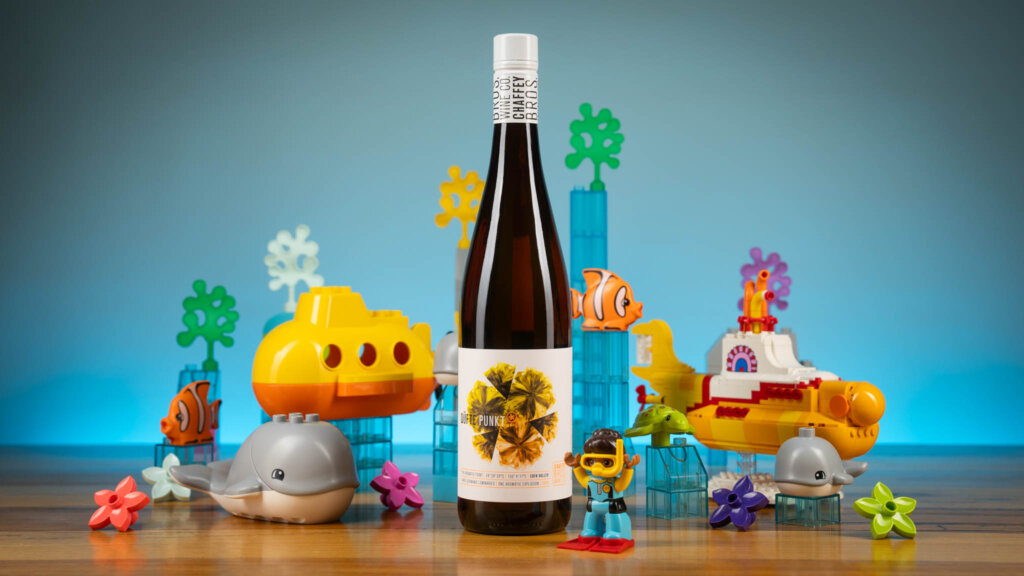
2025 Chaffey Bros. Wine Co. ‘Düfte Punkt’, Eden Valley $30 RRP
McCarthy, Aitken, and Nadeson all selected this among their top six wines from the day. McCarthy was drawn to its captivating perfumed energy: “So aromatic, grabs your attention, jumps out of the glass. Some fleshy fruit sits in behind – yellow, fully ripe, just about to fall off the tree, peach and plenty of spice. No holding back but multi-dimensional – that’s the beauty of a field blend. Big rich palate with some viscous elements, hints of pineapple, but also crisp stone fruits and spices, jasmine on top. Ever-present acidity holds it together with lovely texture and extended finish. Absolutely captivating.” Aitken’s reading was about generous balance: “A heady nose of white flowers, sweet white peaches and nectarines – forthright and generous. The fruit’s almost candied, but with enough pithy bitterness and stony minerality to keep it lively. Soft and round, but with lightness. Something reminds me of pineapple and raspberry, freesias, and an afternoon in the park.” Nadeson appreciated varietally ambiguous freshness: “A fresh, vibrant white, varietally ambiguous in the best way. I could not name it blind. An exuberant nose of white flowers, honeysuckle, and peach blossom – all lift and no weight. The palate brings lemon and a bite of grapefruit pith, with acidity beautifully judged, long and seamless to the finish. I would want oily seafood with this – something simple and very fresh, cooked with restraint.”
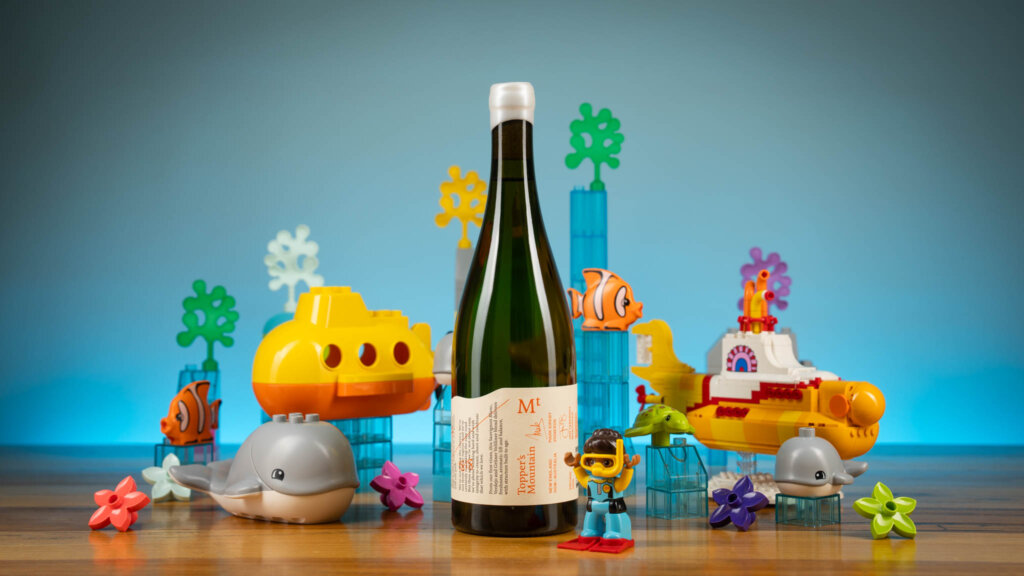
2025 Topper’s Mountain ‘Beeswing’, New England $40 RRP
Aitken selected this among her standout six picks, finding thoughtful complexity in every sip: “This opens with yellow passionfruit, flint, and an intriguing herbaceous note that reminds me of summer camping – green grass, citronella, even tea tree. Sweet tropical fruit to follow: jackfruit and melon. The palate has great acidity, really mouthwatering, with phenolic grip and rounded texture through to the finish that hints at cashew cream or crème pâtisserie. Warm hay and fields of flowers remind me of sunshine. It’s a thoughtful wine, but not without drive and energy. Just delicious.”
McCarthy selected this among his top six picks from the blind tasting and found engaging complexity and food-friendliness throughout: “Complex aromatics, immediately engaging – a full spectrum of ripe orchard fruits into various yellow citrus, more the pith and zest. Some nice fermentation characters build plenty of depth into the aromatics and flavours. Yellow-fleshed fruits, both cool-climate and tropical, dominate the palate with plush mouthfeel, all neatly tied up with ever-present ripe phenolics. The whole thing is a bit of a moving target suggesting there are perhaps more than a few varieties in here, grown well – keeps you entertained. I’m chasing something salty – fresh pickled veg, maybe some fish. Keep it simple, nothing too fancy.”
2023 Cherubino Wines ‘Laissez Faire’ Field Blend, Pemberton $37 RRP
The contradiction is the thing – Nadeson and Walpole each selected this, but located that contradiction differently. Nadeson found it in the palate itself: “A structured, medium-bodied white that still holds real freshness. Herbal on the nose in the nicest possible way, with a mineral edge sitting behind it. Lemon and almond flower, a touch of lime, and a spice note that I kept coming back to. The body reads light, yet there is a viscosity to it, an oiliness across the tongue that has no business being there at this weight. That contradiction is the interesting part – the palate feels lighter than the wine actually is, and somehow the two never argue. Very cleverly done, and genuinely intriguing to drink.” Walpole found aromatic complexity and phenolic balance commanding the stage: “Very good aromatic lift and complexity of varieties – jasmine, ginger, pot-pourri. Subtle hints of beeswax and flinty complexity. Very nice phenolic grip and texture building around tight mineral fruit – just ripe citrus, lemon, and some lemon curd on the finish. Complex lift and palate layering with lengthy finish. Good amount of flint and funk that really ties the fruit together. Enveloping layers of sweetness pinned firmly by fresh citrus acid. There’s something inherently fun and no-nonsense about this that makes it hard to miss.”
2024 Sittella ‘Avant-Garde Series – El Vivero’ Rouge, Swan Valley $41 RRP
Lapalus selected this among his standout six picks and found seductive softness woven throughout: “Bright red colour with a hint of garnet and good limpidity – this wine is looking very fresh. The nose has good intensity with a dominance of floral aromas like dark iris, which makes me think of Tuscany. A very soft attack with rich, silky texture supported by medium volume. Tannins are in the same vein as the mouthfeel – very soft. Such a great touch on this wine with very seductive aromatics. It will go well with some delicate plates of antipasti.”
Nadeson selected this among his top six selections, finding perfect balance in every aspect: “I love it when a rosé gives you the whole Turkish delight thing – rose petal and green raspberry, sweet exotic perfume with something unripe and sharp running under it. This one has all of it, and it arrives fresh rather than confected. The palate is vibrant and inviting. There is proper mouthfeel here – textured phenolics giving it grip and something to feel – and the acidity holds the whole thing straight. Balanced, satisfying, compelling. I’m not sure what more you would ask of a rosé. I could sit almost anywhere with this on a summer afternoon and be perfectly happy.”
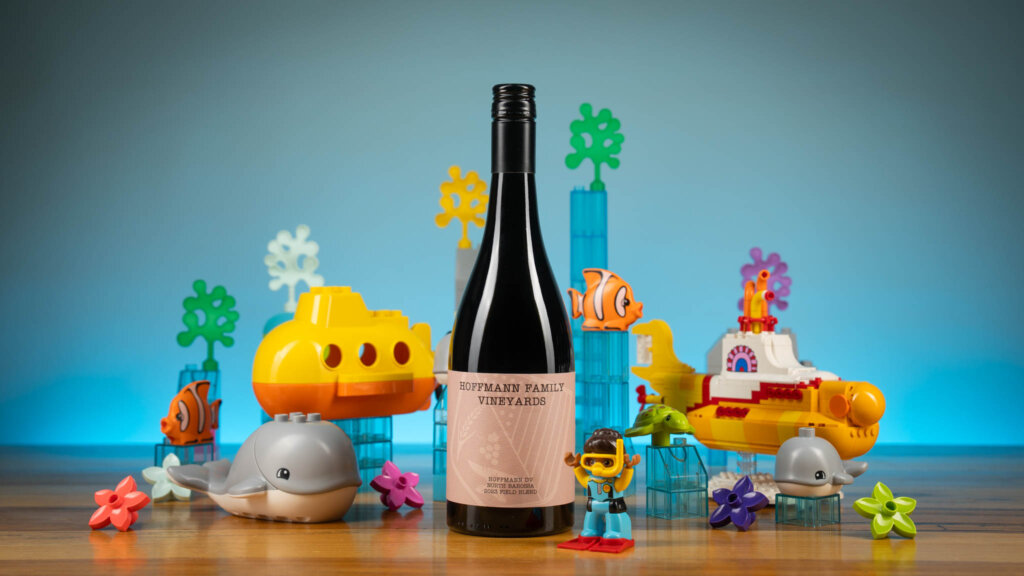
2023 Hoffmann Family Vineyards ‘Hoffman DV’ Field Blend, Barossa Valley $40 RRP
Lapalus selected this among his top six picks, and found well-made richness that rewards patience: “Red with garnet hue and some light signs of evolution. The nose opens with good intensity, showing a little evolution as well. Then the fruit takes centre stage with strong cassis, followed by some chocolate and woody notes. The mouthfeel starts with great fluidity and a great level of concentration – a balanced, rich volume equally matched by the aromatics, revealing more fruits – cassis again – complemented by the oaky touch of the barrel. A rich wine, well made and with some future.”
2025 Boulder Fields Field Blend, Macedon Ranges $40 RRP
Lapalus selected this among his standout six selections, finding clean, aromatic energy throughout: “The sight gives immediately a direction or style with its cloudiness. Totally confirmed by a very intense nose showing a mix of tropical notes like pineapple, citrus grapefruit notes, and some more vegetal nuances of fresh grass. The mouth is very energetic at the start with great acidity followed by the same aromatic intensity seen on the nose. The volume is medium-low and the length is supported by the strong aromatics. A lovely clean wine to sip in the afternoon instead of tea.”
2025 Jack Rabbit Vineyard ‘P2’, Geelong $45 RRP
The balance is the thing – Nadeson selected this for his top six wines of the blind tasting, finding it a perfect chilled red: “Crunchy cranberry, white cherries, and green raspberry – bright and unfussy, the kind of aroma that has you reaching for the glass again before you have finished the first sniff. The flavours run long and persistent, and what strikes me is that neither tannin nor acid takes charge. Both are there doing their work, but the fruit stays out in front the whole way. Balance is the word for this wine. Half an hour in the fridge, a warm afternoon, and not much else required. I loved it.”
Hilliker selected this among her six most-loved wines of the blind tasting: “Pretty, fresh, floral, and fruity. Aromatic and floral with a touch of ginger and tropical fruit. Super silky mouthfeel with a little lime curd and pith, saline and super refreshing. A little lees for texture – yum! Some vanilla and custard apple too. I love the acid, citrus, fleshy orchard fruit, greenness … I didn’t clock how phenolic this was before … jasmine, acacia, savoury buttered biscuits.”
2023 Red Hill Estate ‘Artist Series’ Field Blend, Mornington Peninsula $45 RRP
McCarthy selected this among his six standout picks and found richness and complexity: “A bigger, richer style here than many others – perhaps a little more age. Fleshy orchard fruits are really pronounced, thinking nectarine and fully ripe peach – very SPC (Shepperton Packaging Company, from fond childhood memories). Stacks of phenolic texture and some savoury elements tie the whole thing together, giving it that complex field blend feel.”
2023 Higher Plane ‘Three’s Company’ Field Blend, Margaret River $30 RRP
Really exotic lift, incredibly intense – Walpole selected this white field blend among his most-compelling six wines from the blind tasting: “Guava, mango, and green pineapple. Orchard fruit and custard apple. Smoky reduction and very good phenolic play and texture. Really good layering that makes you go deeper – the interest factor here is very high. The evolution in the glass is phenomenal here. Lengthy finish driven by the phenolic weight. Soft and plush with great texture.”
2024 Tenafeate Creek ‘Vincenzo’ Shiraz/Cabernet, Mount Lofty Ranges $70 RRP
McCarthy, Hilliker, and Walpole selected this among their six standout selections from the blind tasting. McCarthy was drawn to its old-school charm: “Last wine of the line-up and it’s a big, solid number to finish – all dialed up but in a good way. Perhaps a little more oak and ‘classic’ than many here. A little menthol, a heap of dense fruit – some dried, the rest very ripe – with plenty of tannin already looking integrated. Surprisingly plush, maybe one for the cellar. Not something I’d reach for, but would absolutely enjoy if poured for me – preferably at an old-school steakhouse after the final siren.” Hilliker found structure and approachability: “Great and grippy, spicy with heat from the alcohol. The pinot-esque aromatics and flavours make this incredibly approachable, while tannins support aging another twelve months at least. Super grippy with tart, mouthwatering acidity. This wine wants to talk about its structure – tannin and acid do the talking here. Plusher cassis and cocoa nib with great tannic grip.” Walpole found seamless power: “Very bright red and blue fruit lift – bramble, blueberry, and five spice. Lovely crunchy acid line. Extremely fun and slurpable with lovely open-knit structural core. Dark, light notes of vanilla oak supporting blackberry and blackcurrant. Very powerful expression with components melding seamlessly. Not shy, but the fruit presence is so deep and lingering there’s real evenness to this one.”
2025 Quealy ‘Pobblebonk’ Field Blend, Mornington Peninsula $38 RRP
Walpole selected this among his top six picks, and found refined minerality: “Light colour with lots of almond meal, worked solids drive. Chardonnay-esque framework – steely and flinty intensity with gun-metal edges. Quite tight and refined. Zippy acid attaches to fruit like a spine. White grapefruit pith and savoury complexity. Would be excellent with or without food. Really enjoying the evolution of the solids work – complexity is high, with very good mineral length and grip.”
2024 Dune ‘Pyla’, McLaren Vale $32 RRP
McCarthy selected this among his finest six selections of the blind tasting: “All this river stone and graphite is framing a whole spectrum of fruit-driven aromatics – from delicate, just-ripe berries to super-dense dark-fleshed plums. Captivating. The palate is more lively than expected – yippee! – with glossy, truly ripe forest fruits followed by bright, persistent acidity and lovely, fine, crunchy tannins. Finishes refreshing. The combo comes together so bloody well.”
2024 Oakdene ‘Red’ Field Blend, Geelong $24 RRP
Lapalus selected this among his top six picks and found youthful promise: “Red with garnet hue of medium intensity and good limpidity. The nose is very intense with a strong fruity note – dark berries, cassis, mulberries – increased by some spice and earthy notes like celery root. The mouthfeel shows moderate volume with great fluidity followed by refreshing acidity. The aromatics are still on the same profile as the nose – with fruit. Despite the youth of the wine, it will work really well with a spring lamb or a fine guinea fowl.”
2024 Small Victories ‘Blended Fields’, Barossa Valley $32 RRP
Lapalus selected this among his standout six selections and found balanced complexity: “Red with garnet nuances and good limpidity. The nose is showing good intensity with spice and some richness of fruit. The strength here is the rich concentration well balanced by the aromatics, revealing dark floral notes, spice, and some cacao in the finish. Tannins are fine and add to the complex overall impression. A very present wine that can support rich food.”
Aitken selected this among her top choices from the blind tasting: “This feels super classic and respectable, displaying its age through dried dates and prunes, undergrowth, and leather. The big, syrupy texture and sweet nose recall port – so much so that I’d perhaps put the origins of the blend in Iberia, if just for the dark plummy fruit and sun-ripened feeling. There’s spice too: anise, cloves, and dusty cocoa. It’s ripe, and it’s beefy – not a wine to start an evening, but something to build up to. Lots of fine, smooth tannins and satisfying richness on the palate. Almost a caricature of a dad wine, built for a chesterfield lounge in front of the fire, or a rich meat stew.”
The backstory
For centuries, grape varieties grew together in the same vineyard for one simple reason: farmers couldn’t control the vintage. A frost, a drought, a rogue heatwave – any of it could wipe out a single crop, so growers hedged their bets across many. Then modern viticulture came along and pulled it all apart, variety by variety, block by block – because now, suddenly, it could. Control replaced chance. And for the best part of a century, that felt like progress.
Now the pendulum is swinging back. Winemakers are deliberately putting varieties back together in the same row, the same pick, the same ferment – chasing something modernisation may have quietly engineered out of the vineyard: resilience, complexity, a rawer, less curated sense of place. But there’s a catch. As “field blend” has drifted from agricultural necessity to bona fide desirable wine style, the term itself has stretched to fit almost anything a marketer wants it to mean. Which leaves one deceptively simple question: what, exactly, is a field blend?
A Brief History of the Field Blend
Mixed-variety vineyards are not, as is sometimes claimed, the “original form” of wine – the archaeological record for early winemaking, stretching back to the Neolithic period, simply doesn’t yield enough information to make such a claim. What can be said with confidence is that for much of viticultural history, particularly in Europe, planting several varieties together in the same vineyard was commonplace.
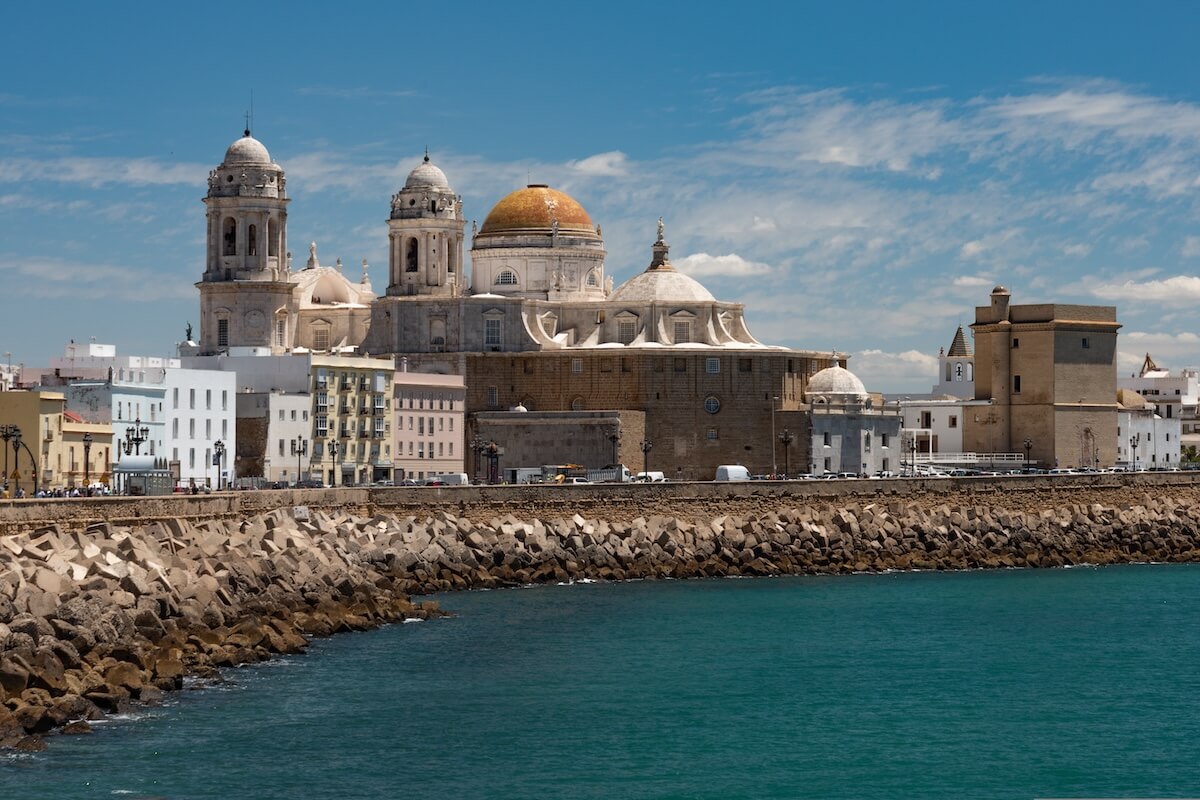
The tension at the heart of the field blend is genuinely ancient – at least two thousand years old. In the first century CE, the Spanish-born Roman agricultural writer Lucius Junius Moderatus Columella weighed up whether vineyard varieties should be planted separately or “intermingled,” and laid out the practical logic for mixing them: one variety might fail in drought, another in frost or excess rain, so a mixed planting reduced the risk of losing an entire harvest to a single bad season. Yet Columella himself actually preferred separating varieties where possible – he was equally alive to the problems mixed planting caused, from staggered flowering and ripening to the sheer difficulty of deciding when to pick everything at once. The core dilemma of the field blend, in other words, isn’t a modern invention: diversity makes a vineyard more resilient, while separation gives the grower more control. Winegrowers have been weighing that trade-off since antiquity.
Opposite: An engraved portrait of Lucius Junius Moderatus Columella from the Middle Ages. Above: Cadiz, Spain – Columella’s birthplace.
By the nineteenth century, mixed-variety vineyards were firmly entrenched across large parts of Europe. Historians of French wine note that before the phylloxera crisis which decimated vineyards of entire regions across Europe and the world, most French vineyards were field blends of interplanted varieties rather than the neatly organised single-variety blocks familiar today. Phylloxera didn’t directly cause single-variety blocks by itself – what it did was force a total teardown of the vineyard, and that teardown created a rare opportunity to redesign from scratch: to organise vineyards methodically for the first time, block by block, variety by variety, rather than reproducing the old mixed plantings. Monovarietal block planting, in the sweep of winegrowing history, is a comparatively recent phenomenon.
None of this was primarily about flavour or terroir. Different varieties bud, flower and ripen at different times, respond differently to heat, drought and disease, and yield differently from one season to the next – so a mixed planting spread that risk across the vineyard. If one variety failed, another might not. Put simply: the old field blend wasn’t planted to make a more interesting wine. It was planted to make sure there was a wine to make at all.
Modernity and the Return of the Field Blend
It would be too simple to credit phylloxera alone with inventing the single-variety vineyard – after all, Columella had been arguing for separation nearly two millennia earlier – but the replanting era was a major accelerator, and wine historians point to post-phylloxera France as a period when vineyard organisation became dramatically more systematic. The logic is straightforward from a grower’s chair: a single-variety block can be pruned, sprayed and picked to that variety’s own timeline, while a mixed block always has vines at different stages of the season at once. Twentieth-century advances in clonal selection and viticultural science only reinforced that direction of travel – identify the variety, isolate it, optimise it, blend later only if the winemaker chooses to.
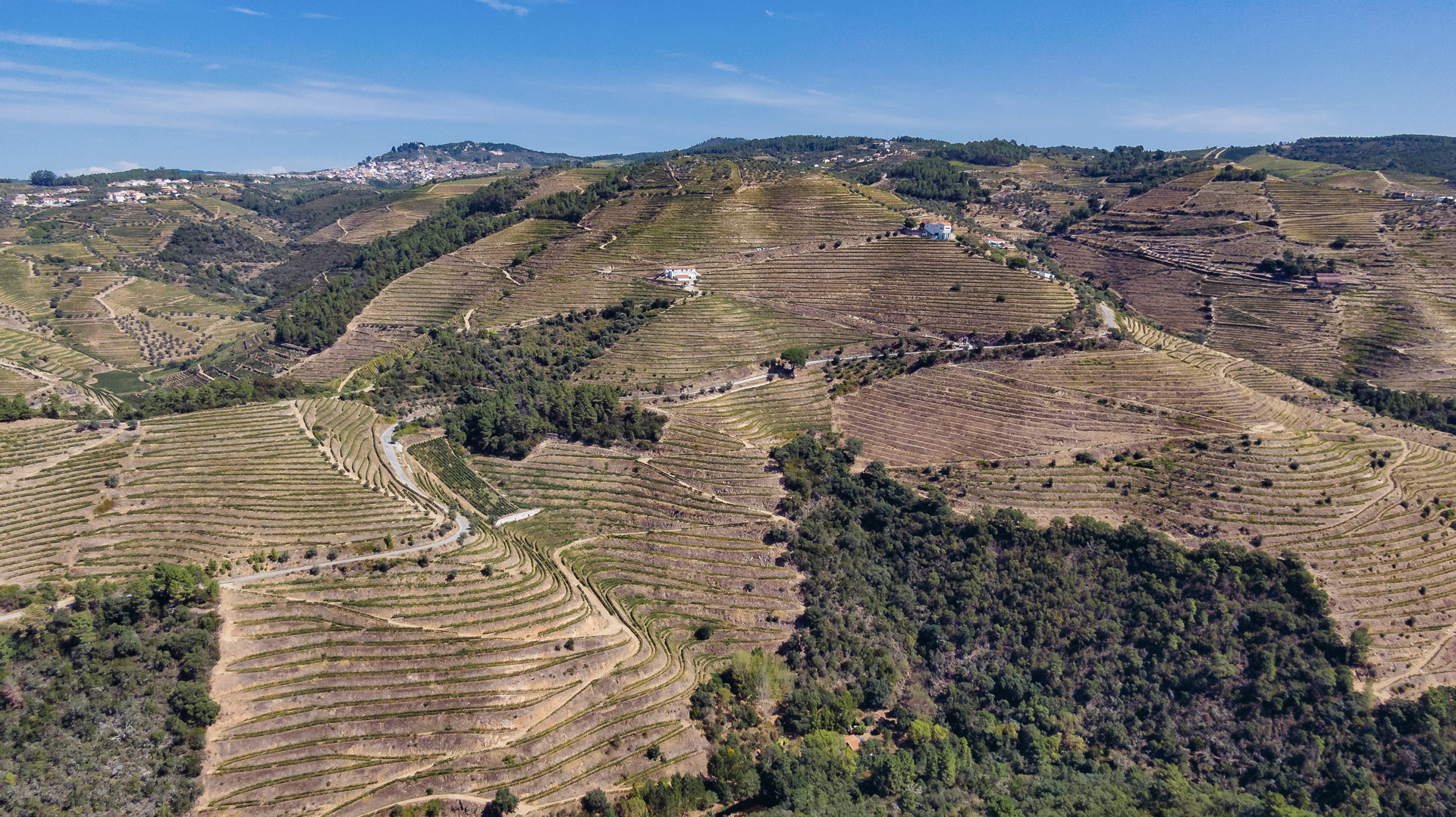
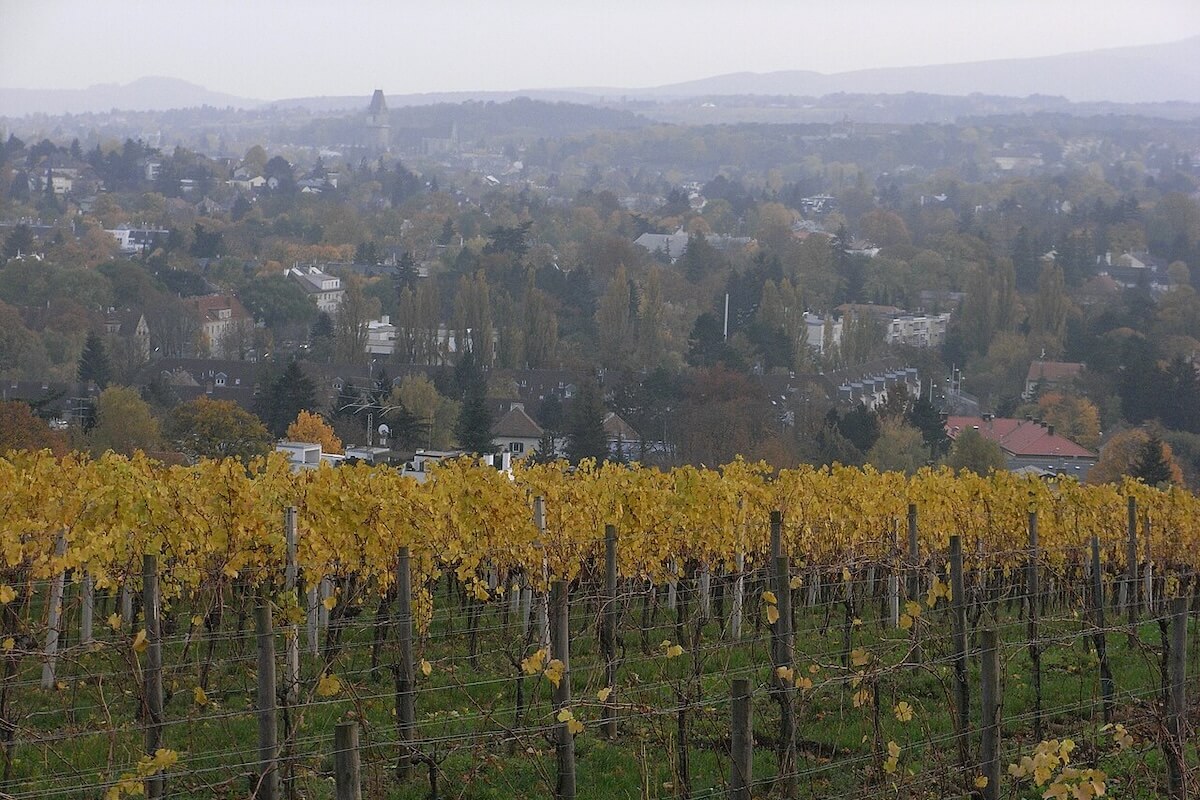
Then, in recent decades, something reversed. Qualities that once looked simply unsophisticated – vineyard diversity, an inherited jumble of old vines – began acquiring a very different reputation: heritage, resilience, terroir, minimal intervention, authenticity. Surviving old mixed vineyards, from the Douro to Vienna to California, went from being treated as relics to being actively prized, and some growers have gone further still, deliberately planting new mixed vineyards specifically to bottle as field blends. Austria offers the clearest example of that shift being formally recognised: the Wiener Gemischter Satz DAC of Vienna and its surrounding areas turned mixed planting itself into a protected part of a regional wine identity, rather than an old-fashioned habit to be modernised away.
Above: Vineyards in the Douro, Portugal. Opposite: An urban vineyard in Vienna, Austria. (Photo by Tiefkuehlfan, CC BY-SA 4.0.)
That revival has created a genuine conundrum – arguably the real story here. Once “field blend” starts carrying real cultural value, the incentive to use the term grows, and several genuinely different practices get collapsed under the one phrase. At one end sits a true field blend: varieties interplanted, picked together, fermented together. Several varieties from one vineyard but grown in distinct blocks, still picked and co-fermented, can reasonably claim the term too. A co-fermentation of grapes grown in entirely different places is sometimes presented as a field blend too — but given the fruit never actually shared a “field,” such claims don’t really wash. And an ordinary blend – grown, fermented and matured entirely separately, then assembled afterwards in the traditional way – isn’t a field blend at all. Australian law offers no equivalent of the Gemischter Satz DAC’s strict rules – Wine Australia’s labelling regulations govern claims like variety and vintage (with a familiar 85% rule), but don’t define “field blend” as a protected category. Here, as in other markets around the world, the term operates as descriptive language rather than codified standard – which is exactly what makes the conversations that follow worth having.
The Field Blend, Codified
Long before “field blend” became a drawcard on a wine list, it was simply how vineyards worked. Early, mid and late-ripening varieties were planted together – not for flavour, but for insurance. As Vienna-born wine importer Andreas Puhar of Enoteca Sydney explains, growers had no reliable way to guarantee a harvest in any given year, so they hedged: “If there is an early ripening variety, a middle variety, a late ripening variety… things were interplanted to make sure that we get something in a bad year.” The varieties were picked, fermented and bottled together as one lot, whatever the ripeness – “a little bit underripe, a little bit overripe, a little bit perfect” – and that unevenness, Puhar says, is “the charm of the blend.”
For most of its history, this was humble stuff. Puhar, who grew up around his family’s vineyard outside Vienna, traces the culture back to a specific moment: an imperial decree of 1784, in which Emperor Joseph II gave ordinary growers the right to sell their own produce directly, without a licence. That’s the origin of Vienna’s Heurigen – the rustic wine taverns still scattered through the city’s outer hills – and of Gemischter Satz’s original identity as the most everyday wine in town. “It used to be the cheapest,” Puhar says, “and now it’s definitely a specialty.”
Above: A typical Austrian Heuriger. Opposte: Andreas Puhar at a Young Gun of Wine tasting panel.
The shift from everyday drink to protected regional icon happened comparatively recently, and in two distinct legal steps. In 2011, ‘Wiener Gemischter Satz’ was formally written into Austrian wine-labelling law for the first time, giving the term an official basis. Two years later, from the 2013 vintage, it became a DAC (Districtus Austriae Controllatus) in its own right – Austria’s ninth, arriving roughly a decade after the country’s first, Weinviertel, in 2002. The DAC rules are specific: at least three white varieties must be planted in the same Viennese vineyard, no single variety can exceed 50% of the planting, the third-largest must make up at least 10%, and all of it must be harvested and processed together. Where most of Austria’s other DACs are built around one or two signature grapes – grüner veltliner for Weinviertel, blaufränkisch for Mittelburgenland, zweigelt for Neusiedlersee – Vienna’s did something different: it protected a method, not a variety. In a sense, the mixed planting and the shared harvest date are the appellation.
“If there is an early ripening variety, a middle variety, a late ripening variety... things were interplanted to make sure that we get something in a bad year.”
Puhar puts the recent leap in quality down to something simpler than legislation: money. “People have become wealthier and demanding a better product,” he says, noting that the number of producers has fallen sharply even as quality has risen – “much fewer producers, but this has become much more specialised.” Today’s Gemischter Satz, he’s careful to note, isn’t necessarily profound. It doesn’t need to be. “They are extremely quaffable. And do I think that they are profound? Well, no – but they can be extremely well balanced, good drinking wines. That’s what they are.”
The status reversal, in Puhar’s telling, happened fast – he says of the shift over the last twenty years that Gemischter Satz has “become almost very trendy and pretty cool.” There’s civic pride bound up in that rise, too – “a lot of parochial pride, that this is unique to Vienna,” as Puhar puts it – the kind reserved for something a city recognises as truly its own. It’s also, for now at least, a pride that stays largely at home. Puhar’s company, Enoteca Sydney, doesn’t currently bring Gemischter Satz into Australia – the wines’ fame around their city of origin comes at a price, quite literally. Being grown within Vienna’s own boundaries keeps supply tight and cost high.
Field blends – by accident and by design
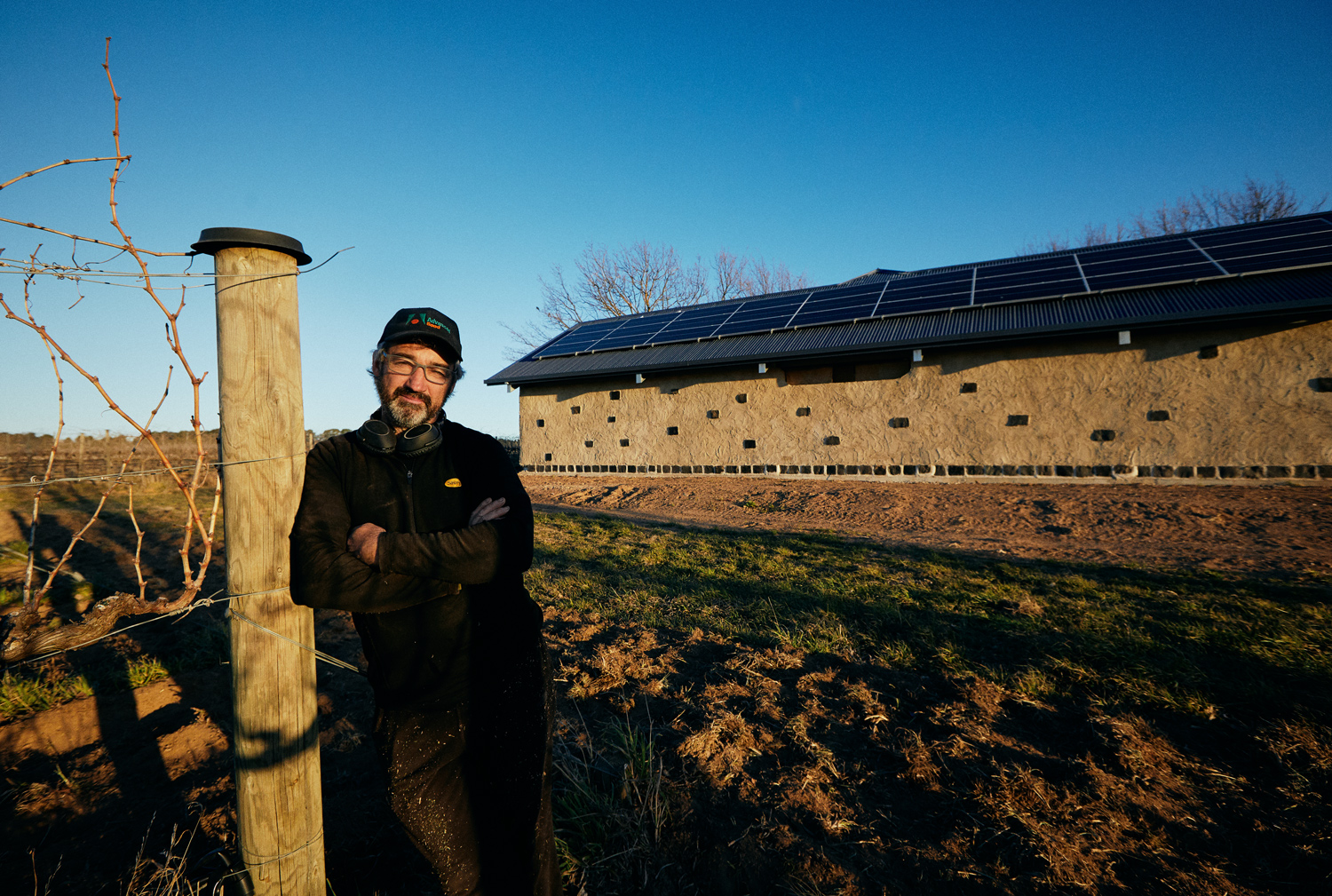
Bryan Martin has been growing unusual company for his vines for decades. The first vines at his Ravensworth estate went into the ground in 1998, and the Canberra District property was one of the first in New South Wales to plant sangiovese and marsanne. and today the estate carries somewhere between 12 and 14 varieties across just four hectares. That range wasn’t planned as viticulture – it grew out of restlessness in the winery. “It’s probably more driven from trying to do something interesting in the winery afterwards, rather than any reason to grow,” Martin says, adding that a single, high-performing variety would be the sensible commercial choice. “I’d rather have six wines come from a vineyard, rather than two.” Years spent working alongside Tim Kirk at Clonakilla, watching their acclaimed single-vineyard Shiraz take shape, only sharpened his own appetite for the opposite: variety, difference, small parcels of something nobody else nearby was growing. Rows of ribolla gialla sit beside rows of sauvignon blanc; marsanne, viognier and roussanne came in early, chasing the Rhône; sangiovese and nebbiolo followed later, the latter a genuine climatic gamble given its early budburst and exposure to frost.
That vineyard philosophy sets up what happened in 2024 – though not by design. A severe spring frost wiped out roughly 95 per cent of that year’s crop, reducing an estate that would normally yield 30 to 40 tonnes to barely half a tonne of usable fruit. Rather than let the scraps go to waste, Martin’s son Lewis pushed to pick what remained: four white varieties gathered from around the vineyard’s end-posts, plus three skin-contact varieties – pinot gris, sauvignon and ribolla – fermented separately on skins. “There is a reason for doing it then, because there’s no point picking it separate,” Martin says of that year specifically – a rare instance where circumstance, not curiosity, produced a genuine field blend. The whites were pressed together into a glass fermentation vessel; the skin-contact varieties were fermented together, pressed, and topped back into the same vessel. The entire 2024 harvest from the estate came to 440 litres.
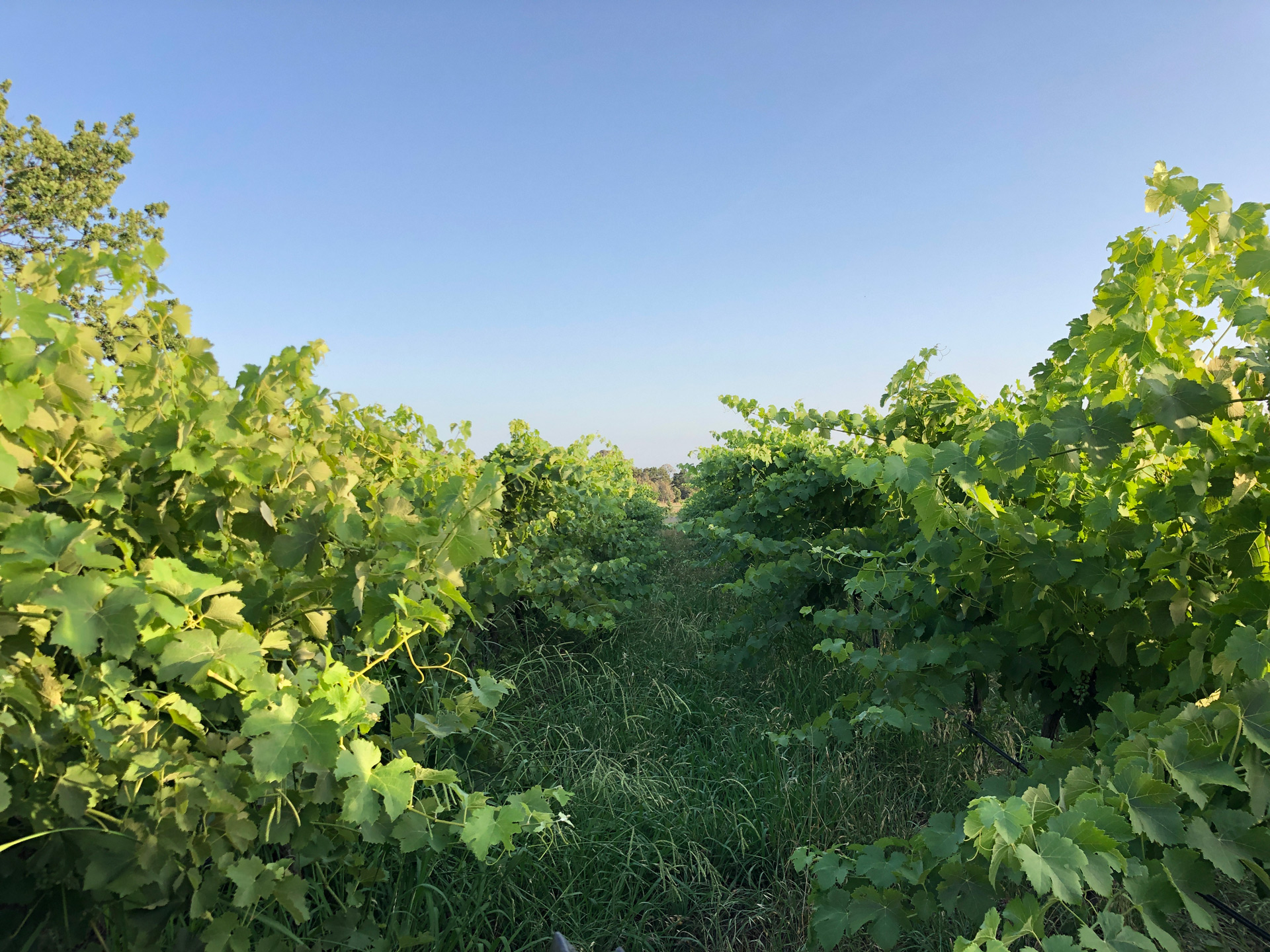
Opposite: Bryan Martin at the Ravensworth winery. Above: The Ravensworth vineyard.
Martin draws a firm technical line around what actually qualifies as a field blend, and he’s happy to say so plainly. “If someone’s going out saying they’re making a field blend … generally, to me, it’s this idea that we’re doing something different here. We’re not picking things that would normally go together.” For him, that means fruit from a single vineyard, picked on the same day, and fermented as one lot – not separate ferments blended together afterwards, and certainly not fruit sourced from different vineyards or regions under the same label.
The practical obstacle, in Martin’s telling, is ripening. Genuine field blends demand varieties that mature in step with one another, and few combinations do. Across his own vineyard the harvest window stretches across six weeks from first pick to last, with pinot gris and gewürztraminer coming off early and sangiovese and nebbiolo among the last. Shiraz and viognier can work as a field blend because they ripen together; cabernet and merlot, by contrast, cannot, despite their familiarity as a blend. “You’re either picking too early or too late,” he says of most other pairings.
“If someone’s going out saying they’re making a field blend … generally, to me, it’s this idea that we’re doing something different here. We’re not picking things that would normally go together.”
Martin has been experimenting with the idea for close to two decades. His first attempt came around 2008 – a six-variety field blend that drew a puzzled response from prominent Australian wine critic James Halliday, who, as Martin recalls, questioned why he’d bothered making it at all.
Given all that, Martin is candid that only a small part of his own portfolio meets his own bar. Going forward, his genuine field blends are narrow and specific: the long-running ‘Seven Months’ wine, a skin-contact amber field blend of pinot gris and gewürztraminer, in production for years, and the 2024 vintage born of necessity. Other wines that read like field blends in the glass – his Viognier-Marsanne-Roussanne white among them – aren’t, in his own accounting, because viognier ripens roughly three weeks ahead of the other two and each component is fermented separately before being blended together soon after. “In my mind, I think of that as a field blend,” he admits of the wine, “but it’s not really – technically, they’re meant to be all in the same ferment.”
Leaving It to the Vineyard
Matthias Utzinger’s wine ‘Roter Satz’ – winner of the Danger Zone trophy at the 2024 Young Gun of Wine Awards – is not sourced from his own vineyard, but from a small Tasmanian site his operation took on in 2020. He initially managed the property in full; today the arrangement has shifted to a consulting role, working alongside the owner’s daughter and son-in-law, who now look after the vines themselves. It’s a distinction worth holding onto, because Utzinger’s own vineyard – five hectares carrying ten varieties, including pinot, chardonnay, syrah, sauvignon and riesling – is where an entirely separate field blend project is under way: a deliberately planted, purpose-built white due for release around 2028.
The roots of ‘Roter Satz’, though, are personal, and go back to Switzerland. Utzinger’s grandparents grew wine in the German-speaking part of the country, minutes from the German border, where – as in many villages there – tending a household vineyard was simply part of family life. “They would look after it on the weekends – probably a bit more than just weekends – but it was part of the overall structure of the family to have a vineyard and look after that as well,” Utzinger says. His grandmother, he adds, “was a passionate viticulturist.”
That inherited idea of a home-vineyard blend – what his grandparents, like many in Austria, would have called a Schlosswein – shaped his thinking on the Roter Satz directly. “People like my grandparents who used to make wine would just go and pick whatever there was, and that would be their house wine,” he says. “I always liked that idea of leaving everything to the vineyard and taking away all that blending work in the winery, and just saying: that vineyard gave us that, and that’s what’s in the bottle.” The name itself borrows from Austria’s own field-blend tradition – ‘Roter Satz’ translates simply as “red set”, a direct nod to Gemischter Satz (“mixed set”).
Opposite: Winemaker Matthias Utzinger. Above: Utzinger Wines’ vineyard in the Tamar Valley of Tasmania – the site of plantings for a future wine based on the Viennese tradition of Gemischter Satz.
But the project wasn’t born purely of romance. When Utzinger’s operation first took on the vineyard, the individual variety parcels were so small that none would fill a barrel on its own. “It actually just made sense to blend everything together so we could make up enough to fill a couple of barrels,” he says. “And then we just really liked the result, and we’re like, well, might as well continue with that field-blend idea.”
Utzinger describes himself as a grower first, and the Roter Satz’s picking regime reflects that instinct for ceding control rather than exercising it. The blend runs to five varieties – syrah and cabernet franc make up an estimated 60% between them, followed by cabernet sauvignon at around 20%, with merlot and a small proportion of pinot rounding it out. Rather than tracking ripeness across all five, the team watches only one: cabernet sauvignon, notoriously marginal in Tasmania’s cool climate. “We basically just go and taste cabernet, and when that methoxypyrazine character has disappeared, that’s when we pick,” Utzinger explains – referring to the green, capsicum-like flavour compound that lingers in underripe cabernet. “That means the cabernet’s ripe, but by then the pinot is well overripe, the merlot is overripe, the syrah and the cabernet franc are probably just about right.” The result, he says, is that “the merlot and the pinot tend just to be overripe and give it a bit of plushiness” – a blend built not from careful calibration but from the accepted consequences of a single, non-negotiable picking trigger.
And it works. The 2022 vintage – the wine that took out the Danger Zone trophy at the 2024 Young Gun of Wine Awards, the only trophy in the show reserved for a single wine, judged purely on originality, risk and reward – is proof the gamble pays off. A true field blend of five varieties, picked and co-fermented as one, it carries the almost unbelievable distinction of having cabernet sauvignon and pinot noir harvested on the very same day. In the glass it shows a dark crimson red, with blackcurrant, cooked plum, sour cherry, vanilla and white pepper woven through. The palate opens soft, carried by a solid frame of young tannin, full-bodied with real volume and a long finish – a wine still unfurling, with its best years clearly still ahead of it in the bottle.
He holds a strict personal line on what a field blend actually is. “Ultimately it has to come from one vineyard, it has to be one site, multiple varieties picked together on the same day,” he says. “For me that’s always a field blend: multiple varieties picked on one day from one vineyard, co-fermented.” Pressed on whether picking spread across several days could still qualify, he allows some practical flexibility – “if your quantities are such that you can’t pick them on the same day… I don’t think one day of ripening, certainly not in Tassie conditions, makes a big difference” – but the underlying principle doesn’t bend: “we kind of like to say: one vineyard, one pick, one day, one ferment. I think it’s important.”
“We kind of like to say: one vineyard, one pick, one day, one ferment. I think it’s important.”
The vines that make ‘Roter Satz’ are old by any Tasmanian measure – the mother-vine block dates to the early 1970s, around 53 to 54 years old, with younger cuttings gradually added since. Utzinger credits some of the wine’s concentration to that vine age, and is quick to credit whoever first planted the site with a decision that, in hindsight, looks close to reckless. “I think back then that would have just been a crazy bet to plant all those varieties,” he says. “I guess they didn’t know better, so they just planted cabernet because they thought it would work in Tassie, and it turns out it’s probably the worst variety down here” – on its own, at least. Within the blend, it’s doing exactly the job Utzinger needs it to do.
The next chapter is on his own land, not the leased vineyard, and it’s being built with far more deliberation than the Roter Satz ever was. Last year Utzinger planted a one-hectare “experimental block” at the back of his own vineyard, laid out specifically to produce a white field blend: scheurebe, gewürztraminer, petite arvine and riesling, all aromatic varieties, planted in the middle of the block and flanked deliberately by riesling and petite arvine earmarked for standalone single-varietal wines. “The idea is to make basically a Tasmanian version of Gemischter Satz,” he says – “a white blend, fresh, vibrant, aromatic.” Some of the plant material has been imported directly from Switzerland, including an old riesling crossing not otherwise grown commercially in Australia. Fruit isn’t expected until around 2028, and Utzinger is candid that even the name may need rethinking, given some field-blend terminology can carry legal protection he’ll need to check before using it.
For a grower who describes his own instincts as risk-averse, the pull toward field blends is, by his own account, a deliberate departure from safety. “We’re so trained to be safe and secure, and to give a bit of that away and leave a little bit to fate, or to mother nature,” he says. “I really like that.” Asked to reflect on multi-variety plantings more broadly, he’s just as candid about the cost of that choice: “every grower would tell you not to do that, because they’ll budburst at different times, they’ll flower at different times, the ripeness will be different. We probably complicated our lives a fair bit by doing that. But I think that’s when exciting things happen – when you go against what is common advice.”
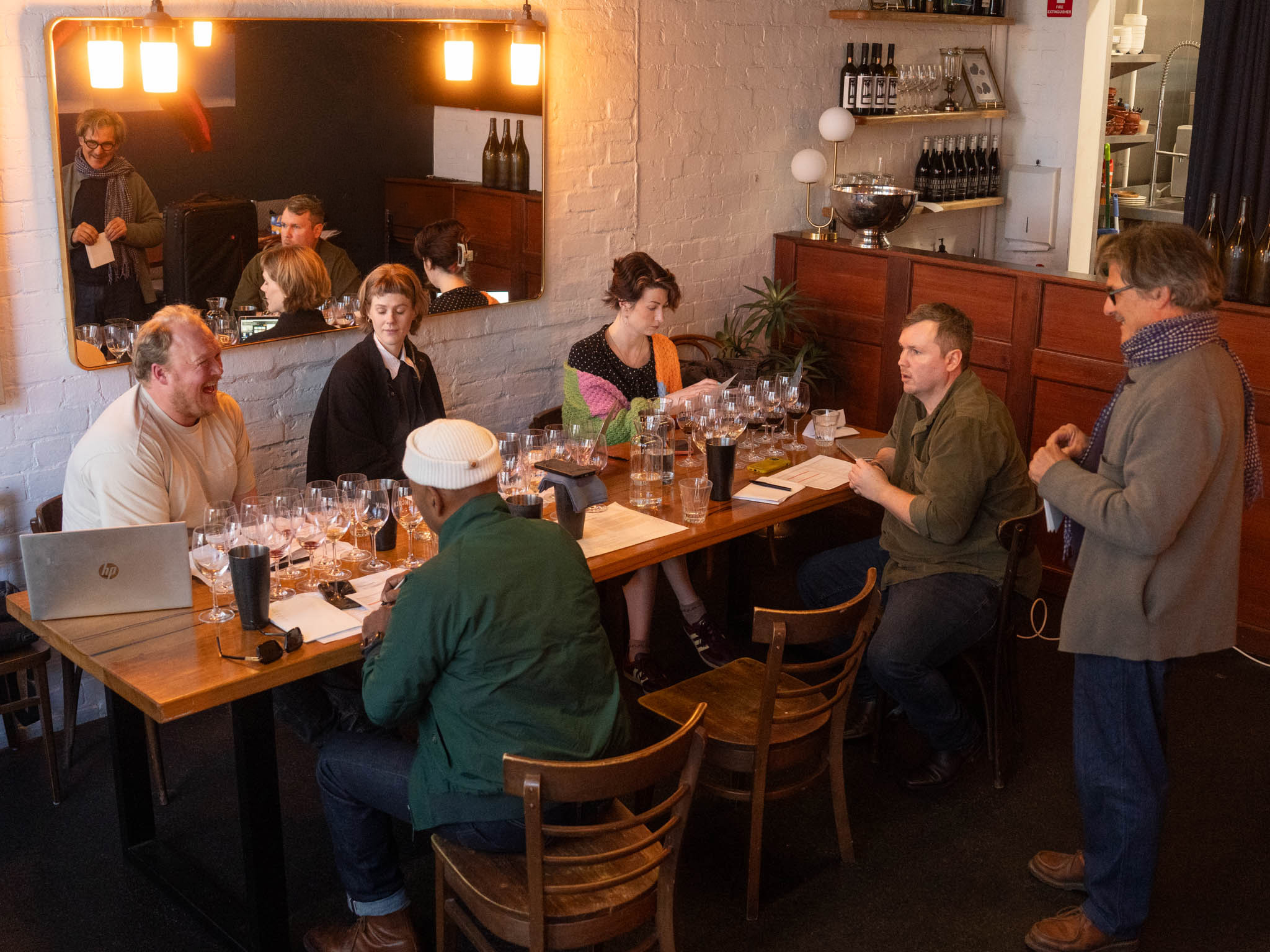
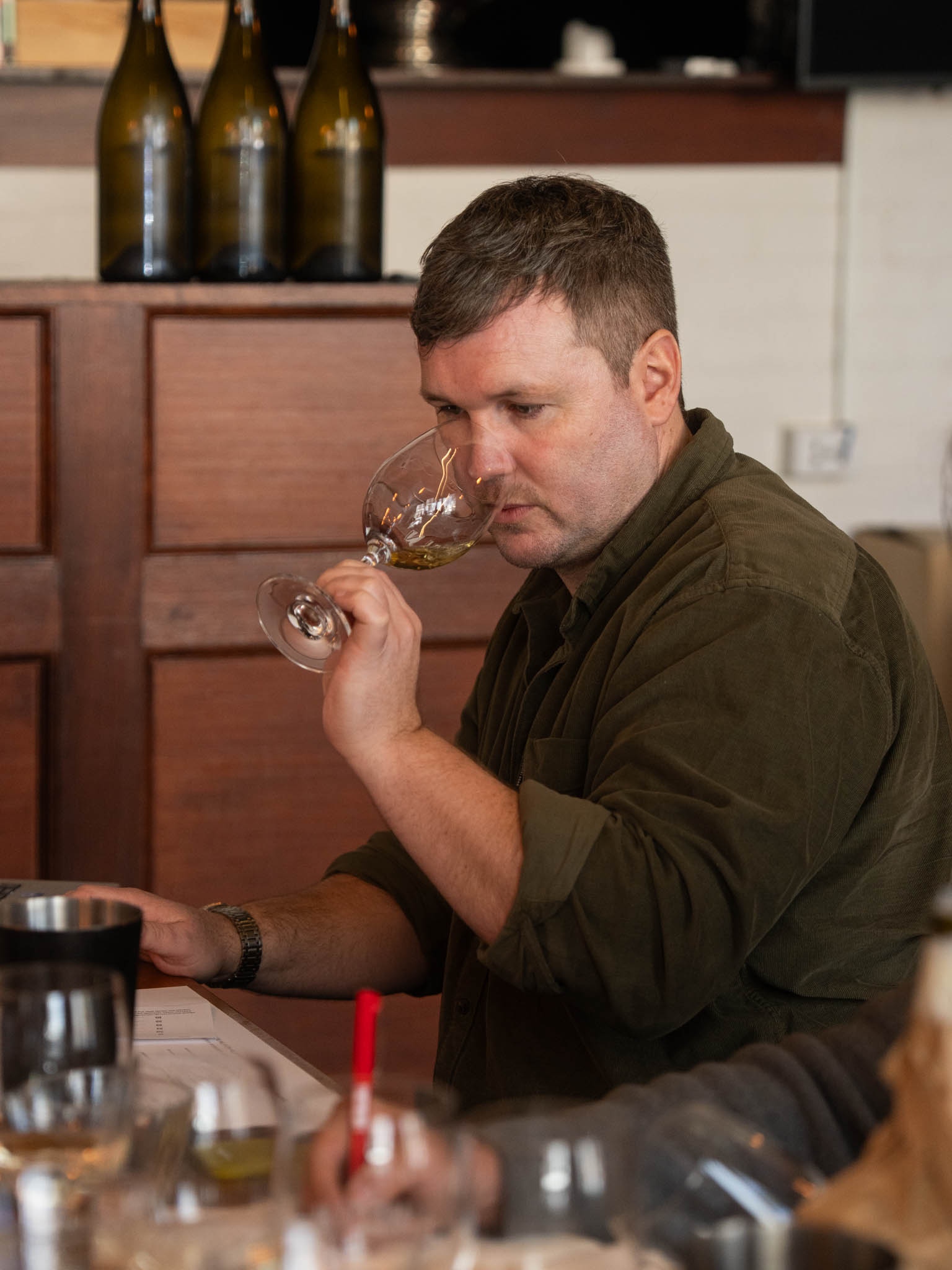
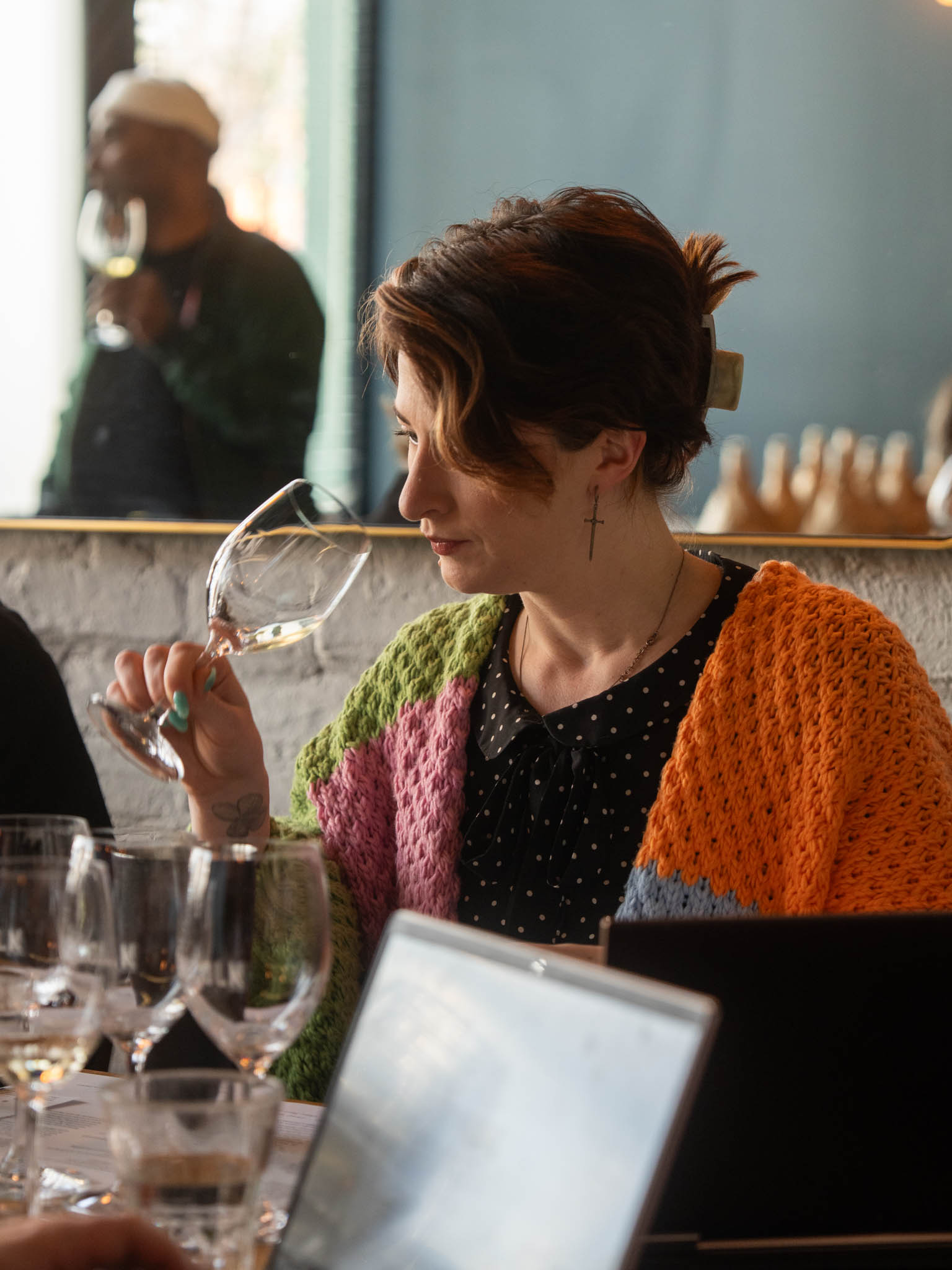
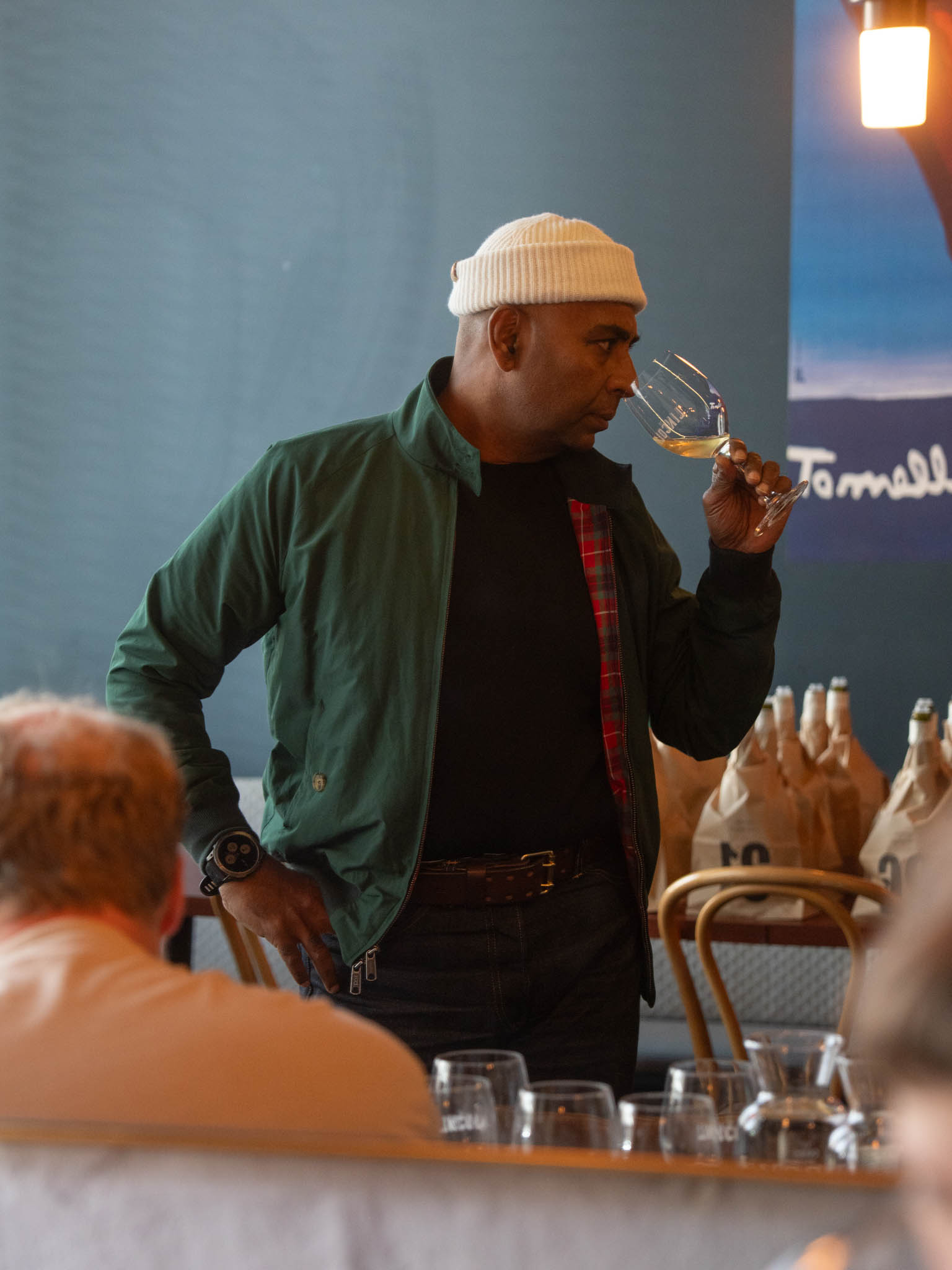
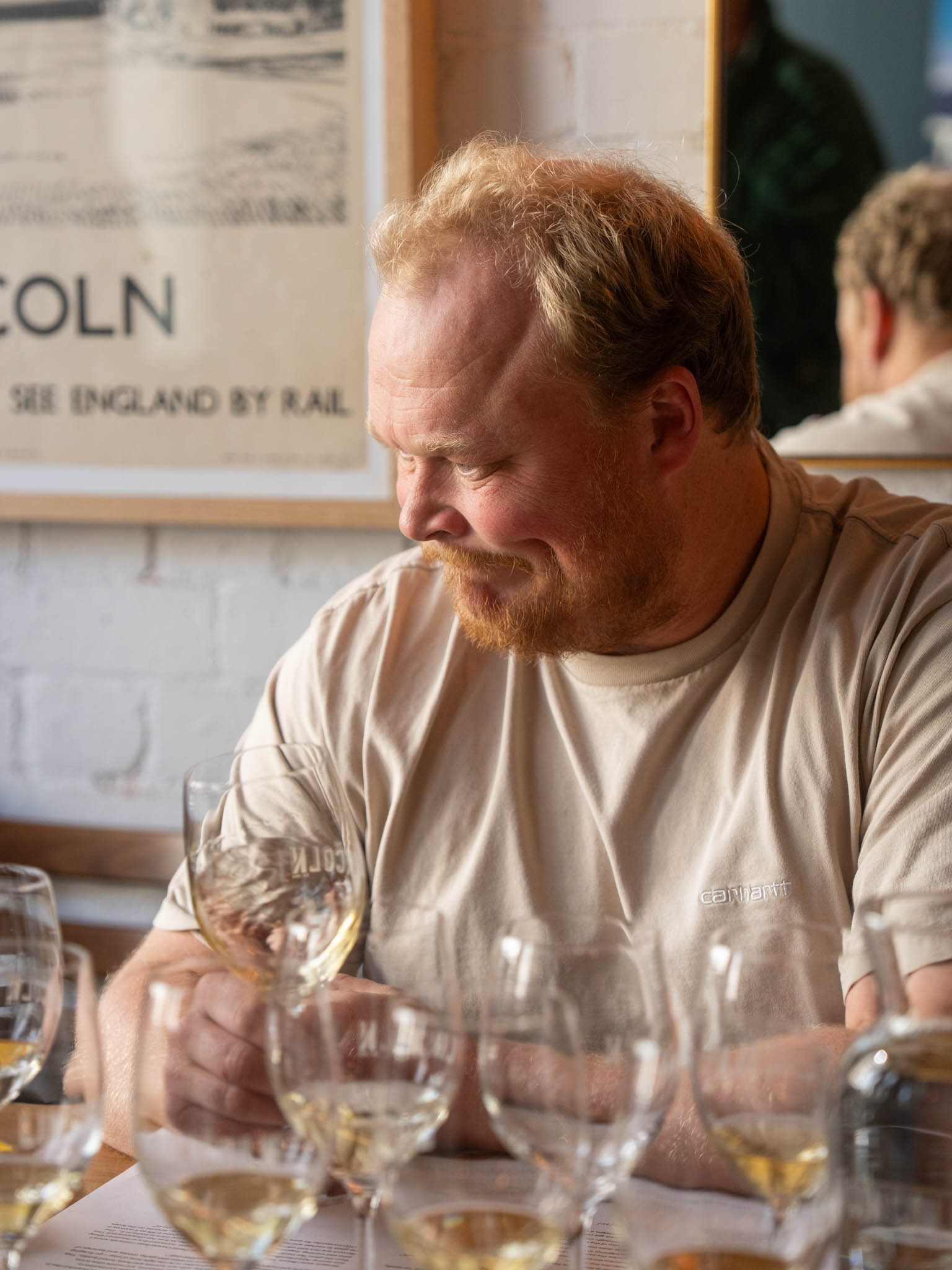
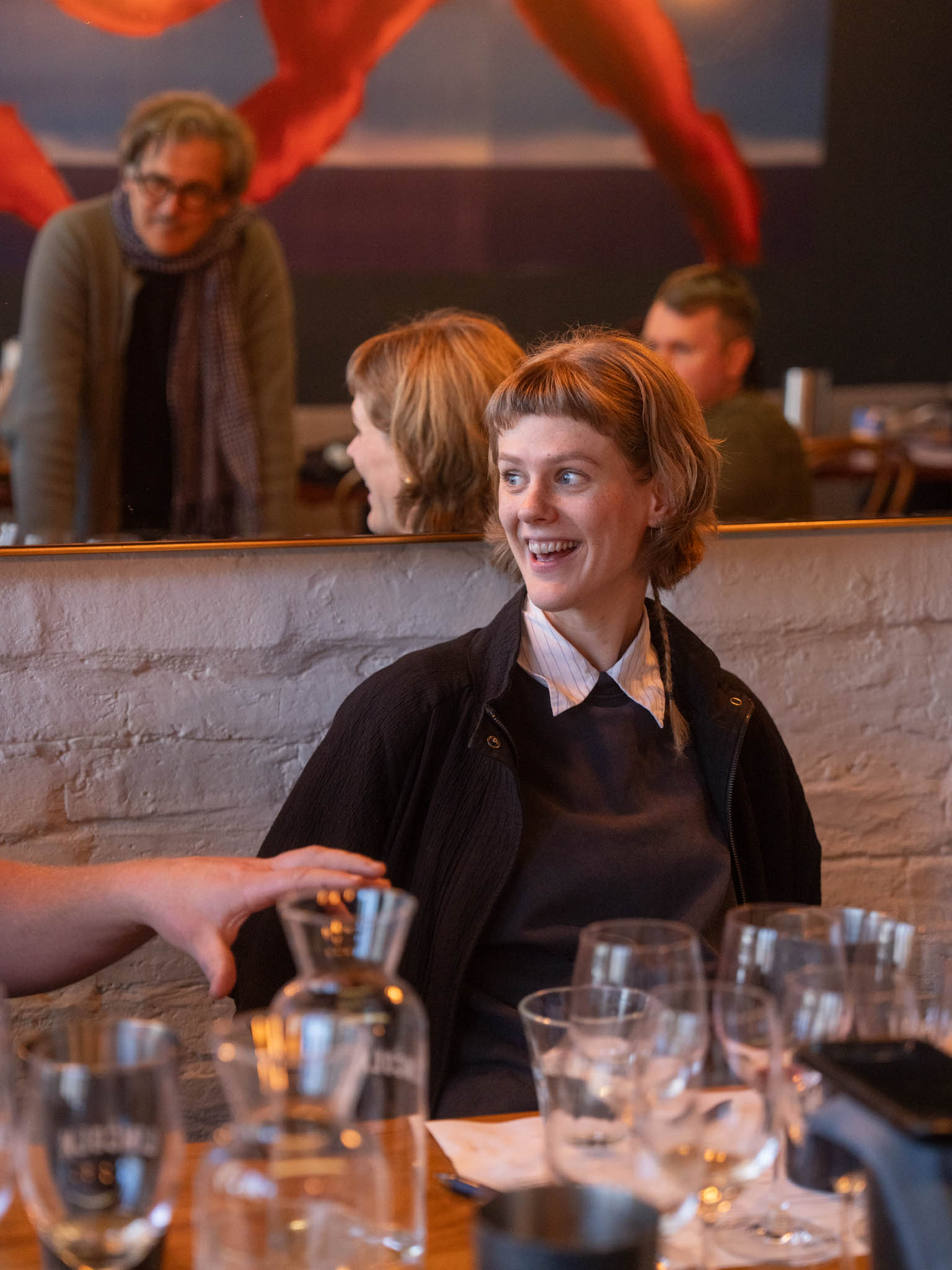
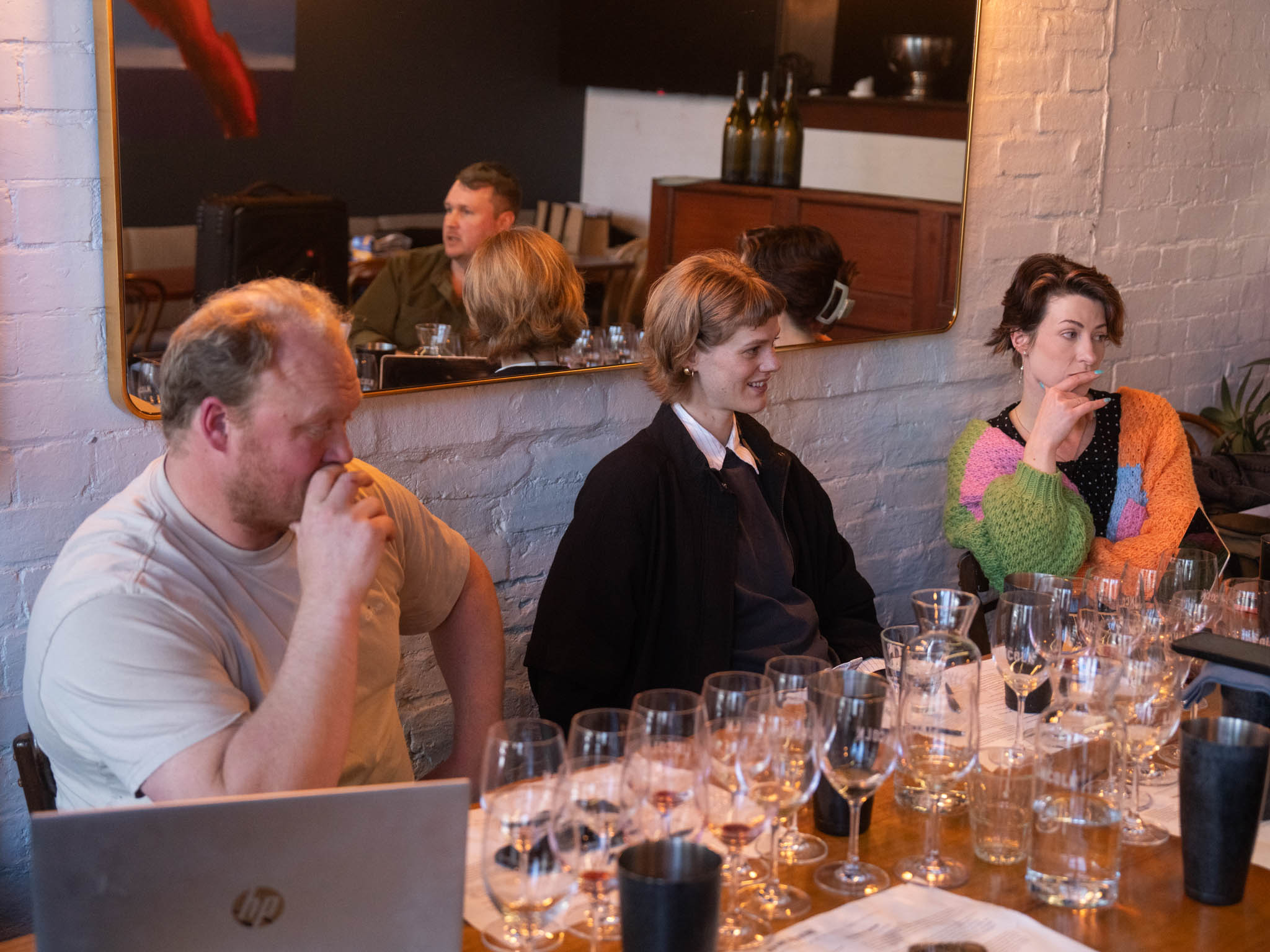
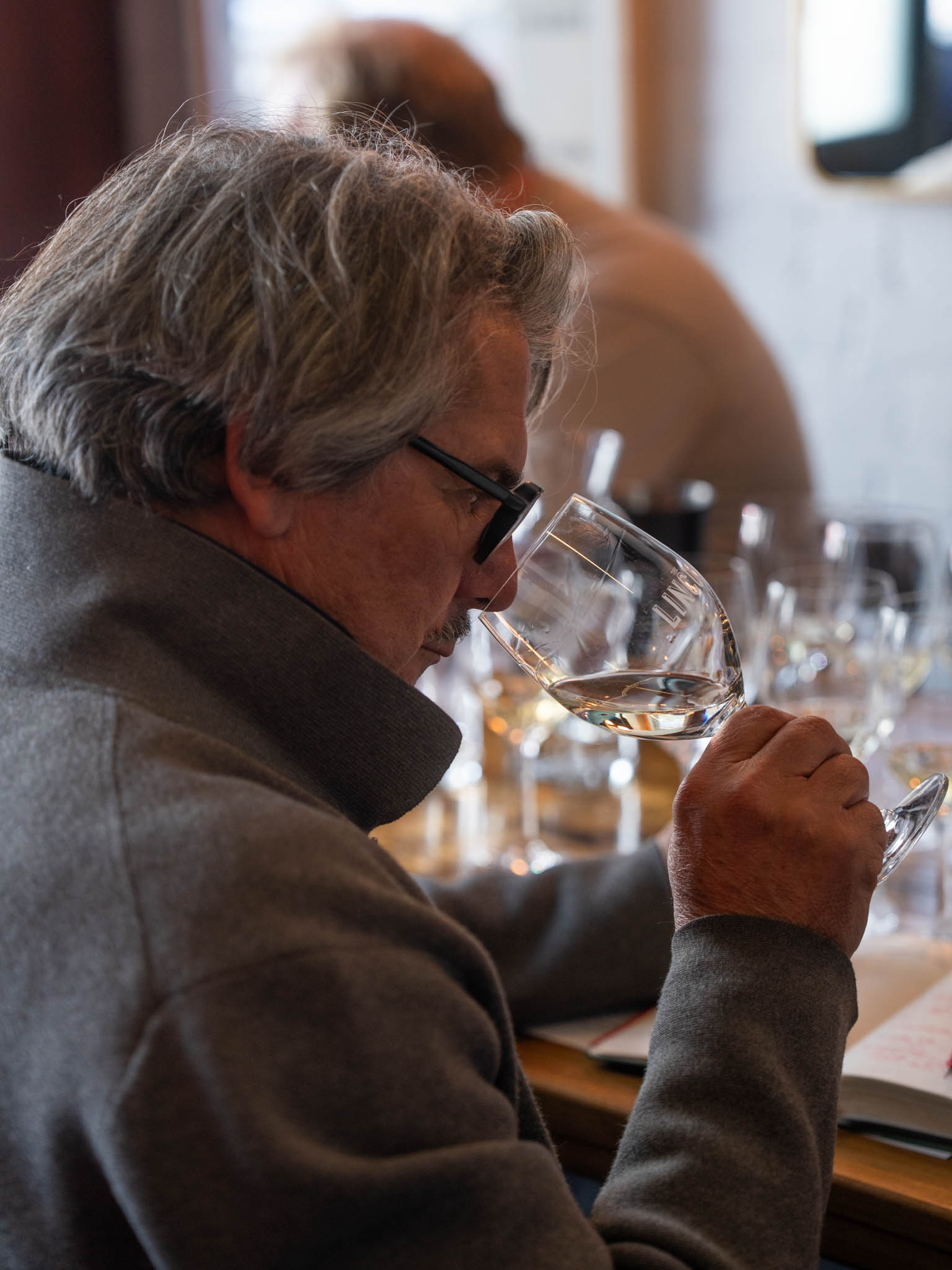
Above: Our expert panel gathered at The Lincoln, Carlton (Melbourne).
Outtakes from the tasting
We gathered every Australian field blend we could find – multiple varieties from the same vineyard, fermented together – and set our expert panel the task of finding the most compelling wines among them.
Our panel: Tom McCarthy, vigneron, Quealy; Gilles Lapalus, owner and winemaker, Maison Lapalus, Bertrand Bespoke, and Maidenii; Ray Nadeson, vigneron, Lethbridge; Eden Walpole, senior winemaker, Blue Pyrenees Estate; Sarah Hilliker, sommelier, Vespa Pasta & Vino; Michelle Aitken, sommelier, Cardwell Cellars.
On further investigation into our initial lineup of wines assembled for the tasting, a few had to be withdrawn because they didn’t fit the brief of grapes coming from the same vineyard and being co-fermented together. It’s a reminder of how loosely the term gets used – a tension our own panel spent much of the day arguing about. Here’s what was said.
It started, fittingly, with a fight over the word itself. “The definition remains on the notion of ‘field,’” Lapalus offered, “because the land, we know what it is – that’s what the field is. And yeah, there are some properties that are a thousand hectares. Is that a field?” Pushed further, Lapalus went for broke: “Bordeaux is the definition of the field blend.”
Walpole wasn’t having it. “By whose definition, though? The blending – the assemblage – comes at the second-last point. So why would you tie a ‘field’ to that? That comes from multiple plots.”
McCarthy tried to draw a cleaner line: “Your field could be one entity. It’s all connected. You can’t have a field that’s on the other side of the valley. It’s got to be connected.”
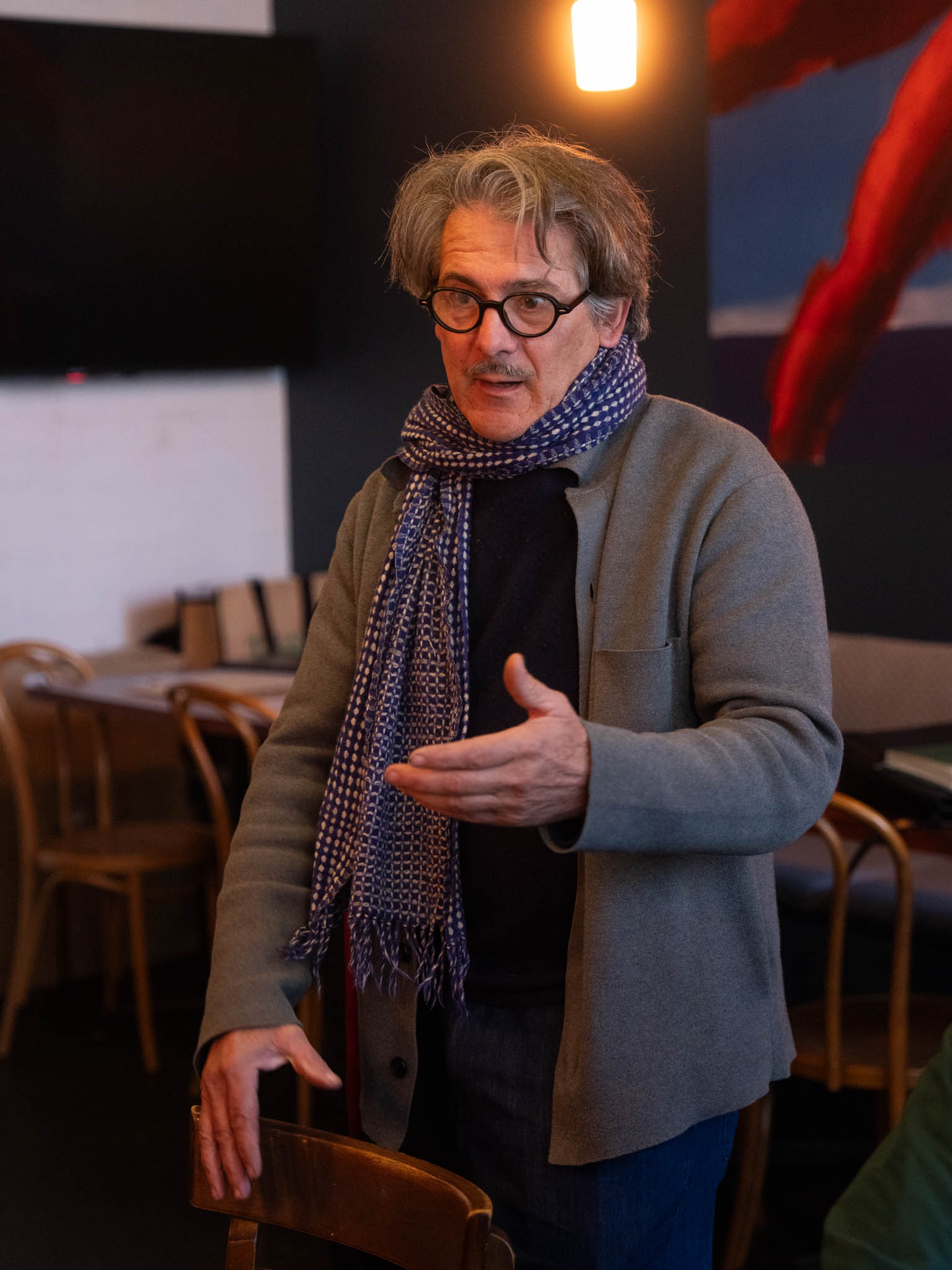
Above: Gilles Lapalus. Opposite: Eden Walpole.
Co-fermentation split the room just as cleanly. Nadeson made the strongest case for it: “What makes a field blend different is the synergy, the complexity that comes together during fermentation – different tannins, different compounds, different levels of ripeness, the way they interact. When it doesn’t work, it looks ordinary.”
Hilliker’s question cut straight to it: “Do you feel like it’s a bit of that difference between a winemaker’s wine and a site’s wine?”
Walpole agreed that co-fermentation mattered: “my gut tells me a lot of that would come from co-fermentation.”
But Lapalus wouldn’t budge: “With co-fermenting, sure you get a point of difference, but if the aim is only a point of difference, I don’t think it’s very interesting. The point is to have something great.”
“What makes a field blend different is the synergy, the complexity that comes together during fermentation – different tannins, different compounds, different levels of ripeness, the way they interact.”
Lapalus’s sharpest observation of the day was historical, not technical: “I think that notion of the field blend arrives quite recently with the promotion of clonal selection in vineyards, because before it was massale. You think it’s pinot, but it could be pinot noir, pinot gris – it’s random a little bit. That makes it a true field blend. The moment you have the same clone of the same variety, it’s a different game.”
Nadeson’s own vineyard put that idea into practice. “I did that on purpose because I didn’t want that level of control,” Nadeson said, describing a block planted with rootstocks and clones mixed at random. “I never regretted it.”
McCarthy, weighing a similar move on a new block of his own, admitted the idea alone was unsettling: “It absolutely terrifies me.”
Opposite: Sarah Hilliker. Above: Ray Nadeson.
Nadeson’s reply doubled down: “This idea of control – the goal of control – isn’t real.”
Once the wines themselves were on the table, the definitional fight kept going, just with glasses in hand. McCarthy noticed a pattern: “As soon as we went to the whites, they were really complex, all over the shop, kind of hard to follow – but I really liked them. As soon as we went to the reds, we jumped immediately into pretty solid red wine.”
Nadeson’s tasting philosophy became the line of the day: “I like my field blends to be variety-ambiguous. If I can start teasing it apart, I go, ‘yeah, boring’ – that’s just a blend.”
“The whites were really complex, all over the shop, kind of hard to follow – but I really liked them.”
Walpole pushed back with a real-world problem: “How are you going to get away from sauvignon blanc looking like sauvignon blanc if there’s thirty per cent sauvignon blanc planted with twenty per cent semillon?”
Hilliker offered the more useful test: “Do the different structural components of these different grapes sit well together in the glass, and do they lift each other?”
Nadeson had the best language for what happens when it doesn’t work: “Sometimes they’re woven tight and seamless, and sometimes they’re open… The ones that didn’t work for me looked like a bag of bones. Everything was elbows, knees, ankles – everything trying to get out. Jangling. No joy.”
Above: Tom McCarthy. Opposite: Michelle Aitken.
Hilliker’s kicker landed the point: “All the right intentions in the world, but you’ve created something ugly.”
Not every impression was so severe – Aitken, asked for her favourites, kept it simple: “Do I think it was the best one? No. Would I smash a bottle of it? Yes.”
Around the table, the room leaned white – Hilliker, Aitken, McCarthy and Nadeson all favoured whites in their top selections – with Walpole the notable holdout: “I probably found more joy in the red.”
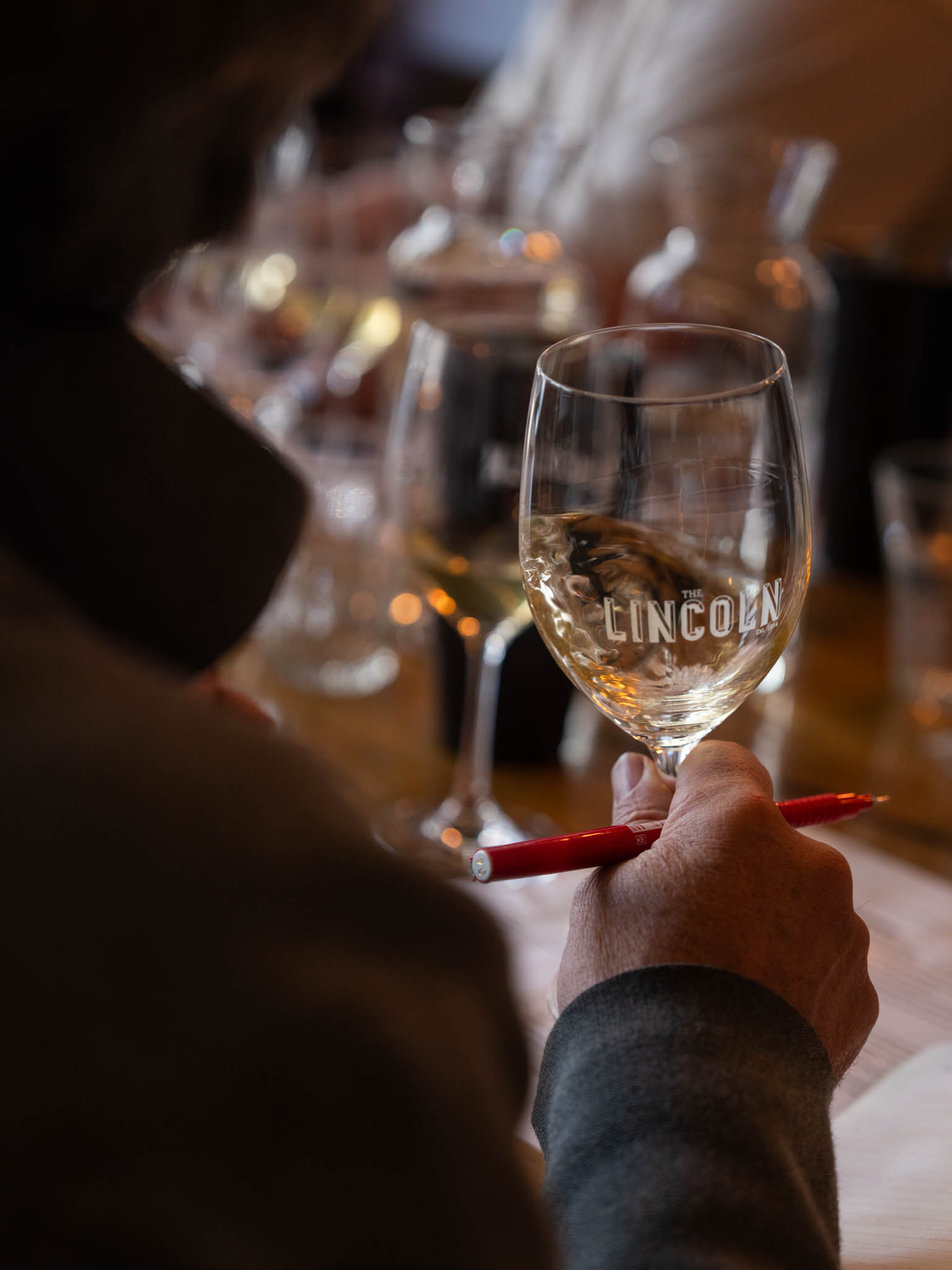
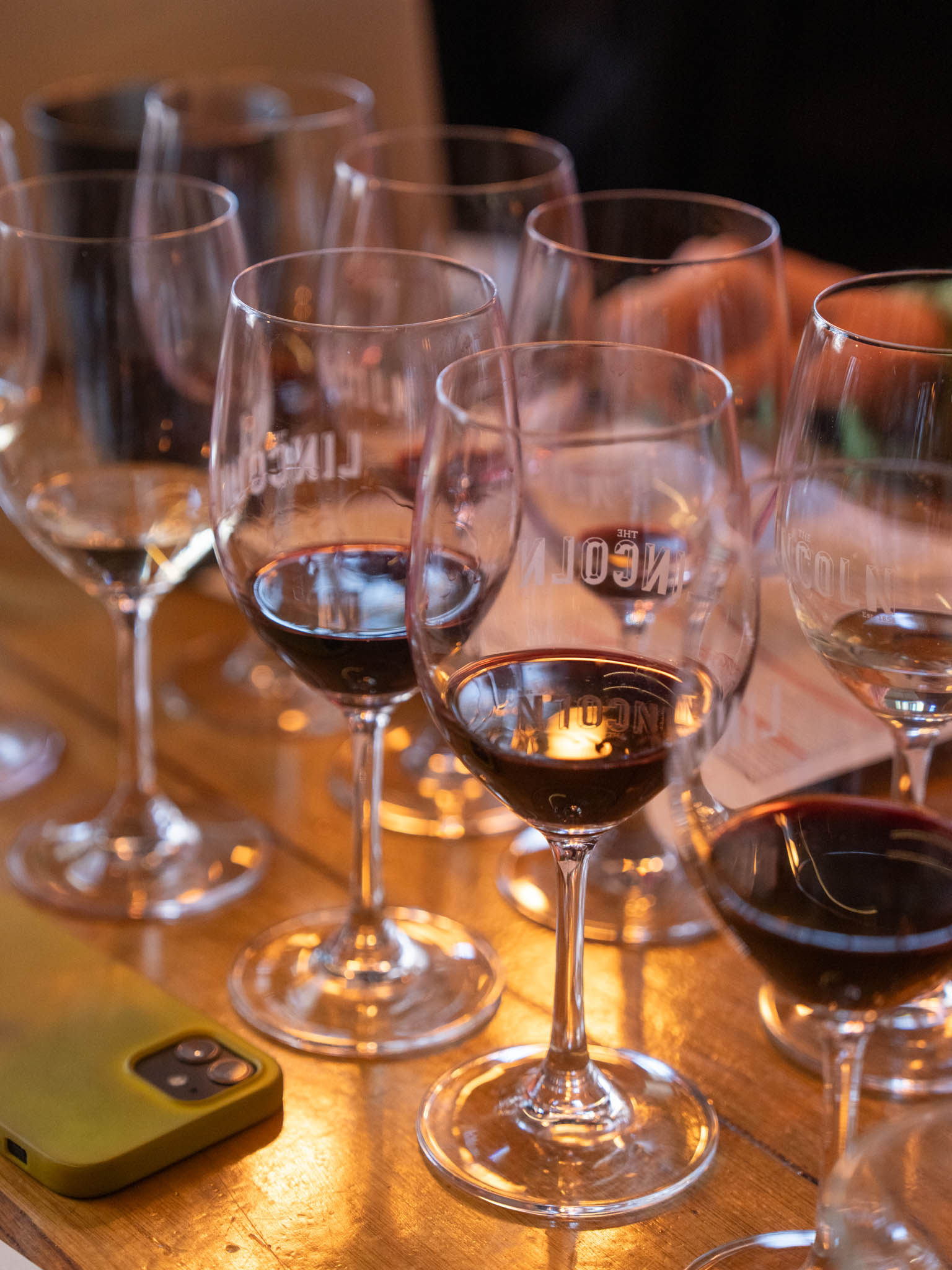
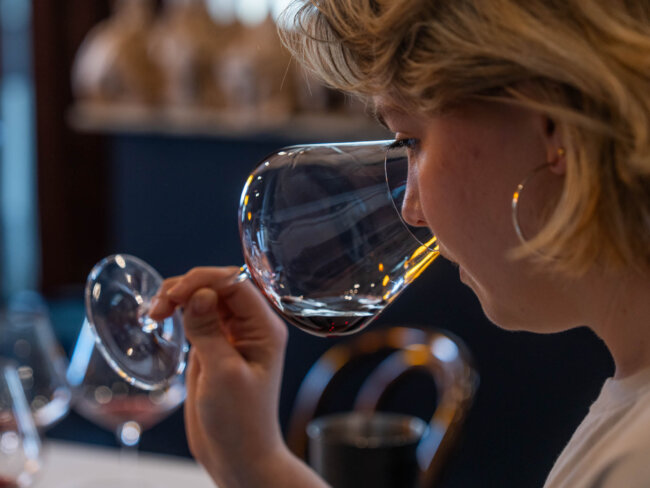
Above and opposite: The tasting in action at The Lincoln, Carlton (Melbourne). All wines tasted ‘blind’.
The conversation closed on labelling, and the honesty got sharper. “I make a few field blends,” Nadeson said, “but I never have ‘field blend’ written on anything. Makes no sense to me personally.”
Walpole went further, landing the panel’s most quietly provocative line: producers chasing the trend “muddies the waters as to what the true legs of field blends can be,” while, in his view, “maybe the producers who aren’t putting it on the labels are making the most compelling field blends. They’re probably able to command the higher price points. Better storytelling wines.”
“It’s an exciting place. But I don’t think it’s ever going to be fine wine in the classical sense.”
To end on an inspirational note, Hilliker made the case for field blends as a kind of creative release valve: “As much as people want to break wine down into scientific components and chemical compounds, it is an artist’s playground… you have your block set aside for you to feel fulfilled as a winemaker.”
McCarthy was more circumspect: “It’s an exciting place. But I don’t think it’s ever going to be fine wine in the classical sense.”
Nadeson shared the fateful last words: “I don’t want it to be a variety. I don’t want it to be a category. Once you start categorising things, it becomes a joke.”
Above and opposite: The tasting in action at The Lincoln, Carlton (Melbourne). All wines tasted ‘blind’.
THE PANEL
Winemaking wasn’t in Tom McCarthy’s plans, though vines certainly were, with him studying an agricultural science degree. That interest soon bloomed, though, and he undertook a practical apprenticeship both at home and around the world. In 2011 and ’12, Tom spent vintage at Domaine Paul Blanck with Frederic Blanck. Short visits to Friulian skin-contact pioneers Damijan Podversic and Josko Gravner informed the process further, with a vintage with Kristian Keber of Edi Keber following in 2015. Vintages in the Hunter Valley at Keith Tulloch, with cult natural maker Jean-Jacques Morel in Burgundy, and with Xavier and Arnaud Desfontaine of Château de Chamilly, Burgundy, round out his practical experience … so far. He is currently the head winemaker at Mornington Peninsula producer Quealy.
Gilles Lapalus is originally from Burgundy, and the third generation of his family to be involved with wine. He studied oenology in Dijon. He moved to Australia in 2001 to help establish the Sutton Grange Winery, near Castlemaine. In 2011, he started to experiment with native botanicals, which led to the founding of Maidenii with Shaun Byrne. Theirs was the first vermouth to employ Australian botanicals. After leaving Sutton Grange in 2015, he started his own labels, Maison Lapalus and Bertrand Bespoke. He is also the co-author, with Byrne, of The Book of Vermouth (Hardie Grant, 2018).
Dr. Ray Nadeson is the head winemaker and co-owner of Lethbridge Wines. During a career researching and teaching neuroscience at Monash University, Nadeson founded Lethbridge Estate with his partner Maree Collis. He also managed to squeeze in a winemaking degree in his spare time. Since 2003, Nadeson has been focused solely on the estate, farming with biodynamic principles and making wine from Lethbridge’s estate vines, select local vineyards, and as far afield as Heathcote, the Pyrenees, Henty, the Barossa Valley and Beaujolais, France.
Born and bred in the Hunter Valley, NSW, Eden Walpole cut his teeth working for established brands such as Brokenwood and Thomas Wines, as well as completing vintages abroad in California and New Zealand. After a brief stint in wine retail, in 2023 he joined Blue Pyrenees Estate in the Pyrenees region of Western Victoria as Senior Winemaker. Here he oversees winemaking for the Blue Pyrenees Estate and Glenlofty Estate brands, with a specific focus on red wines. He is an active wine show judge and is driven by the continued pursuit of crafting wines that allow each vineyard site to express itself, honestly, in the glass.
Sarah Hilliker has worked in hospitality since 2011 – but didn’t find wine until 2019, while at Treviso Bar & Dining, where she worked as the bar manager and also eventually became the wine buyer. During her four years at Treviso, she completed both the Wine & Spirit Education Trust (WSET) Level 2 Award in Wines and Level 3 Award in Wines. She landed her first sommelier position at Kisumé in 2023, and completed the Introductory Sommelier Certificate and Certified Sommelier Certificate with the Court of Master Sommeliers (CMS) during her time there. She took the position of Venue Manager at Bijou bottle store at the start of 2025, where she also headed up the wine program and ran training sessions for the four venues in the Gin Palace hospitality group. She has recently moved to a new Yarra Glen venue, Vespa Pasta & Vino, where she works as the venue manager and hopes to curate an Italian- and Yarra Valley–focused wine list.
Michelle Aitken currently works as a sommelier at Cardwell Cellars.
GET FIRST ACCESS TO THE NEXT WINE ICONS – DELIVERED
Pinot noir loves a cool climate – which makes it a natural fit for the ultra-chilly Macedon Ranges region. Is this Australia’s pinot promised land – or does the difficulty of growing grapes here mean it will never make the mainstream? Inside: the full backstory, plus the top wines to emerge from our blind tasting panel.
It’s not so long ago that the mere idea of grape tannin and skin-derived colour – let alone a hazy appearance – in white wine would have winemaking lecturers and show judges frothing at the mouth in horror. Noticeable grip in white wine was seen as a fault, a failure of process. Today, the script has had a new chapter added, with a big payoff in terms of texture and flavour complexity. From wines with the faintest of complexing grip to those that are made like red wines with ample chew and deep colour, and everything in between, are now an accepted part of the wine landscape. Anita Goode (Wangolina), Sven Joschke (Sven Joschke Wines), Matt Purbrick and Leigh Ritchie (Minimum), Raquel Jones (Weathercraft), Marcus Radny (Gonzo Vino), Chad Connolly (White Gate Wine Co.), James Scarcebrook (Vino Intrepido), Peta Kotz (Sabi Wabi), Sam Renzaglia (di Renzo), Richard Burch and Nic Bowen (Mon Tout) are all pursuing textural styles.
With six of the brightest wine minds in attendance, and 36 wines carefully selected and decanted for this blind tasting, we set out to get a better image of where the grape currently stands in an Australian context.
Subscribe to our newsletter
Young Gun of Wine is your shortcut to cutting edge wines, the places to go, and the people behind it all.
Subscribe to be amongst the first to know of our latest discoveries in wine.
We'll bring you the inside running from the growers, the makers, the wholesalers, the retailers and the sommeliers, too.