Pinot noir currently rules the roost when it comes to red wine varieties in the Yarra Valley – but the region earned its reputation with cabernet sauvignon and cabernet-based blends modelled after the wines of Bordeaux. With a small but dedicated band of producers keeping the flame of cabernets alive and well in the Yarra – and warmer vintages making these varieties more climate-apt than ever before – is it time for Australian wine drinkers to rediscover the virtues of one of our most under-appreciated regional styles? We felt that a Deep Dive was in order to find out.
We gathered every example of cabernets from the Yarra Valley that we could find – that is, wines that are 100% cabernet sauvignon or blended wines made from the traditional Bordelaise varieties – and set our expert panel the task of finding the wines that compelled the most. All wines were tasted blind, and each panellist named their top six wines. Below are the wines that made the panellists’ top-six selections from the tasting.
Our panel: Amanda Flynn, winemaker, Yering Station; Jarrod Johnson, winemaker, Punt Road; Jim Mullany DipWSET, wine retailer, Atlas Vinifera; Andrew Duff, winemaker, Briar Ridge and Duff Wines; James Becker, winemaker, Musical Folk and Southern Light; Sam Baxter, sommelier, Maha.
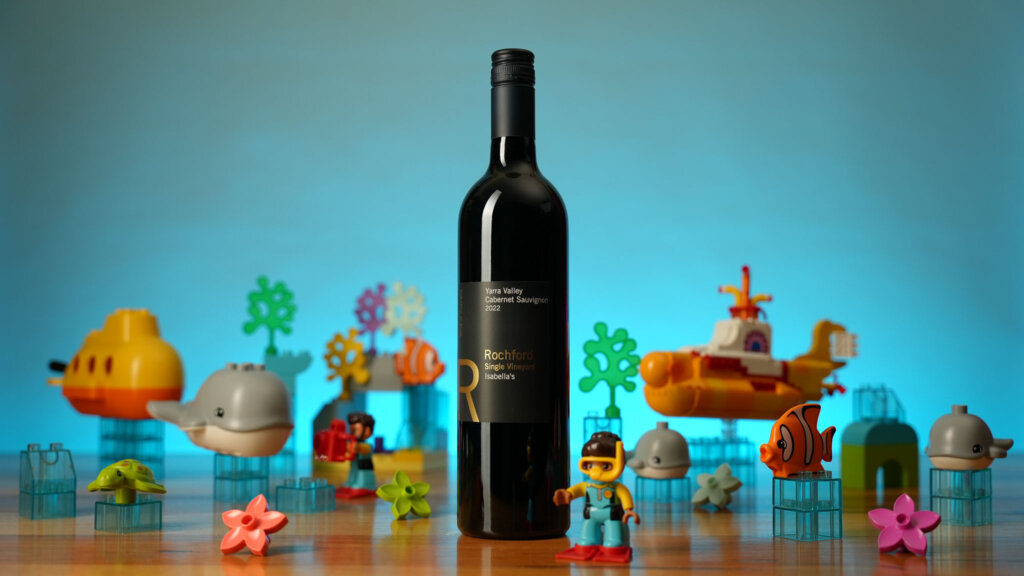
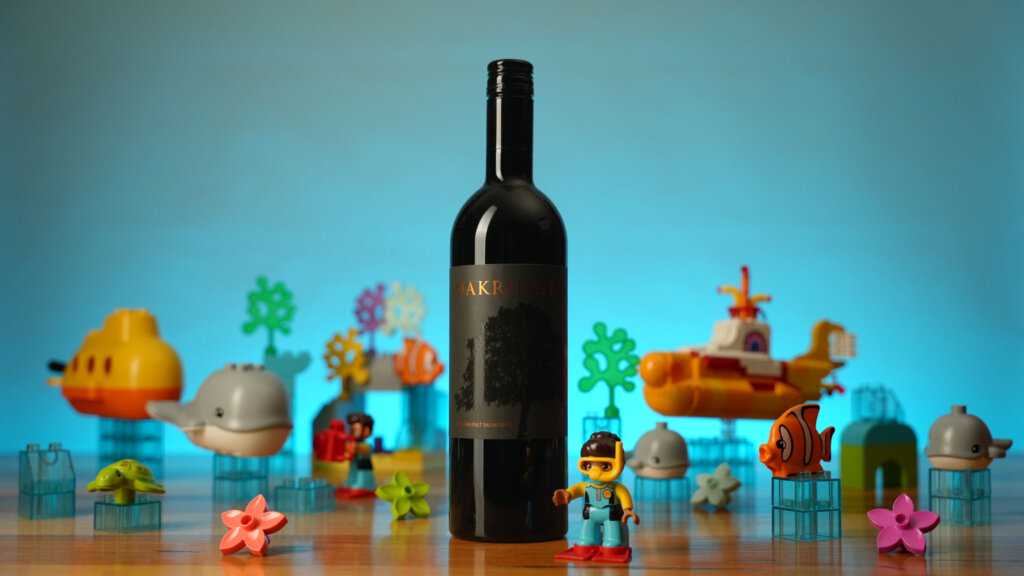
Baxter, Johnson, Duff, Flynn, and Becker all selected this wine in their top six from the blind tasting. Baxter found “the wine opens with an intensity of ripe spring blueberries and blackberries, accompanied by garden violets, French parsley, rosemary and thyme, and a tickle of smoked paperbark and bush herbs. The palate is powerful, with a rustic, dusty, smoky edge that keeps the expressive blue florals in check, with a deceptive long finish.” Johnson described “a powerful wine with great structure and fruit weight. Black plums and blackberries, cigar box and hint of chocolate. This wine has such generosity in its fruit that is very well complemented with some classy oak that adds great flavour and complexity without dominating the wine.” Duff called it “a complex number, warm freshly baked pastry and summer red fruits play through a cinnamon churro-like influence giving way to dominant redcurrant and cassis. Very engaging and lots to like. It’s warming on the palate, vibrant and textural whilst being viscous and slippery as silk.” Flynn noted “herbal notes of rosemary and fresh tomato leaf, with some light fresh tobacco, blueberries sitting nice and bright at the front as well. Lots of layering and flavour. Tannin just chalky adding a lovely chewiness.” Becker described “red liquorice, sour cherry, blackberries and tinned tomatoes. Milk chocolate with really fine-boned tannin. Has a nice lavender and potpourri note that lifts the nose. Great acid and tannin balance.”
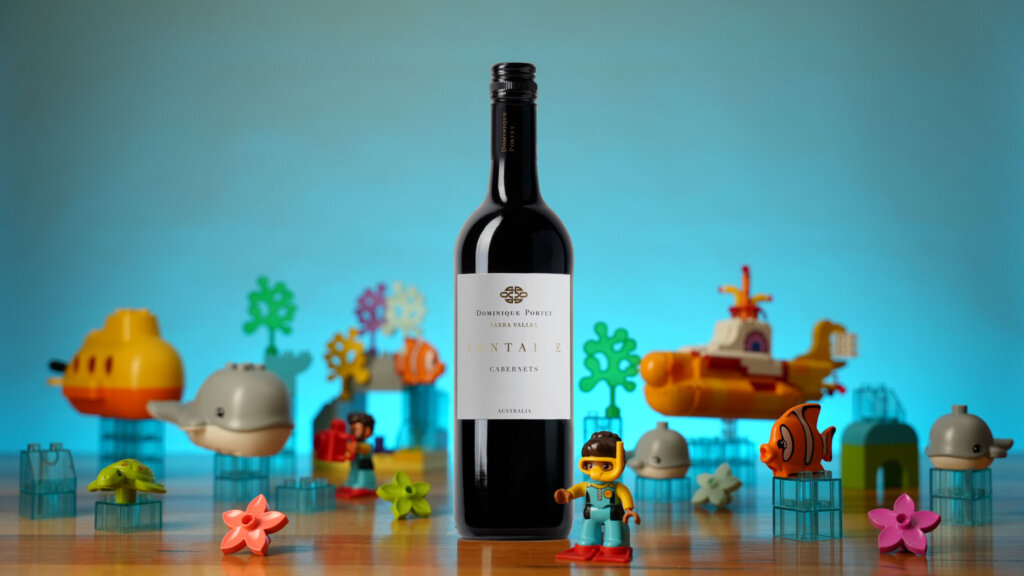
Johnson, Flynn, Mullany, and Baxter all included this wine in their top six from the blind tasting. Johnson called this, “What we mean when we talk about classic Yarra Valley cabernets: an elegant and balanced style with great concentration of flavour, smooth tannin and fantastic natural acidity giving the wine great length. Red and black fruits, cedar and violets present in a complex and textured wine, that will age gracefully but is also delicious right now.” Flynn found “layers of bright blue plums, violets, and lavender. Very floral and pretty. Super fine tannins. Pretty and light mid-palate with a beautiful density of fruit, just sour plum acidity lifting through the back of the wine.” Mullany described the inviting nose filled with cherry, cassis, and violet: “Add in a distinct iodine character and you might just be tasting a drop from the Médoc. This is, however, delightfully Yarra,” he observed. “To taste, the wine is refined with mouthwatering blackcurrant, graphite, clove and cedar. If this is the direction of travel for cabernets in this country, there is much to be excited about.” Baxter called it “a showcase of layers and complexity. The nose is intense and wild, taking me back to the rainforest; dark wild mulberries, bush flowers, spring rain, fallen logs, wild spring mushrooms and a warming midnight campfire in a swag. The palate is alluring, bursting with boysenberry and plum, brimming with violets and dried Italian herbs.”
2022 First Foot Forward Cabernet Sauvignon, $32 RRP
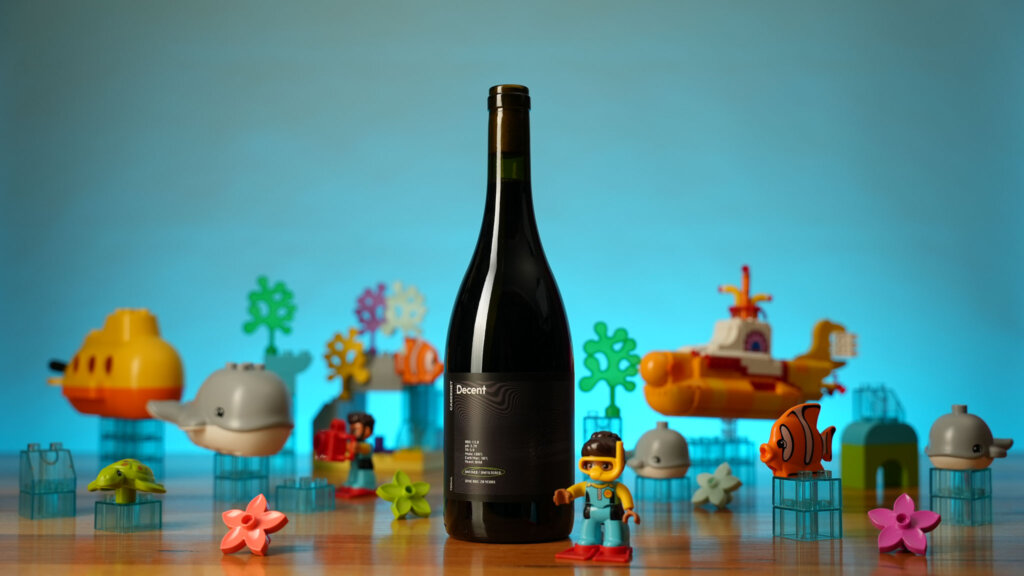
Mullany, Baxter, and Becker all chose this wine in their top six from the blind tasting. Mullany called it “an impressionist’s wine with many tones. The lifted scent of heirloom roses mingles with damson plum, black cherry, balsam and cedar. From the first taste, the wine is mouth-filling and suave like a tailored overcoat. Along with the alluring fruit there’s dark chocolate, charcoal and cola nuances. Pair simply with game and enjoy this art in a glass.” Baxter found “the wine’s bouquet is like four seasons in a glass; fresh, ripe, sun-kissed raspberries, first of the season cherries, boysenberries, red and black mulberries accompanied by soft black roses, damp earth and herbal notes that take me back to a walk through an English spring garden. The palate is a complete contrast to the nose; rounded, dark and brooding, a complete showcase of Yarra’s rich earth backed by a rich game meat savouriness.” Becker described “salted plums and blackcurrants, fresh tobacco leaf and rain on hot bitumen. Like that fresh petrichor vibe, it’s got a similar lift and gives freshness. Blood orange and black forest cake. Chewy tannins with redcurrant and blackberry-soaked acid.”
2024 Decent Cabernet, $32 RRP
Duff and Baxter both selected this wine in their top six from the blind tasting. Duff found it “vibrant in colour, bringing together elegance and effortless balance. Bright cherry and subtle red liquorice flavours flirt with creamy chocolate across a medium-bodied grainy frame, finishing polished and poised. It’s a seamless wine that shows why the Yarra is in vogue when it comes to cabernet, perfect for fine dining, easily paired and simply the kind of wine you’ll want to pour again and again.” Baxter called it “an ultimate meat-friendly wine. Rich, intense cocoa and raw vanilla soften the tart mulberries, ripe blackberries and black bush plum. The wine becomes dark, sultry and silty on the palate and yet still holds a backbone of spice and dried herbs, with a powerful, long finish. Perfect for cleaning up a rich grass-fed steak or lamb shoulder.”
2023 Pimpernel Cabernet Sauvignon/Merlot, $75 RRP
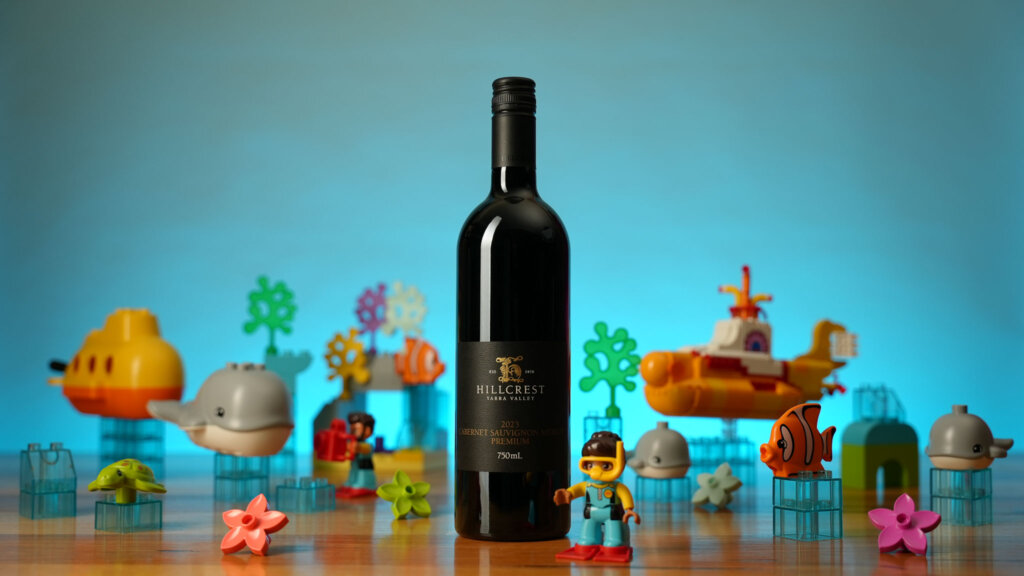
Johnson and Flynn both included this wine in their top six from the blind tasting. Johnson found it perfectly balanced, all things as they should be: “As winemakers we are always striving to create harmonious wines that find an equilibrium, and this wine has achieved that feat,” he noted. “The wine has great drive with flavourful plumy acid that is balanced with generous blackberry fruits, spicy charred oak and supple tannins. All of these components come together to make a beautiful, elegant and complex wine.” Flynn described it as layered and delicious: “Vibrant red plums, charcuterie, and smoky notes. Blue flowers and violets. Heaps of layering and personality in this wine. Great structure and tannin support. Some delicious fresh cacao notes underneath as well.”
Mullany and Flynn both chose this wine in their top six from the blind tasting. Mullany found “the wine crackles with brambly redcurrant, blueberry, cassis, tea leaves and gunpowder leaping from the glass like fireworks. Its mouthfeel is fine and velvety. There’s hints of new leather, clove and fig, along with that reassuring Cabernet character of cigar box. What distinguishes this wine is the combination of its perfume, depth of fruit and varietal typicity. And while it has power, there’s a balancing restraint too. A product of the Yarra Valley’s unique moderate climate. Grand Vin.” Flynn described “mulberry jam and stewed fruits, there is a beautiful core acidity to this wine. Super-bright red plums. Tannins are fine and silky. Fine spices, white pepper. Oak is showing its presence through the tail of this wine but is supportive.”
2021 Thick as Thieves ‘McIntyre Lane’ Cabernet Sauvignon, $48 RRP
Becker had this wine in his top six from the blind tasting. “Bright and lifted, red cherry skin, blackcurrant pastilles, rose water and moreish salted plum,” he described. “Red liquorice, blood, coconut husk and cherry ripe. A great luncheon claret. Green olive brine, refreshing sun-dried tomato laced acid, with chalky tannins. This is a claret-style Cabernet in a lighter frame, perfect for daytime drinking – think picnic tables, barbecues and friends leaning back with glasses in hand. A more fun, fresh-faced Yarra Cabernet that still carries its varietal identity loud and clear.”
2023 Mayer Cabernet, $50 RRP
Duff featured this wine in his top six from the blind tasting. “There is a warmth to this wine, lift and a first impression that it’s from a potentially warmer or much lower-cropping site,” he observed. “The fruits are complexing through red and blue spectrums, before flirting with an almost over-ripeness that melds quickly to a subtle bell pepper profile. This wine is a beast of complexity! The wine’s forward dominance on the palate is confronting with an alluring natural fruit sweetness that dances across a graphite-like persistence.”
2023 St. Hubert’s ‘Cellar Reserve’ Cabernet Sauvignon, $80 RRP
Mullany selected this wine in his top six from the blind tasting. “Brooding black cherry and blackberry infused with thyme and wild mint emerge from the glass,” he described. “Think of a savoury peppermint patty. There’s also a pencilly note. And violet. On the palate, the wine is lithe with a firm and chalky structure. Subtle salt bush, eucalypt and tree bark rub shoulders with the sappy black fruit. Delicious. Pair with char-grilled lamb.”
2023 Yarra Yering ‘Dry Red Wine № 1’, $160 RRP
Becker chose this wine in his top six from the blind tasting. “Dark and brooding, cured meats, ripe blackcurrants and blueberries, with that classic cabernet cassis, leafiness and garrigue that is most welcomed,” he described. “A bit of cedary and charred-oak vibes in there too, I reckon. Great flow and soft talc-like malleable tannins, with a juicy blueberry acid line – not too extracted or overworked, just enough, balanced. There’s a seriousness to it, but also a generosity that invites you in. A wine for dimly lit rooms, old vinyl records, and leaning in as the night stretches on.”
Flynn included this wine in her top six from the blind tasting. “Initially a little reductive and restrained, the wine gradually unfurls to reveal vibrant fruit notes of redcurrant and mulberry, layered with savoury elements of black olive tapenade, bay leaf and subtle tobacco leaf,” she noted. “Hints of clay and red earth also provide some lovely, layered texture. The palate is concentrated without excess weight, balancing purity of fruit with savoury complexity. Fine, chalky tannins lend a lovely grip and shape, carrying the wine to a refined, persistent finish.”
Johnson had this wine in his top six from the blind tasting. “A seductive and intoxicating nose of blue and black berries, purple flowers and spice, hooks you as soon as you raise the glass to your nose,” he described. “What follows is a well-balanced wine with beautiful fruit, great natural acidity and supple tannin. A sexy wine.”
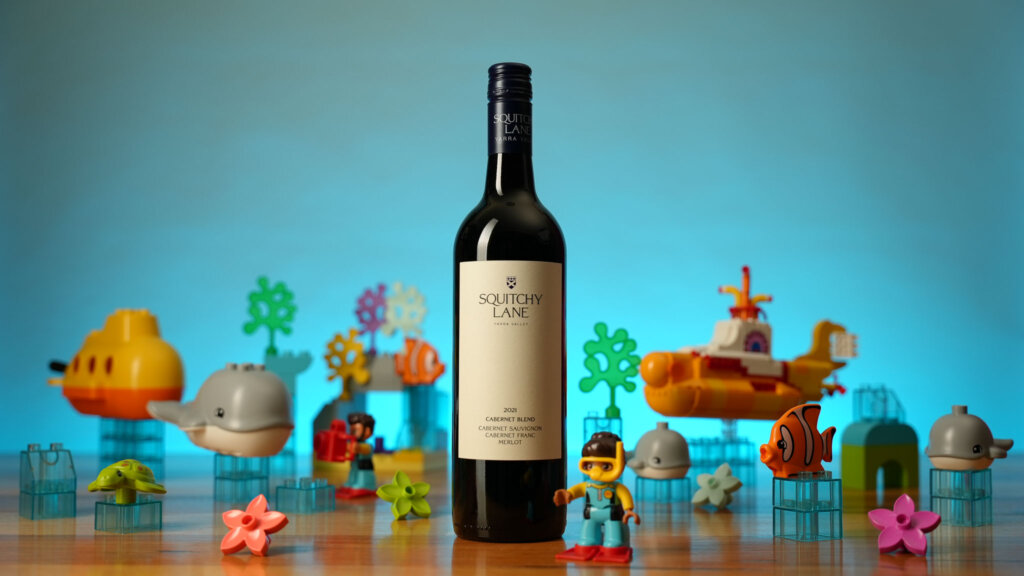
2021 Squitchy Lane ‘Cabernet Blend’ Cabernet Sauvignon/Cabernet Franc/Merlot, $38 RRP
Mullany and Flynn both featured this wine in their top six from the blind tasting. Mullany found “the wine is poised and bright with brambly blackberry fruit and loamy soil tones together with rose petals, eucalypt and spice. It’s ripe, yet finely structured. A baritone rather than a bass. Demonstrative of the elegance evident in many of the Yarra cabernets tasted today. Sip in dimmed light and contemplate this beauty.” Flynn described “black olive tapenade and some moreish savoury notes. Savoury line of this wine drifts along with mulberry and red plum. Beautifully framed and vibrant sour plum acidity keeping the wine lovely and bright.”
2024 Rob Hall Cabernets, $30 RRP
Duff selected this wine in his top six from the blind tasting. “Not the most powerful wine I came across, with subtle persistence and quiet appeal,” he noted. “Lighter than your average medium-bodied cabernet, there is a lot to love here. Red fruits are at play, but fruits resembling the first of the harvest. Timid in nature, with a faint green edge is complexing rather than detracting. The palate is framed by crunchy acidity that stirs a texture and a charm throughout a soft but persistent finish with harmonious artefact. There was elegance throughout the day across some great examples of Yarra cabernets, but this example treated the flight with a polite and quiet presence, like a royal amongst their subjects.”
2023 Sticks Cabernet Sauvignon, $25 RRP
Johnson and Mullany both chose this wine in their top six from the blind tasting. Johnson noted feeling like he was repeating himself with these tasting notes. “This is another classic Yarra Valley Cabernet, showing great balance of black and blue fruits, beautiful perfume smooth tannin and subtle use of oak, producing a wine of great elegance and complexity,” he described. “I think this shows how great the overall quality of Yarra Cabernet and the great skill and care that the winemakers have been showing these beautiful grapes.” Mullany called it “a divergent and joyous expression of cabernet in the lineup. The wine is perfumed with redcurrant, orange peel, musk, pressed flowers and seaweed. On the palate, it’s filigree, fine and juicy with blueberry, graphite and thyme emerging. The fruit wraps around the tannins like a silk thread. A touch wild and certainly fun with Mediterranean vibes.”
2023 De Bortoli ‘Melba Amphora’ Cabernet Sauvignon, $75 RRP
Duff included this wine in his top six from the blind tasting. “Punchy and ripe, dense cassis and subtle cedar dominate and elegant redcurrant undertone,” he described. “Yes, there is artefact, and yes, there is an understated stem-like greenness. But the way these influences fuse together to promote an alluringly textural cabernet is what I like the most.”
2023 Soumah Cabernet Sauvignon, $44 RRP
Becker had this wine in his top six from the blind tasting. “Cured meats, redcurrants, black olive brine and a bit of smoky reduction and oak – hell yeah, this is Jimi Hendrix in a glass,” he described. “There’s tomato leaf lift and that sanguine, iron-rich edge, before blood orange tang and pomegranate brightness refresh the mid-palate. Secondary notes of cigar box, pencil shavings and a whisper of graphite echo old-school Bordeaux stylings, while a fine chalk-dust tannin structure grounds everything in place. It feels built for the long haul – restrained but confident, classic in tone.”
2023 Yering Station Reserve Cabernet Sauvignon, $130 RRP
Johnson featured this wine in his top six from the blind tasting. “Blackcurrants and blackberries explode out of the glass from this fruit-driven wine,” he described. “After the fruit comes great complexity with violets, cedar and tobacco leaf, bound together with long silky tannins. The wine’s natural acidity helps drive a fresh and vibrant finish. This wine’s medium body allows it to be enjoyed on its own, but it will also make an exceptional food wine, it screams out for animal fat and salt, a simple rack of lamb with a red wine jus would be perfect.”
Baxter selected this wine in his top six from the blind tasting. “This wine is a summer market in a glass,” he described. “Ripe, sun-kissed raspberries, blueberries and mulberries find companionship with a bouquet of roses, and cooking spices. The nose is contrasted by a cassis and blueberry dominated palate, driven by an angular acidity, finishing with fine-boned tannins and a gamey edge that surprises and delights. It holds perfect balance between bold and elegant, that could enrapture Pinot Noir drinkers and entice Shiraz drinkers. A perfect summer red for barbecue meats and great tipple with friends.”
Duff chose this wine in his top six from the blind tasting. “Bright colour, lifted bay leaf on complexed candied apple through a redcurrant profile,” he noted. “Yes, there is artefact here – but who doesn’t love oak! It’s still the one thing that doesn’t get old every year in vintage, smelling the new oak as it arrives. The wine is perfectly framed for drink now with salivating vibrancy through to mid-long term cellaring on the coat tails of the crunchy acidity the palate offers – a factor which also promotes a textural mid-palate elegance and plush peacock’s tail.”
Becker included this wine in his top six from the blind tasting. “Savoury style, blueberries, blackcurrants, cedar and tobacco,” he described. “Great tannins that fan out and really lead the charge on this one, shimmering across the palate and pulling some blackcurrant and preserved red cherry and liquorice with them as they flow. Again, the tannins offer refreshment and direction, a svelte softness – hard to stop tasting this one. Would drain a bottle with some blue cheese and Junior Kimbrough over the airwaves, and have a great time in that.”
2022 Medhurst Cabernet Sauvignon, $60 RRP
Baxter had this wine in his top six from the blind tasting. “Wagyu lovers, prepare for your new favourite pairing,” he noted. “The wine’s ripe Christmas cherry, raspberry and plum notes are embraced by smoked dark chocolate, hazelnut, and campfire. The palate is powerful, ripe, rich, and takes no prisoners. It’s mulberry-laden, cleansed by a warming slap of cedar wood and spice, perfect to champion the flavour of wagyu and clean up the fattiness of such wonderful meat. A rich expression of cabernet that would rival the best of Margaret River and Coonawarra.”
The Backstory
Pinot noir currently rules the roost when it comes to red wine varieties in the Yarra Valley – but the region earned its reputation with cabernet sauvignon and cabernet-based blends modelled after the wines of Bordeaux. With a small but dedicated band of producers keeping the flame of cabernets alive and well in the Yarra – and warmer vintages making these varieties more climate-apt than ever before – is it time for Australian wine drinkers to rediscover the virtues of one of our most under-appreciated regional styles?
Cabernet sauvignon and its fellow-travellers from the Bordeaux region – cabernet franc, merlot, petit verdot, and malbec – hold a special importance within the Yarra Valley region, and one that is at odds the official yearly harvest figures. On paper, pinot noir is the king of the Yarra Valley’s red wine grape varieties, with 3,837tonnes harvested in 2025compared to 800 tonnes for cabernet and its associates. But the wines that put the Yarra Valley on the average Australian wine drinker’s map were not made from pinot noir, despite the fact that both varieties arrived in the region at the same time – they were cabernet-based blends. For a certain breed of Australian wine connoisseur, just the names of these same wines can act like catnip: Mount Mary’s ‘Quintet’, Wantirna Estate’s ‘Amelia’, Yarra Yering’s ‘Dry Red Wine №1’, Yeringberg’s ‘Yeringberg’ (self-titled in conscious imitation of a Bordelaise château’s grand vin). These are all iconic wines, and often priced accordingly – but there are plenty of other producers in the Yarra Valley making less well-known but exceptional wines from these varieties, too.
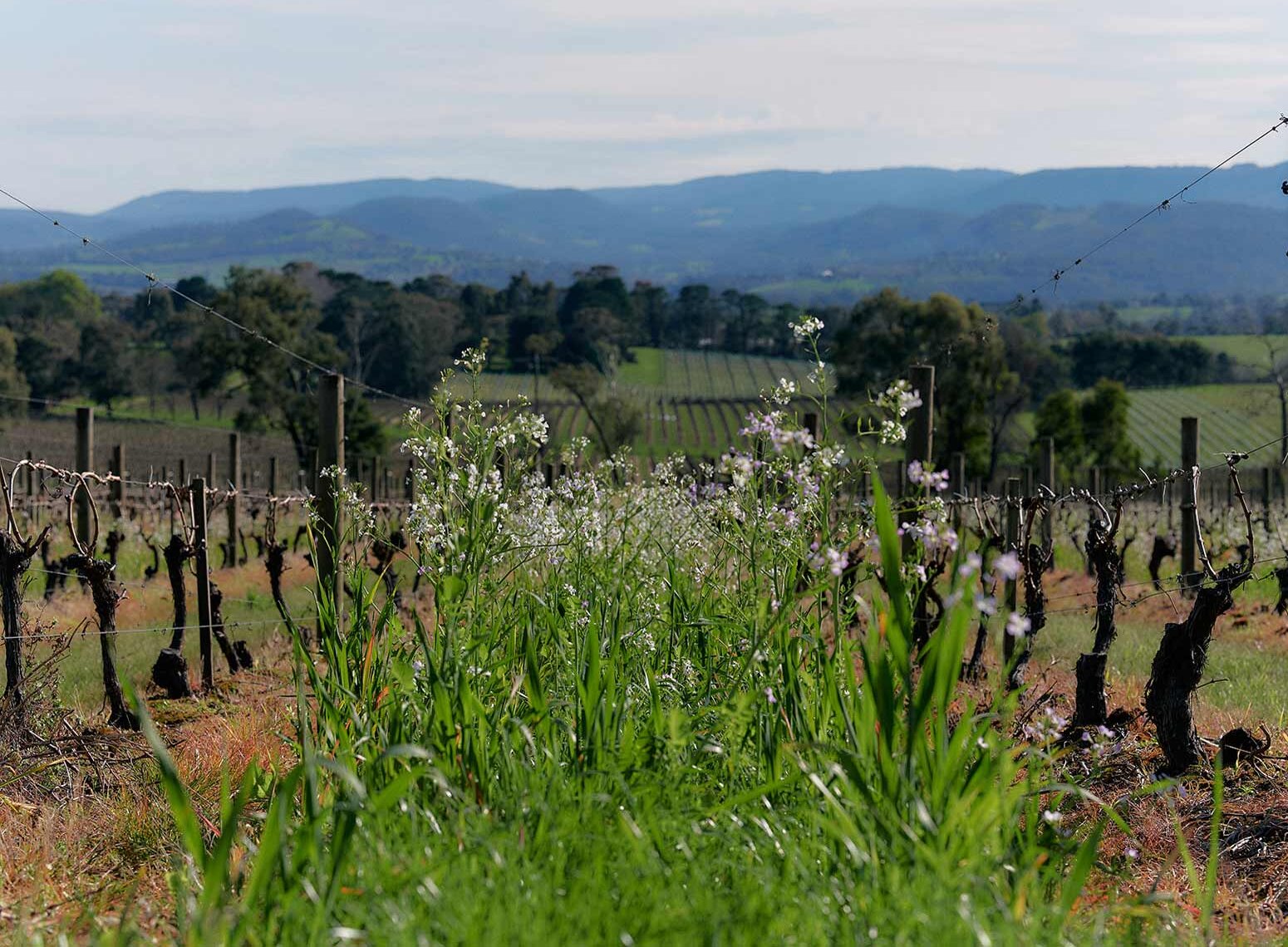
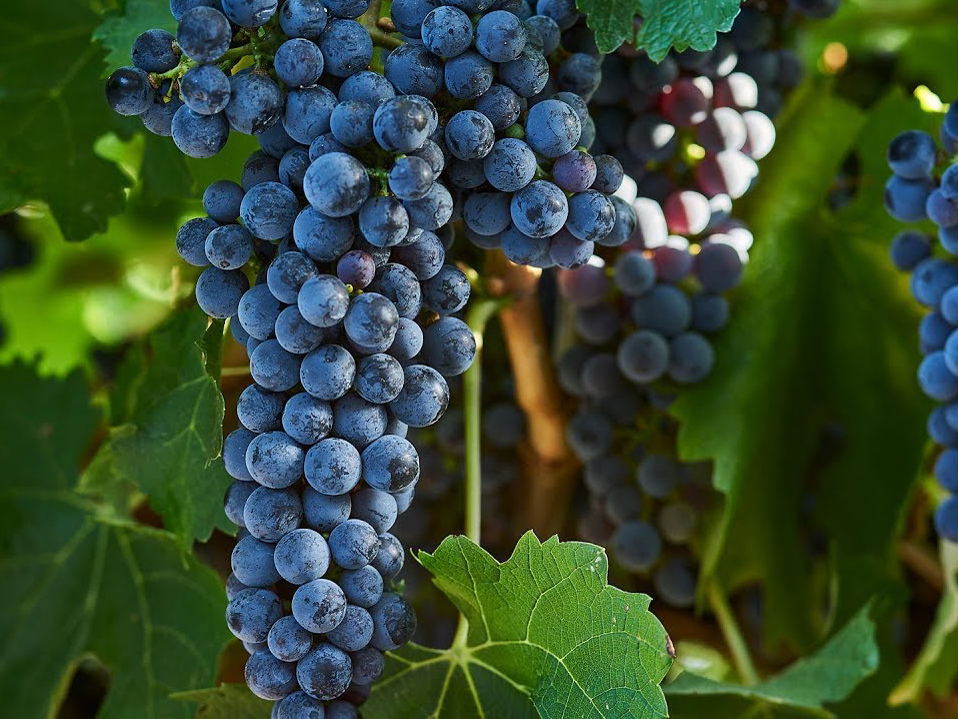
Opposite: The Yarra Valley, as viewed from the vineyard at Yarra Yering. Above: Cabernet sauvignon grapes on the vine.
The Yarra Valley’s preference for pinot over cabernet and its relatives may make perfect sense to the average pinot-obsessed Melburnian, but is an anomaly from a global perspective. At the time of the most recent official global wine census (2017), cabernet sauvignon was the world’s most widely planted wine grape variety of any colour, at approximately 341,000 hectares, with Merlot in second place at 266,000 hectares. Pinot noir, by contrast, clocked in at 112,000 hectares globally – a mere 16% of the estimate of 702,000 hectares in total dedicated to the suite of six Bordelaise red wine varieties. (The sixth, carmenère, is not grown in the Yarra Valley, and was presumed practically extinct until 1998, when it was discovered that nearly all of Chile’s ‘merlot’ vines were in fact carmenère.) Although these numbers have no doubt changed in the intervening years as the wider world has discovered the joys of pinot noir – Australian wine drinkers were relatively early adopters in this regard – and global vineyard area has shrunk in response to declining demand for wine, they nonetheless point to the historical importance of the Bordelaise varieties. Why this particular collection of varieties has so profoundly shaped the story of wine across the wider world – and why they also have something of an image problem for Australian consumers today – is as much a story of power and prestige as it is of viticultural suitability or winemaker skill.
All roads lead to Bordeaux
France’s largest wine region, Bordeaux, promotes itself with images of grandeur and prestige – think sweeping gravel driveways and manicured lawns leading to sumptuous châteaux, or neatly-organised barrel halls filled with spotless new oak barriques. Despite this aristocratic aura, though, its history has not always been salubrious. In 56 BCE the Roman Empire seized the region from its original occupants, a Celtic tribe known as the Bituriges Vivisques, owing to its strategic position – a large estuary on the west coast of France where several major rivers meet, allowing easy access to the Atlantic Ocean, the Iberian Peninsula, the British Isles, and (by heading upstream on those major rivers) the hinterlands of the Mediterranean coast. Ideally positioned within an expanding empire, the city of Bordeaux soon became a hub for the trade of wines from Spain and the Mediterranean coast around Marseille, with small-scale viticulture and wine production on the region’s limited amount of suitable land naturally following.
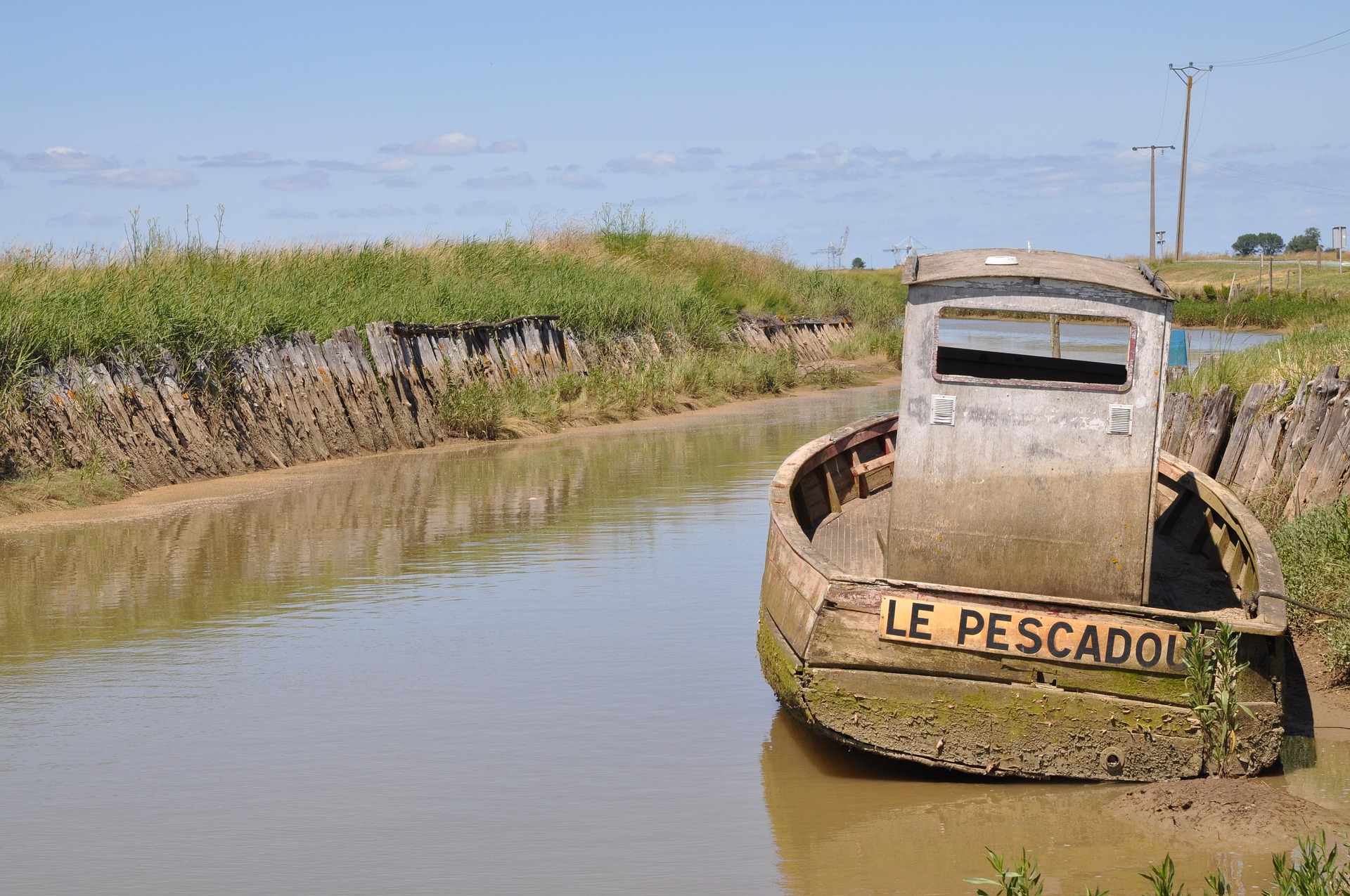
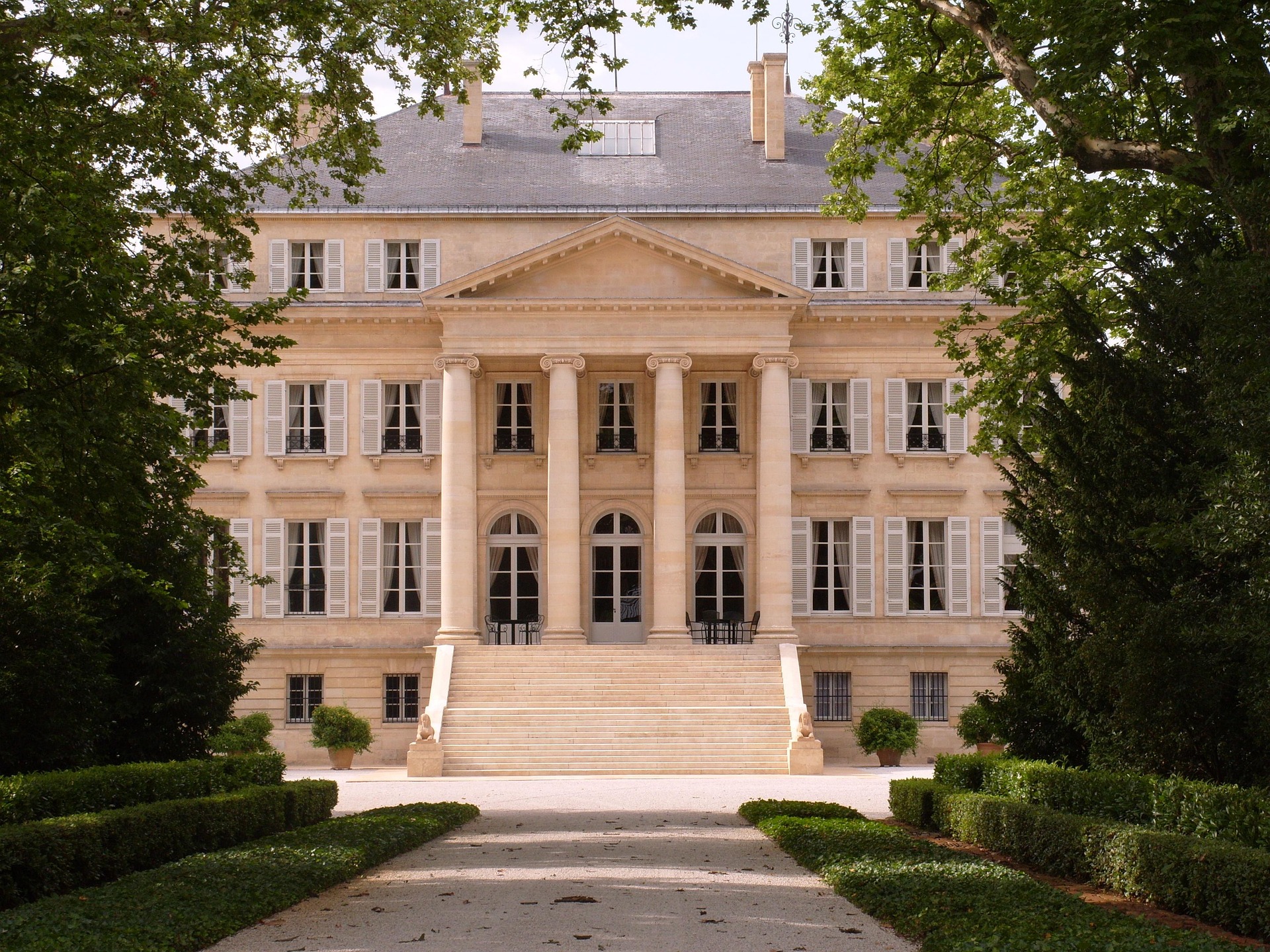
Opposite: The imposing and immaculately manicured entrance to Château Margaux – an archetypal example of a Bordeaux château in all its grandeur. Above: A marshy vista in the Gironde estuary – a reminder that much of the vineyard land in Bordeaux was formerly a tidal swamp.
Much of Bordeaux’s current influence in the wine world can be attributed to its role as a trade hub. During the region’s time as a possession of the English crown (from 1152 to 1453), the English ruling class buttered up the local wine producers and merchants with tax breaks and rules that prioritised Bordelaise wines over those from other regions. These included a notorious law that prevented wines from other regions leaving the port of Bordeaux for roughly two months after the local harvest, giving Bordeaux’s wines a serious head-start on the English market. During this time Bordeaux began developing its unique – and uniquely complex – system of wine trade, now known as the ‘Place de Bordeaux’. The development of this system of trade drove the development of viticulture – in fact, much of the region was essentially a swamp until it was drained in the early 1600s by Dutch engineers, allowing for significant expansion of vineyard area. Wine wasn’t the only trade in town, either – owing to its position on the Atlantic coast, the city of Bordeaux became an important node in the ‘triangular trade’ between Europe, Africa and the Americas in the 1700s. Sadly, many of the grand châteaux that now help project the region’s distinguished image were built with money from trading expeditions that included human cargo (in the form of African slaves) on the middle leg of the journey.
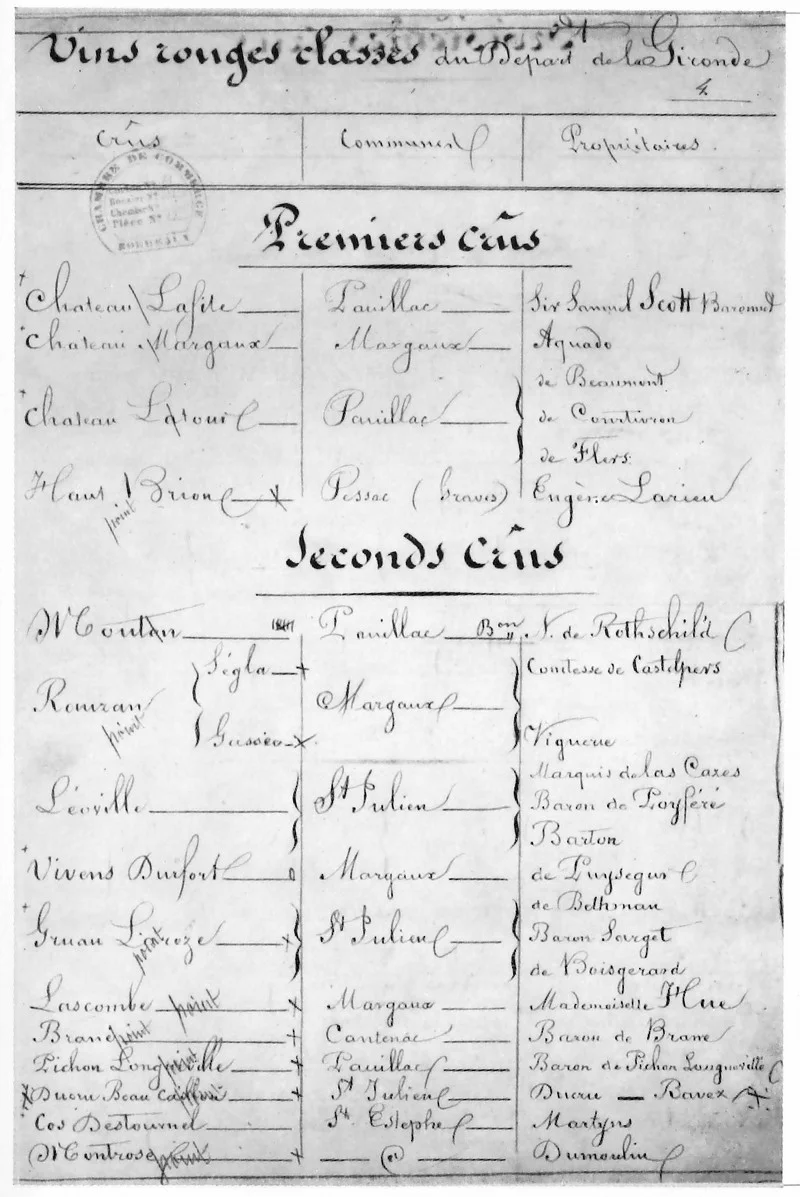
The moment that arguably cemented Bordeaux’s pre-eminence in the world of wine came with the now-famous classification of its producers in 1855. This hierarchical ranking of châteaux (from first growths at the top to fifth growths at the bottom) was instigated by Emperor Napoléon III for the purposes of the Parisian Exposition Universelle of the same year. Despite its current fame, it was not the first classification of Bordeaux’s producers, nor was it intended to be the final say in the matter. It also excluded vast swathes of the region’s producers, ignoring all of the châteaux from the right bank of the estuary, and only examined red wines and dessert wines, leaving dry white wines and their producers in the cold. Perhaps fittingly for a region whose lifeblood had been commerce, the main criteria on which producers were ranked was the price that each château could command of its wines – no tastings were held to discover underpriced gems or to discover châteaux whose wines may not live up to their reputations. Despite these shortcomings, it has since gone on to become the most influential classification in the history of wine, lent an aura of solidity and permanence by the fact that it has only been changed twice in its existence. (The first change occurred a few months after its publication, when it was emended to include a château, Cantemerle, that had been inadvertently excluded by a clerical error. The second, more controversial, change occurred in 1973 when Château Mouton-Rothschild was promoted from second- to first-growth.) With the 1855 classification precisely delineating the region’s winners and losers, Bordeaux positioned itself as a nexus of money, power, and vinous pedigree – the most blue-blooded of France’s wine regions.
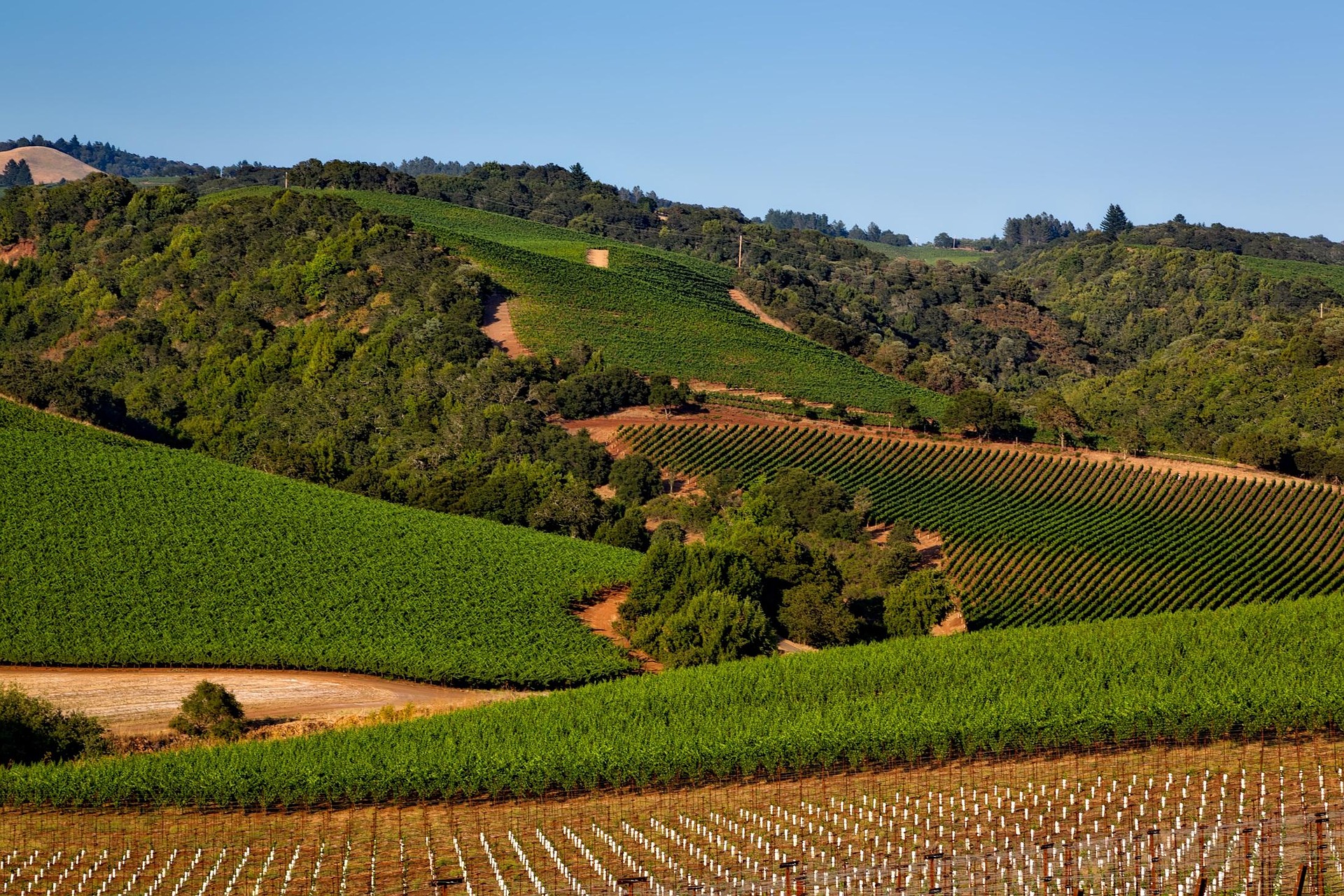
Opposite: The original 1855 classification of Bordeaux’s wineries, starting with the original four first growths (and listing Mouton as the first of the second growths). Above: California’s Napa Valley – a leading example of a ‘New World’ wine region that has built its identity around cabernet sauvignon.
That aura of nobility extends to the red grape varieties associated with the region, no matter their actual origins. (Cabernet sauvignon, merlot, and carmenère emerged there; cabernet franc, malbec, and petit verdot came from elsewhere.) Many wine guides still unironically refer to the ‘noble varieties’ of Bordeaux, helping to maintain an implicit hierarchy in which certain varieties are valorised as better than other, ‘minor’ varieties. As with real-life nobility, there’s hierarchy within the ranks, too – and cabernet sauvignon, as the predominant component in the blends of the most highly acclaimed wines of Bordeaux, is seen as the most noble grape of them all. This valorisation of cabernet sauvignon – which was only intensified by the world’s embrace of varietal wine labelling throughout the 1970s and ’80s – has seen it planted in practically every wine-growing country in the world, with merlot not far behind. Entire ‘New World’ wine growing regions, such as California’s Napa Valley or Australia’s Coonawarra, now hang their identities on cabernet sauvignon. Likewise, many of the red wines that act as ambassadors for their countries, such as Lebanon’s Château Musar, China’s Ao Yun, and Syria’s Domaine de Bargylus, contain significant quantities of cabernet. Such is the impact of Bordeaux on the wider wine world that even the less-distinguished malbec and carmenère, now both relative rarities in Bordeaux, have gone on to become the ‘national varieties’ of (respectively) Argentina and Chile.
Even better than “better than Pommard”
The first vines to arrive in the Yarra Valley were planted in 1838 in a small experimental vineyard that was part of the Ryrie Brothers’ enormous (17,400 hectare) leasehold property named ‘Yering’. By 1845, the brothers had produced the first wine from these vines – a combination of pinot noir and ‘sweetwater’ (now known to be the Spanish white variety palomino fino). That vineyard plot remained strictly small-scale at only one acre (0.4 hectares) until 1856 when, at a social gathering held at Yering, the estate’s new owner, Swiss nobleman Paul de Castella, served a Yering pinot noir from the early 1850s. The assembled guests declared that this wine was “better than Pommard” (a village in Burgundy renowned for its powerful pinots) – and de Castella was inspired to expand the vineyard and produce commercial quantities of wine.
Above: the homestead and winery building (built 1885) at Yeringberg. The gravity-fed design of the winery is reported to have been inspired by the facilities at Bordeaux’s Château Pontet-Canet.
De Castella dispatched his brother-in-law William Ackland Anderson to Bordeaux in 1859 to acquire from the négociant firm Barton & Guestier presses, vats, and cuttings of ‘cabernet gris’ (i.e. cabernet franc), cabernet sauvignon, merlot, malbec, and petit verdot. Those cabernet sauvignon cuttings were reputedly sourced from none other than Château Lafite, which had just been anointed as one of the four first growths in Bordeaux’s 1855 classification – and while that claim may have been wishful thinking, it certainly didn’t damage Yering’s reputation, as the expanded vineyard went on to win the 1861 Melbourne Argus Gold Cup for best vineyard. In the years that followed, de Castella’s older brother Hubert and fellow Swiss nobleman Frédéric Guillaume de Pury each purchased sections of the original Yering property, creating their own estates, St. Hubert’s and Yeringberg. The plantings at St. Hubert’s reflected the journey that Hubert’s younger brother Paul had followed – while initial plantings were pinot noir, poor results saw Hubert graft over the vineyard to cabernet sauvignon. As the region gathered steam in the late 1800s, many other Yarra Valley vignerons were similarly moving from pinot noir to cabernet and its relatives.
“We invite owners of exhausted vineyards to abandon France and transfer their plant and capital to the boundless fields open in the Colony.”
The 1879 vintage of St. Hubert’s Red Sauvignon went on to win a gold medal at the 1882 Bordeaux Exhibition – a result that would have been more impressive if host city’s own famous vineyards weren’t being decimated by the grapevine louse phylloxera at the time. The Australian delegation even went so far as to publish a document enjoining their hosts to “abandon France and transfer their plant and capital to the boundless fields open in the Colony.” Luckily for the Yarra Valley, the French didn’t take up this invitation – the Yarra had somewhat miraculously avoided phylloxera despite its proximity to Geelong, which was Australia’s ground-zero for the pest. In the end, though, the Yarra Valley didn’t need phylloxera’s presence for its booming wine industry to suddenly and dramatically bust – the drying up of money from Victoria’s goldfields, diminished export markets, and the national preference for sweet, fortified wines over dry table wines did the job instead. The last vintage of the Yarra Valley’s first era took place at Yeringberg in 1921, before all of the vines were grubbed up and the land returned to cattle farming by 1937.
Pinot vs. cabernets in the Yarra: the rematch
The rebirth of the Yarra Valley as a winegrowing region commenced in 1963, when Melbourne-based lawyer Reg Egan and his wife, Bertina, planted the first vines at Wantirna Estate, in the far south-east of what is now the official Yarra Valley geographical indication (GI). The vineyard’s continued existence amongst the urban sprawl of Melbourne is something of a happy accident, explains Reg’s daughter Maryann, the current winemaker at the estate. “When my father planted the vineyard, he always expected the suburbs to continue past Mount Waverley, past Glen Waverley – which didn’t exist in those days – and continue out,” she says. “Dad always thought that it would be a bit of an experimental vineyard to see what varieties did well in the cool climate that we were in.” As such, Maryann explains, Reg “planted a real fruit salad of varieties here to see how it’d all go”: some traditional (such as pinot noir, cabernet sauvignon, merlot, and cabernet franc), some exceptionally forward-thinking (such as barbera and dolcetto), and others that can be filed under ‘failed experiments’ (the heat-loving Spanish variety pedro ximénez). The fact that Wantirna Estate was planned as an experimental vineyard rather than a commercial proposition explains why Yarra Yering, planted in 1969, beat Wantirna Estate to the punch in 1973 by releasing the first commercial wine of the region’s renaissance.
Opposite: Maryann Egan in the vineyard at Wantirna Estate. Above: Reg Egan, founder of Wantirna Estate.
“But in the ’70s, the then-premier Rupert Hamer put a ‘green wedge’ overlay onto the area,” Maryann says, “which, in effect, meant that by chance we were protected.” With Wantirna Estate no longer under the threat of being turned into a housing development, Reg then “consolidated” the varietal mix in the vineyard, as Maryann puts it. “Once he realised that the vineyard wasn’t going to be to be pulled up for housing, he sort of decided what he wanted to make – and he was very infatuated with the wines of France,” she says. “I imagine Dad just drank quite a lot of Bordeaux in those days. He was bringing in fine wines at auction from Christie’s in London, and some of the wines he brought in …geez, I wish we still had them. Just incredible wines, and they were Burgundy and Bordeaux, because that’s what the wine world was really seeing.” Reg’s circumscribed tastes reflected the significantly smaller size of the wine world at the time – “I mean, the Italians weren’t making very good wines in those days!” Maryann adds – and he was by no means the only budding vigneron in Victoria whose choice of planting material was inspired by French classics. “Phillip Jones initially planted cabernet down at Bass Phillip [in Gippsland] because he was a Bordeaux drinker,” Maryann says. Likewise, when other pioneers of the Yarra Valley’s second act such as Yarra Yering, Mount Mary, and the replanted and relaunched Yeringberg were putting in their vineyards in the late ’60s and early ’70s, both the drinking habits of the time and the plant material available dictated that the suite of Bordeaux varieties usually lead the plantings, with pinot noir often absent (owing to lack of availability) or relegated to smaller trial plots.
“The cabernet that is made in the Yarra is nothing like the big huge cabernets of the past – our cabernets have never been like that, but they’re just not fashionable.”
In an ironic reversal of the way cabernet and its companions took over from pinot noir in the Yarra Valley’s early history, the Yarra’s focus soon switched from the Bordelaise varieties to pinot noir – which became a popular planting choice as the region expanded throughout the 1980s, with fruit destined for both still and sparkling wines. It’s a change that Maryanne argues is at least as much driven by market demands as it is by the variety’s inherent suitability to the region. “For whatever reason, cabernet isn’t the drink of younger people,” she says. “Even though the cabernet that is made in the Yarra is nothing like the big huge cabernets of the past … our cabernets have never been like that, but they’re just not fashionable.” By contrast, she says, “Pinot seems to have caught the attention very much of wine drinkers. It wasn’t that long ago that there was a lot of pinot being made that was absolute rubbish. And good winemakers – and grape growers particularly – have come in and made pinot very well.” Pinot’s versatility in the winery – it can be made into a spectrum of styles from light and fresh to more structured and serious, with a commensurate range of prices attached – doesn’t hurt its prospects, either. “Pinot can be made in that pretty sort of flibbertigibbet style,” Maryann adds, “which you can chuck in the bottle and you charge, I don’t know, twenty-five bucks, and you can glug it down – happy days. You can’t make cabernet like that – cabernet like that would be horrible.” Thus while the rest of the world was madly planting cabernet sauvignon and merlot – both varieties doubled their percentage share of the world’s total vineyard holdings between 1990 and 2010 – these same varieties fell quietly out of fashion in the forward-thinking, Burgundy-obsessed Yarra Valley. But don’t count these stalwarts out just yet – there are signs of a comeback brewing.
Old variety, new approaches
Viticulturist Sally Belford, who runs Yarra Valley wine label Bobar with her husband Tom, credits Tom’s childhood in the region with their shared love of cabernet-based wines. “Tom grew up in the Yarra Valley, so when he was beginning in the wine industry in the mid-to-late 90s, he was surrounded by cabernet sauvignon,” she says. “He was working at Yarra Ridge at the time, and at that time cabernet sauvignon was still quite popular, thanks to those full-bodied reds [from other regions]. So when we had the chance [around 2010] to plant some vines here where we live [in Yarra Glen], he was like, ‘No, we’ve gotta definitely do cabernet sauvignon’.” Sally herself didn’t take much convincing on that front – she had also become an ardent fan of Yarra Valley cabernets. She singles out as particular inspirations for their home vineyard not only the ‘big four’ icon cabernets of the Yarra Valley – Wantirna Estate, Yarra Yering, Mount Mary and Yeringberg – but also the relatively hard to find wines of Ian Maclean’s Yarra Yarra Vineyard, for whom she briefly worked. “I mean, those wines from Ian Maclean are incredible,” she says. “That classic Bordeaux blend of cabernet sauvignon, merlot and cabernet franc.”
Above: Sally Belford picking grapes at the Nenagh Park vineyard, Yarra Glen. Opposite: The Bobar home-block vineyard.
The wines from Bobar’s home vineyard are yet to be commercially released: “It’s a really personal thing, because it’s our little vineyard, and because it’s so varied with the vintages,” she says. “It’s a little bit like, ‘What does this mean? What’s this trying to tell us?’” While the couple attempt to understand what their home block cabernet is capable of, they make two separate cabernet-based wines with fruit sourced from viticulturist Stephen Sadlier’s nearby Nenagh Park vineyard. “He had some cabernet sauvignon planted there, and around the 2018 mark he was finding it really quite hard to sell those grapes – because it was just out of fashion,” she says. “Everyone was talking about pinot. So Tom and I thought ‘Oh, why don’t we just give that a crack?’” The couple decided to take on the fruit, but took an unconventional approach when it came time to turn it into wine: they used carbonic maceration, a process usually reserved for lighter and juicier styles of wine, in which the berries are left whole and the fermentation starts from inside. “We’d never carbonic macerated cabernet before, but we thought we’d had really good results with the shiraz and everything else we used it on, so we thought we’d give it a crack – and it worked really well.” Sally says. “Cabernet sauvignon has this thing when it’s made [via traditional red wine techniques] of having a ‘hole’ in the middle palate. Hence why it’s normally blended with these other varieties, particularly with merlot – to try and fill those gaps in the palate. But we find with carbonic maceration – because it’s a completely different pathway with the ferment – you don’t tend to see those gaps.”
“Everyone was talking about pinot. So Tom and I thought ‘Oh, why don’t we just give cabernet sauvignon a crack?’”
The resulting wine, called ‘Cabaret’, is aged only in neutral oak – another departure from the cabernet norm – to preserve its lightness and freshness. “We wanted something which was a little bit lighter in alcohol, and a little bit more fun, but not not simple – something we can still talk about,” Sally says. “Tom and I, we love a long lunch, and if you’re drinking wines that are thirteen to fourteen per cent alcohol – I’m mainly thinking about big reds here – I find them to be party killers. People just get too drunk and go to sleep, or just get too rowdy.” Inspired by the surprising longevity of some of the early vintages of Cabaret, Bobar now makes a second, more structured cabernet wine called ‘Savant’ – which also undergoes carbonic maceration and avoids new oak, but sees some of the grapes crushed towards the end of the fermentation and their skins plunged in to extract “deeper fruit, a deeper colour – more intense wine.” And while avoiding new oak is a deliberate stylistic choice, it also means saving money in the winery, which can be passed on to end consumers: “It comes down to the money – sometimes [the icon wines] are very expensive,” she adds. “Those cabernets from Yarra Yering, Mount Mary, and Yarra Yarra, they’re incredible wines – they’re still delicate, and the nuance of them is incredible – but they’re probably not something that I’d want to pull out for a casual lunch.”
Making cool-climate cabernets cool again
While the Belfords’ interest in cabernet sauvignon goes against the grain of current wine fashion in the Yarra Valley’s key domestic market of Melbourne, they’re still commercially canny enough to leave the variety’s name off the front labels for both ‘Cabaret’ and ‘Savant’. “It’s a bit of a hard sell,” Sally says of the variety name. Their unorthodox approach in the winery helps: “We’ve given our wines names rather than calling them straight-up cabernet sauvignon, because – well, you’re gonna get something different to what you probably expected anyway,” she adds. For their part, Wantirna Estate have little trouble selling their limited-production ‘Amelia’, a blend of cabernet sauvignon and merlot, to their established mailing list customers – who, in Maryann Egan’s words, “love it because it’s so approachable as a young wine, but it ages really well, too.” While Maryann acknowledges that cabernets in general currently have something of an image problem, she argues that the inherent virtues of the Yarra Valley’s expression of these varieties will eventually win out: “There’s a lot to be said about the weight of cabernet that we make, and a lot of the Yarra people make,” she says. “It’s very light, and it has these beautiful tannins like the wines of the Piedmont region [of Italy]. I’m not alone in being a fan of those wines – there’s a huge part of the Melbourne wine scene that are loving those wines – and there’s a lot to be said about cabernet and its fine tannins.”
“There’s been a whole heap of replanting over the last eight years, and in that there’s been a lot more pinot planted, a lot more chardonnay – and I really don’t think there’s been a hell of a lot more cabernet sauvignon.”
In another historical irony, phylloxera now casts a shadow over the variety’s future in the Yarra. The region’s luck in avoiding this devastating pest finally ran out in 2006, forcing growers to choose between replanting on resistant American rootstocks now, or risk losing their entire vineyards later – and the unfashionable nature of the Bordeaux varieties means they’re not high on most growers’ lists of priorities. “There’s been a whole heap of replanting over the last eight years, and in that there’s been a lot more pinot planted, a lot more chardonnay – and I really don’t think there’s been a hell of a lot more cabernet sauvignon,” Sally Belford says. “Like, not too many people are going, ‘We’ll rip out our cabernet and replant it’.” She’s grateful that Sadlier has stuck with the variety and replanted newly-available clones of cabernet sauvignon on rootstocks – and also that she and Tom had the foresight to plant their home block on rootstocks from the get-go. “Fashion comes and goes, right?” she says.
While phylloxera may be a looming threat in the Yarra, the other great looming viticultural threat – that is, climate change – may prove to be the salvation of this suite of varieties. “We still call ourselves ‘cool climate’ in the Valley, but I have a bit of a giggle every time I say that – because I’m not quite sure about that,” Maryann Egan says. “The climate’s changed a lot. Even if the climate brings forward vintage by one day per year, that’s a lot – in ten years that’s a week and a half, and that’s significant with pinot noir. You’re pushing into February – this year we picked our pinot, and it was the second-earliest we’ve ever done it … so with pinot, probably more than cabernet, you’ve really got to look to your viticulture.” She adds, “There would have been a time when cabernet was a lot less ripe than we make it now, with a lot more of that herbal, capsicum-y character – which isn’t my thing. But cabernet can ripen beautifully here now.”
“There would have been a time when Yarra Valley cabernet was a lot less ripe than we make it now, with a lot more of that herbal, capsicum-y character. But cabernet can ripen beautifully here now.”
It’s a sentiment that Sally Belford agrees with. “With the warming climate … I think for pinot to really express itself, it needs a much cooler climate,” she says. “Where we are in Yarra Glen, we’re on the valley floor and in the west of the Yarra Valley – so we’re a lot warmer than the south, where the Applejack vineyard is. That’s not to say you can’t grow good pinot here, but it’s a different thing altogether.” By contrast, she sees the broad spectrum of climates that cabernet sauvignon can grow in as one of its virtues: “It’s planted all over the world: Chile, South Africa, some arid areas – Australia’s pretty arid, too. That’s the beautiful thing about grapevines, they’ll grow bloody anywhere – it’s just about what they produce.” Fortunately, she’s of the belief that cabernet and its associates can produce beautiful fruit in the region she calls home: “The Yarra Valley is just so bloody pretty – so bloody pretty! – and it really mirrors what the [cabernet-based] wines of the Yarra Valley can be: just so pretty, and a little more elegant.”
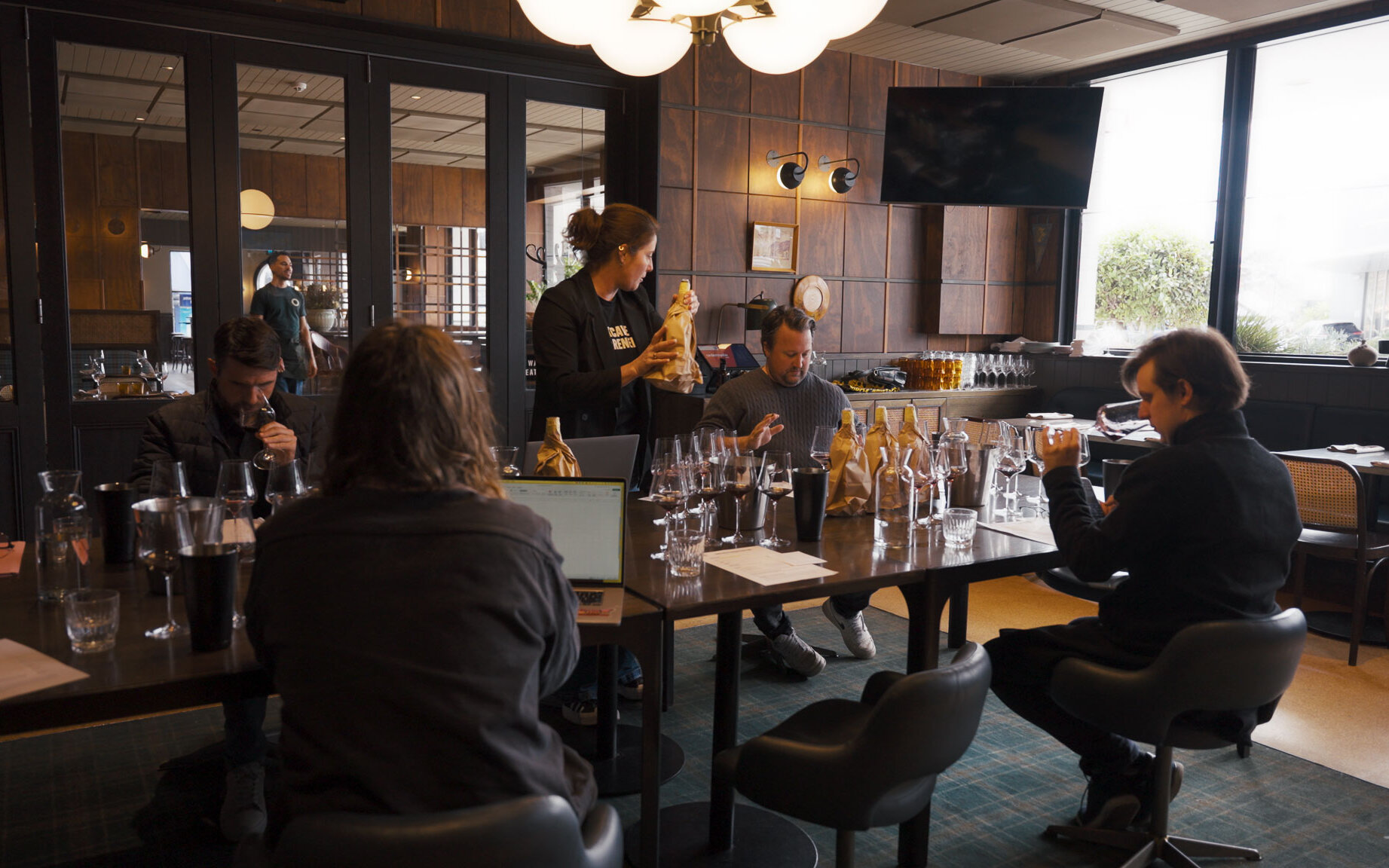
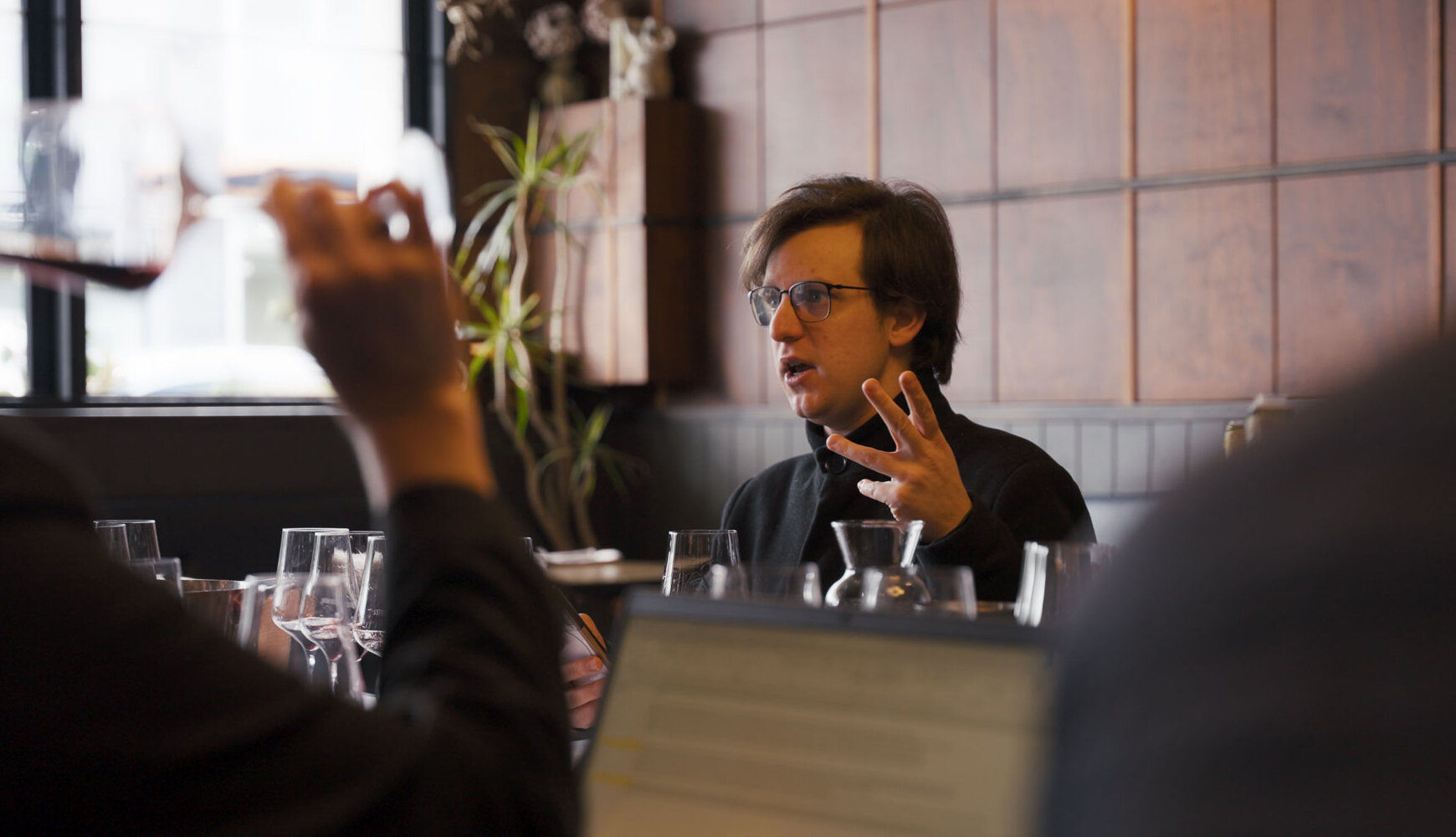
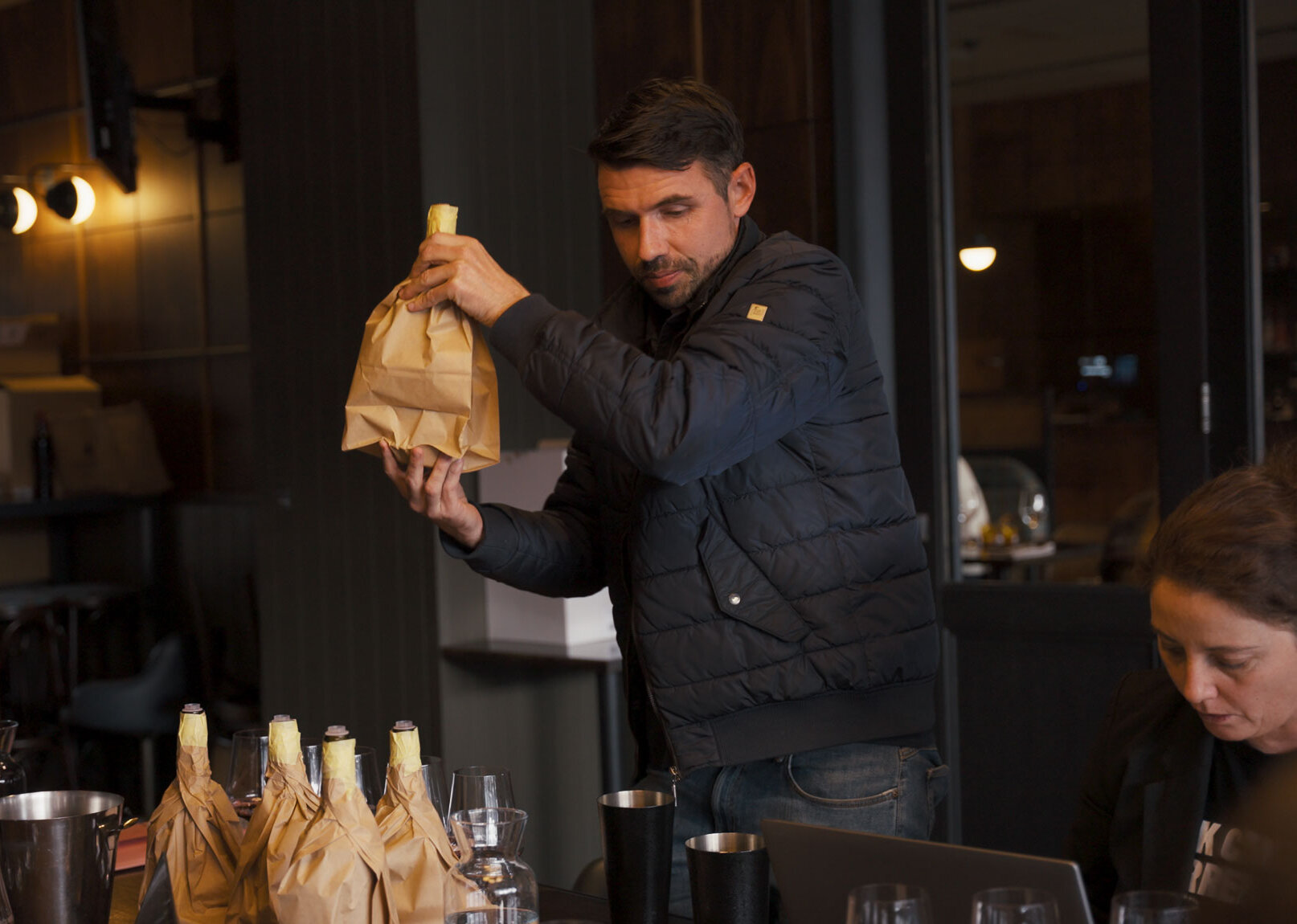
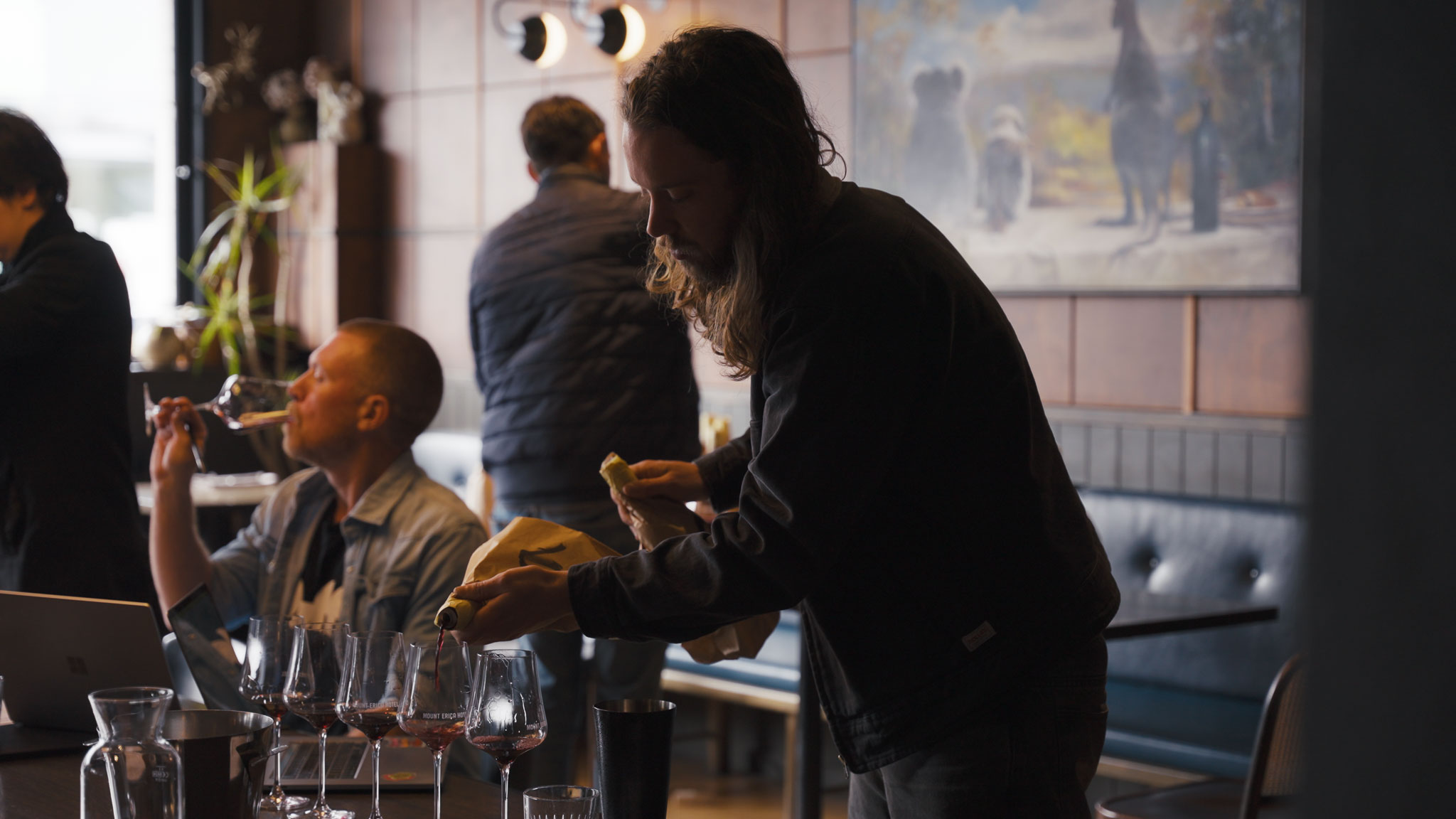
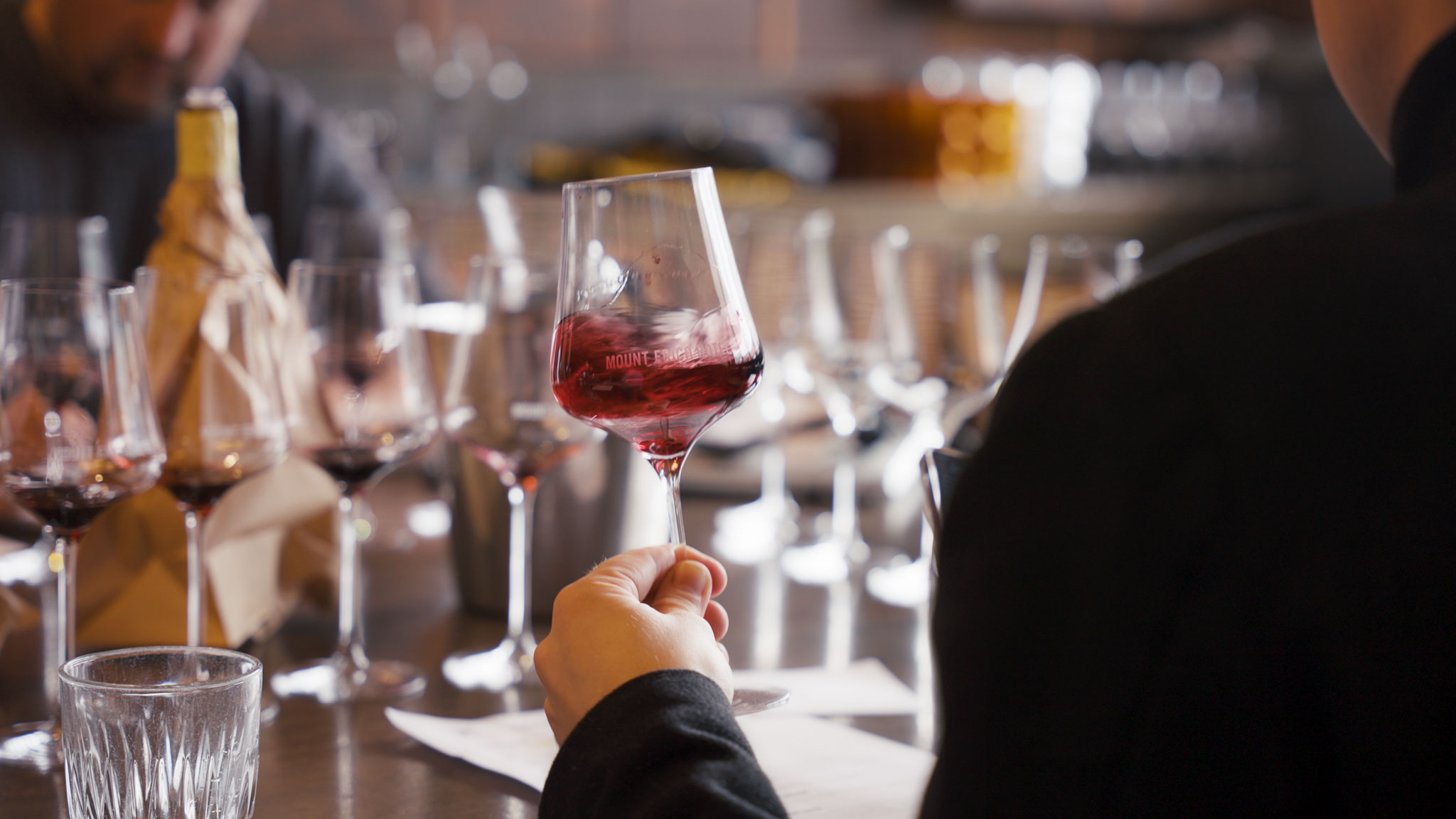
Above: Our expert panel gathered at the Mount Erica Hotel, Prahran (Melbourne).
Outtakes from the Tasting
We gathered every example of cabernets from the Yarra Valley that we could find – that is, wines that are 100% cabernet sauvignon or blended wines made from the traditional Bordelaise varieties – and set our expert panel the task of finding the wines that compelled the most. All wines were tasted blind, and each panellist named their top six wines. Below are the wines that made the panellists’ top-six selections from the tasting.
Our panel: Amanda Flynn, winemaker, Yering Station; Andrew Duff, winemaker, Briar Ridge; James Becker, winemaker, Musical Folk Wines, Jarrod Johnson, winemaker, Punt Road Wines; Sam Baxter, sommelier, Coda Restaurant, Jim Mulaney, wine buyer, Vinomofo.
Baxter commenced the discussion by noting the diversity of the lineup: “It was really interesting to see the diversity between them all – because when you see a lot of cabernets from other areas in Australia, there is a through-line that they have,” he said. “For this one, I felt like it was quite wild in terms of the variations of approach, and winemaking, and vineyard that you could see, not to mention the blending. But there was always this boysenberry, blueberry, violet floral thing in the wines, which always attracted me back to those more elegant styles.” He added: “It’s good to just see them side-by-side and find that through-line.”
Opposite: Amanda Flynn. Above: Andrew Duff.
Johnsonconcurred with Baxter on the subject of elegance. “The theme across all the wines – and therefore it’s a pretty good theme for the Yarra – is just that they are really elegant in style. They’re not overblown; there’s beautiful natural acidity; the tannin buildup is lovely and structural, but it’s not overpowering, and the fruit just kind of sits in the wine really well. They handle a little bit of oak – there were some that were a little more heavy-handed with that, but I think overall there’s a real complexity, elegance and beauty in these wines and a lot of them would be able will do very well for a very long time.”
“The theme across all the wines – and therefore it’s a pretty good theme for the Yarra – is just that they are really elegant in style. They’re not overblown.”
Flynn argued that the restrained use of oak was a natural consequence of the Yarra Valley’s comparatively cool climate for growing cabernets. “I think the cooler seasons have called for less oak,” she said. “You’ve had to be quite particular with the play of oak because they’ve been more more restrained and more elegant. We’re pushing more in that red currant–pomegranate–rhubarb spectrum with the fruit, I think – although those blue notes are definitely there, those violets and lavender-like hints – but you just need that oak tannin to be supportive.” She added: “That little dusty oak on the top of the wine is quite nice – but it has to be fine-lined support, because otherwise you see that smokiness, and you see that kind of heavier use of oak out the back of the wines.” Johnson added: “I think oak tannin and Yarra cabernet tannin can kind of clash if you overdo the oak.”
Above: James Becker. Opposite: Jarrod Johnson.
For Duff, the elegance and restraint of the wines in the lineup showed the development of winemaking skill in the region. “I love the way ‘elegance’ has taken over as the major theme for Yarra Valley cabernets – when maybe ten years ago it was just ‘green’,” he said. “Now we’re elegant and we’re restrained and we’re harmonious with oak – there’s not too much winemaking artefact. The colours are beautiful.” He added that when the ‘green’ character some might associate with Yarra cabernets did appear, it wasn’t necessarily a negative: “There were a couple of wines throughout that had a little bit of sappiness and stemminess – but when you really looked at it, I thought it was actually quite complexing. It wasn’t a drawback. Overall, this was, a very, very delicious bracket of wines.”
“The alcohol was well-integrated, and that’s the style of wines that people want to drink at the moment – a little bit more fresh and vibrant.”
Mullany saw the comparative coolness of the Yarra Valley for cabernets as a virtue. “I think the Yarra Valley has a bit of an advantage with cabernets with its moderate climate,” he said. “I didn’t see the alcohol sticking out too much across the wines. It was well-integrated, and that’s the style of wines that people want to drink at the moment – a little bit more fresh and vibrant.” He added that this vibrancy and freshness made Yarra Valley cabernets especially well-suited to food pairing: “These more-delicate examples are really well-suited to dining out, because you get the fragrance and perfume that people like – especially if you’re a pinot drinker – but then there’s a little bit of structure and dark fruit flavour to go with the food.”
Opposite: Sam Baxter. Above: Jim Mulaney.
Becker, like Mullany, was impressed by the wines that skewed lighter: “The wines that were really complete, well put-together, and balanced had nice acidity and light tannin,” he said. “It’s nice to see wines that were maybe earlier-picked and a bit on the juicier side – not something that has been balanced by being in the bottle for a couple of years. These were a bit more early-release, a bit more fun drinking, which is what consumers are after now: that kind of bright, juicy, real fruity – still with tannin and acid to just support them – but not-so-classic style.” He added: “I liked to see the contrast between the classic ‘claret’ styles, and ‘luncheon’ wines that were a bit more juicy, free, and enjoyable.”
“Just getting these wines in front of people is so hard – especially in Melbourne. It’s like, ‘No, I only want shiraz’. Or ‘No, I only want pinot’.”
Talk of how neatly these wines lined up with consumer trends got the panel going on the topic of the elephant in the room – the surprising difficulty of selling Yarra Valley cabernets. “It’s really frustrating, out in the more commercial side of the business, to see how great these wines are and yet how hard they are to sell,” Johnson said. Baxter added: “Even in restaurants! Oh my God, it’s just an absolute nightmare. I’m lucky that I’m in a place where we do degustations, so you can just throw it on pairings, and people just froth it – they’re like, ‘Right, let’s just get a bottle, let’s get a half-bottle’. But just getting it in front of them is so hard – especially in Melbourne. It’s like, ‘No, I only want shiraz’. Or ‘No, I only want pinot’.”
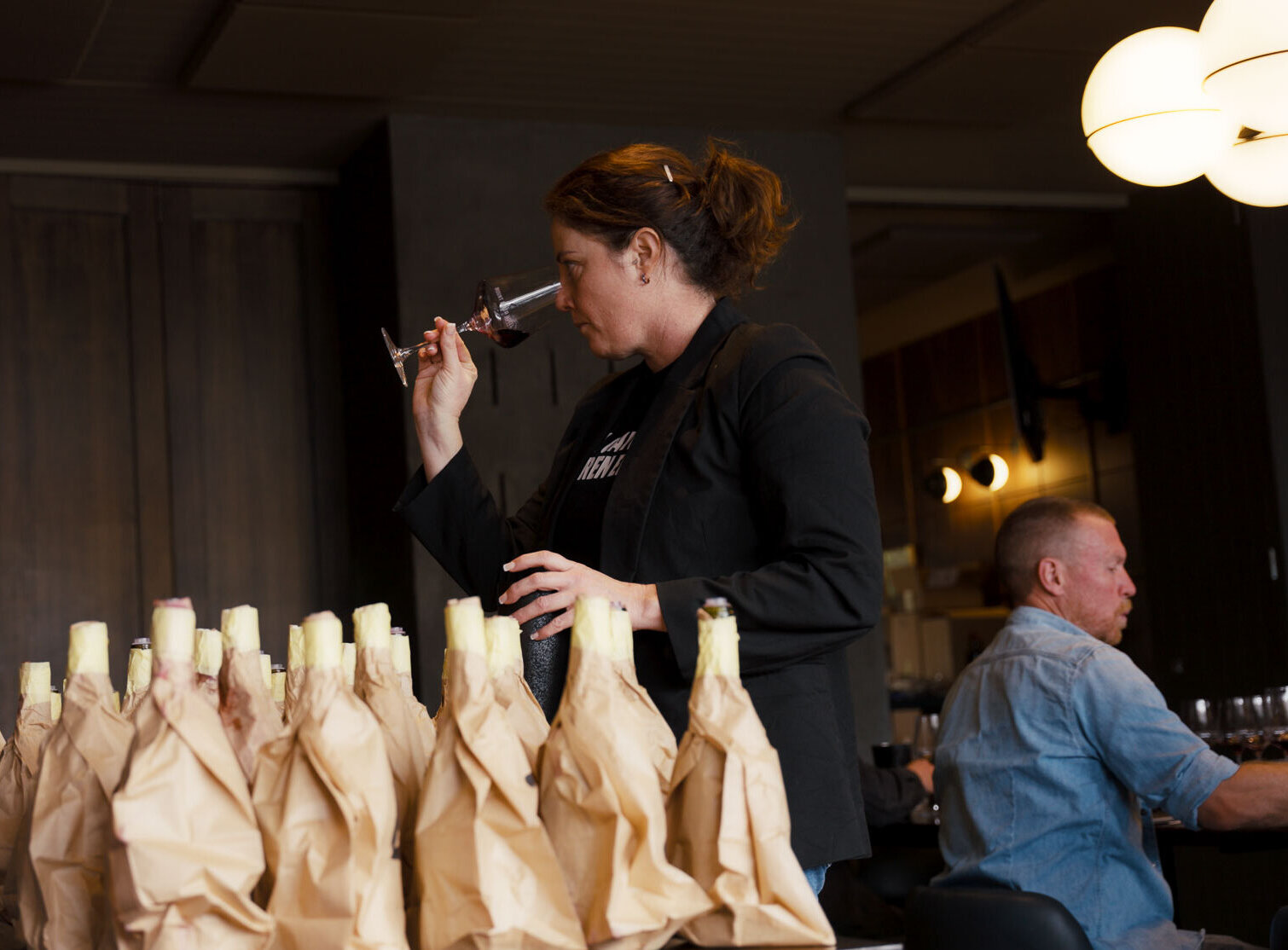
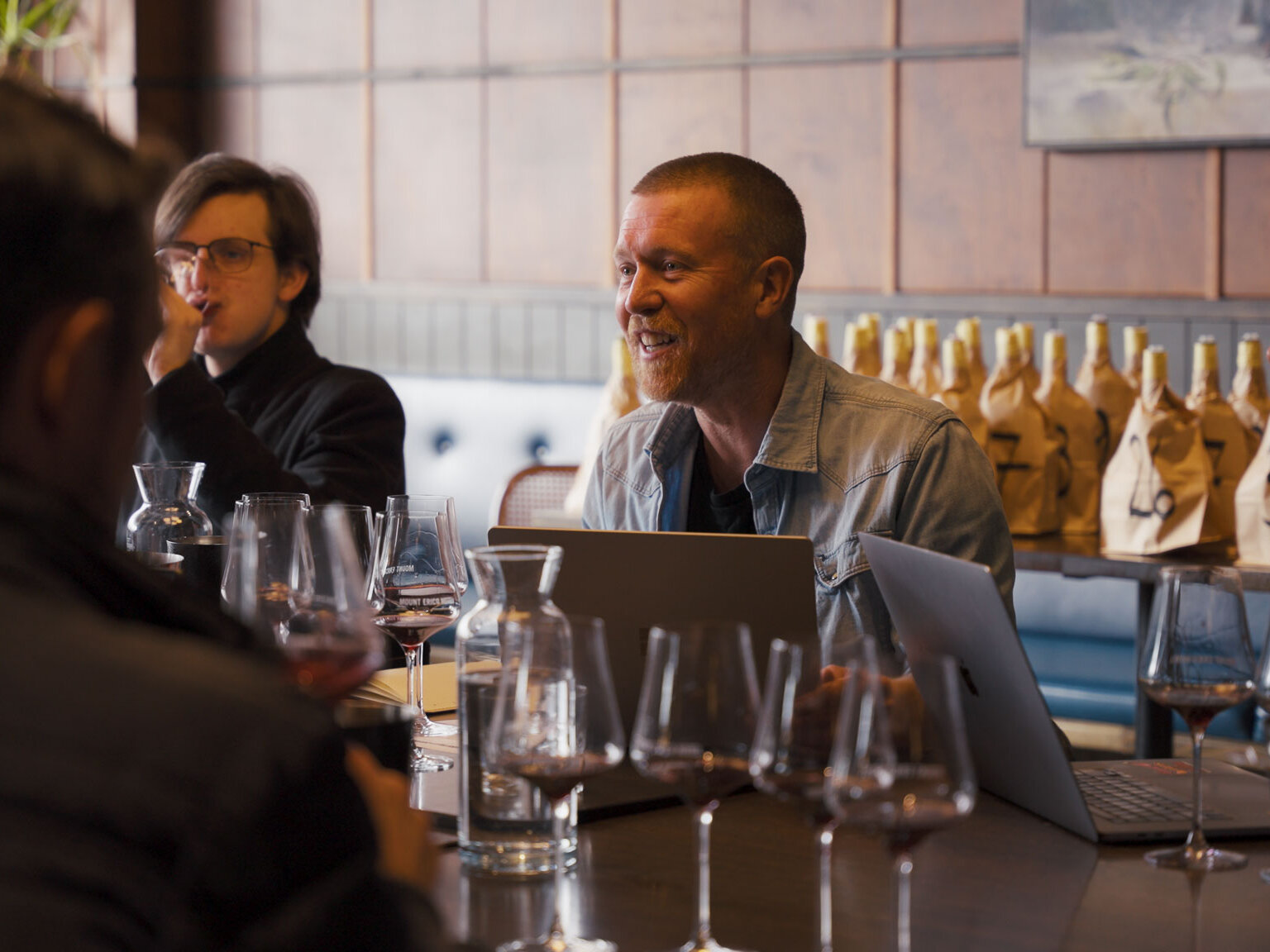
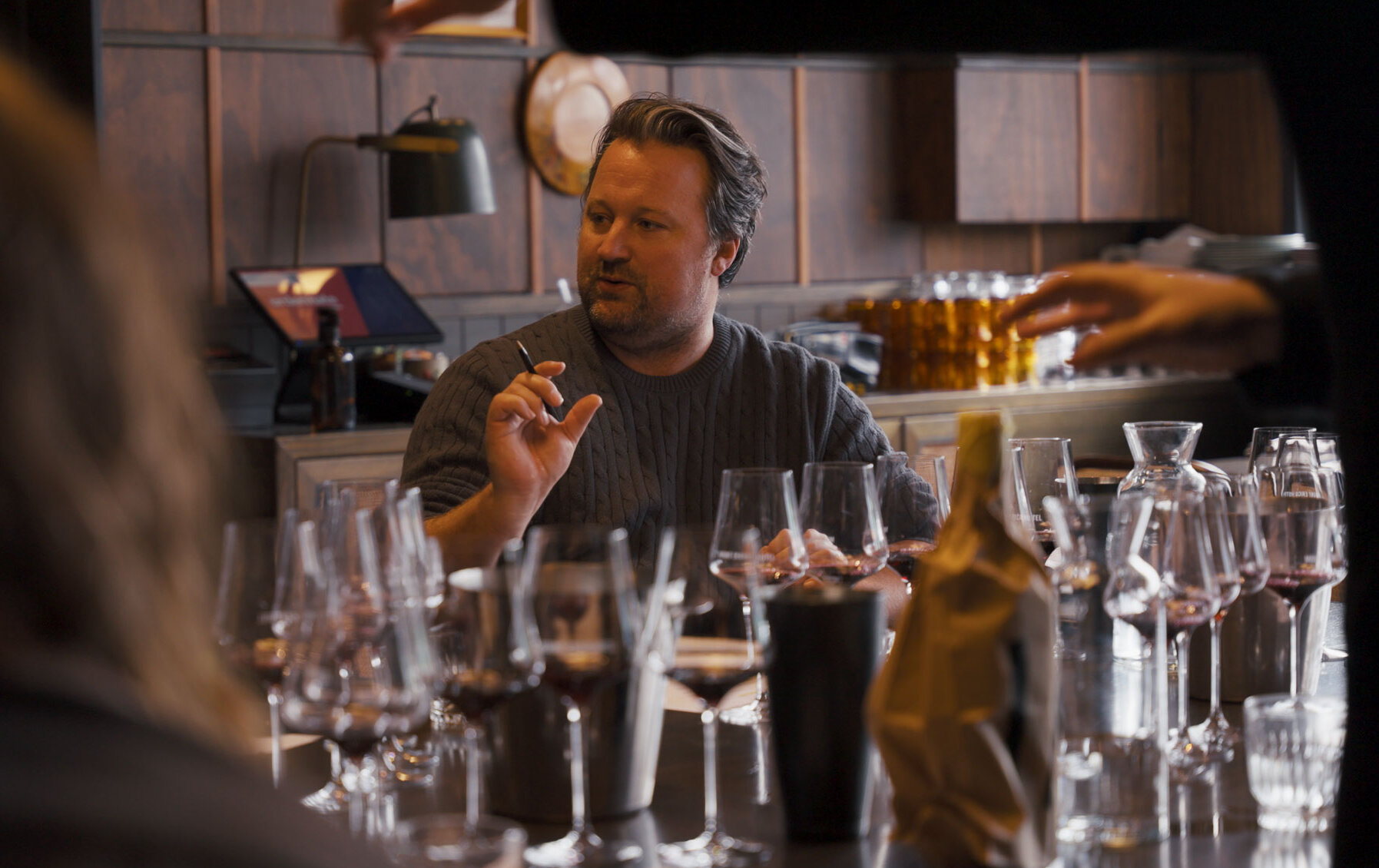
Above and opposite: The panel tasting in action at the Mount Erica Hotel, Prahran (Melbourne).
Flynn noted an irony in the fact that Yarra cabernets are often neglected by consumers in favour of either pinot noir or shiraz. “In terms of consistency of quality across really difficult years in the Yarra, the cabernets are a bit of a mainstay,” she said. “Whereas pinot can be fickle – and shiraz, especially in the Yarra, just hates wet feet. So in the super-wet years that we’ve just had, the shiraz was extremely difficult – but the cabernet is just consistently good. It has to be a horrible vintage for the cabernet to not perform.”
GET FIRST ACCESS TO THE NEXT WINE ICONS – DELIVERED
Malbec has taken a long and winding path from its birthplace in the Cahors region of France to becoming a globally popular varietal wine in its Argentinian form. Yet Australia actually beat Argentina to the punch on malbec by thirty or so years, and the variety has played a small but important role in Australian viticulture ever since. With a passionate collection of winemakers and winegrowers seeking to understand what this variety can do in the Australian context, we thought it was time to take a Deep Dive.
With the imprint of iconic makers, like Giaconda, Sorrenberg and Castagna, Beechworth has a big reputation despite a relatively small output. It’s a region of extraordinary untapped potential, with the ranks of newer makers swelling and testing the limits. This year’s Young Gun Top 50 includes Sentio and Weathercraft, two of that new guard, and our Young Gun for 2015 was Adrian Rodda, who has been charting his own course in the region for nearly a decade.
Merlot’s reputation in Australia is mixed, to say the least. On the one hand, the variety is the source of one of the world’s most highly regarded (and therefore most expensive) wines, Petrus. On the other, the shelves of Australia’s chain bottle shops groan under the weight of cheap and cheerful bulk-produced merlots, self-professed wine aficionados love to hate it, and the infamous line about “not drinking any f**king merlot” from the 2004 film Sideways still hovers over any discussion about it. Now that Australian winegrowers can plant a diverse range of genetic material for their merlot, and as a new generation of winemakers discovers the virtues of the variety, merlot now has its chance to shine – which means a Deep Dive into the subject is in order.
Subscribe to our newsletter
Young Gun of Wine is your shortcut to cutting edge wines, the places to go, and the people behind it all.
Subscribe to be amongst the first to know of our latest discoveries in wine.
We'll bring you the inside running from the growers, the makers, the wholesalers, the retailers and the sommeliers, too.