Ashleigh Seymour spent more than a decade making wine at Avignonesi – Italy’s largest biodynamic estate in Montepulciano, Tuscany – before Covid, young children and the pull of home brought her back to Australia in 2021. After several years as winemaker at McLaren Vale biodynamic pioneer Paxton Wines, she launched her own label, Vino Selvatico, from the 2023 vintage: two wines, a McLaren Vale grenache and a fiano, made from organically and biodynamically farmed fruit with spontaneous fermentation, minimal sulphur, no fining, and a sensibility shaped by two continents. The name means wild wine. The wines live up to it.
Seymour grew up on the edge of the Yarra Valley where winery visits were part of childhood, moved to Adelaide to study winemaking in 2005, and worked her way through a formative series of cellars – Peter Lehmann, The Lane Vineyard, André Perret in Condrieu – before a vintage at Avignonesi in 2010 turned into eleven years. “It took me a journey from Australia, to Italy and back again to feel ready to make my own wine,” she says, “and that journey is reflected in the style and expression of the varieties.” Those years at Avignonesi, mentored by Giampaolo Chiettini and Adriano Zago and influenced by producers like Elisabetta Foradori, immersed her in biodynamics not just as a farming practice but as a philosophy. “Not just for the earth, soil and wine but as a way of life,” she says. “We breathe, feel and touch the different seasons, living in flow and not to the monotonous beat of sameness all year round. This is what inspires my winemaking – the basics of producing something magnificent which breathes the seasons of life on earth.”
The return to Australia in late 2020 – prompted by Covid, young children, and the need for change – landed her at Paxton Wines in McLaren Vale, where she spent four years before being made redundant in August 2025. She is now consulting to Shirvington Wines and working with BHF Technologies alongside Vino Selvatico. The Vale, she says, has a magnetism that doesn’t let you leave. “Ocean, hills, wine, food, culture. Amazing people. Great energy.” More specifically, she was drawn to its complex geology, its Mediterranean climate, and its remarkable concentration of organic and biodynamic farming – nearly 40 per cent of McLaren Vale’s vineyards are certified, the highest proportion of any Australian region. “McLaren Vale is a uniquely collaborative place,” she says. “It doesn’t seem to matter if you interact with original families or young recent graduates, everyone is open and willing to share their experiences or lend you a barrel washer to make McLaren Vale a better place. Maybe it’s the sea spray or the whispering old vines, or the ancient rocks – whatever it is, everyone is bound by a deep connection and love of the landscape and each other, and that’s what makes it such a beautiful and welcoming place to make wine.”
The idea for Vino Selvatico had been bubbling since she was still in Italy. What finally made it happen was a push from her husband. “I probably wouldn’t have done it without him pushing me,” she says, “which possibly initially I thought was because he missed working in wine and wanted to dabble a bit, but I now realise he pushed me because he wanted me to have the opportunity to express myself in my winemaking for me and not for someone else.” The reality of launching it has been as unglamorous as it is for most. “You make mistakes, you do things the expensive way because you didn’t know better, things don’t go to plan or your wines sit without labels for an extended period of time before you get your shit together – but somehow you just hustle and glue it all together with grape juice and hope it sticks.” She is candid about the near-misses too: renting the wrong kind of trailer to move a pallet tank, being a bit sketchy on the forklift tending to her own wines after long vintage hours at her day job, sending the wrong wine to the wrong person. “There’s only two wines so far – it shouldn’t be that hard!”
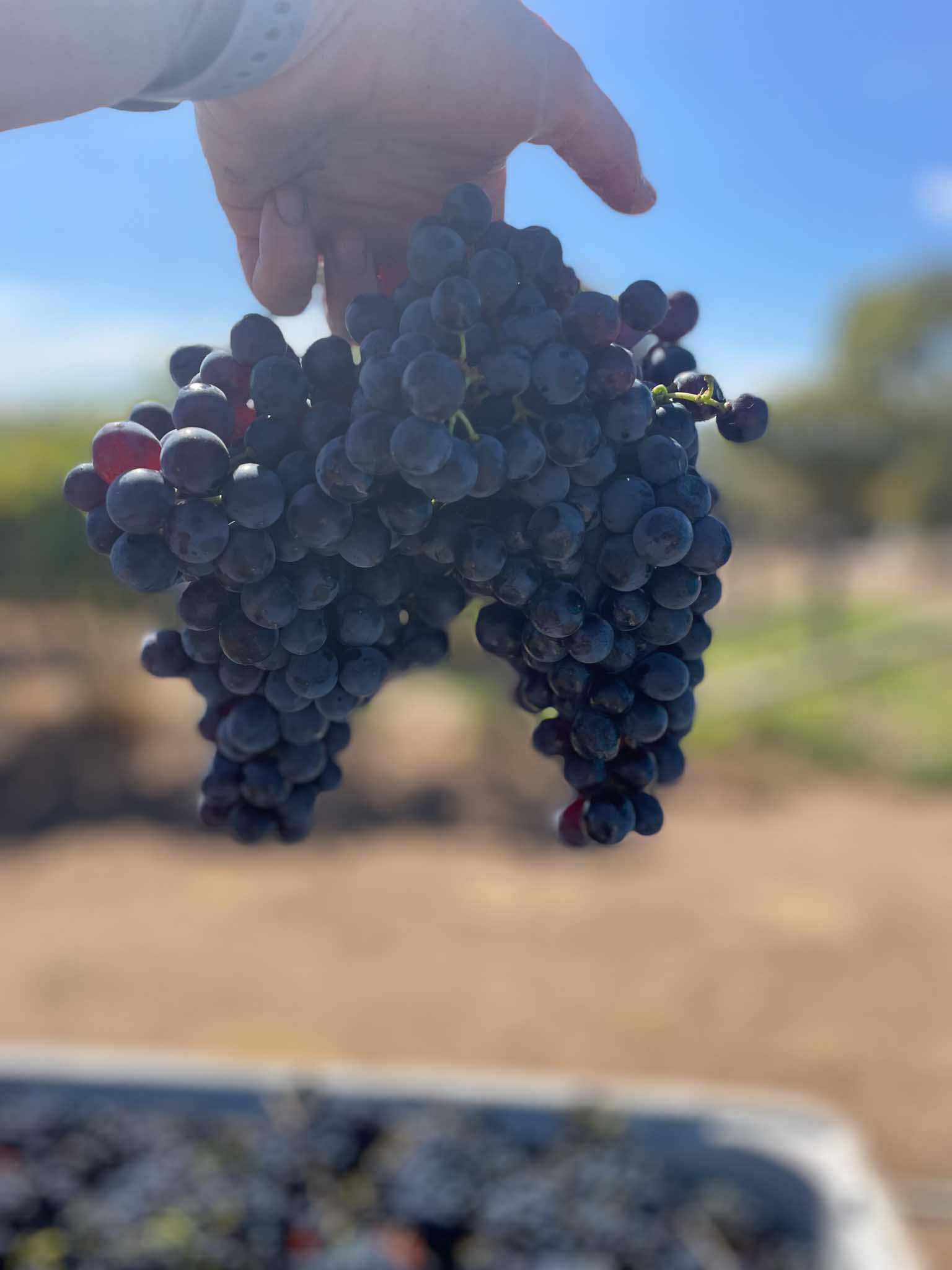
Grenache drew her in as the natural starting point. “I spent a long time in Tuscany where sangiovese is the long-time queen of grapes,” she says, “and although sangiovese does exceptionally well in McLaren Vale, I felt that the equivalent variety for McLaren Vale was grenache. It’s been here forever. It has had periods in history where it was momentarily overshadowed by other French varieties but has come back, stronger than ever, especially in its pure form. It’s also very climatically adapted to McLaren Vale and thrives here as it has done since the 1800s.” The grenache comes from Paxton’s Thomas Block, sand-dominated soils on the valley floor, made with spontaneous fermentation and a winemaker’s golden rule distilled from years working with the variety’s Italian cousin: “Grenache can’t suck as much air as sangiovese.” The fiano is newer territory – a variety she has tasted widely and admired, inspired in part by her winemaker friend Raffaele Pagano from Joaquin in Campania. Rather than chasing the more reductive, citrus-driven style common in southern Italy, she looked further south for her reference point. “Compared to its home in Avellino, McLaren Vale is perhaps not quite cold enough in winter,” she says. “This is why I decided to pursue a more skin-contact, opulent version of fiano like I have seen made on Capri island, off Naples.” Fiano is not riesling, she is at pains to point out: “Please people, give it some respect.”
The winemaking philosophy runs directly from her biodynamic formation. Organic and biodynamic fruit – from Paxton and the Brown family – spontaneous fermentation, minimal sulphur (both wines under 80ppm total), a touch of bentonite on the fiano, technical corks chosen partly out of eleven years of Italian habit. “My whole winemaking career has been in organic and biodynamic wineries and it changed who I am as a person, as a mother and the impact I have on the planet,” she says. “I don’t think we should poison the earth making a luxury.” She uses Australian-produced bottles, specifically because she didn’t want them to have travelled the world empty before being filled. “My value statement is that I will foster connection between people through wine, in a socially, economically and most of all environmentally sustainable and thoughtful manner. I make all my decisions based around this.”
Flavour, though, remains the first principle before any of it. “Flavour is the main ingredient for me – it needs to be there before anything else,” she says. “Ideologically, many of us are chasing some incarnation of perfection in our wines; maybe I will get there some day, but for now I will focus on varieties flaunting themselves as if nobody is watching.” Longer term, she wants to experiment with sangiovese in the Australian context, and has an ambition to one day make wine in Italy and bring it back – “not as competition but as complement.” Vino Selvatico, though small, is already the fullest expression of everything she has become.