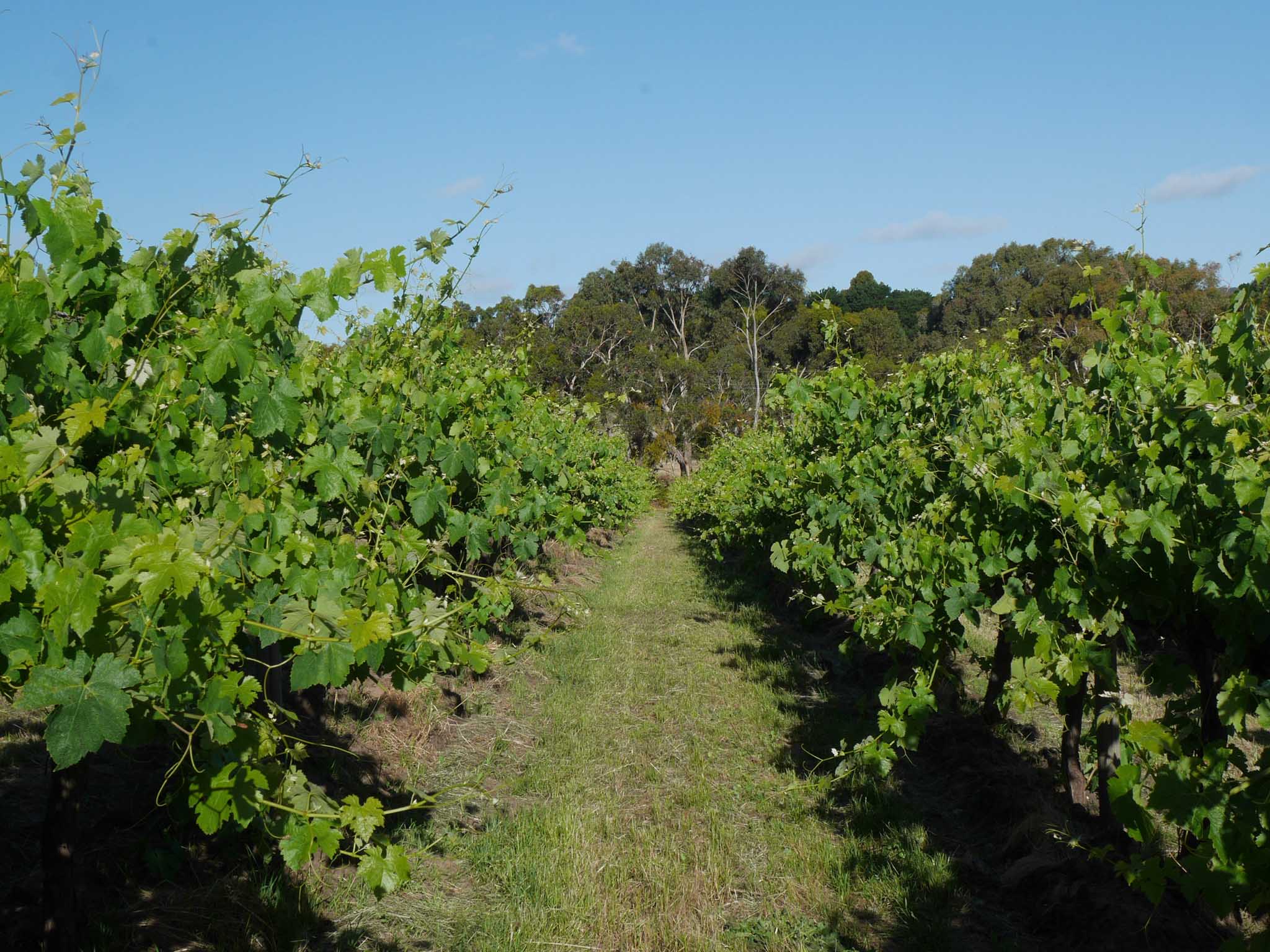
Ollie Bevan is a first-generation winegrower making shiraz and grenache from a small organic (not certified) estate in Blewitt Springs, McLaren Vale – one of the subregion’s most compelling pockets for both varieties. Parea, launched from the 2022 vintage, is built around a single dry-farmed shiraz vineyard planted in 1992 and a young block of own-rooted, bush-vine grenache planted from cuttings Bevan took himself from highly regarded local sites. The wines are made with minimal intervention – sulphur the only addition, unfined and unfiltered – and a vineyard-first philosophy that prizes site and seasonal honesty over stylistic consistency. Small, serious, and deeply rooted in place.
Ollie Bevan didn’t arrive at wine through family heritage or a formal winemaking degree – he came through a science degree in Melbourne, a wine appreciation elective, and a teacher who opened a door he never closed again. What followed was a self-assembled education: vintages in Barolo and at Steve Pannell in McLaren Vale, then a formative stint with Rémi Jacquemain and Rob Walters at Place of Changing Winds in the Macedon Ranges, a project known for obsessive attention to vineyard and winery detail. Then COVID, which closed off further overseas opportunities and pushed him inward. “I dove deep on various viticultural texts, winemaking podcasts, and a period of great creativity and planning,” he says, “where I doodled labels, imagined winemaking and farming styles, and explored different wine regions around Australia trying to find a place which would suit both my lifestyle and what I wanted to achieve in wine. I had no epiphany or pivotal point – just a gradual realisation that this world and its endless complexities truly satisfy every part of my physical and mental being.”
Blewitt Springs was the answer. Bevan grew up in McLaren Vale, and returning after years away gave him a clarity about the subregion he hadn’t had before. “Coming back and working in my home region after spending many years away, I found a renewed sense of love for my home region and its people,” he says. “Every day I spend here in McLaren Vale, my cup of fulfilment grows.” The conviction about Blewitt Springs goes beyond sentiment. “I truly believe that Blewitt Springs has the capacity to produce world-class fine wine, and that it already is in the form of grenache. The grenache wines being produced from old vineyards scattered around this subregion are so specific and so great that they rival many of the fine wines we are already accustomed to around the world today.” The region’s sustainability credentials matter too. “Dry farming, low disease pressure and a perfect match between variety and place encourage both sensitive farming and winemaking – I believe that to be a very sustainable model for any wine business and the industry more broadly moving forward.”
The vineyard work is the core of everything Parea does, and Bevan is direct about it. “I would not make my own wine if I couldn’t farm my own fruit,” he says. “This privilege allows experimentation, steep learning, and ultimately more authentic and expressive wines.” Dry farming – growing vines without supplementary irrigation, relying entirely on rainfall and the vine’s own deep root system – is the foundational discipline. “In a hot and dry climate, dry farming presents many challenges, but primarily it forces you to reduce crop loads and watch them carefully in accordance with seasonal influences.” Each vine is pruned to approximately six to eight spurs; shoot-thinning runs to two passes where needed; crop-thinning follows where necessary. “Ultimately, we have more concentrated fruit and much lower sugar levels, which allows us to pick early – between 12 and 13 baumé – while still achieving elevated aromatics, concentrated flavours and balanced phenolics.” The young grenache block, currently irrigated during establishment, is being progressively weaned toward the same dry-grown model through mulching and cover-cropping.
Precision in the vineyard extends to individual vine management. “Certain parts of the vineyard have different growth habits to other parts, so we prune to less buds and shoot-thin more in weaker sections, and the converse in stronger sections,” he says. In 2025, ahead of two significant heatwaves, he dropped all fruit from the youngest grenache vines growing in the shallowest soils at the top of the hill – the section with the least water-holding capacity. After the heatwaves, all remaining vines were treated with concentrated kelp to minimise stress and support recovery. “We essentially never ask too much of the vines,” he says.
The winemaking is as restrained as the farming. Sulphur is the only addition, kept under 50ppm total – “a practical rather than dogmatic approach,” as Bevan describes it. “Sulphur is a very useful tool in maintaining freshness and reducing the risk of certain faults which can cloud the clarity of place in the wines.” Everything is unfined and unfiltered, clarified naturally through extended time in barrel in insulated cellars. Whole-bunch inclusion in the shiraz has been a variable depending on the season – cool, wet years taught him to pull it back. His golden rule, held with appropriate humility: “Pick just before you think a block is ready, and bottle a wine just before you think it is ready. This results in tension in the wine, allowing it to mature steadily both in barrel and in bottle.” He is wary of absolutes. “As soon as I commit to a particular way of doing things, nature contradicts my choice and proves something otherwise.”
What drives him, at the deepest level, is the experience that wine can create. “I always come back to what’s in the glass, and the capacity for a great glass of wine to awaken so much in someone,” he says. “My love for complex and delicious wines that possess the unique ability to transport me to a particular place in the world is what keeps the flame alive.” McLaren Vale, and Blewitt Springs specifically, is the place he keeps being transported back to. The plan is to stay small, add chenin blanc in time, and eventually open a small cellar door on the property. “We hope to gain a small following of likeminded drinkers and thinkers who we would love to welcome to the property.” For a first-generation winegrower working at humble scale, the foundations are quietly impressive.