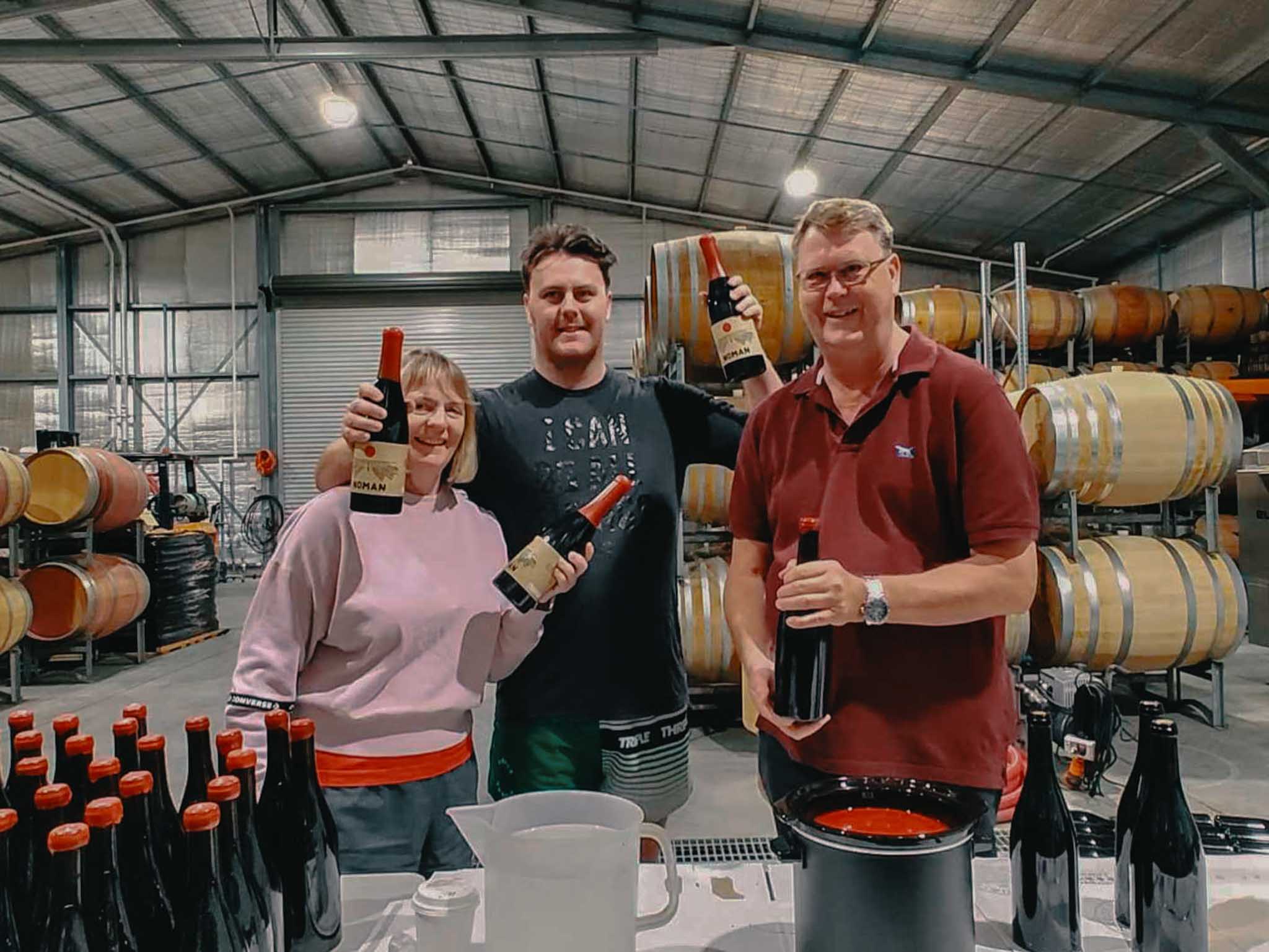
Samuel Rumpit is a Hunter Valley-based winemaker whose Noman label – launched from the 2024 vintage – makes small-batch wines from alternative varieties sourced wherever they’re growing best that year, with no intention of repeating a wine or a region from one vintage to the next. The current range spans a McLaren Vale montepulciano, a Hunter Valley fiano and a tempranillo rosé, all made with Hungarian oak, minimal intervention and a deliberate refusal to take wine too seriously. Noman sits at the approachable, exploratory end of the Australian alternative variety conversation – swimming pool wine, as Rumpit calls it, made for you and your mates.
Samuel Rumpit wants to make swimming pool wine. That’s his phrase for it – wines you can drink by the rusted aluminium and frosted glass table with your mates, wines that pair well with a conversation rather than demanding to be the subject of one. “I just reckon as good as wine can be, it’s just wine – it shouldn’t be scary,” he says. “Why should it be any more complicated than picking up a nice looking bottle? I wanted to make wine that could be focused on anything other than the wine.” Noman, launched from the 2024 vintage and based out of the Hunter Valley, is built entirely around that idea: small batches, one tonne at a time, from alternative varieties sourced wherever they’re growing best that year, made with what Rumpit calls “necessary intervention” – as little as possible, as much as needed. The current range spans a McLaren Vale montepulciano, a Hunter Valley fiano, and a tempranillo rosé. There will not be a second vintage of any of them. That’s the whole point.
“I did it slowly – I bought a barrel in 2023, I bought my first fruit in 2024, I bought and designed labels in 2025. It is just step by step to make sure the funds are there. I wasn’t really in any rush to grow and I’m still not in any rush to grow. I just enjoy doing my own thing and if I get burnt out I might just stop for a year and come back to it, who knows.”
The name is drawn from Homer’s Odyssey – the moment Odysseus tells the cyclops Polyphemus his name is Nobody (Noman), so that when the cyclops cries out in pain, no one comes to help. It’s an unlikely source of inspiration for a wine brand, but it suits the spirit of the project: a small figure moving through a large landscape, making wine that earns its place not through pedigree but through what’s in the glass. The road to Noman wound through an agriculture science degree at Charles Sturt University in Wagga, a research winery placement at CSU in collaboration with the CSIRO, then winemaking study while working in industry – cellar hand at Lerida Estate in Canberra, then First Creek in the Hunter Valley, now full-time winemaker at Saddler’s Creek Wines. The label was built incrementally on top of a day job: a Hungarian oak puncheon purchased in 2023, first fruit in 2024, labels designed in 2025. “I did it slowly – I bought a barrel in 2023, I bought my first fruit in 2024, I bought and designed labels in 2025,” he says. “It is just step by step to make sure the funds are there. I wasn’t really in any rush to grow and I’m still not in any rush to grow. I just enjoy doing my own thing and if I get burnt out I might just stop for a year and come back to it, who knows.”
The variety logic is climate-driven and deliberate. Rumpit has no interest in loyalty to a grape or a region – only in finding what’s growing well in a given year, in the right place, from growers farming with genuine care for the soil. His agriculture science background informs how he reads vineyards, and he’s more interested in biodiversity above and below ground than in certification. “Vineyards don’t need to be certified organic to be doing the best they can,” he says. “I have seen certified organic vineyards with the most incredibly humic layers but not an ounce of actual macro soil life, where on the other hand I have seen many uncertified vineyards where the soils are filled with native grasses that might be considered weeds but the biodiversity is awesome above and below. I’ll go for the biodiversity every time.” The first montepulciano came from a vineyard on a gentle slope in McLaren Vale – perpendicular to the ocean, benefiting from a dramatic diurnal shift, the temperature swinging between stinking hot 45-degree growing days and cool nights thanks to an uninterrupted ocean breeze. “When I saw where it was, I couldn’t turn it down,” he says. “I just had to have faith that the fruit was going to turn out alright, and I am so stoked that it did.”
“I hope that growers in the Hunter see the fun things this new generation can do with alternate varieties and then adopt fun varieties of their own – it will help the Hunter flourish, help growers sell their fruit at a premium, and maybe reignite a passion for growing in a region that has seen an unfortunate decline thanks to urban sprawl.”
The fiano and tempranillo rosé are both from the Hunter, where Rumpit has become an enthusiast for alternative varieties not because they’re fashionable but because they make practical sense in a warming, unpredictable climate. He makes the case bluntly. “Why would I pick Hunter Valley semillon in a wet year when I could find fiano that in the same year is still looking immaculate – pumping water into the leaves, producing more canopy and allowing for greater fruit development with a much lower risk of disease – when the semillon has been sprayed fifteen times and still has botrytis?” The broader point is about adaptation as a philosophy. “I have no interest in making the same variety over and over again – it seems tedious and frustrating. Instead I watch how the year progresses and I actively seek out growers that are producing varieties which are far better adapted to the current climate than traditional varieties. The way forward is adaptation, not stubbornness and refusal to evolve.”
The Hunter community is part of what energises him. “There is a heavy-handed smattering of awesome new generation winemakers that I think are going to give the Hunter a much needed update – some really good wines are being made in alternate styles and with alternate varieties. The Hunter kind of gets swept under the rug a bit at the moment, which is a shame, but they’re a resilient lot up here and everyone pitches in and just keeps on kicking.” He’s also hopeful that Noman might play a small role in pushing growers toward alternative plantings. “I hope that growers in the Hunter see the fun things this new generation can do with alternate varieties and then adopt fun varieties of their own – it will help the Hunter flourish, help growers sell their fruit at a premium, and maybe reignite a passion for growing in a region that has seen an unfortunate decline thanks to urban sprawl.”
In the winery, everything goes into Hungarian oak – a puncheon for the reds and rosé, a separately treated puncheon for the whites – and Rumpit is evangelical about it. “Hungarian timber has such a unique flavour compared to French, Austrian or American oak,” he says. “In most of those I see what I call baking spices or dessert spices, but in Hungarian I see incredible earthy-driven cooking spices – paprika, bay, Australian pink pepper. As a tool, oak is so versatile. Why would you not want to play with different forests?” Sulphur is kept under 100ppm total where possible. No copper, activated carbon, PVPP or other manufactured processing aids. No filtration unless necessary. “My wines get exactly what I deem is necessary – nothing more and nothing less. And for every wine that will be different, because the grapes are unique and should be treated as such.” The label also steers well clear of over-oaking, which Rumpit sees as a defining mistake of a certain era of Australian winemaking. “Too often we see these riserva-style wines that as a young vintage are near unpalatable because they’ve spent three, five or more years in timber – it dries out the wine and annihilates the fruit character. I think this is one of the things that sets Australian winemaking apart: we aren’t forced to over-oak, and because of this we have such malleability and potential creativity.”
“It’s wine you can have with a beer,” he says, “and I think that kind of says all it needs to. Wine should be about having fun with your mates – so I guess that is what drives me. Making wine for you and your mates.”
GET FIRST ACCESS TO THE NEXT WINE ICONS – DELIVERED