Mem Hemmings is a British-born, Hunter Valley-based winemaker whose Meredith label – launched from the 2022 vintage – makes natural wines from lesser-known NSW regions with a no-additions philosophy, low-impact packaging and a set of ethical commitments that run all the way from grower relationships to how the wine arrives at your door. The current range spans a cabernet sauvignon rosé, a chardonnay amber – made with nine months of skin contact – a chenin blanc, a sparkling riesling, a light red blend and wines available in 250ml recyclable cans and 25-litre refillable kegs. Fruit comes from vineyards across the Hunter Valley, Orange, Hilltops, Tumbarumba and Gundagai. Meredith is a small label with a clear voice, and that voice is increasingly hard to ignore.
Hemmings moved to Australia in 2014 and found her way into wine through hospitality – working at Three Blue Ducks, Sydney’s ahead-of-the-curve sustainable dining destination, before two days spent in a winery during harvest settled the question of what came next. She studied a Bachelor’s in Viticulture at Charles Sturt University while working across Sydney’s inner west at Marys and Bloodwood, and her wine education deepened significantly through a Women in Hospitality mentoring program under Mike Bennie, which led to her role on the opening team at P&V Wine + Liquor Merchants. For four years she led P&V’s education arm, running masterclasses and developing content alongside growers, producers and importers – a formative period that shaped how she thinks about wine’s relationship to its community and its responsibilities within it. She has since worked vintages with M&J Becker in the Hunter Valley, completed a harvest in Kakheti, Georgia, and poured Meredith at a wine fair in Mexico with Pheasants Tears. “I am often struck by how I literally would not be making wine if it was not for my community,” she says.
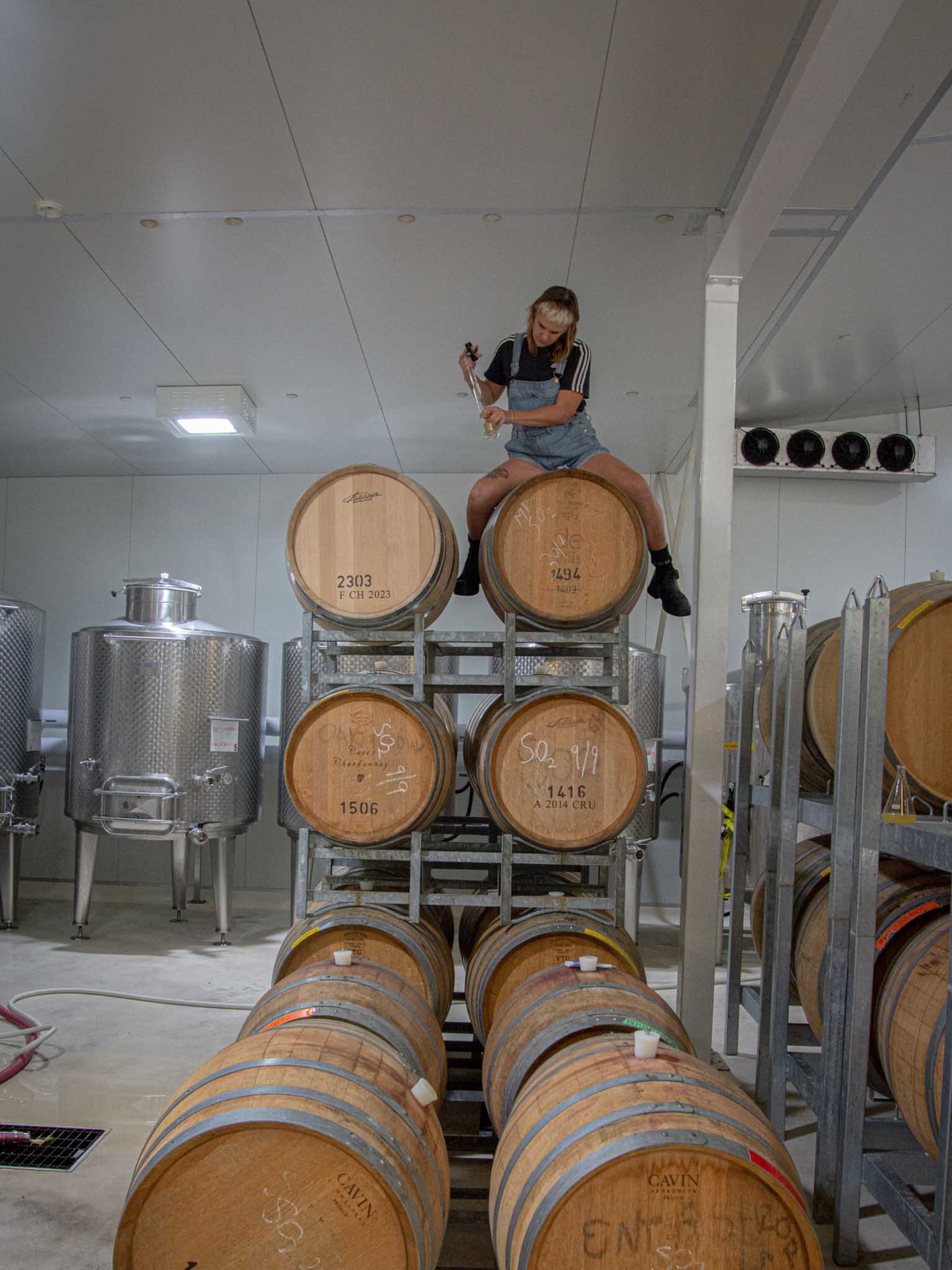
That community is tangible and immediate. Hemmings makes Meredith in a shared winery alongside four other winemakers – James Becker, James Turpie, Peta Kotz and Dan Simmons – whose co-operation and occasional disagreement she describes as essential. “They are my sounding board, my challengers, and my cheerleaders,” she says. “We spend a lot of time discussing, and often disagreeing about, everything from production to pricing to style. It is a very healthy ecosystem because we do not always agree, but we support each other completely.” The practical support – equipment loans, early harvest mornings, extra hands on press days, someone keeping watch if she is away – is as important as the philosophical. “I believe small projects like mine only work because of the strength of community.” Beyond the winery, the sommeliers, buyers and hospitality staff she grew up with in Sydney remain a driving force. “That feeling of my success being their success is something that drives Meredith.”
What makes Meredith genuinely distinctive is the no-additions philosophy applied across the entire range. No acid additions, no commercial yeast, no fining agents – sulphur used in some wines but not all, kept low where it does appear. That constraint is not a limitation so much as a creative framework. “My winemaking is quite creative,” she says. “As I’m not using winemaking additions in any of my wine, what that means is I think very creatively about the choices I make with my fruit in the winery. This can be anything from using three different vessel types for one wine to leaving a wine on skins for nearly an entire year. I take finished wine and mix it back with unfermented fresh juice the following year for sparkling. I use uncommon blends to achieve the result I want sensorily, and with one of my wines I reuse the pressed skins from a different wine to add additional colour and flavour. Winemaking is my creative outlet. It’s where I get to have the most fun.” The pét-nat – a lightly sparkling wine bottled before fermentation is fully complete so natural bubbles are trapped in the bottle – remains the wildcard in the range, and the most stressful. “True pét-nat will always be so incredibly stressful to make. I have made it for four years now and it isn’t getting lower stakes.”
The golden rule, passed on by a fellow producer and taken seriously: time. “Give it time. Time heals all wounds – or maybe not heals, but lessens their impact, makes them more manageable.”
The regions Meredith draws from were not chosen for reputation. “I’ve always been drawn to regions that sit slightly outside the spotlight,” Hemmings says. “I have a bit of a chip on my shoulder about the hierarchy that exists in the wine industry around regions, varieties and styles, and I find myself more motivated by working with growers who share my values than by pursuing a particular postcode.” Orange has become a particular focus for rosé – the altitude, volcanic soils and long cool ripening window allowing fruit to develop into the red-fruit spectrum without tipping into jammy or overripe. Tumbarumba, with vineyards on the western side of the Snowy Mountains, produces fruit with extreme natural acidity that Hemmings has found its ideal home in the sparkling program: base wine aged for a year and then refermented with fresh juice from the following vintage, the acidity becoming an asset rather than a problem to manage. “That approach has let me turn what could be a limitation in a still wine into something that feels very suited to the site,” she says.
The ethical dimension of Meredith is not decorative – it runs through every decision from fruit sourcing to packaging. Lightweight glass, recyclable cans, refillable kegs, recycled paper labels, local beeswax seals, recycled cardboard boxes. The winery Hemmings works in is certified organic, and certification for Meredith itself is something she is actively exploring. “I’m doing this because I don’t think wine exists in a vacuum,” she says. “The industry I work in has a history, and that history includes colonisation, patriarchy, exclusion, and a lot of imbalance in who gets opportunities and who doesn’t. Ignoring that has never sat right with me.” The ambition, stated plainly, is to build something sustainable in the fullest sense of the word. “If the wines can exist in a way that still makes sense in ten or twenty years, and the people involved along the way feel respected, then I feel like I’m doing what I set out to do.”
The impulse that started all of it, she admits, was not entirely rational. “What finally galvanised me into winemaking was, probably, a mixture of blind, all-consuming infatuation with equal part naivety,” she says. “I think if anyone knew exactly how hard this could be before they started, there would be a lot fewer small winemakers.” She also credits, with characteristic candour, her neurodiversity. “I should probably also admit my ADHD, and therefore gaps in my impulse control, add to my spontaneity in deciding to take the leap with Meredith.” The infatuation has not dimmed. “My infatuation with everything to do with wine does mean that nothing ever really feels too hard, too far, or too much.”