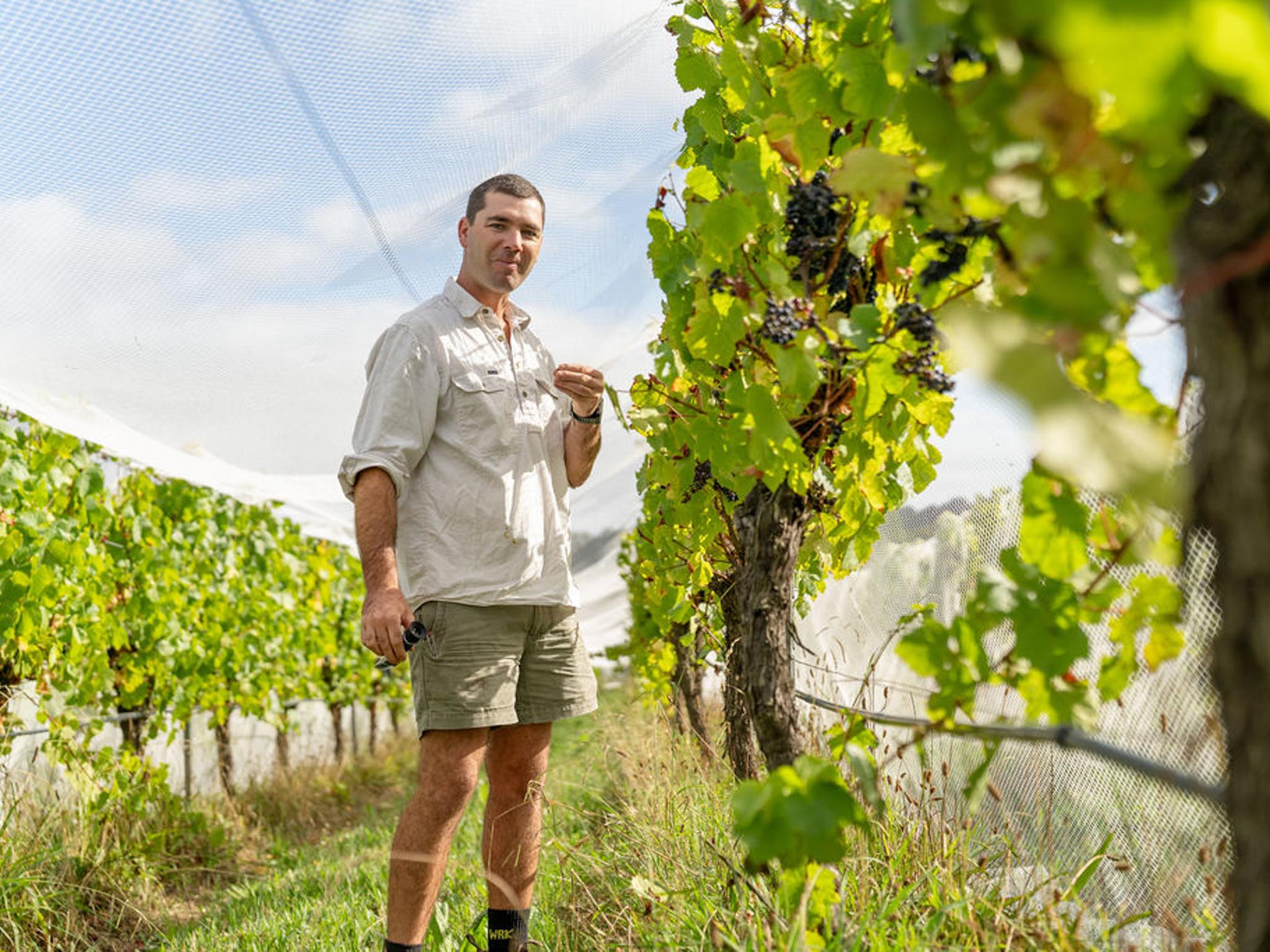
Lucas Blanck grew up at Domaine Paul Blanck in Alsace – one of that region’s most respected family estates – before a vintage in Australia in 2010 led to a life on the Mornington Peninsula instead. Kerri Greens, the label he runs with his wife Alyce, launched in 2015 and has grown from a single-vineyard chardonnay into a range spanning riesling, chardonnay, pinot noir, sauvignon blanc, rosé and a small clutch of aromatic and experimental wines. A grower-maker in the truest sense, Blanck leases and farms four vineyards across Red Hill South, Balnarring and Tuerong with organic practices across all sites (not certified) – and the project is deliberately counter-programmed to the region’s pinot noir and chardonnay dominance. Riesling is the true focus, made in an Alsatian idiom that has no real precedent on the Peninsula, and it is quietly reshaping what the region is capable of.
The path from Alsace to the Mornington Peninsula was never the plan. “Originally I always imagined making wine under my family estate in Alsace,” says Blanck. “But life had other plans – I moved to Australia, fell in love, and ended up building a life here.” The love in question is Alyce, who grew up on the Peninsula. After completing vintages at Domaine Zind-Humbrecht and Domaine Trimbach during his formal studies in Alsace, and a vintage in Bordeaux in the Côtes de Blaye, Blanck arrived in Australia in 2010 for a vintage with Quealy – one of the Peninsula’s most progressive producers. He stayed, became vineyard manager, and guided the Balnarring vineyard to certified organic status over the following years. By 2015, working the land he loved but yearning to put his own ideas into practice, he launched Kerri Greens alongside his role at Quealy. He stepped away from that position entirely in early 2023 to focus solely on the label.
The four vineyards Blanck farms are each at different stages of development, and each tells a different part of the Mornington Peninsula story. The Hickson Vineyard in Red Hill – where he began in 2013 – is a heritage two-acre block of P58 clone chardonnay planted in 1982, regenerated from lyre to VSP trellising and farmed without herbicides, systemic fungicides or insecticides, with sheep as natural mowers, annual cover crops and dry-grown vines. The Silverwood Vineyard in Balnarring, under management since 2016, sits in a localised rain shadow on poorer soils that push the vines harder, producing bolder, more powerful fruit. The Kayes Paddock in Red Hill South – taken on in 2024 – holds the old-vine riesling that is the source of the flagship Citrea, on an elevated, north-east facing site overlooking Western Port Bay, with a slower ripening season that builds flavour while holding freshness. And the Turners Vineyard in Tuerong, also added in 2024, is an entirely pinot noir site that contributes to the multi-vineyard Par Foi blend. “The wine is really made out in the field,” he says, “so the parcel or block we’re working with will shape the style more than anything I do in the winery.”
Across all sites, the organic (not certified) approach follows the same principles: no herbicides, no synthetic fertilisers, cover crops sown in every second row during spring to improve soil health, then mulched down in October to return organic matter to the soil. Most vineyards are dry-grown; where irrigation infrastructure exists, Blanck has chosen not to use it – a decision he stands by philosophically, even if practically it has taught him a hard lesson. “Don’t plant vineyards without irrigation, even in regions that get reasonable rainfall,” he says. The Silverwood site has been progressively converted to arch cane pruning – a technique from Blanck’s Alsatian background where the cane is bent into an arch along the trellis wire, distributing growth more evenly along its length. “Arch pruning opens the canopy, giving better airflow and more balanced fruit distribution along the cane,” he says. “It tends to produce slightly smaller bunches and a more even ripening pattern, which helps with both quality and disease pressure. In the wines, that translates to cleaner fruit expression and better balance, particularly with aromatic varieties.” At Kayes, the focus has been on restoring vine balance after years of conventional high-yield farming – shorter canes, fewer large cuts, gentler practices that allow the old dry-grown vines to express themselves properly rather than pushing volume. “These old dry-grown vines are now being nurtured with greater care,” he says. “We have adjusted pruning to restore vine balance and unlock the vineyard’s full potential for high-quality Riesling.”
In the winery, Alsatian instincts are equally present. Old oak – barrels that have been used enough times to no longer contribute flavour – is preferred for riesling, adding gentle texture and integration without masking the variety’s natural aromatic profile. Sulphur additions are kept low, averaging 35 to 40mg/L total, rarely exceeding 50. No acid additions in most cases. No fining. Generally no filtration. “Our philosophy is minimal intervention both in the vineyard and the winery,” says Blanck. “The aim is to let the fruit express itself while still making wines that are clean, stable and enjoyable to drink.” The Peninsula’s maritime climate – surrounded by Port Phillip Bay, Western Port and Bass Strait – means picking windows can close faster than expected, and the fresher style Blanck is after can be lost if harvest is delayed. “You often have to make the call earlier than you might ideally want to, otherwise the style can shift away from the fresher profile we aim for,” he says. “It requires a lot of constant observation in the vineyard and being ready to act when the timing is right.” In warmer years, canopy management adapts accordingly – more cover retained to protect against sunburn; in cooler years, the canopy opened earlier to encourage airflow. The golden rule above all of it: “Don’t be lazy. If something needs to be done, do it. If a wine needs attention, act quickly rather than waiting and hoping it fixes itself. Anticipation is always better than reaction.”
The ambition from here is to stay Peninsula-focused and push further into Alsatian varieties – more riesling, and ideally gewürztraminer and pinot blanc if the right sites present themselves. “There will likely be a stronger focus on Alsatian varieties, particularly Riesling,” he says, “and hopefully Gewürztraminer and Pinot Blanc if we can find the right sites. The goal is gradual growth while refining both the viticulture and the expression of these varieties in the region.” For a winemaker who could have inherited one of Alsace’s great estates and chose instead to build something from scratch on the other side of the world, the direction is clear. “Honestly, it’s instinct – it’s in the blood,” he says. “I grew up around vineyards and winemaking, watching my father work with his own vision. That naturally shapes the way you approach things.” He is, by his own admission, most happy on his tractor in the vineyard. Everything else follows from that.