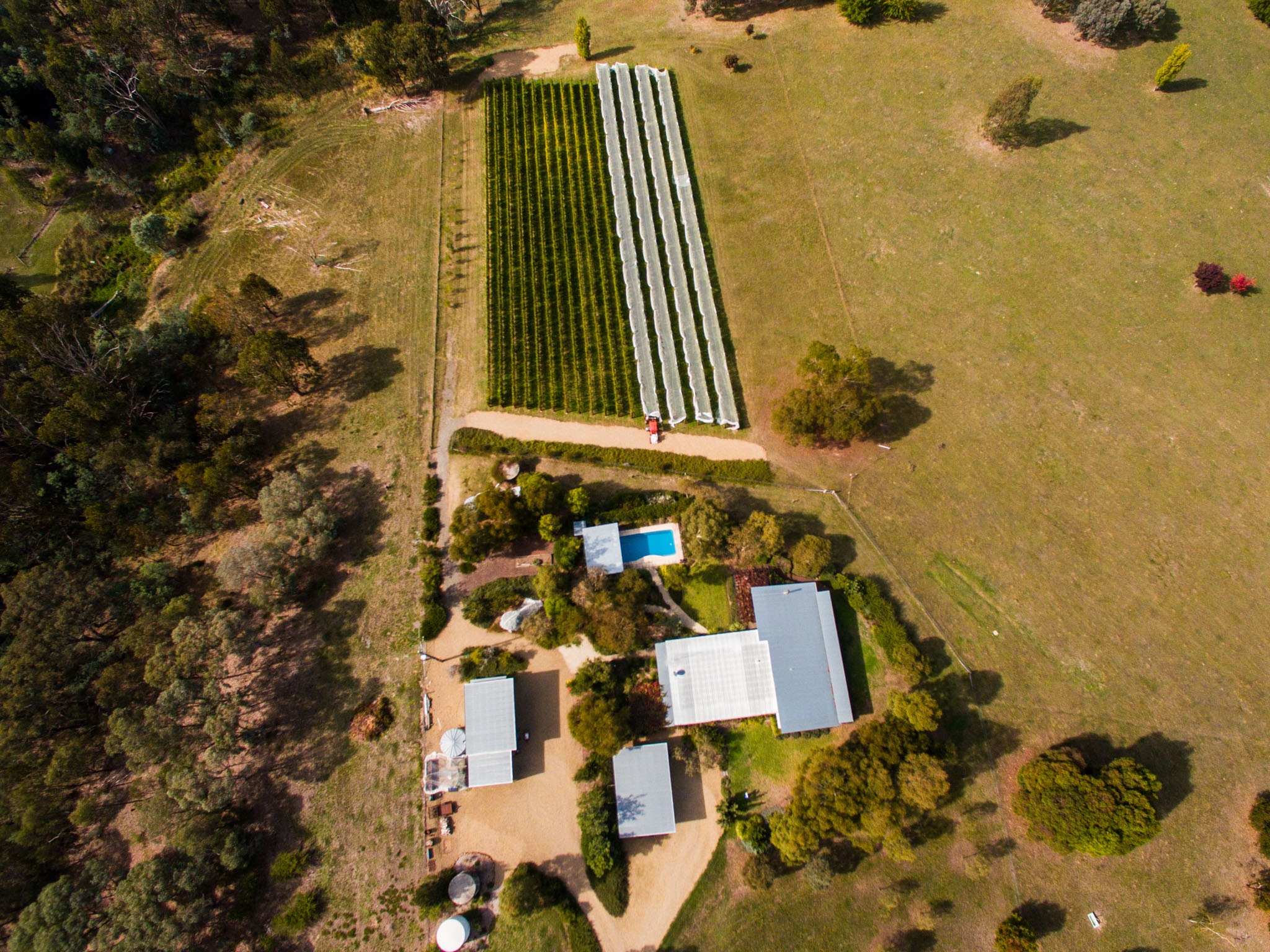
The Pipan Steel Vineyard is the result of a dedicated quest to find the perfect site for nebbiolo in Australia. Paula Pipan and Radley Steel caught the bug for nebbiolo through tasting Barolo and other Piedmontese examples, then searched across the length and breadth of Australia’s winegrowing regions for the perfect site to grow this famously finicky variety. The half-hectare vineyard they now call home, in the Alpine Valleys region of Victoria, is ideally suited for nebbiolo – at 400 meters elevation, bathed in fog throughout winter, and with high diurnal temperature range, its climate frequently mirrors that of Barolo. As you might expect, nebbiolo is the only variety grown here, in the form of three separate clones – each chosen for their contrasting qualities.
“Stylistically, it’s our intention to make nebbiolo that nods to its Italian heritage, but is very much Australian in nature,” says Pipan Steel’s co-proprietor, winemaker, and co-viticulturist, Paula Pipan. “That is, one that entices the drinker with inviting aromatics, backed up with balanced flavours, chalky textures and smooth, long finish. To achieve this we had to ensure the vineyard site was inland – that is, continental in climate, with large diurnal temperature differences – and in a sub-alpine location at around 400m elevation with heat accumulation data similar to the Piemontese hills.” Pipan and Steel’s quest for this perfect site lead them across Australia, from the Hunter Valley to Margaret River, until they found the perfect spot in Mudgegonga, in the foothills of the Victorian Alps. “If you squint really hard, you can see the similarity with the rolling hills of Piedmont – though sadly, no castle on each hilltop!” says Pipan.
“Alpine Valleys and the nearby King Valley and Beechworth regions are hilly country,” Pipan adds. “There are many mesoclimates within the various aspects of the hills and valleys, so they’re suitable for a broad range of varieties … our regional climatic conditions result in good acid retention, fine tannic structure and flavour development, characteristically producing wines with great texture, flavour, length and balance – with excellent potential for aging.” She adds: “Our site faces Mt. Buffalo and Mt. Hotham, so slightly cooler than Beechworth and King Valley. We tend to pick later than Beechworth and King Valley nebbiolos – the extra hang time theoretically allows for extra flavour development, though clonal variations and vine age will also influence flavour profile. Beechworth tends to produce bigger, more tannic-style wines and usually earlier release. We look for aroma retention, slow maturation and later release.” The region comes with its own challenges, though – not least amongst them being frost: “Proximity to the Alps means frost risks, so frost mitigation strategies are employed,” she says. “For example, when not able to choose later budburst varieties” – and one of Nebbiolo’s famous difficulties is that it buds early and ripens late – “you need frost fans, or, as we have done, planting down the hill instead of across to allow for cold air drainage.”
This downward row orientation has advantages other than frost mitigation – it also allows for Pipan Steel to chase purity of clonal expression in nebbiolo, further refining their understanding of the many facets of this complicated variety. “Many years ago, a CSU academic – I’ve unfortunately forgotten their name – in conversation suggested planting clones by row,” Pipan says. “Our vineyard has repeated plantings – a row of Mat 7, then a row of Mat 9, followed by a row of Mat 10 – right across the vineyard. This means that any variations in soil or aspect are distributed across all three clones.” These three clones – sourced from Italy’s Gruppo Matura – are all vinified separately, using identical winemaking techniques, and bottled as individual cuvées, each named in roman numerals after the clone in question. “When the wines are made using same winemaking techniques, you can be sure that the flavour and textural differences are due to the clone, and not the block they are planted on. The three single clone Nebbiolos that we produce are stylistically quite distinct and identifiable as the specific clone from vintage to vintage,” she says. A fourth cuvée, ‘Tesoro’, blends all three: “Clonal selection is also important to achieve the complexity of savoury, aromatic and textural elements working in balance in our ‘Tesoro’ blend,” Pipan adds.
While the climate and altitude of Mudgegonga might be similar to Barolo, there are many salient differences beyond a lack of hilltop castelli. One them is soil type – the decomposed granite here helps curb nebbiolo’s natural vegetative vigour. Another is wildlife. “When pruning late this past winter, we had a wombat join us every afternoon, intent on munching the clover in our midrows,” Pipan says. “Wombats make us nervous due to their reputation for being prodigious diggers, so we gave it a gentle little nudge with a foot to encourage its departure. This experience turned out to be like trying to nudge a bulldozer – no detectable movement occurred apart from the occasional side-eye in our direction. This wombat remained unperturbed by our presence, kept hoovering up the clover, and left lots of manure in its wake. Fortunately, it has not been seen since!” Yellow-tailed black cockatoos, by contrast, make their presence known by sharpening their beaks against the vine trunks, leading to what Pipan calls an ‘eye-watering’ amount of vine replacement. “We are managing these with scare tactics in the evenings when they tend to want to congregate and chew in the vineyard,” she says. “They have now moved on, but we are researching bird scaring drones or possibly ultrasonic bird scarers for next spring.” Despite the hassle they sometimes bring, for Pipan, these wildlife encounters are valuable reminder that “we share our space with the native animals that were here before us.”
As this perspective suggests, vineyard management here is oriented towards the long-term, with a focus on soil health and sustainability. “After the initial ripping-up and liming of the vineyard site, we have had seventeen years of composting and mulching undervine, plus the mulching of prunings in the midrows,” Pipan says. “This has dramatically changed our soil profile – the pH is now around seven when it was initially 4.6, soil moisture retention has improved under the mulch, and soil organic matter has slowly built up. Our midrow growth is a mix of native and pasture species – although since the Black Saturday fires in 2009, we have noted much stronger clover growth in late winter and early spring, maybe due to a pH change from the ash?” Likewise, not all of the property is dedicated to vine, and Pipan Steel have invested in native revegetation to help balance the local ecosystem. “The southern end of our property has a band of wetlands across it,” Pipan says. “We have fenced these off and revegetated with local native species – with the help of our local Landcare group. In summer, we open the gate to the neighbour’s cattle to keep the pastures down around the outside of the fenced wetlands, which helps reduce fire risk.” They have contingencies for a warming climate, too: “We have room to plant further around the cooler side of the hill if the climate heats up too much and the spring-fed dam does not dry up,” Pipan says. “Our east-west row orientation helps to reduce heat problems that are experienced with western aspects. We also push lateral shoots from the south side to the north in a ‘comb-over’ style to help protect fruit from sunburn.”
The vineyard’s small size keeps the entire project at a human scale. “We have deliberately kept our vineyard site small, so that Radley and I can handle most of the work, but employ some locals at peak times,” Pipan says. “Not only does this give us total control over management practices, but also keeps us intimately connected to our vines. The vineyard is often referred to as our third child – the one that will never leave home.” Employing locals helps create and sustain connection to the Mudgegonga community. “Picking time is very community oriented as a whole bunch of locals help us do it,” she says. “As we pick one clone at a time, we are finished by morning tea – which is always a sumptuous home-baked cake affair that keeps the pickers coming back year after year.” Similarly, she sees Pipan Steel as part of a village of other nebbiolo growers across the country. “There is always robust discussion with other nebbiolo producers about ‘best’ practices,” Pipan says. “Most of us agree on the importance of vineyard site and clonal selection – though we may not all agree on where and what these should be.” For her own part, though, she’s very happy working with this fussy variety in a spot that seems to have been precision-calibrated for its needs. “When you look up from working in our vineyard, the vista is breathtaking,” she says. “Even when pruning in the middle of winter, when the icy wind is whipping off Mt. Buffalo, you can’t help but pause and watch the light change.”
GET FIRST ACCESS TO THE NEXT WINE ICONS – DELIVERED