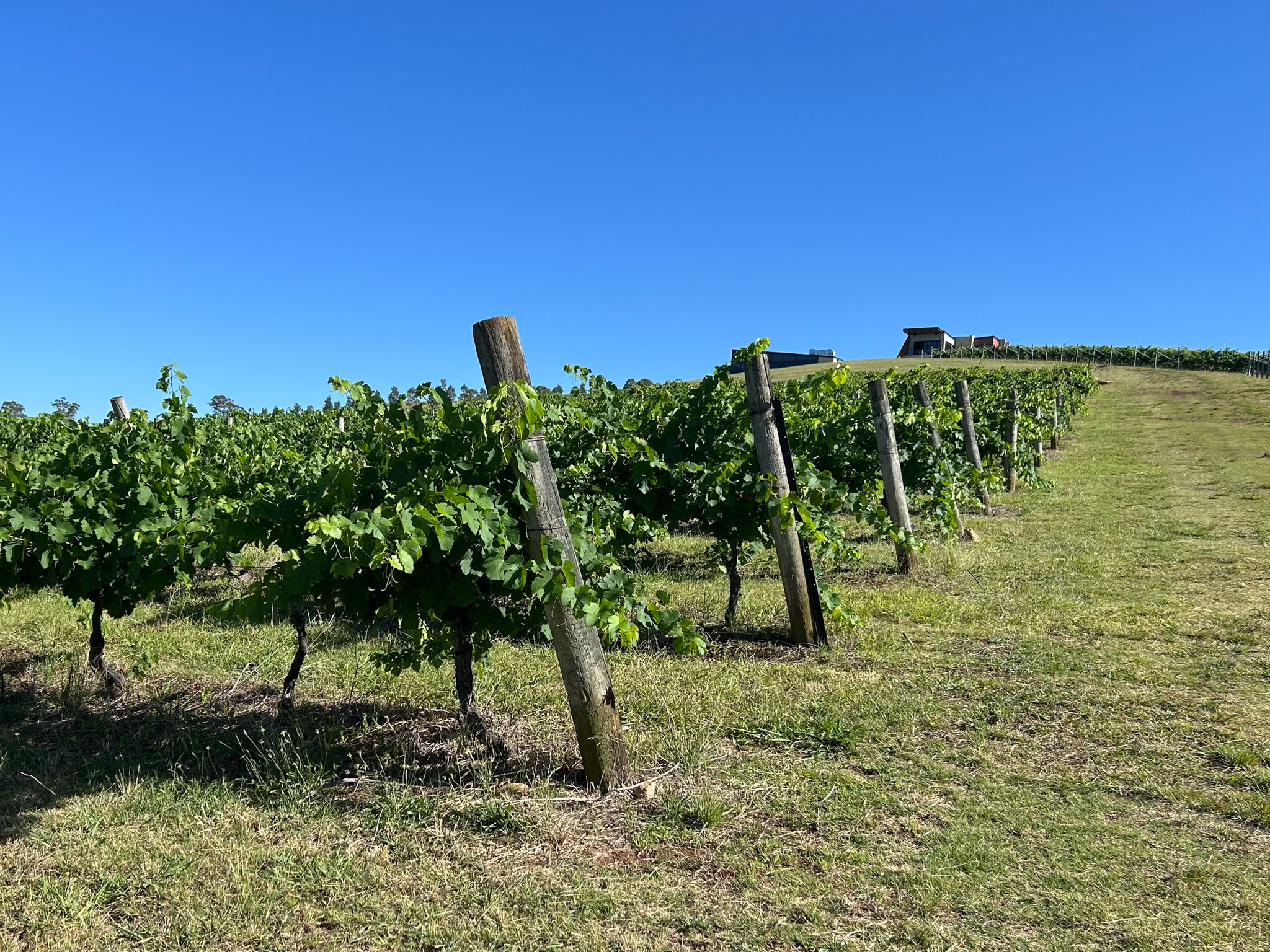
Mount View Estate is a vineyard steeped in Hunter Valley wine history. Established by famed viticulturist Dr. Harry Tulloch in 1971, who was attracted to the quality of its red basalt volcanic soils over limestone bedrock, it formerly served as an open-air laboratory for clonal trials. Since then it has transformed into a fully-fledged wine label, now under the direction of winemaker and viticulturist Scott Stephens. The approximately five hectares of shiraz, semillon, pinot noir, verdelho, and durif here are mostly old vines from Tulloch’s initial planting – but that doesn’t mean that vineyard management here is old-school. Instead, Mount View Estate is a case study in how older vineyards can be brought into the twenty-first century using the principles of sustainability and sensitive viticulture.
Somewhat paradoxically, the inspiration for the biggest change in Mount View Estate’s viticultural operations came from a moment outside of the vineyard: “When excavating for our new winery and tourism facility in 2019, we noticed how shallow our topsoil is,” says Mount View Estate’s winemaker Scott Stephens, who also took over the reins of viticulture from former vineyard manager Tom Cant in 2020. “This started us thinking about how precious this topsoil is – and how our whole farming and future depends upon looking after it!” This was a lightbulb moment for both Stephens and Cant, who immediately began reconsidering the estate’s conventional management systems: “We then queried our practice of cultivation, because this allowed our topsoils to be disrupted and degraded, and allowed for potential losses of soil by wind and rain. By keeping a vegetative cover, we are protecting that soil, and gradually building it back up over time. A vegetation-covered soil is a cooler soil – so when the mercury hits forty degrees over summer, I bet the vines are glad they have their roots in cooler covered soil, rather than hotter cultivated soils. I’m sure this has positive impact on vine physiology and fruit quality.”
Stephens talks about his approach to vineyard management with an admirable frankness, calling his approach ‘conventional lite’ – an amalgam of mainstream Australian viticulture and as many organic and regenerative principles as the vineyard’s position in the warm and humid Hunter Valley will allow. “Due to the Hunter’s northerly latitude and proximity to the coast – as well as having half our annual rainfall over the spring and summer months – disease pressure is high,” Stephens explains. “Whilst we endeavour to use the cheapest and softest sprays we can – invariably ‘organic’ sprays – we still have to resort to a small amount of synthetic chemicals.” (The limited number of synthetics in use do not include any pesticides or glyphosate.) One of the biggest drivers for this reduction in chemical use has been the cost of those synthetics – not just in terms of impact on people and ecosystems, but also on the accountant’s bottom line: “The tough times we are experiencing in the industry has certainly laid bare our input costs,” Stephens says. “We now look very closely at what inputs we use in our viticulture, and try to minimise chemical usage wherever we can. We definitely will do some trial blocks to test if not doing a certain thing or not using a certain chemical is going to be the end of the world!”
Stephens calls this shift in mindset ‘farming smarter’, and points to a pared-back vineyard spraying regime as evidence of the shift. “We only spray when required – based on what we can see in the vineyard and reasonably accurate weather forecasts, not when historical practices or chemical companies tell us we should,” he says. “We have managed to reduce our vineyard foliar spraying from twelve to fourteen times per year down to seven or eight. We have reduced our weed-spraying down from five to three.” The benefits here are not restricted to a smaller chemical bill, as Stephens explains: “This reduced amount of spraying has flow-on effects as well – less diesel use, less load on the tractor, so less soil compaction, et cetera.” All up, he sees the benefits in this change in thinking as “a win-win – for people, planet and profitability.”
Implementing these win-win changes requires some forethought and the investment of both time and money, as the changes to Mount View Estate’s vine training system demonstrates. Most of the estate’s vineyard has been painstakingly converted from a spur-pruned ‘Aussie sprawl’ of vines on trellises made of wood treated with chromium, copper, and arsenic (CCA) to a system of cane-pruned vines with vertical shoot positioning (VSP) on an all-steel trellis. “Going from Aussie sprawl to VSP canopy management has greatly helped our pest and disease management approach,” Stephens says. “Air flow has increased, which has decreased disease pressure; sunlight interception has increased, helping with fruit ripening and decreasing disease pressure; and spray penetration is better, which has decreased disease pressure.” (Stephens argues that the reduced disease pressure from this retraining of the vines is one of the key reasons he can pare back the estate’s spraying program.) He adds, “While steel posts are more expensive, removing the CCA-treated posts and replacing them with steel posts is a real boon for people and planet. There’s no leaching of CCA into the soil, and no cutting down forests for wood. Steel posts can be recycled; CCA posts can’t. And over time it will be better for profitability, as this system will have a greater life than CCA posts.”
In line with the renewed focus on soil health, the estate has switched to both hand-pruning their vines and hand-harvesting grapes – a process that avoids compacting the soil and is gentler on the vines. “The pruning and picking of our vines is all done by hand.” Stephens says. “It’s more expensive to do this, but over the long term the results are better – older vineyards that are in balance with their site, producing commercially viable yields of high-quality fruit.” He’s passionate about the ill-effects of machine harvesting in particular: “When you hand pick you are very gentle on the vine and trellis, so you need fewer remedial actions – a machine harvester just belts the shit out of everything,” he says. Moving to hand-harvesting has not just benefited the health of the vineyard – it has also allowed for much more freedom in the winery. “When you hand-pick, you can sort the fruit better, throw out fruit that doesn’t meet quality criteria, and so on,” Stephens says. “In the winery, you have more options with hand-picked fruit versus machine-picked fruit – you can do whole bunch pressing, whole bunch fermentations, et cetera. Hand-picking our grapes has been one of the biggest things we have done in the vineyard to improve our finished wines in terms of both quality and style.”
Hand-harvesting also allows the team to make multiple selective passes of vineyard blocks – an important consideration given the clonal diversity on show here from when Mount View Estate was Harry Tulloch’s trial vineyard. “Harry was famous for pioneering the shiraz ‘1654’ clone – and Mount View Estate was Harry’s little laboratory, so there are different clones all over the vineyard,” Stephen says. “Different shiraz clones are planted in our shiraz block – not all vines are the same. Over this seven acres, the shiraz grapes ripen at different times, so we generally pick this block over four occasions and keep each batch separate in the winery.” Although this is a time-consuming and resource-intensive approach, it pays dividends in Stephens’s ability to create wines across a wide range of quality levels and price points: “This block has the potential to make estate-grade wine through to flagship-grade wine – often both in the same year!”
Although the changes that have taken place at Mount View Estate are impressive, Stephens remains modest about his achievements. “Precious few things in this world are novel – oftentimes they are a re-iteration or re-invention,” he says. “Like everybody in farming today, we are trying to be as sustainable and minimalist as we can, which is better for our staff health, environmental health and financial health.” A changing climate means further adaptations will be necessary: “Having an old vineyard is a great resource and a pleasure to work with, however some of our row orientation is not ideal,” he says. “We see a lack of water being an issue in the future, so we are investigating drought tolerant rootstocks for all new plantings.” Despite the hard work ahead, Stephens is honoured to be looking after this vineyard, and helping to keep the legacy of the late Harry Tulloch alive: “This was one of the first vineyards I visited when I came to the Hunter Valley in the early 1990s,” he says. “The man who brought Mount View into life, Dr. Harry Tulloch, was actively involved in his business, and he sold some of his surplus grapes to another winery in the Valley that I was working at. I managed to strike up a professional relationship with Harry, who provided me with advice over the course of my career. When I started as winemaker at Mount View Estate in 2013, Harry had sold the business. However, he still lived over the road, and continued to maintain a professional and personal interest in the vineyard – including telling me what not to do!”