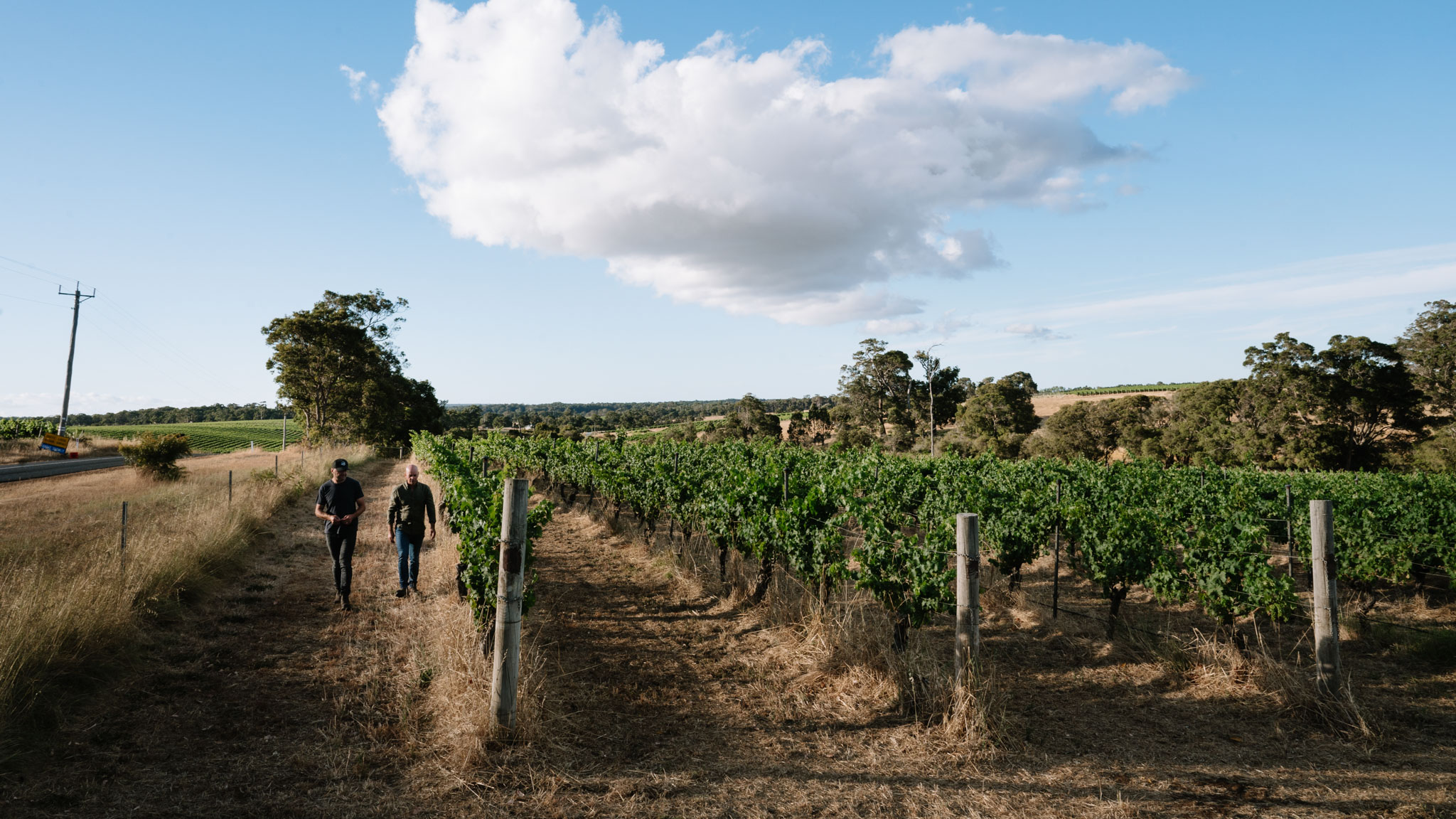
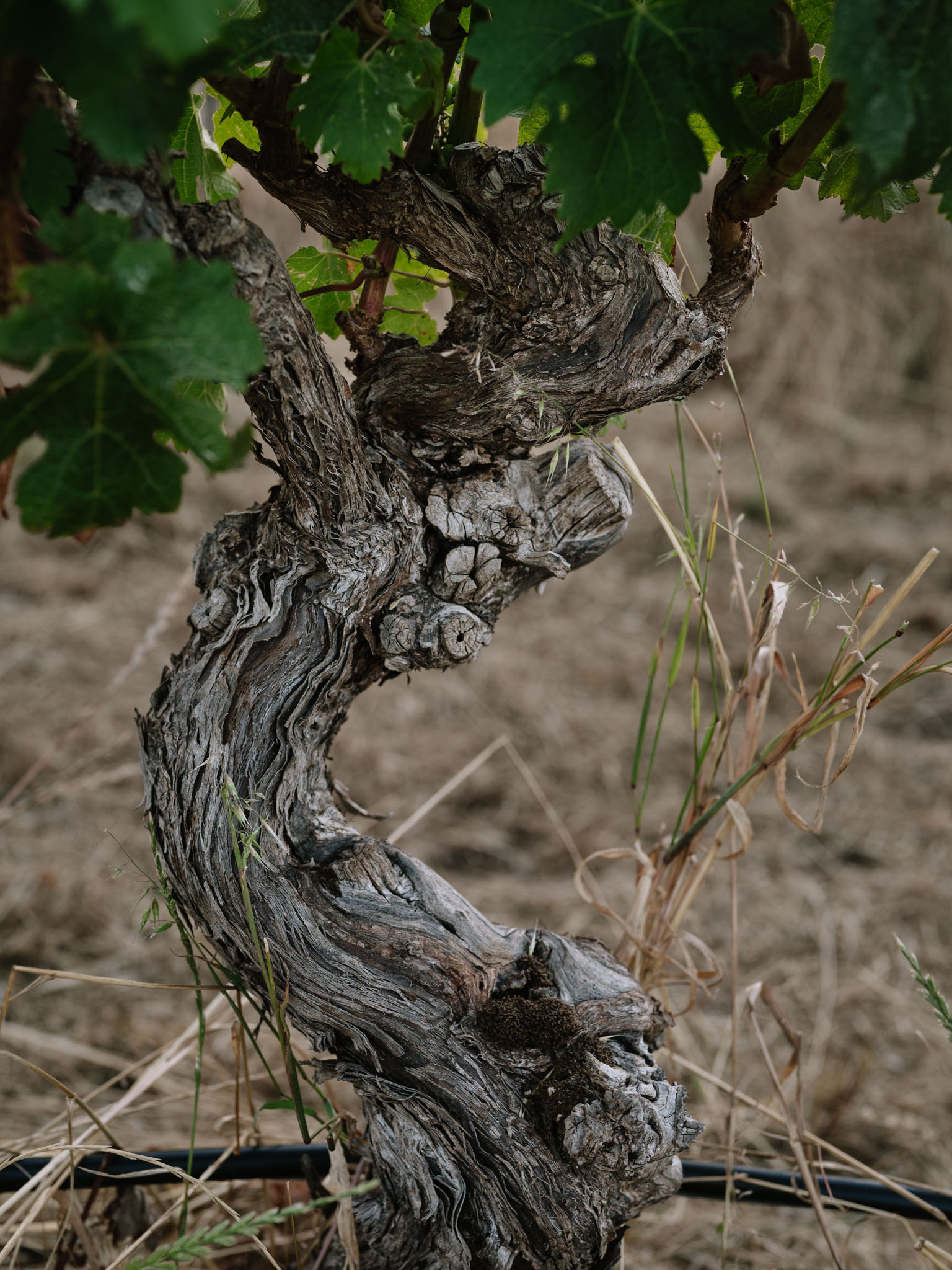
At just 0.85 hectares, Lirica – Hutton Vineyard is one of the smallest vineyards in this country to produce its own wine. Planted in 1976 in the Wilyabrup subregion of Margaret River – the heartland of Australian cabernet sauvignon – it carries 49-year-old vines on their own roots, dry-farmed, in gravel loam over clay, on a mid-slope east-facing site that captures morning light and sidesteps the heat of the afternoon. Since 2017, the vineyard has been leased and managed by Lee Haselgrove, one of Australia’s most respected viticulturists, who helped Swinney Vineyards claim the inaugural YGOW Vineyard of the Year in 2020. Here, working on a scale where every vine is a decision, Haselgrove is building toward a single wine – Lirica – that he believes can make a meaningful contribution to the conversation around fine cabernet sauvignon.
The vineyard sits in distinguished company. Willespie, Ashbrook, Sandalford and Moss Wood are neighbours, all of them long-established custodians of Wilyabrup’s reputation. Fruit from Lirica – Hutton Vineyard has historically fed some of Margaret River’s finest labels – Cape Mentelle in the 1990s, Deep Woods, Stella Bella – a testament to the quality of a site that has been sought after by discerning producers for decades. Haselgrove spent his first five years farming the property, selling fruit to others, using those seasons to rebuild the soil, eliminate irrigation, and understand what the site could become. When 2023 arrived – a vintage with the attributes he had been waiting for – he held back the fruit and made Lirica himself. The wine will release in 2026.
“I spent many years searching for a Grand Cru cabernet sauvignon site in Margaret River to bring my energy to, to grow and share a wine that I believe can contribute very positively to the reputation of both cabernet sauvignon and Margaret River.”
The scale of the operation is, Haselgrove admits, slightly embarrassing. But in practice, the smallness of the place is its greatest asset. At 0.85 hectares, every vine can be individually observed and managed – pruning decisions, shoot thinning, crop load, canopy architecture, all calibrated vine by vine rather than row by row or block by block. The textbook definition of single-vine viticulture, applied to a site where vine balance is already excellent. All the work is done by Haselgrove himself. “I love the solitude and connection to plants and place that comes from working every vine myself,” he says. “Although I seek help with the bird netting. That is the worst job ever. Rage Against the Netting Machine is a real feeling.”
The central philosophy is equally compact: dry farm, feed the soil, slow the sugar, and wait for tannin ripeness. Haselgrove’s great preoccupation – built across 25 years of growing cabernet in Australia and informed by extensive time in Bordeaux, Piedmont and Hawke’s Bay – is the relationship between sugar and phenolic maturity. The Margaret River climate, generous and reliable, is both cabernet’s great friend and its subtlest adversary. “A Bordeaux colleague once described cabernet sauvignon as ‘the easiest variety to grow, but the hardest to grow well’,” he says, “and that resonates strongly with me.” Sugar accumulates quickly in Wilyabrup’s warmth; tannin maturity takes longer. The gap between the two is where clumsy wine is made. “All of my thoughts, strategies and actions are completely focused on trying to achieve physiological ripeness at 12–12.5 Baumé. All of our focus is about capturing the site, and the season, in the bottle.”
“All of my thoughts, strategies and actions are completely focused on trying to achieve physiological ripeness at 12–12.5 Baumé. All of our focus is about capturing the site, and the season, in the bottle.”
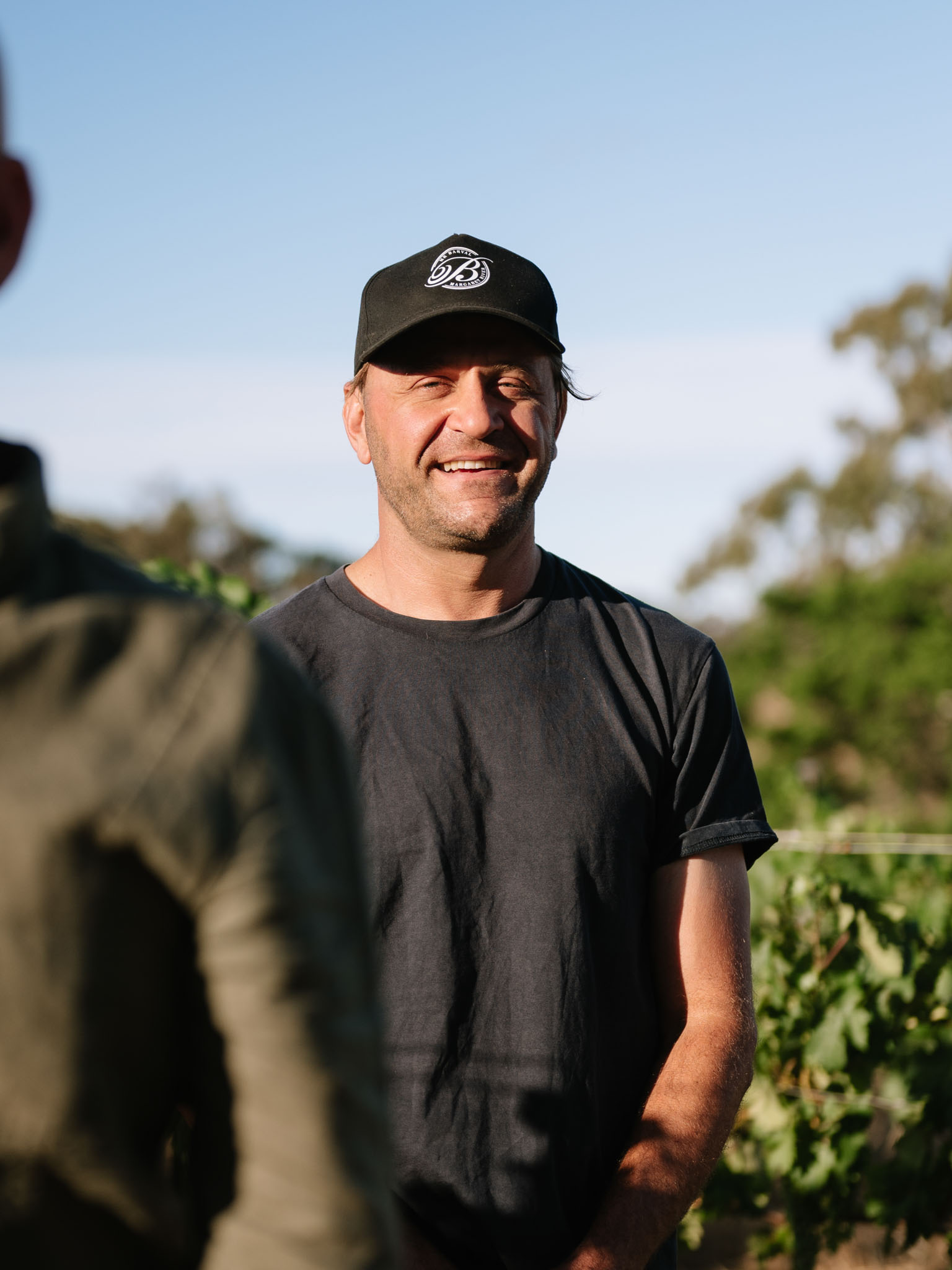
Opposite: Lee Haselgrove. “A Bordeaux colleague once described cabernet sauvignon as ‘the easiest variety to grow, but the hardest to grow well’,” he says, “and that resonates strongly with me.”
That ambition shapes every decision at Lirica – Hutton Vineyard. Rather than reducing yield, Haselgrove carries a moderate crop with a deliberately restrained photosynthetic canopy, slowing sugar accumulation so that flavour and tannin ripeness align. The vine’s east-facing aspect plays into this – cooler afternoons, longer ripening curves, more time for tannins to develop without sugar racing ahead. Haselgrove’s goal is to harvest in autumn, not summer. “That is the best definition of site suitability for a variety that I have ever heard,” he says.
The soil program has been the quiet engine of it all. Since taking over in 2017, Haselgrove has recorded measurable gains in organic carbon – assessed annually with Microbiological Labs Australia – through high-quality compost applications and diverse multi-species cover crops, always legumes, cereals and brassicas, never grasses, with calcium-to-magnesium ratios corrected to encourage deep, expansive root development. No herbicides have been used since he took the lease. Targeted cultivation is used not to manage weeds, but to break up shallow root systems and force roots downward into the clay-loam subsoil. The logic is direct: deeper roots mean access to stored winter rainfall, which means the vines can be dry-farmed without stress. “I have been nurturing this site for nine seasons now,” he says. “It’s responding very well.” The results show in the fruit chemistry – achieving full physiological maturity at 13 Baumé now, with the target of 12 to 12.5 Baumé firmly in sight, and fruit clean enough to sustain four to five weeks of post-ferment maceration without issue. “We never need to add acid – which I despise – as we have the perfect composition in the fruit,” says Haselgrove.
Irrigation – almost an article of faith in Australian viticulture – is essentially absent at Lirica – Hutton Vineyard. An emergency system exists on the property, but Haselgrove has used it once in nine seasons, during the exceptional heat and dryness of 2024, running it for two to three days in the manner of a deep soil soak. “I have a strong view that sustainability has three pillars: environment, community and business,” he says. “Sustainability has to be economic first, otherwise there is no money or time to act with vision and purpose.” He is equally blunt about what irrigation does to the wines it makes possible. “Australian viticulture has a lazy and unhealthy reliance on irrigation. It’s a powerful lever, and very few people understand or even consider the impacts of pulling on that lever.” His frustrations extend to the picking decisions that often follow. “Lots of clumsy wines result from winemakers making a ‘no pick’ decision and waiting for the weather to tell them to pick. Talk about hiding from responsibilities. However, Margaret River isn’t the Hunter, or Burgundy, so you actually need to make a decision – the weather won’t make it for you.” The antidote, for Haselgrove, is partnership: with a like-minded winemaking collaborator who shares his goals, who eats and tastes and wonders alongside him. “Cooking, tasting widely, and wondering aloud with thoughtful wine people is nourishing.”
That partnership principle is what underpins his model at Lirica. “I don’t own the property, but have a long-term lease over a very small part of a much larger property,” says Haselgrove. “It operates as a very lightly grazed mixed farm, so I sometimes graze sheep, or young cattle in the block during the late winter. Sustainability has to be economic first, otherwise there is no money or time to act with vision and purpose.” The economics are made to work through precision rather than volume. Ultra-premium fruit from a meticulously managed old-vine block commands prices that justify the investment in soil, time and manual labour. It is sustainability of the most elemental kind: make something rare and irreplaceable, and the case for its existence makes itself.
For Haselgrove, the conversation about what makes a site special is a pointed one. “With respect, I don’t think much of the concept of regional characteristics,” he says. “Regionality is a marketing ideal, likely dreamed up by a moderated focus group. Regions don’t do the work. The soils and the people do the work. Deeply invested wine enthusiasts and collectors don’t trust ‘regions’ with their money. They trust individual producers in regions. The people that think more deeply, and act with purpose, at every level, over long periods of time. Consistency of purpose and concurrent behaviour matters.” It is a philosophy that cuts to the heart of what Lirica represents: not a flag planted in a fashionable appellation, but a very particular piece of ground, farmed by one person who knows it vine by vine.
Lirica – Hutton Vineyard sits in the Burgundian tradition in more than just spirit. “My site is very small and very defined,” Haselgrove says. “Lirica is like a small plot in Burgundy or Barolo.” Build a wall around it, and you could call it a clos. Forty-nine-year-old cabernet sauvignon, on its own roots, dry-farmed, in mid-slope Wilyabrup clay – this is a site with deep roots in both the literal and historical sense. Haselgrove is in no doubt about the destination. “I spent many years searching for a Grand Cru cabernet sauvignon site in Margaret River to bring my energy to,” he says, “to grow and share a wine that I believe can contribute very positively to the reputation of both cabernet sauvignon and Margaret River. Lirica is the perfect site for me to practice my craft.”
GET FIRST ACCESS TO THE NEXT WINE ICONS – DELIVERED