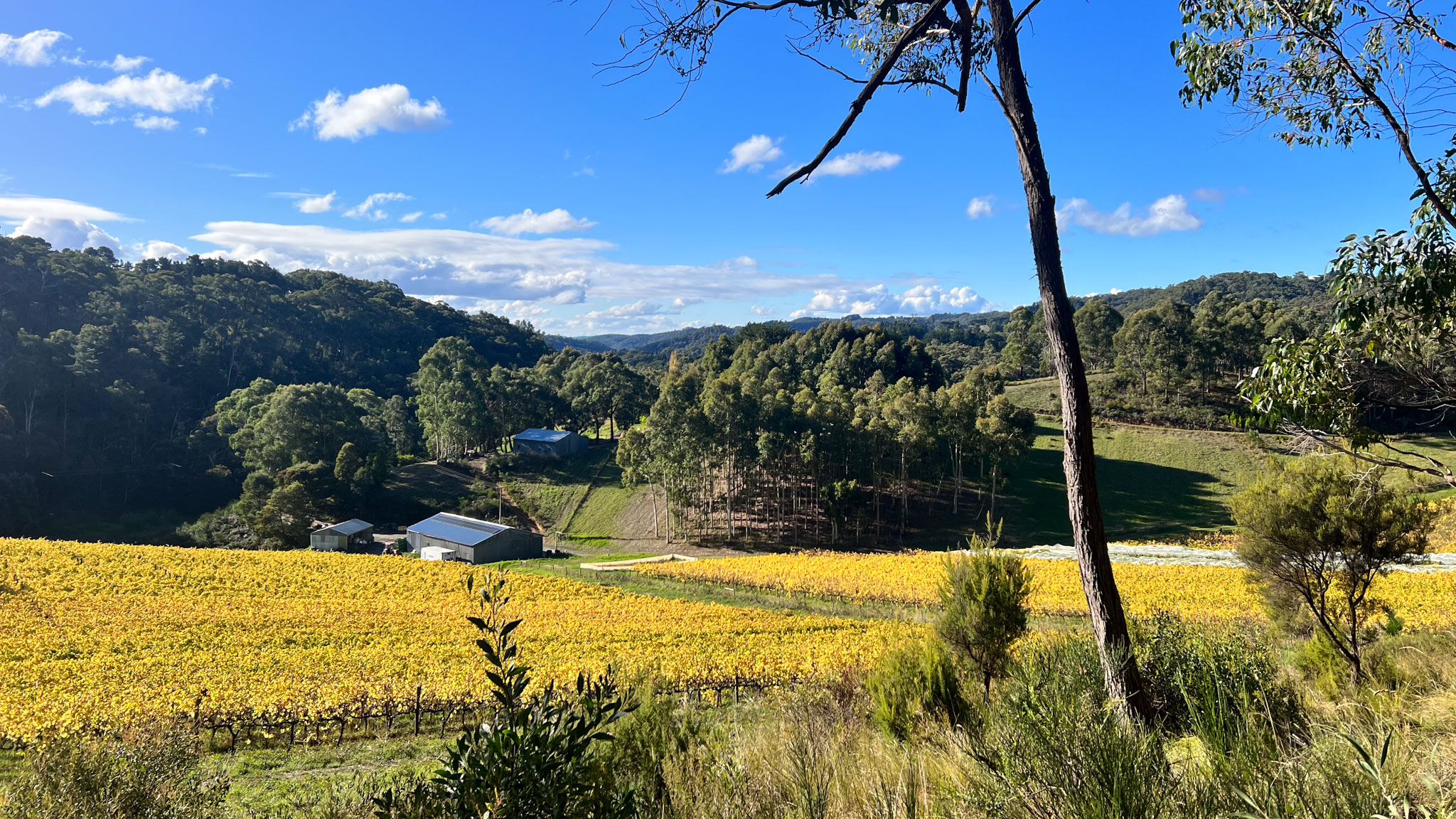
Jasper Button’s journey is, in many ways, an archetype for many others who were formerly lumped into the category of ‘natural winemakers’. That cultural moment arrived in the early 2010s, generated a lot of buzz online – not to mention sometimes harsh criticism from the vinous establishment – and turned a generation of young Australians on to the delights of wine. But what happens after the both hype and the hatred dissipates? For Jasper and his sister Sophie, what’s next is about going back to basics – and the current incarnation of the Commune of Buttons project is all about celebrating the birthplace of the project, Fernglen. Here Jasper tends to four hectares of pinot noir, chardonnay, gamay, chenin blanc, nebbiolo, and cabernet franc, nestled amongst twenty-eight hectares of rolling hills and bushland in the Piccadilly Valley sub-region of the Adelaide Hills.
The Commune of Buttons project got started somewhat accidentally. Jasper Button returned to his family’s farm, Fernglen, in 2012, having grown up on a vineyard, but not having been bitten yet by the wine bug. Like many other Adelaide Hills vineyards, Fernglen had been established in the early 1990s to take advantage of the first wave of interest in the Hills’ cool-climate wines – and had no problem finding buyers for its fruit, particularly its chardonnay, courtesy of the interest generated by Brian Croser’s Petaluma label and Shaw & Smith. But by 2012, the business model of selling fruit to large players wasn’t working any more, and Button started reaching out to smaller boutique producers in search of new clients. That got him in touch with Anton von Klopper of Lucy M, and, well, the rest is history … But, like many of the other leading lights of the natural wine scene, the wines Button is now making are a far cry from the hoary old ‘natty wine’ stereotype of funky, cider-like concoctions with screeching acidity and a host of technical flaws. Instead, they are clean, precise and supple articulations of terroir – and most of the fruit for them now comes from the original Fernglen property.
“Piccadilly Valley has shorter daylight ripening hours compared to vineyards further south in the world, thanks to its latitude,” Jasper says, “but we are at altitude, between 300 and 600 metres, and have bigger diurnal shifts, meaning that it’s often cool in the evening and in the mornings. This means that we have to grow cool-climate grapes to find optimal ripeness. Pinot, chardonnay and sauvignon blanc dominate the slopes – but I would suggest other varieties that are not yet widely planted might find success, such as cabernet franc, gamay, and chenin.” Within that regional framework, the Fernglen site is special: “We are completely surrounded by hilltop stringybark gum forests, and in the valleys there are two permanent creeks that cool the air in the evenings,” Jasper says. “The vineyards sit where the soil is healthy, but not too vigorous. The vineyards are perched on sandstone shelves, and once the roots get into the sandstone there is a lot of water, so we can dry-grow our mature vines.” The bush surroundings also help retain humidity, even in the height of summer, ensuring that the vines rarely experience dehydration stress.
Appropriately for a figure who cut his winemaking teeth at the forefront of the natural wine movement, vineyard management at Fernglen is based on organic and biodynamic principles (not certified). Button deploys biodynamic preparations and compost to encourage mineral uptake in the vines, inter-row and under-vine cultivation to activate soil bacteria and release nitrogen, a targeted regime of cover crops to build soil health, and a regenerative pruning program based on Simonit and Sirch’s updated Guyot-Poussard pruning method. “Those ‘a-ha!’ moments in viticulture often come about from mistakes that can be years in the making,” Button says. “An intimate knowledge of your site only comes with time. How do we come to understand our vineyard? We have to spend time with it, and make mistakes. Vines are very forgiving and will grow anyway, but to grow them well requires an intimacy that comes from knowing what to do – and, most importantly, when to do it.” That awareness of time extends to a zen-like patience: “A regenerative pruning project might take ten years before you really see the results,” he says. “You have to be patient in viticulture, and trust that the work you are doing is doing good. Changes in soil structure, plant diversity and vine health all take place over a number of years.”
Button’s meditative approach flows through to the winery, too: “That the vineyard informs the winemaking is one of the biggest lessons to learn in wine,” he says. “You can’t put into a grape what got left out – and the faster you come to terms with this, the faster you can make interesting wines from your site. You have to work within your limitations – every vineyard is limited in some way in terms of the wines it can produce. Understanding that process is very important from vintage to vintage.” Getting to that level of understanding isn’t a cheap process, either, entailing lots of expensive labour: “Viticulture is expensive, because it requires many man hours to complete the work – and we would always like to do more in the vines, to give ourselves every possible opportunity to make wines that show the vineyard’s full potential,” he says. “It’s a labour of love. This pushes up the cost of production – and therefore the price of the bottle. Our biggest challenge is to convince the consumer that it’s worth spending an extra ten or twenty dollars on a bottle of wine because it is from a grower-producer – and it is worth it!”
As Button’s thoughts on the price point of his wine indicates, he sees the economic, social, and ecological aspects of sustainability as fundamentally intertwined – even if their demands are sometimes at odds. “Farming is about the economics of productivity,” he says, “but what farmers forget is that a farm is on land – and not all of that land is used for farming. So how do we integrate the two, and can they be beneficial to each other? Can a vineyard be more sustainable or economical via the use of the ‘unused’ areas that surround it?” As the ratio of vineyard area to bushland at Fernglen indicates, Button’s answer to that question is that those ‘unused’ areas are in fact vital parts of a connected ecosystem – one that human beings are an inextricable part of. “I think vineyards before the mechanical age were always social places, as it took many hands to complete the work,” he says. “I would like to think we carry the same ethos of the past in what we do at Commune of Buttons. We prune and green prune with the same group of people every year, and we pick our own vines with the help of the same vintage crew who arrive from around Australia and the world each harvest. Vineyard work is repetitive and sometimes uncomfortable – but with the right group of people, it can be very rewarding and life-affirming, which is why people return year after year. People often are searching for meaning and purpose, and you can find that very quickly in a vineyard during vintage!”
As with most other growers, warming weather patterns is a key concern: “Climate change, in our experience, is all about extremes – and each season that passes we learn to adapt and build resilience,” Jasper says. And while he’s looking forward to Commune of Buttons’ recent plantings of gamay, chenin blanc, and cabernet franc to start fruiting enough to commence serious production of wines from these varieties, he doesn’t see them as a panacea for the various issues that accompany climate change: “I’m not sure new varieties are the answer – but perhaps they represent new ways of adapting to the extremes in weather within each season and figuring out what works and what doesn’t,” he says. Part if that adaptation is knowledge-sharing with other viticulturists – both within the immediate Adelaide Hills community and globally. “The community is great, and is very important in the process,” he says. “It’s also is a worldwide thing – as soon as you meet another vigneron in France, or anywhere in the world, you can talk vines and viticulture, often long into the night. It’s an all-consuming passion, and the knowledge shared between likeminded people is always inspiring.” He also draws inspiration from the site itself, and its many denizens. “I love the seasonal nature of the work here – the black cockatoos, the white cockatoos, kangaroos, red-bellies, wattle birds, magpies, rosellas, deers, wedgies and hawks, possums, and very occasionally echidnas. There is so much unique and beautiful wildlife that surrounds the vines that I enjoy being a part of – most of the time, that is!”