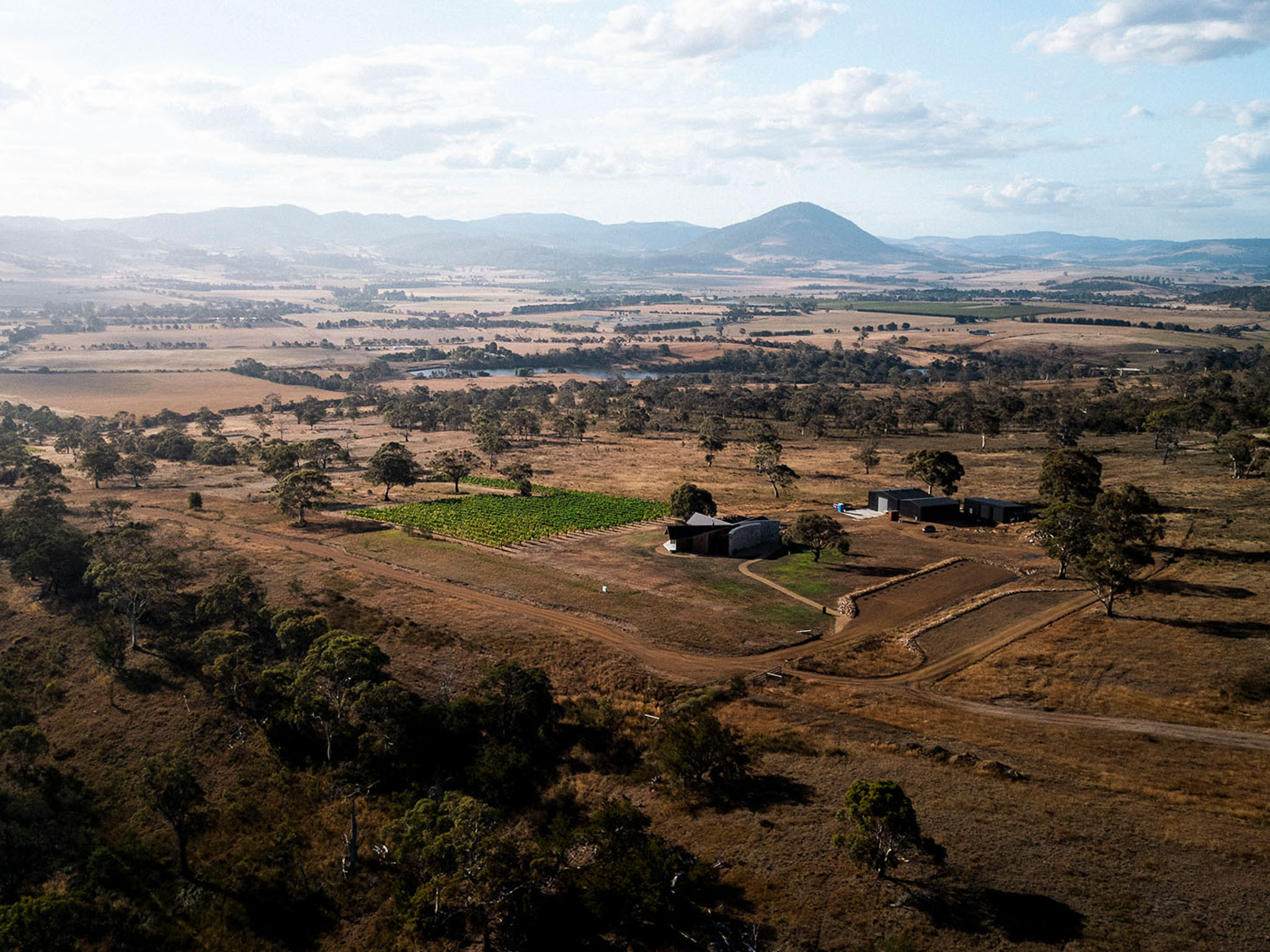
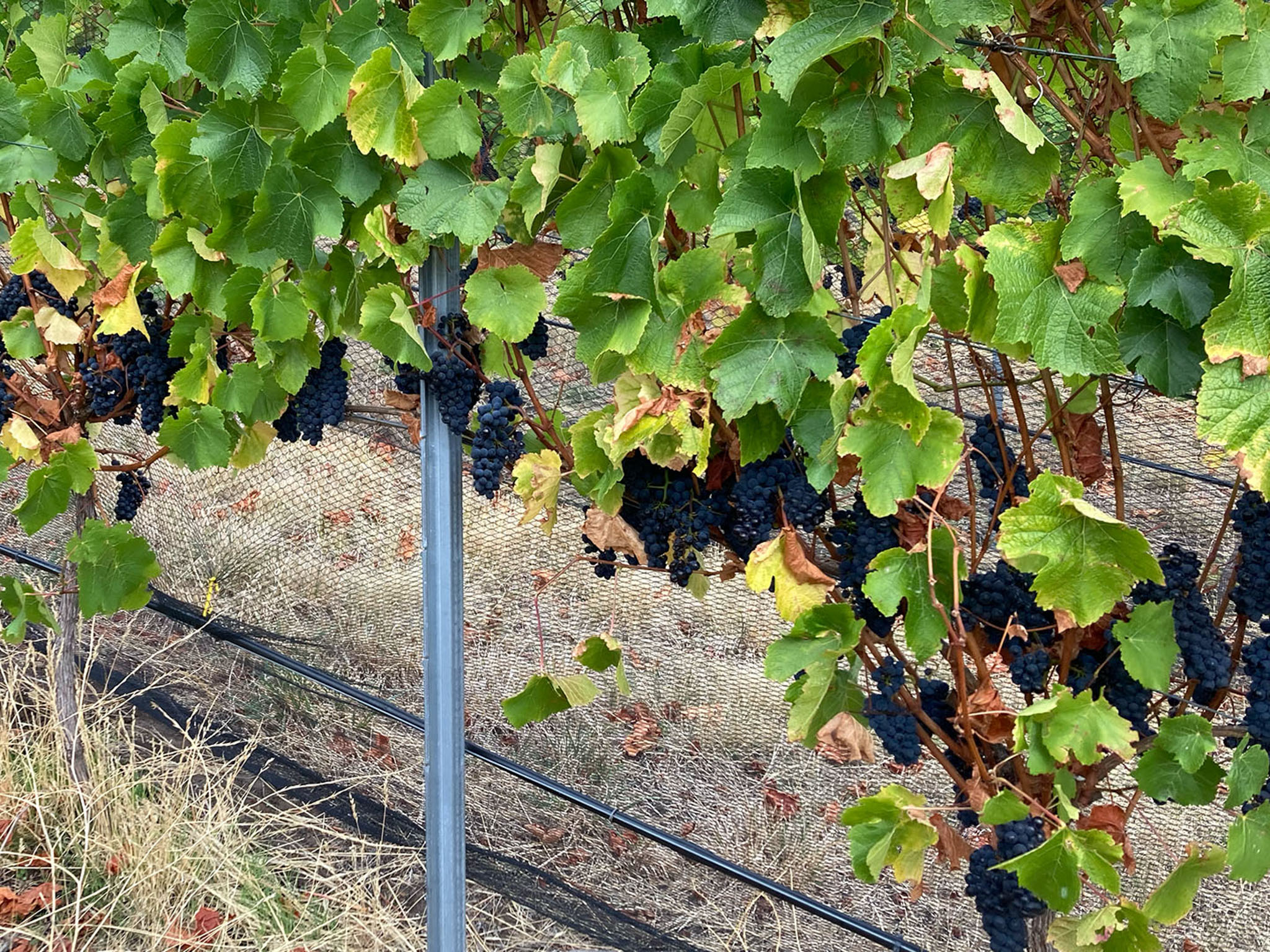
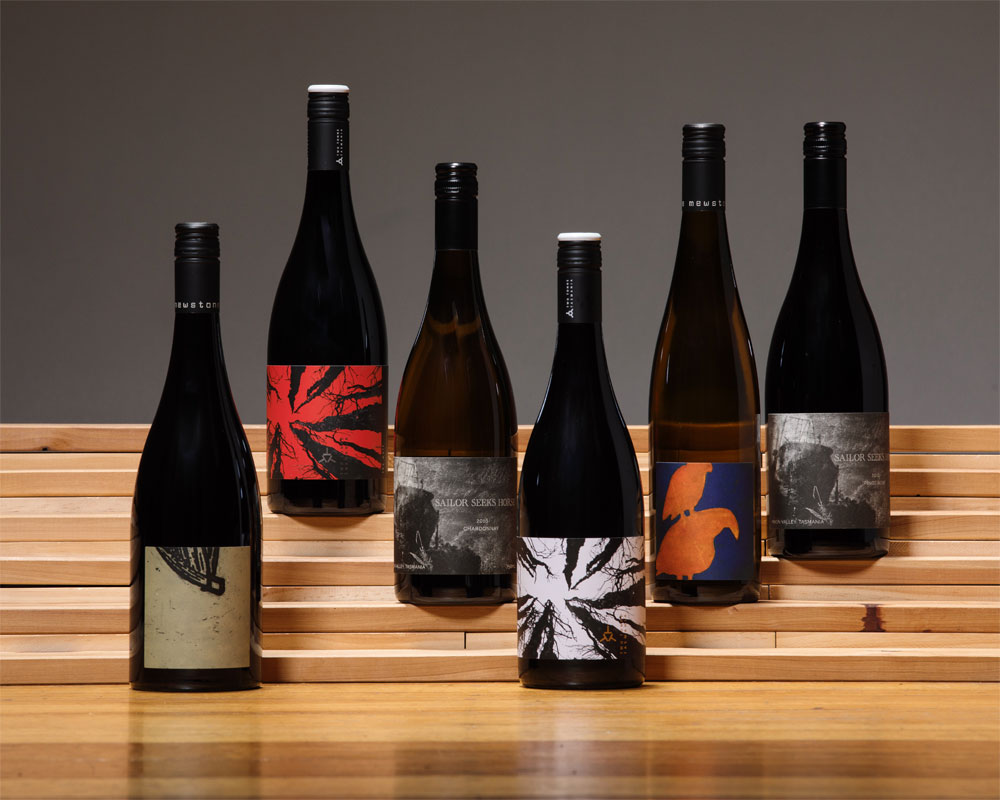
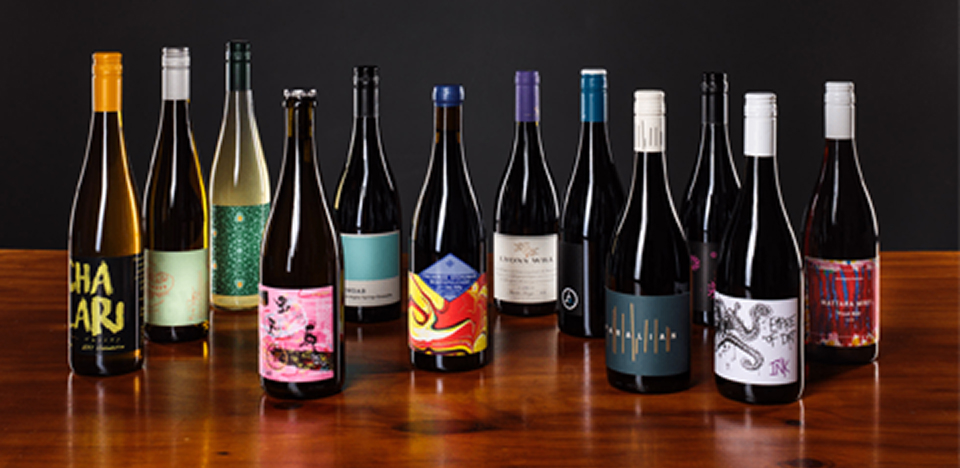
Caledon Estate is a young vineyard on an uncompromising site. Planted in 2019 by owners James and Karen Stewart on a steep, exposed property in Tasmania’s Coal River Valley and today managed by viticulturist Justin Folloso, the 11.27-hectare vineyard climbs from 30 metres above sea level at its lowest point to 140 metres at its highest, battling prevailing north-westerly winds, shallow rocky soils and a harshness that the site makes no attempt to conceal. Six-year-old vines of pinot noir, chardonnay, sauvignon blanc, pinot gris, riesling and a small planting of cabernet sauvignon grow on their own roots, sourced mainly from cuttings from Spring Vale on Tasmania’s east coast. The fruit is made into the Caledon Estate range by winemaker Matt Wood of Spring Vale, with small parcels sold to select producers – including a pinot noir to Cave Wines – as the label builds its range of single-vineyard bottlings. It is early days, but the wines are already drawing attention, and the site itself is unlike anything else attempted in the state.
Viticulturist Justin Folloso came to Caledon by way of a cricket match. He and owner James Stewart know each other through an annual Winemakers vs. Distillers fixture; when Stewart reached out to see if Folloso might be interested in looking after the vineyard, the timing wasn’t obvious. Folloso and his partner Rosario had spent the year running Cave Wines, leasing vineyards of their own, and returning to employed work wasn’t part of the plan. “Keeping an open mind, I went out to see the site and was just blown away,” he says. “The slopes, the exposure, the soils, the views – this place could make beautiful pinot noir and chardonnay. There is, for lack of a better word, terroir here. It’s unique.” He took the role. The arrangement evolved into something resembling a modern métayage – Cave Wines takes a little fruit, and Folloso brings his full attention to a vineyard he describes as having motivated his career decisions. “The site dictates the work that will need to be undertaken,” he says. “And for us, we will only ever be working towards what’s in the best interest of the vineyard.”
What the site dictates is considerable. Caledon sits on the side of a range of hills with a generally westerly aspect, and the geology changes dramatically as elevation rises. At the base of the vineyard, the riesling, sauvignon blanc and sparkling varieties sit on 800 to 1,000 millimetres of lighter clay loam over sandy loam, with sandstone beneath, producing expressive, mineral wines with a lively finish. Moving up one side of a central gully, the pinot gris block at 80 metres sits on only 300 to 500 millimetres of red to brown clay over sandstone – hitting bedrock early, producing wines of taut structure and quiet intensity. On the other side, the majority of the vineyard climbs to 140 metres, where 500 to 700 millimetres of brown to black clay over dolerite supports the main pinot noir blocks and some chardonnay. “Working with the shallow top soils and hard rock bases leans into keeping yields at a good level for quality,” says Folloso. “It also means that for such a young vineyard, you can specifically see in some cuvées how hard the root systems and vines are already working, which translates into quite structured and complex wines.”
The difference between the site and the broader Coal River Valley floor – where most vineyards sit on alluvial soils – is stark. Most of the valley is farmed on the flats; Caledon is on the hill. The elevation and aspect mean more sunlight hours, better phenolic development and a natural capacity to reach both sugar and phenolic ripeness in balance. The wind, though, is a constant presence. The spring north-westerlies sweep through the valley during flowering and fruit set, acting as a natural yield mitigant and keeping everything in check. “I love leaning into 60km gusts and almost getting bowled over,” Folloso says. “I love how pieces of dolerite keep making their way to the surface and make sure you’re awake in the tractor as you find them with the slasher.” The harshness is not a problem to be managed away; it is part of what the site is. “Some of the greatest wines come from the harshest of environments,” he says. “We’re looking to turn the lower yields and more expressive wines into our favour.”
The vineyard was farmed conventionally for its first five years under previous manager Josh Winen, who established the vines well. Folloso arrived with the aim of moving the program firmly toward organics – a direction that aligns naturally with the values of the Stewarts, who planted the vineyard with the explicit intention of leaving the land healthier for the next generation. In doing so they removed exactly one tree. All existing ancient white gums were retained; the areas not under vine have been set about regenerating. “Their values of preservation are intrinsically felt as you drive up the driveway and feel a part of the land among the native grass and gum trees,” says Folloso. This season, all fungicides and herbicides were switched to organics. Caledon became the first vineyard in Tasmania to use the bioherbicide Firehawk, a decision that exceeded expectations: not by producing a conventionally tidy vineyard, but by leaving no bare earth for erosion, oxidation or new weed seed beds. Native grasses – retained from generations of sheep grazing before the Stewarts arrived – have been kept under vine rather than eliminated, maintaining soil structure, moisture retention, functioning mycorrhizal networks and habitat for beneficial insects. “The soil has always had a high level of organic matter,” Folloso says, “but it is nice to see the worm population under vine when digging into some of the native grass instead of the dusty grey earth from previous herbicide sprays.”
The approach to weed management has been one of the great evolving lines of thinking at Caledon – a subject Folloso describes as “a series of moments which will likely continue.” Cultivation was always an option, but the slopes, the wind and the risk of erosion made it feel wrong for this specific site. In a workshop at the AWITC, a line from panellist Dan Falkenberg struck a chord with Folloso: “It felt awesome that instead of going into work with the intent to kill living things, we were actually helping things to grow and live.” Under-vine mechanical control equipment will be purchased for next season, with the plan to run two mechanical passes and one bioherbicide pass per year going forward.
The intention is for all of this to show in the glass. Winemaker Matt Wood of Spring Vale has increased his use of wild ferments each year, a confidence built on the character of the fruit Caledon provides. “We think that’s only going to result in more unique wines that speak of this beautiful site,” says Folloso. “Obviously it’s our goal to grow clean fruit with character to continue giving him the confidence to push provenance.” Wood himself is said to remark that he doesn’t have to do too much with the wines – a signal, Folloso suggests, of what a great site makes possible. “When you hear a winemaker say something like that, it’s fair to assume they’re working with some great fruit from an excellent site.”
Irrigation is under constant refinement, with the aim of pushing vine roots deeper rather than maintaining surface comfort. A slightly more frugal water program in 2025 contributed to a modest decrease in acidity across most varieties, which in turn made it easier for Wood to find structural balance in the wines. Cordon and irrigation wires have both been raised across the vineyard – in preparation for under-vine mechanical equipment but also to create a shorter canopy and longer ripening window, giving more time to achieve the tannin profile Folloso is seeking: riper skins, seeds and stems, at the right sugar level.
Beyond the farming, the Stewarts have built Caledon as a place for the community around it. Tourism Tasmania and Wine Tasmania have chosen the cellar door and vineyard to host events. The Caledon Crawl – an 850-metre race up the vineyard driveway, started as community fun – now raises funds for Landcare Tasmania. Folloso is the first to note the value of the broader human ecosystem too. “We talk about terroir and one element that often gets overlooked is the culture of the people of the region,” he says. “Pretty rich terroir down here.”
The site is young, the vines are six years old, and there is no long history here yet. But the foundations being laid – in the soil, in the farming philosophy, in the relationships between owners, viticulturist, winemaker and community – suggest that what is being built is intended to outlast all of them. “You’ve got to be willing to play the long game,” says Folloso, “but the greatest rewards come from a slow burn.”