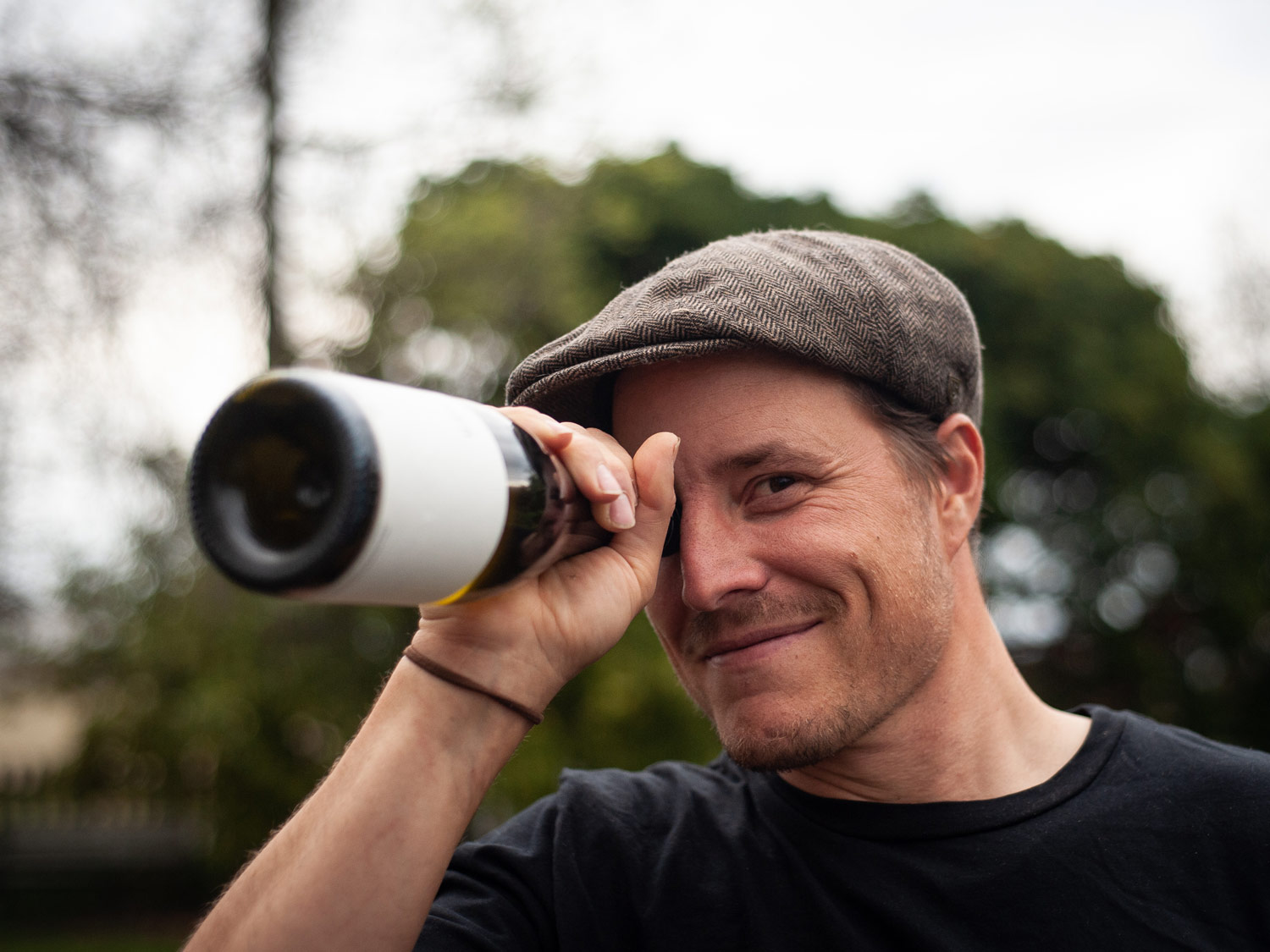
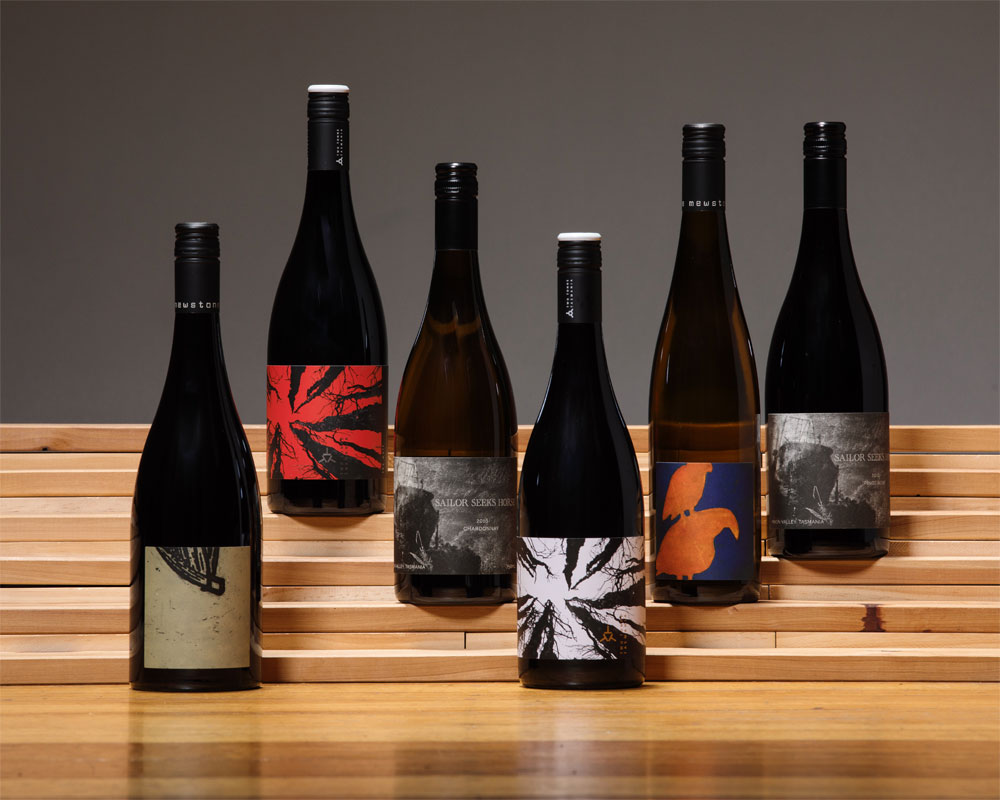
Matthias and Lauren Utzinger are the Swiss-Tasmanian partnership behind one of the Tamar Valley’s most purposeful young estates. Matthias brings a European winemaking formation that spans Switzerland, Provence and the southern Rhône; Lauren brings a childhood steeped in northern Tasmania. Together they planted their five-hectare estate in Legana from scratch in 2018, certified organic, at a density of 6,500 vines per hectare – a figure that says everything about how seriously they take the vineyard as the foundation of the wine. The range spans pinot noir, chardonnay, syrah, riesling and a fumé sauvignon blanc across two tiers – the White Label and the Black Label estate range – with a growing experimental program of Swiss varieties imported by Matthias himself. Their ‘Roter Satz’ field blend won the Danger Zone trophy at the 2024 Young Gun of Wine Awards, with Winemaker’s Choice following in the same ceremony – only the third time in the competition’s history a winemaker has won two trophies at the same awards.
Matthias and Lauren met in Iran, of all places, and travelled together for months before Lauren brought him home to Tasmania at the end of 2015. The effect was immediate. “Of course I fell in love with Lauren first,” he says, “but I definitely fell hard for northern Tasmania too. I love what this region offers in terms of reliability, creativity and possibilities when it comes to viticulture and winemaking. This is home for me now – the cool climate, the green hills, the varieties. It’s all a lot like my native Switzerland, just better.”
His winemaking formation had been long and deliberate before that moment. An apprenticeship as cellar hand in Switzerland, a degree in viticulture and oenology at the University of Changins, roles as chief winemaker at Gregor Kuonen in Salgesch and vigneron at Domaine de Boissière in the southern Rhône, a biodynamic internship in Provence, and eventually a vigneron role at Stefano Lubiana’s Huon Valley vineyard – where Andrew Pirie and the Lubianas became mentors and friends. “I absolutely love how we were welcomed here and the overall feel in the Tasmanian wine community,” Matthias says. “People encourage each other, help where possible, and we’re stoked to be part of the new generation down here that hopefully pushes boundaries even further.”
When the Utzingers bought their farm in 2018, Matthias planted it entirely to his own specifications – the result of years studying vineyards across Europe, New Zealand and Australia, selecting clones he considered most adapted to the site and most likely to produce textural expression from each variety. “I decided to start from scratch because I couldn’t find a vineyard that ticked the right boxes in terms of clonal selection, plant density and trellis,” he says. The organic conversion that followed has transformed the wines. “Together with the above, the organic conversion over the last two years has led to a more mineral and in many ways more terrestrial expression of our wines. Our wines have become darker, more mysterious, and I love this evolution.”
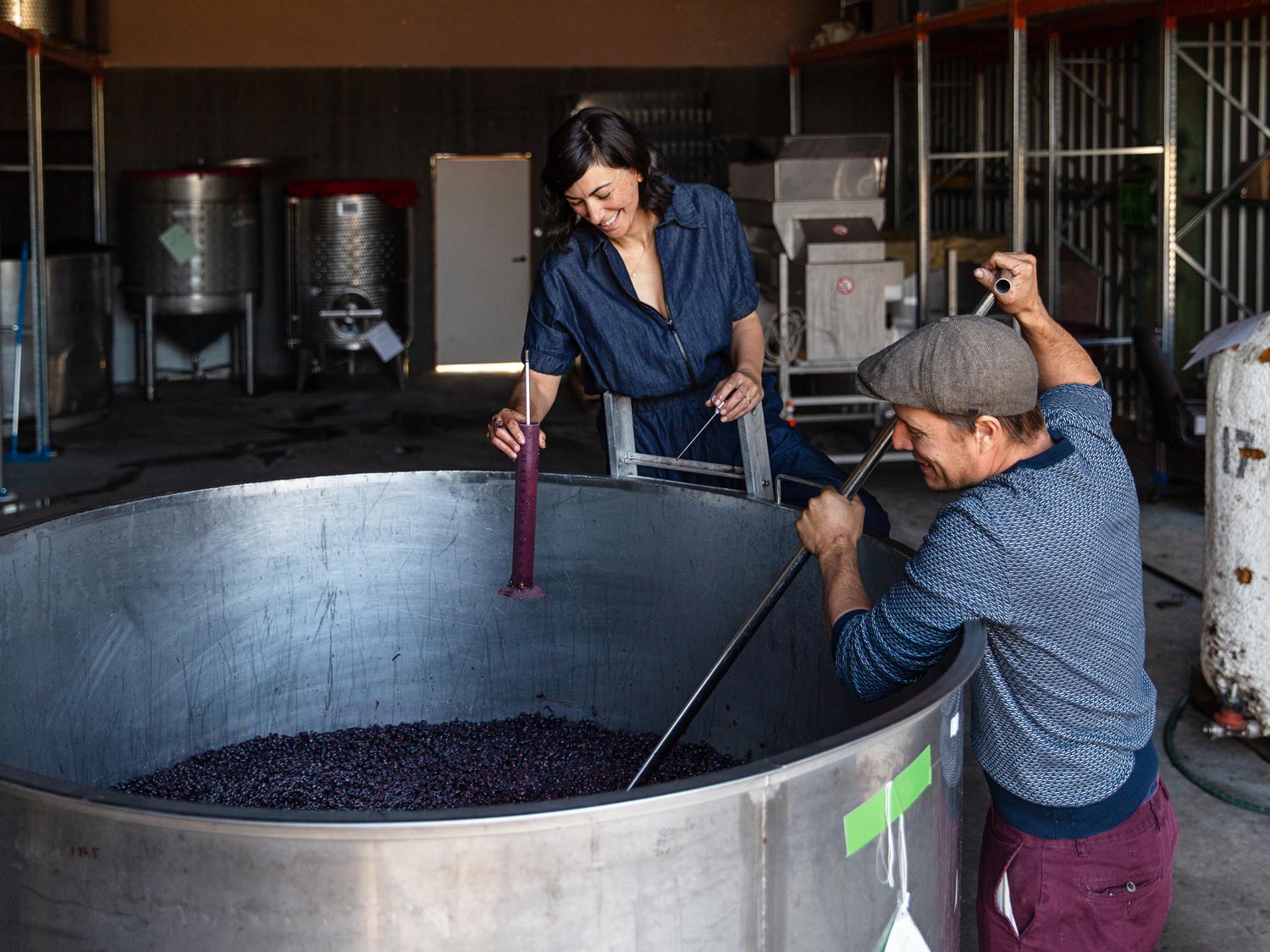
The winemaking philosophy is deliberately restrained. “We believe that wine is grown, not made,” Matthias says. “The winemaking is kept intentionally simple, with small batch ferments – wherever possible wild ferments – and no fining used. Our vision is to be hands-off, but clean and refined, and to truly represent the place and year our wines are grown from.” That feedback loop between vineyard and winery is intimate and constant. During the season he builds what he describes as a virtual map in his head of where different kinds of fruit are growing – so that by harvest, he knows exactly which parcel belongs in which wine. A change to the chardonnay leaf-plucking regime in 2023, leaving fruit more covered, produced wines that were tighter, fresher and more flinty. The kind of incremental discovery that only comes from farming your own vines, year after year.
“We believe that wine is grown, not made. All the fruit is sourced from our own vineyard or from vineyards we’re looking after.”
The wine that most dramatically captured the Utzinger spirit is the ‘Roter Satz’ – a true field blend of five varieties, radically including cabernet sauvignon and pinot noir harvested on the same day and fermented together as a single wine. A wine that looks improbable on paper and completely compelling in the glass. The 2022 vintage won the Danger Zone trophy at the 2024 Young Gun of Wine Awards – the award reserved for the most daring, original wine in the competition – with judge Nick Stock declaring it “dangerously delicious” and noting that “Matthias and Lauren Utzinger’s wines have this sense of conviction and confidence and their contribution to the excitement that surrounds Tasmanian wine is really significant.” The Winemaker’s Choice trophy followed in the same ceremony, voted on by fellow winemaker finalists after tasting each other’s wines. “Being nominated by industry colleagues is the highest praise we can think of,” Matthias said. “This really motivates us to continue on our journey.”
Recent developments have added further dimensions to the range. The first estate-grown syrah was released from the 2024 vintage. A blanc de blancs made in 2024 is ageing quietly toward a 2027 release. The 2026 vintage will see an expanded sparkling program – a sparkling rosé and a non-vintage planned – alongside a gewürztraminer fermented on skins in terracotta amphora purchased specifically for the project. And after more than six years in the making, the experimental block has finally been planted to Swiss varieties Matthias imported himself: Divico, Scheurebe – the only planting of this variety outside of Western Australia – Traminer and Riesling, with petite arvine and rouge du pays to follow. The long-term plan is an aromatic white blend in the tradition of the Viennese gemischter Satz – a field blend of multiple varieties harvested and fermented together as a homage to Matthias’s origins.
The vision from here is refinement rather than expansion. “We are in the process of dropping a lot of our winemaking contract customers in order to focus more on our wines and our site,” he says. “We are convinced that we could still do so much better and that we haven’t used all the potential that lays within our site. We also want to do those Swiss varieties justice, and hopefully release something really special which shows a deep connection to our origin and ongoing journey.” Lauren, meanwhile, is beginning postgraduate research into under-vine cover cropping – bringing academic rigour to one of the vineyard’s remaining frontiers. And the next generation is already being trained: two young winemakers are employed part-time, immersed in the vineyard as much as the cellar. “It’s that mental link that is created when you spend your time in the vineyard that I’m really passionate about and that I want to teach other people in the industry.” Stay tuned.
GET FIRST ACCESS TO THE NEXT WINE ICONS – DELIVERED