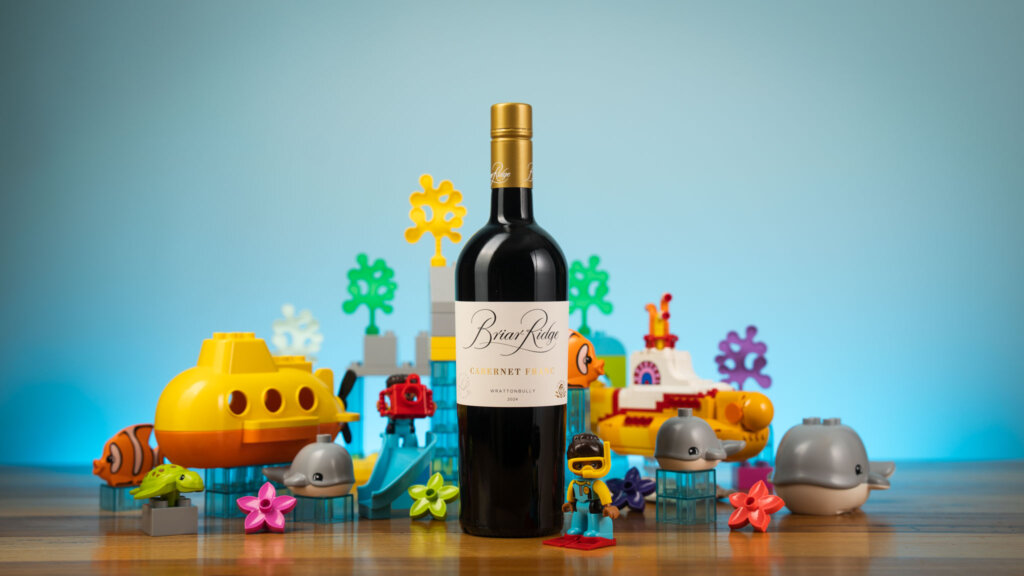
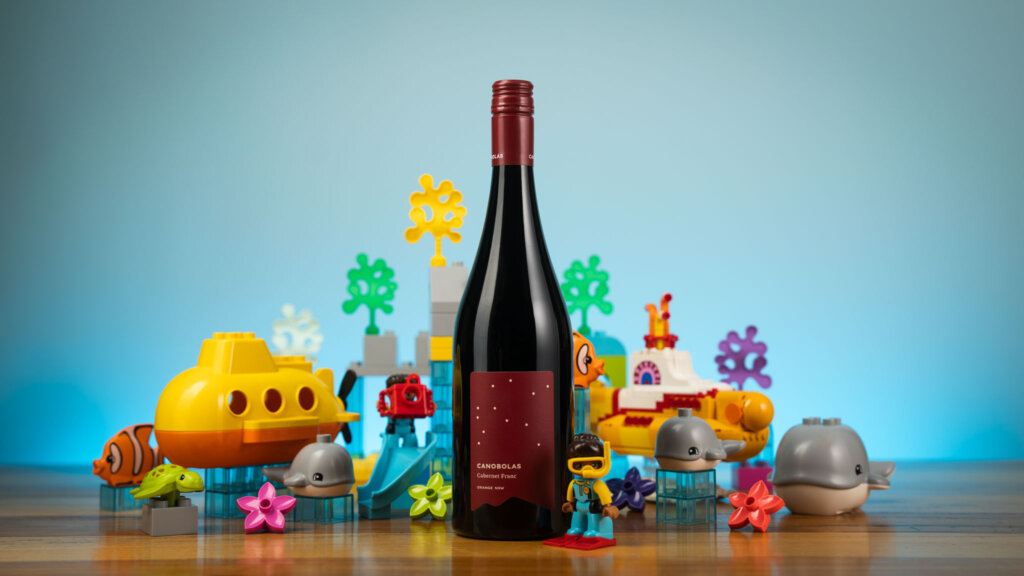
Cabernet franc is the other cabernet. Until recently, it was largely marginalised in blends, its presence banished to the back label – if it was mentioned at all. But it drives some of the great wines of the world, either in part or in total – and it can be rendered as a wine of immediate vibrancy and intoxicating fragrance, or settle into the satisfied purr of a wine of statuesque pedigree destined for a long life and sustained glory. Winemakers and consumers alike have started cottoning on to the merits of 100% cabernet franc wines, and an engaging variety of expressions – typically accessible, both in style and cost – is now appearing on restaurant wine lists. And while France and Italy currently have the lion’s share of the world’s plantings, Australia’s own examples can be as compelling as any other – just the kind of situation that calls for a Deep Dive …
We gathered every example of Australian cabernet franc that we could find, and set our expert panel the task of finding the wines that compelled the most. All wines were tasted blind, and each panellist named their top six wines. Below are the wines that made the panellists’ top-six selections from the tasting.
Our panel: Steffi Snook, owner and winemaker, Yayoi; Patrick Wood, vigneron, Kyneton Ridge and Harbinger Wines; Indra Nadeson, winemaker, Lethbridge; Jason Burns, sommelier and wine merchant, City Wine Shop; Terina Davies, wine merchant, Seddon Wine Store and Union Wine Store; Jordan Veltheer, wine communicator, Vino Champ; Megan Cruickshank, wine communicator, Apartment Six.
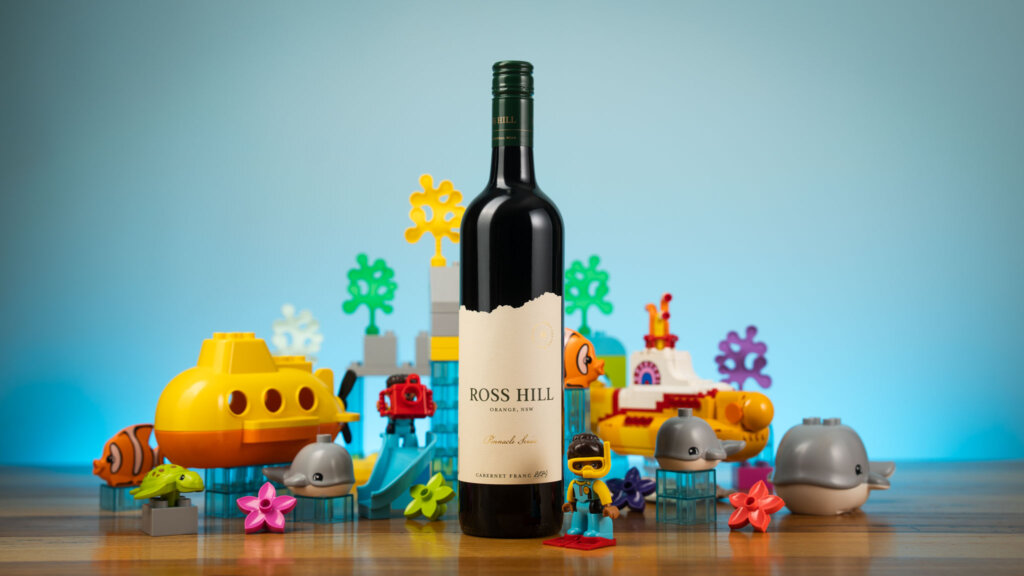
This wine appeared in the top six wines of the day for Nadeson and Cruickshank. Nadeson said, “this intensely perfumed wine shows cabernet franc in its prettiest, most romantic form. The aromas are deeply alluring, with pencil shavings and crushed violets tumbling from the glass, alongside a gentle hint of dried thyme – a soft greenness that adds to the detail, rather than being a distraction. Fine acidity supports a bright-yet-supple palate of indulgent wild berries and crunchy blackcurrant feel, supported by silky tannins and soft, lingering length. The blackcurrant fruit retains pleasing tartness throughout, humming with electric energy. It’s approachable, but with enough gravitas to intrigue any palate.” Cruickshank noted that “this wine has huge raspberry drop energy – reminiscent of Sovereign Hill school trips back in the day, or a grape zappo if you’re not a nostalgic Victorian millennial like me – thanks to some whole-berry fermentation, I’m guessing. Layers of fried green peppercorn oil and an English-brekky tea nip rein it in from full cordial vibes and give it more weight and depth than a picnic wine, although it remains fresh and approachable. A fun-loving, bloody delicious drop that you could impress your pinot-drinking mates with.”
2024 Ross Hill ‘Pinnacle Series’ Cabernet Franc, Orange $50 RRP
Snook, Wood, and Cruickshank selected this wine among their top six from the blind tasting. Snook said, “a ripe yet tart note of blood plum sits at the core of this, rich and juicy, wrapped in a playful thread of red-frog confectionery, a gentle nod to gummy jube-y sweets and their youthful charm. The nose lifts with a cool breath of menthol and wild herbaceousness, bringing freshness and tension, while dried potpourri drifts softly through the wine, lending floral depth and a faintly autumnal perfume.” Wood described it as “juicy, bright, and subtly enticing – this wine is packed full of good times and vitality. A nose reminiscent of dark green foliage with bramble, blackcurrant, boysenberry, and a subtle gaminess brought on by thoughtful harmony of reduction and oak – nothing overdone, everything in balance. There’s a beautiful integration of tannin, with acidity made to savour. This wine has a seriously bright future – it’s already drinking really well, but I get the impression it’s only getting started. Smashing job.” Cruickshank found “this is the wine to bring to dinner when you – the fancy wine king, queen, or gender-neutral monarch – want to drink something good but your mates aren’t really wine drinkers: she’s a crowd-pleaser through and through. The palate shows blackberry, boysenberry, and tiny bush raspberries – and dare I say that delicious grape Dimetapp cough syrup? – lifted by a very intriguing mintiness that reminds me, in a good way, of menthol lip balm. It’s juicy, fresh, bright, and super-approachable, whether you’re drinking it room temperature at dinner or chilled in the park.”
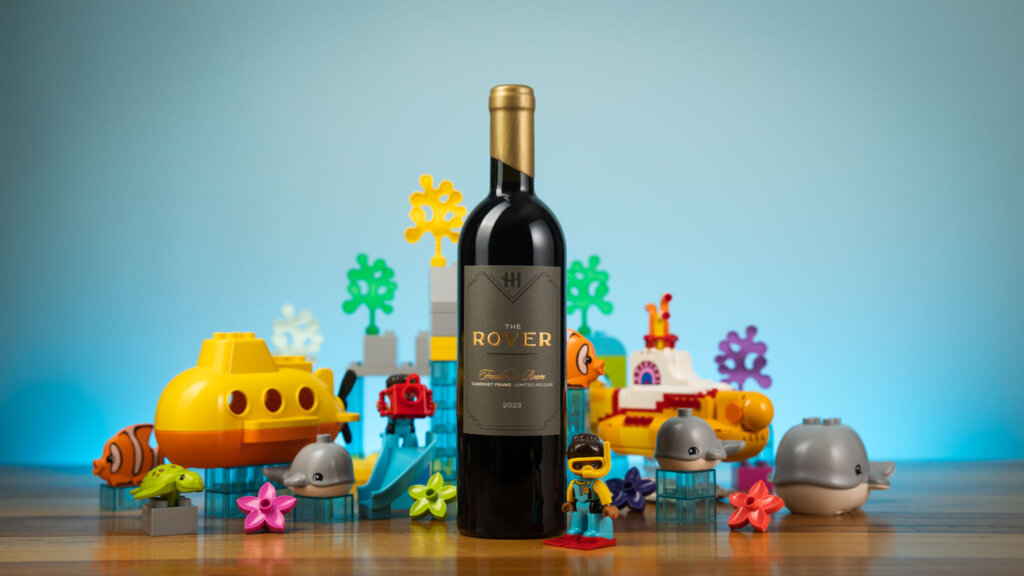
Veltheer and Wood included this wine in their top six wines from the tasting. Veltheer described it as “powerful and concentrated, with notes of raspberry, ripe purple plum, cherry and blueberry all showing up and meaning business. But it’s the tannin that really gets you – it’s dusty and smoky in the best possible way. You know that feeling of punching a dart after a long day on your feet? Somehow that feeling is exactly what this wine tastes like – and I’m absolutely here for it.” Wood said, “notes of luscious raspberry liquorice wrapped in cedar-like oak immediately bound out the glass, with deeper black forest and earthy characters to back it up. The first sip doesn’t disappoint, delivering immediately loveable and juicy flavours of blackcurrant and boysenberry alongside very moreish acidity. Some classic cabernet franc autumnal notes follow, with a hint of tomato stem. The soft, long and savoury landing sets you to contemplate this wine long after the glass is empty. This wine makes a strong case for why Australian cabernet franc deserves a look-in – it matches the soulfulness of the variety with an easygoing Sunday roast lunch vibe.”
2023 Hirsch Hill ‘The Rover’ Cabernet Franc, Yarra Valley $80 RRP
Davies and Burns chose this wine for their top six wines on the day. Davies said, “wild forest berries take the lead here, brushed with terracotta and graphite, before drifting into more savoury territory of smoky kalamata olives, red pepper, and pepper-crusted lonza. The palate is silken and plush, with blood plum and ripe dark cherry at its centre, alongside a streak of petrol-like minerality threaded through freshly cut redwood. A wash of acidity carries sweet royal baby peppers and a subtle pyrazine lift, while brown butter and cured-meat savouriness seep through and linger. Overall, it feels like sitting down to antipasto at a campsite deep in the forest – it’s rustic and quietly evocative.” Burns noted that “this wine displays a great mix of fruity and savoury herbaceous elements. It’s red-fruited, showing cranberry and rhubarb notes, with some undertones of fresh herbs and a tomato-like character that reminded me of a Napoli sauce. The freshness and versatility of this wine means it could pair easily with numerous dishes – I’m thinking pork, pasta, or a nice cheese board.”
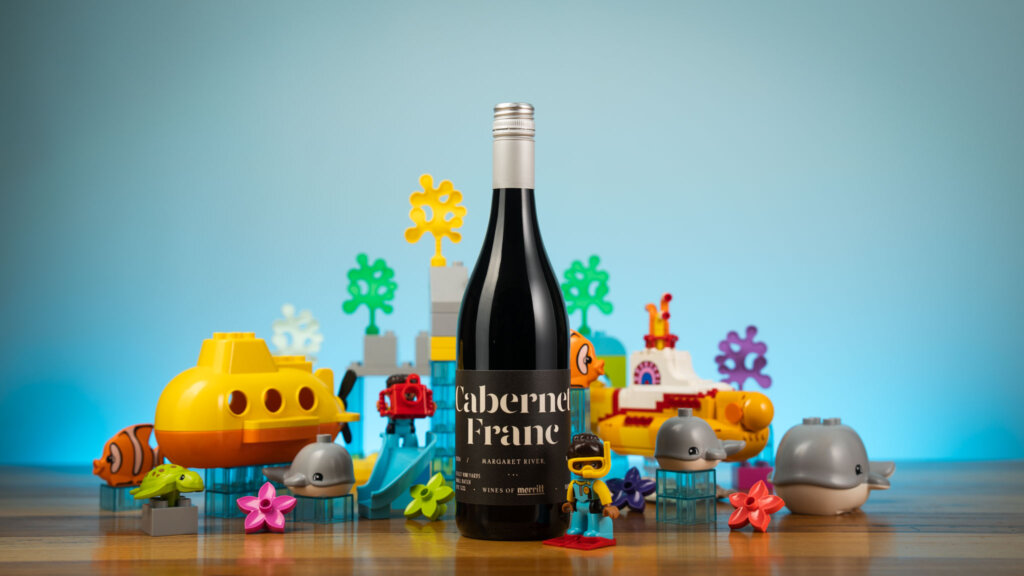
2024 Wines of Merritt Cabernet Franc, Margaret River $45 RRP
Wood and Davies selected this wine among their top six from the blind tasting. Wood said, “there’s a nice bit of edginess to this wine, without the slightest compromise to cabernet franc’s textbook charm. Playful reduction quickly opens up to blood orange and violet notes on the nose. Subtle terracotta and red earth tones on the palate pave the way for blueberry and dark plum preserve. I love how this wine relentlessly morphs in the glass, all vitality and liveliness. The kind of wine that rewards patience and introspection – and is very deserving of a cheese selection and a great view.” Davies exclaimed, “oh, I really love drinking this wine! It leads with tart wild berries and iron on the nose, alongside a hit of sticky raspberry lolly character that immediately whips me back to childhood summers at the local pool chewing on what we now call Red Ripperz. Raspberry danish and raspberry leaf follow, giving both fruit concentration and lift. On the palate, there’s a bewitching interplay between fruit and minerality – wild blackberry and blackcurrant framed by salty black rock and pencil shavings. The wine’s acidity rises from beneath the tongue and dances across the palate, giving energy and shape. It’s youthful and fun, but balanced and classic in feel, with a clarity and structure that makes it immediately appealing.”
Nadeson and Cruickshank included this wine in their top six wines of the day. Nadeson said, “aromas of luxurious rosemary oil and jasmine flowers announce this sexy number, alongside a breath of peppery tomato leaf that feels distinctly cabernet franc. This wine is fine-boned and lacy, suggesting an intentionally delicate touch – a focus on nuance over volume, and the wine is all the better for it. The palate sways melodically between tart mulberry and dried thyme, a song that is slowly realised – an ethereal quality that keeps the flavours lingering for a long time. I’d be choosing something equally fresh and vibrant to drink this with – perhaps some fresh beef carpaccio while sitting in the sun at my favourite wine bar.” Cruickshank enthused, “I reckon this wine might rub a few people the wrong way – but keep your mind open, because it’s a goodie, and something different. Picture this: it’s spring, you’re walking through a French farmyard with a toasted baguette in hand, smelling the straw and crushed leaves, and maybe you step on a couple of strawberries. This earthy, savoury quality makes the wine feel cozy – the strawberries are smooshed and muddled, and the tannins are sandy, as though it has been raised in old barrels that have been babysitting the wine rather than seasoning it. That beating heart of ‘Old World’ savouriness might not be everyone’s cup of tea – but I love it!”
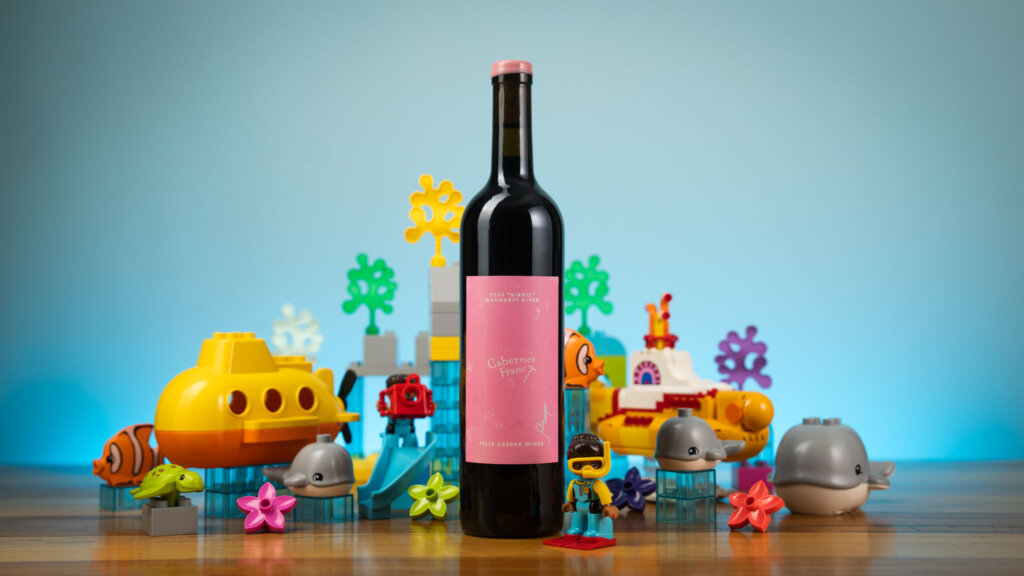
2024 Felix Caspar Wines ‘Birdie’ Cabernet Franc, Margaret River $45 RRP
Burns and Cruickshank selected this wine among their top six wines from the tasting. Burns described this wine as “so aromatic and juicy, with really impressive fruit concentration – ripe red cherries and raspberry compote, sweet spices of star anise, nutmeg and cinnamon, and something resembling cherry liqueur. The silky tannins, acidity, and overall structure help to balance out its sweet characters, resulting in a very well-made wine. This is the kind of wine that’s so good that you’ll find yourself quickly and easily emptying your glass without realising it.” Cruickshank found that it “smells like the fancy dried figs you buy by the kilo at the deli, folded into Connoisseur vanilla bean ice cream, alongside a good drizzle of olive oil. Top that with shaved dark chocolate, kirsch-y cherry notes, a whiff of cocoa and sponge cake … say less! The usual green capsicum note we all know and love in cabernet franc is still hanging around at the back of the palate in a cheeky game of hide and seek – and I’m grateful for its brightness in an otherwise full bag of trail mix. There’s a tuberose lift on the finish that refreshes the palate and feels unexpected for a riper style of cabernet franc – but hey, I ain’t a wine cop, and it’s good!”
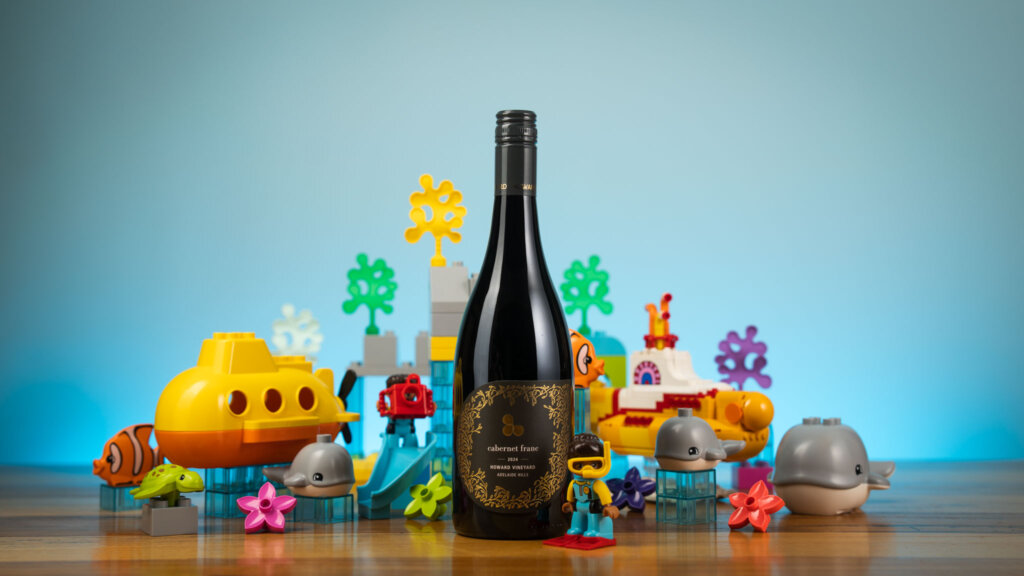
2024 Howard Vineyard Cabernet Franc, Adelaide Hills $42 RRP
Davies and Veltheer chose this wine for their top six wines on the day. Davies described it as “such an autumnal wine from the outset – it’s so pretty and lifted, but with a quiet darkness simmering beneath. There’s mountain-air freshness of fresh thyme and juniper, alongside a perfume of dark damask rose and a faint whisper of rum-and-raisin chocolate. The palate oscillates between sweetness, savouriness, and spiciness – black cherry and marionberry, laced with the iron-rich depth of Spanish blood sausage. What a way to keep the audience captive! A gentle warmth from the alcohol builds, while the acidity swells and recedes like a slow crescendo, stretching flavours out through the finish. Overall, it’s layered and expressive, with a kind of rhythmic energy that keeps pulling you back in.” Veltheer noted that it’s “fresh and red-fruit forward, with raspberries, red plums, pomegranate, cranberry and a little strawberry jam all doing their thing. Soft and light on its feet, with a lovely hint of graphite that lingers just long enough. This is not a wine that takes itself too seriously – it’s the kind of glass that makes you want to put on slow jazz and have a little dance around the kitchen.”
Burns and Nadeson included this wine in their top six wines of the blind tasting. Burns enthused, “this wine immediately captivated me with its atypical nature – I was compelled to keep tasting it over and over to try and figure it out. It feels very alive, with a subtle earthy leafiness and relatively high acidity that reminds me of a Jura ploussard. There’s a hint of sour cherry, some red plums, some dried strawberry, and a bit of red appleskin on the palate. This wine has me very intrigued – I’m excited to learn where and how it was made!” Nadeson noted that “this wine smells so alive – like freshly tilled soil, or a bright winter morning after a night of rain. Distinctive notes of green absinthe and wild herbs are lifted by pure black cherry fruit. It’s soft and languid on the palate, a concoction of dried rosemary, menthol and brambles. Medium-bodied and delightfully expressive, the tannins here have softened into a fine frame that shapes the wine nicely, without imposing on its raw vibrancy.”
Cruickshank selected this wine among her top six wines from the tasting, describing it as “truly bizarre, not at all what I would normally look for in a cabernet franc – and also, I’m not afraid to admit, my wine of the day. Listen carefully: black cherry compote, blood plum skin, pepperoni pizza, a good few puffs of a Montecristo, warmed kalamata olives, and a slice of dark cacao-dusted chocolate cake for dessert. My favourite jalapeño quality in cabernet franc is out absolutely of office doing hot-girl Euro summer here – by which I mean completely absent – and instead we are left with a salty, savoury chewy glass that is simply screaming for a slab of brisket on the barbecue and a strong game of Cards Against Humanity. There must be so much charred oak in this – it belongs at a rock show. Damn. It’s big, bold, smoky, and weird – and it emptied out of my glass quickly!”
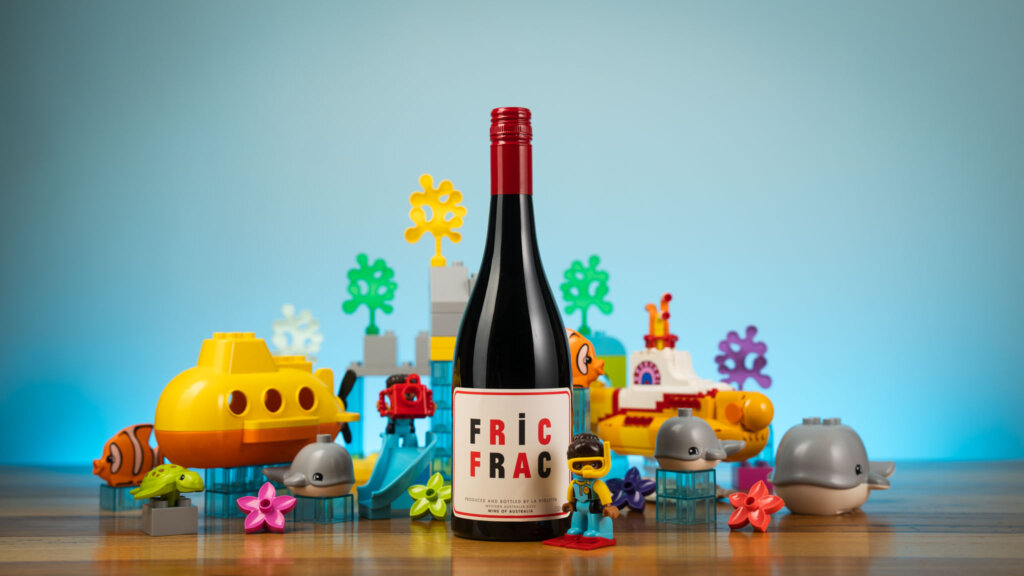
2025 La Violetta ‘Fric Frac’ Cabernet Franc, Mount Barker (Great Southern) $36 RRP
Davies and Snook included this wine in their top six wines from the blind tasting. Davies described it as “leaning confidently into a fruit-forward style, with macerated strawberries and blueberries sitting front and centre, layered over allspice and a heady floral lift of peony and iris. Blackcurrant-leaf freshness cuts cleanly through all this prettiness, and after a few more swirls around the glass, a faint mealy note comes through. The palate, whilst medium-bodied, carries a surprisingly weighted texture and a silky level of glycerol. A full spectrum of red and black berries plays out, kept in check by a taut plum-skin acidity that washes across the palate. That signature blackcurrant leaf note returns, with a grounding counterpoint of black olive bringing balance. It’s pretty generous, in a drink-now style that leans into its fruit, but it keeps enough savoury detail and structure to stay engaging.” Snook noted that “blackberry and blackcurrant drive the nose, framed by violet florals and cocoa spice, while shiso leaf lends a savoury bitterness that adds intrigue. The palate stays bright and crunchy, alive with primary fruit and fresh acidity that gives shape and swagger in equal measure. Vibrant and dangerously drinkable, this is cabernet franc with charm, tension and plenty of personality.”
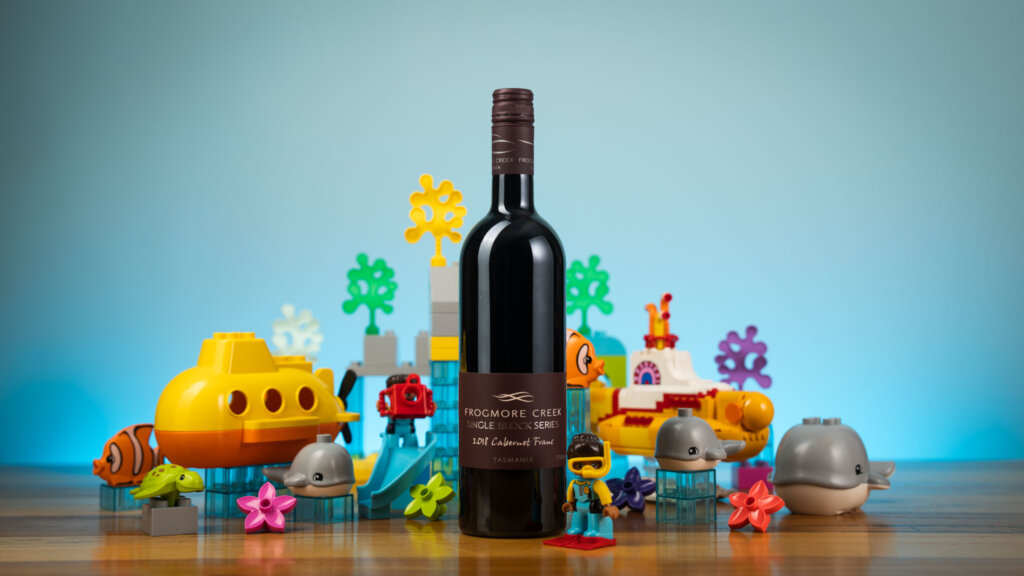
2018 Frogmore Creek ‘Single Block Series’ Cabernet Franc, Coal River Valley (Tasmania) $48 RRP
Burns and Wood chose this wine for their top six wines on the day. Burns argued that “this wine intrigued me with its quite strength and almost broody quality – it’s a wine that makes you contemplate. Power meets restraint here – a balance of richness and savouriness, with dark berry and dark plum notes along with some red capsicum and peppery flavours. The tannins are very well-integrated and harmonious – an excellent wine now, but definitely one worth ageing.” Wood noted “hand-crafted vibes coupled with concentrated sophistication. Elevated terracotta-like earthen aromatics meet strawberry, blackberry and Australian bush tomato notes with a wild, slightly untamed curiosity – this one smells like the Australian bush after spring rain. On the palate, it’s generous and a touch grippy, with rustic earthy tannins and a presence and warmth that keeps you reaching out for more – this is cabernet franc with its work boots on.”
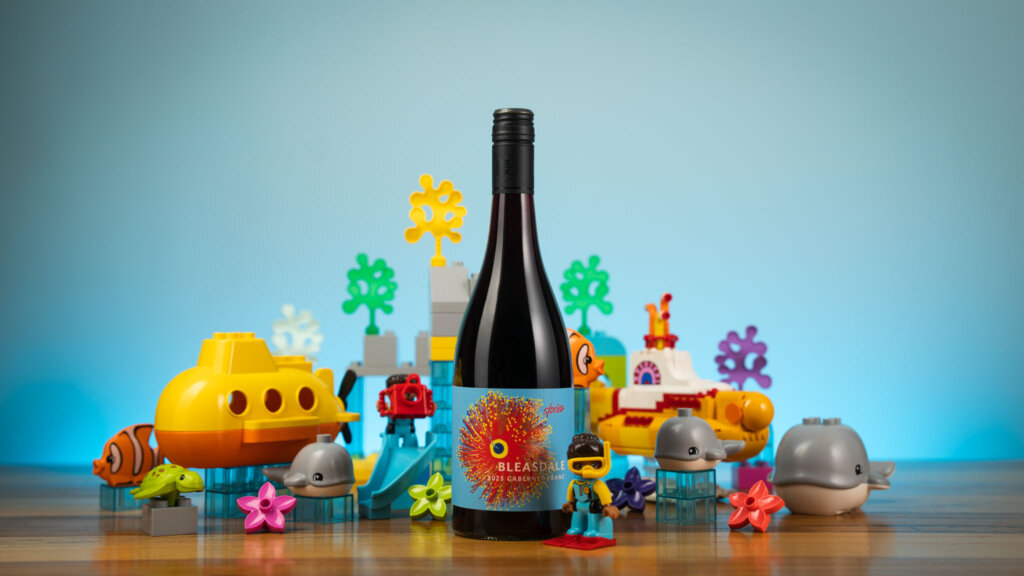
2025 Bleasdale ‘Stories’ Cabernet Franc, Langhorne Creek $30 RRP
Nadeson selected this wine among her top six wines from the blind tasting, describing “a warm and inviting initial aroma of a wafting blackberry pie fresh from the oven, followed by ripe black plums encased in a deep savouriness of bitter dark chocolate and cloves. This is a wine with some power that asks for a little patience – every return to the glass offers new details. The tannins announce themselves early in the piece – prominent, yet in balance with the rest of the palate – and suggest that this is a wine with a long future ahead of it. A brooding and serious wine that shows cabernet franc is not always a mere fling, but can also be a mysterious seductress.”
Snook included this wine in her top six wines from the tasting, saying, “pretty? Certainly. But this cabernet franc has far more than good looks. Lavender, violet and dried rose spill from the glass before darker notes of black raspberry, blackberry and black cherry take hold, bringing both freshness and allure, and hinting at the lively acidity waiting in the glass. Pink peppercorn grips through the back palate, bright and teasing rather than fiery – framed by fine, chalky, lightly savoury tannins that provide shape through the finish, showing less about firm extraction and more about tension and gentle structure. Floral, spicy and effortlessly charming – this is cabernet franc that knows how to flirt.”
Veltheer chose this wine for his top six wines from the blind tasting, describing “juicy raspberries and cranberries up front, with a reductive graphite edge that keeps things interesting. On the palate, soft lolly sweetness – think Allen’s Red Frogs – sits alongside subtle refined tannins and genuinely brilliant oak integration. There’s real length here, with enough palate weight and just a touch of acidity that suggests there’s some serious ageing potential here. This is the kind of wine that you open for someone who thinks French wine is the best, then say nothing – just smile.”
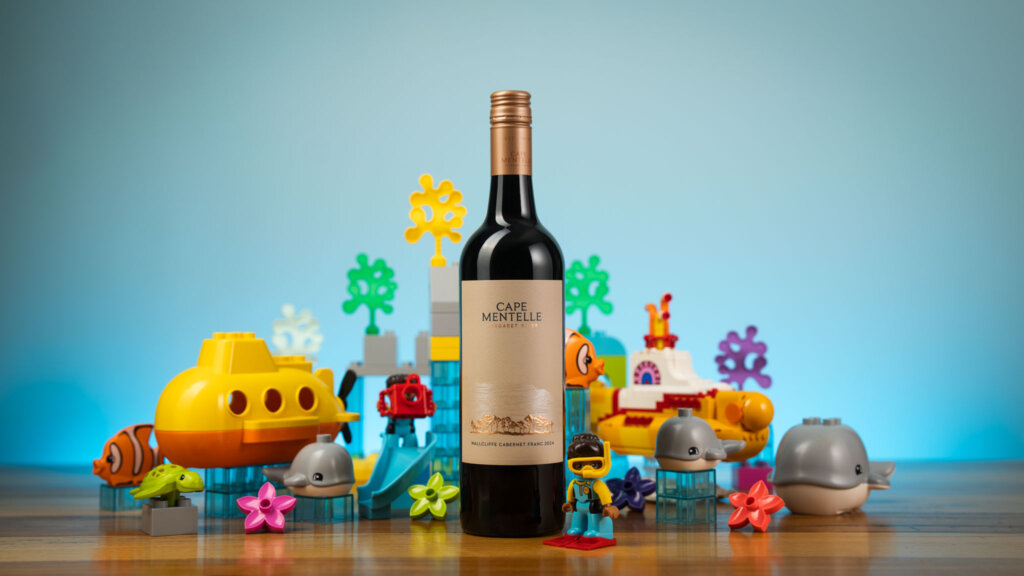
2024 Cape Mentelle ‘Wallcliffe’ Cabernet Franc, Margaret River $49 RRP
Wood selected this wine among his top six wines from the tasting, noting that “classy restraint brings immediate tension in this wine – a broody focus that progressively opens up notes of boysenberry and plum, cedar and bramble on the nose. Volume and weight upfront on the palate shows this wine means business, immersing you in juicy forest fruits and friendly tannins. This one totally fits the bill for cabernet franc, showing a tension between dark fruit and lifted vibrancy – it never loses shape, even as it opens up. This wine transports you straight to a campfire on a chilly autumn night with a pot of goulash.”
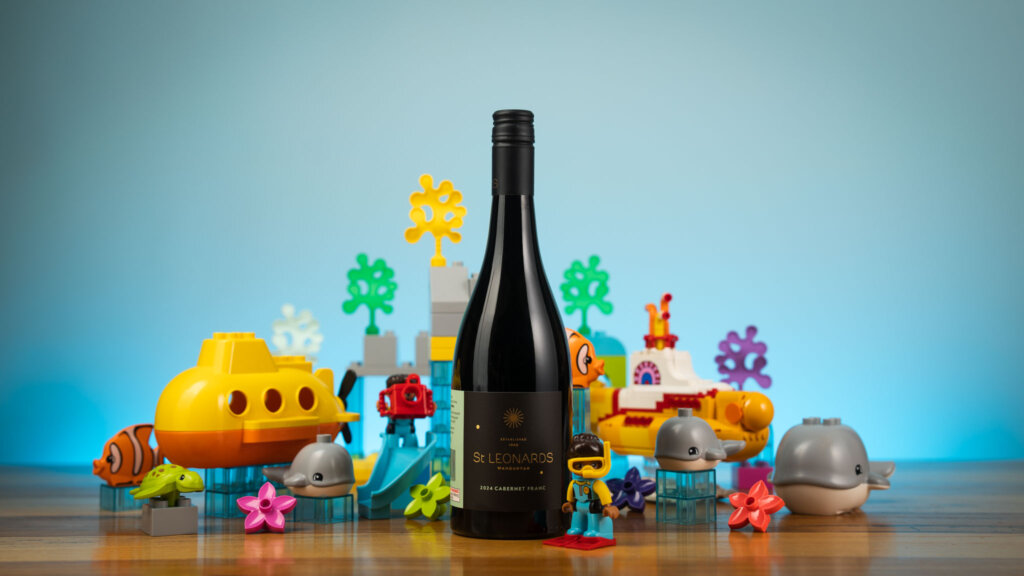
2024 St Leonard’s Cabernet Franc, Rutherglen $38 RRP
Snook selected this wine among her top six wines from the blind tasting, saying “black cherry, blackberry and redcurrant keep things lively upfront, all brightness and swagger, before the wine leans into its savoury side – think herb-crusted pastrami. I love the texture of this wine – layered, sinewy and moreish. This wine feels a bit broader through the middle palate – it’s compelling, warming and wonderfully moreish. Tobacco spice hums through the finish, stitching fruit, smoke and savoury detail into a cabernet franc full of personality.”
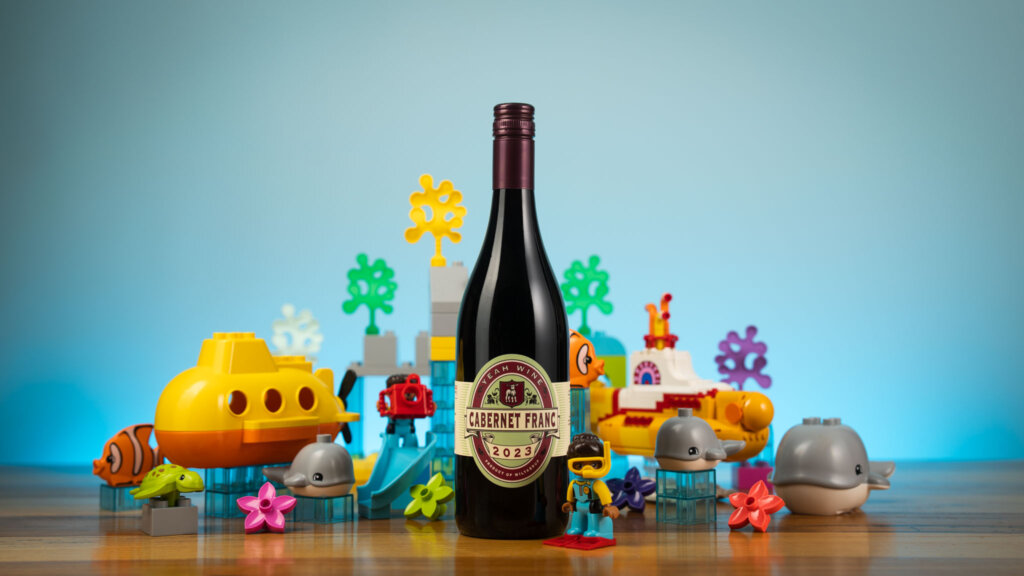
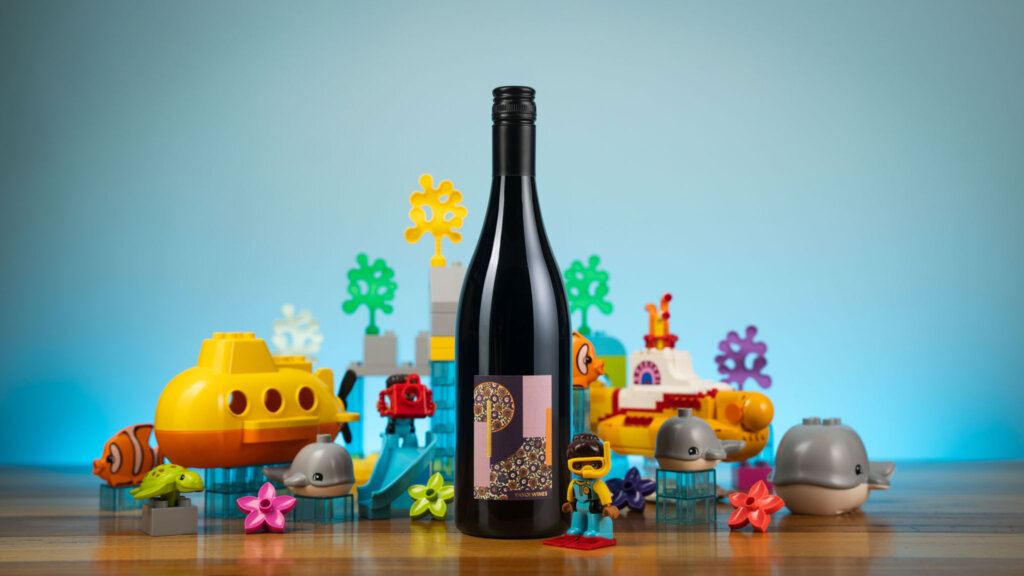
2023 Yeah Wine Cabernet Franc, Margaret River $35 RRP
Burns and Davies included this wine in their top six wines from the tasting. Burns said, “there’s a soothing quality to this wine that just makes you feel good – notes of rich red raspberry, cherry, and cranberry that feels slightly cooked, in a good way, alongside comforting baking spice characters and a Negroni-like amaro note as well. The winemaker has really nailed the ratio of spicy to fruity tones with this wine – it makes me want to get cozy in a comfy chair in front of a fireplace.” Davies noted that there’s “lots to unpack here – the nose of this wine just kept moving each time I returned to it. It launches with a deep cloud of Amarena cherry layered with freshly trodden black earth, dried fern fronds and wet graphite. With time and oxygen, the tune keeps going – raspberry leaf, dried tobacco, and mahogany sawdust. The palate follows with dark, bitter-edged fruit notes, led by that liquor-soaked cherry, while dried shrub and tobacco notes unwind into something smoky and sweet – Black Russian tomato, molasses, and earth. Driving acidity cuts through and keeps everything taut and focused. Overall, it’s ruggedly seductive – rich, savoury and full of personality, with a kind of brooding charisma. Ron Burgundy absolutely drinks this wine!”
Cruickshank and Veltheer chose this wine for their top six wines on the day. Cruickshank described tasting this wine as “like being under a cozy blanket in winter with the windows open – think spiced apple cake batter, lashings of vanilla essence, and fresh cinnamon sticks. There’s flaky pastry-like back-palate that gives the wine a pillowy, comforting finish I can’t get enough of. This is a wine for the lovers, for the huggers, for the people who say ‘I don’t want solutions’. Put your fluffy socks on and settle in, because this is a no-lectures, all-comfort glass of goodness that I will return to again and again.” Veltheer noted that it is “concentrated and perfumed on the nose, with violet florals, cherry, blueberry and blackberry jam doing something really beautiful together. Then the palate arrives and it’s all dark brooding plums, more blueberry, and a sneaky strawberry sweetness that lingers and lingers. Yes, there’s a richness here that borders on decadence – but here’s the thing, the winemaker has clearly seen that quality in their cabernet franc fruit and leaned into it, balancing it out with clever winemaking and seamless oak integration so the wine never tips over the edge. It’s fresh and fun, and five minutes after pouring it’s still just hanging around being delicious. Someone get me a cheese board immediately!”
Veltheer selected this wine among his top six wines from the blind tasting, saying “this wine opens with smoked meats on the nose, alongside cherries and plums, which will have you expecting something serious and brooding. But then the palate completely flips the script – strawberry jam, fresh cranberry, purple plums and blueberry, with a lifting kiss of acidity that just refreshes everything and the softest tannins you could ask for. This wine exists in two worlds simultaneously – party wine and serious wine – and somehow pulls off this tricky balancing act. How cool is that?”
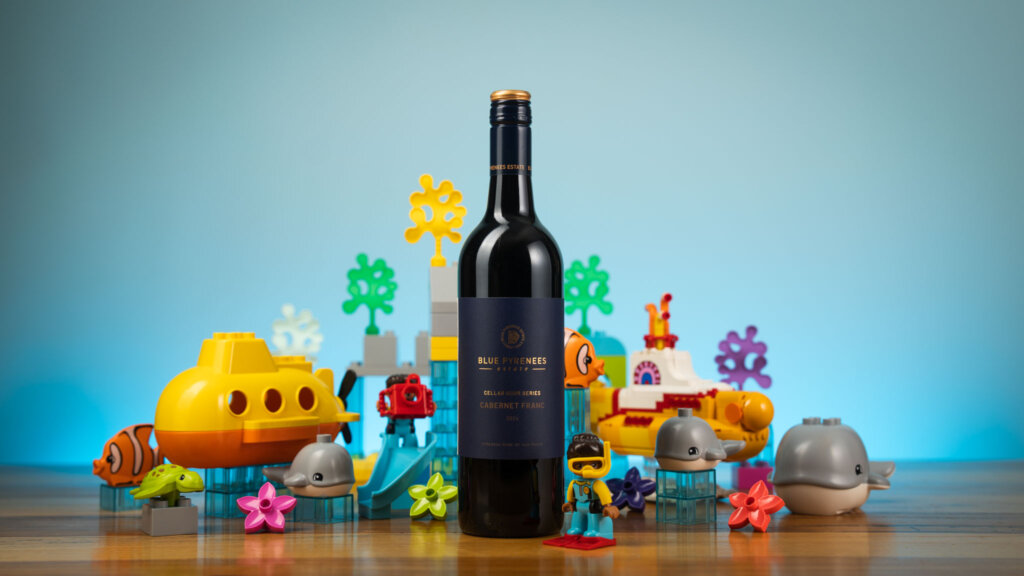
2024 Blue Pyrenees Estate ‘Cellar Door Series’ Cabernet Franc, Pyrenees $38 RRP
Nadeson included this wine in her top six wines of the day, noting that “this wine is evocative and compelling, although I can’t promise that it’s going to be for everyone with its powerful and sometimes challenging flavours. Dried tobacco leaf immediately assaults the palate, accompanied by a gentler woodsmoke note that has me immediately craving some kind of smoked brisket. With time and oxygen, this relaxes to fragrant clove and fenugreek, while the tobacco leaf character runs through the palate, weaving between blackberries and earthy black tea. The wine is dark in colour, and, while earthen-toned, it does not sit heavily on the palate – rather, it slips softly through the mouth. This is a wine that’s worth slow contemplation as it unfurls itself, revealing treasures beyond that first immediate and powerful tobacco character.”
Snook selected this wine among her top six wines from the blind tasting, saying “blackcurrant and red-skinned fruits lead the charge, chased by a flicker of confectionery that feels delightfully naughty rather than overtly sweet. Just as you settle into the fruit, the wine shifts gears, baked ginger spice, tobacco and tomato leaf unfurling through the palate with savoury confidence. Medium-bodied and fresh on the palate, that transition from confectionery sweetness to savouriness creates a layered, evolving texture. There’s ample acidity to go alongside the texture, which keeps the wine fresh and alive, but also creates something more complex and worth thinking about. This is a cabernet franc that dances between bright fruit and earthy intrigue, never standing still for long.”
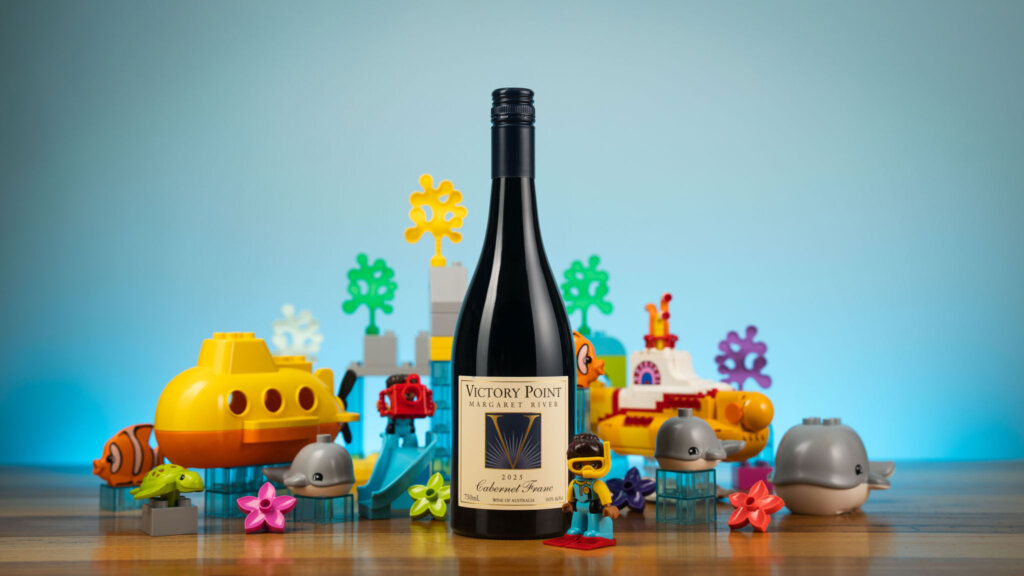
2025 Victory Point Cabernet Franc, Margaret River $40 RRP
Veltheer chose this wine for his top six wines from the tasting, arguing that “dusty rose florals and raspberry on the nose lets you know this wine means business without being intimidating about it. The palate opens up into something altogether more generous – lush and mouth-coating, with a strawberry compote-like richness, bursting with red plum and cooked cherries, backed by beautifully integrated tannins. Drinking this feels like a Sunday afternoon in the sun – and just when you think you have it figured out, a streak of minerality cuts through and a finishing touch of bright acidity pulls everything back into line. Serious and joyful all at once.”
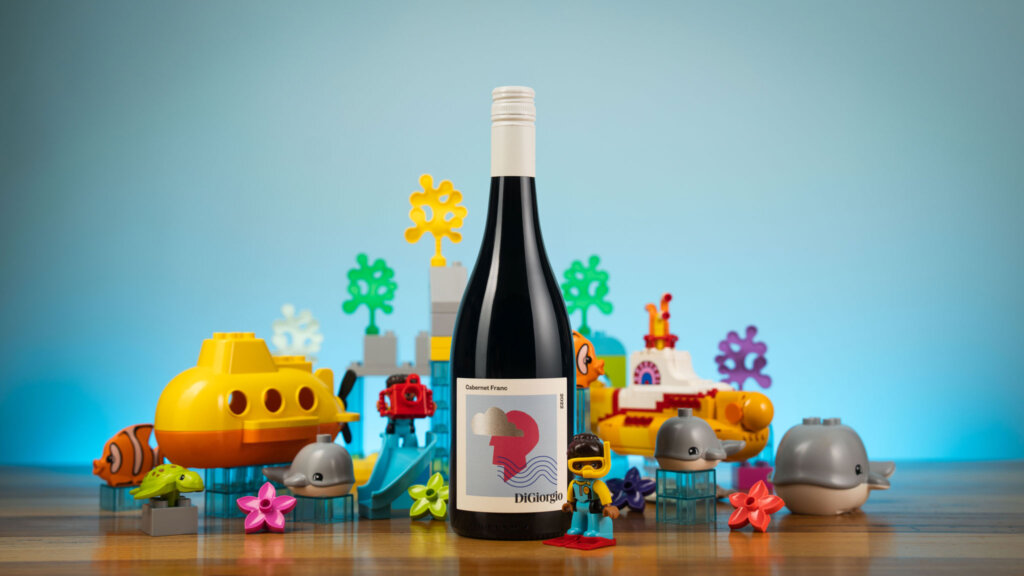
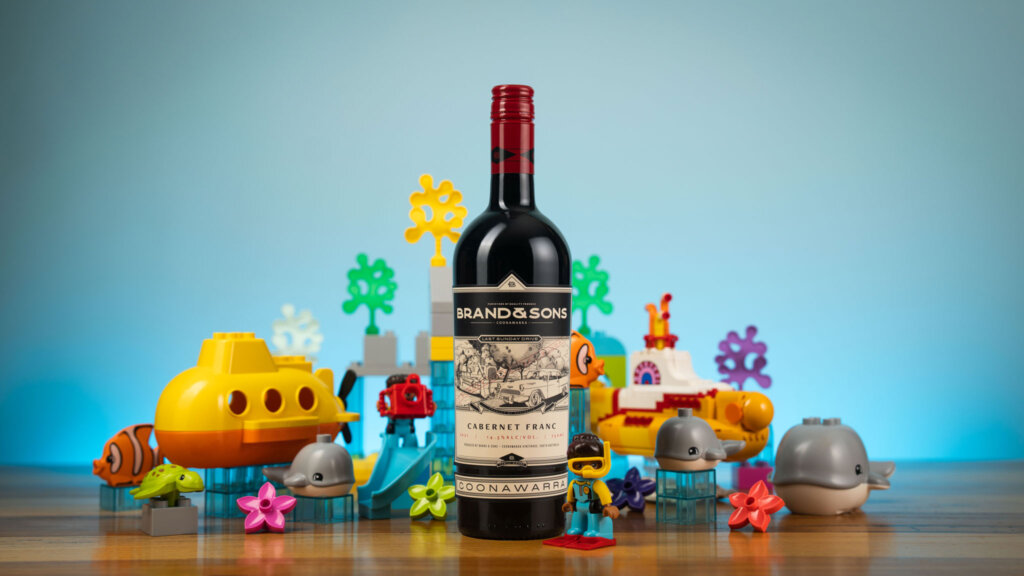
2022 DiGiorgio Cabernet Franc, Coonawarra $31 RRP
Snook included this wine in her top six wines from the blind tasting, noting that “maraschino cherry and blood plum flirt shamelessly from the glass, vivid and juicy with just the right amount of mischief. Then the wine changes mood – dried bay leaf and clove slip in with savoury charm and spice-laced intrigue. Medium-bodied on the palate, and beautifully held in check by fresh acidity, this cabernet franc feels both polished and playful, finishing with spice, lift, and undeniable charisma.”
Davies selected this wine among her top six wines from the tasting, describing it as “a fascinating wine, savoury and complex. It opens with a heady perfume of ripe blood plum, cigar box, and a herbal line of nettle, and darkly musky Darjeeling tea. The palate carries that same interplay of fruit and smoky savouriness – macerated blood plum and wild strawberry giving way to black-tea tannins and charred eggplant skin notes. There’s a quiet intensity here, with flavours that feel both grounded and slightly exotic. Overall, it’s herbaceous, intriguing and quietly captivating.”
Burns included this wine in his top six wines from the blind tasting, arguing that “one of the great qualities of cabernet franc is that, if it’s made in a certain style, it’s perfect for chilling. This is a prime example, with its relatively low tannins, good fruit concentration, light to medium body, and zippy acidity creating refreshment. It’s so zippy, fresh and tangy, showing notes of juicy blackberries, redcurrants and orange zest. It’s already tasty at room temperature – but if you chill it down a little first then go find some place sunny you’ll have a great time. I would suggest that you drink half the bottle chilled then let it warm up, so you can get two wines in one – but honestly, it probably won’t last that long.”
Nadeson chose this wine for her top six wines of the day, noting that “this wine evokes the end of a cosy Christmas meal with amaro-like bitterness and botanical notes of pine needles and fresh herbs. Silky tannins coat the palate, carrying gentle baking spice and quietly powerful black liquorice notes. There’s a meatiness to the wine – reminiscent of pork and fennel sausage perhaps – that provide some heft on the palate. Just-ripe black plum disrupts the wine’s chewy savouriness, and it finishes smooth and soft in the mouth, delivering both comfort and complexity – a hallmark of a good cabernet franc.”
Wood selected this wine among his top six wines from the blind tasting, describing “some serious pedigree in this wine – it shows an immediate posture of subtle blonde oak aromatics tied in with soft vanilla pod, diffused through forest fruits and berry compote. There’s a refinement on the palate that feels almost ‘Old World’ in its composure: blackcurrant and dark cherry held together by silky, well-integrated tannins, and a beautiful acid line keeping it honest. It’s beautifully framed, and a leading example of what feels like a bold renaissance of textural cabernet franc wines. This wine bears the kind of confidence that makes you check your posture – it warrants a proper occasion.”
The backstory
Cabernet franc is the other cabernet. Until recently, it was largely marginalised in blends, its presence banished to the back label – if it was mentioned at all. But it drives some of the great wines of the world, either in part or in total – and it can be rendered as a wine of immediate vibrancy and intoxicating fragrance, or settle into the satisfied purr of a wine of statuesque pedigree destined for a long life and sustained glory. Winemakers and consumers alike have started cottoning on to the merits of 100% cabernet franc wines, and an engaging variety of expressions – typically accessible, both in style and cost – is now appearing on restaurant wine lists. And while France and Italy currently have the lion’s share of the world’s plantings, Australia’s own examples can be as compelling as any other …
Genetically speaking, cabernet franc is the patriarch of the family of Bordelaise grape varieties – it’s a parent variety to carmenère, merlot, and cabernet sauvignon. And while grapevine genetics are a complicated topic, in this case the family resemblance is very clear: in fact, until relatively recently, all three of those varieties were frequently confused for each other, and for cabernet franc itself. It’s not hard to see why. Each of these varieties grows five-lobed leaves, ripens somewhere between the middle of the season and late in it, and makes red wine of medium to full weight, often with a distinctive ‘green’ flavour from a family of organic compounds known as methoxypyrazines (or, less formally, ‘pyrazines’). In short, you have to pay close attention to distinguish between them.
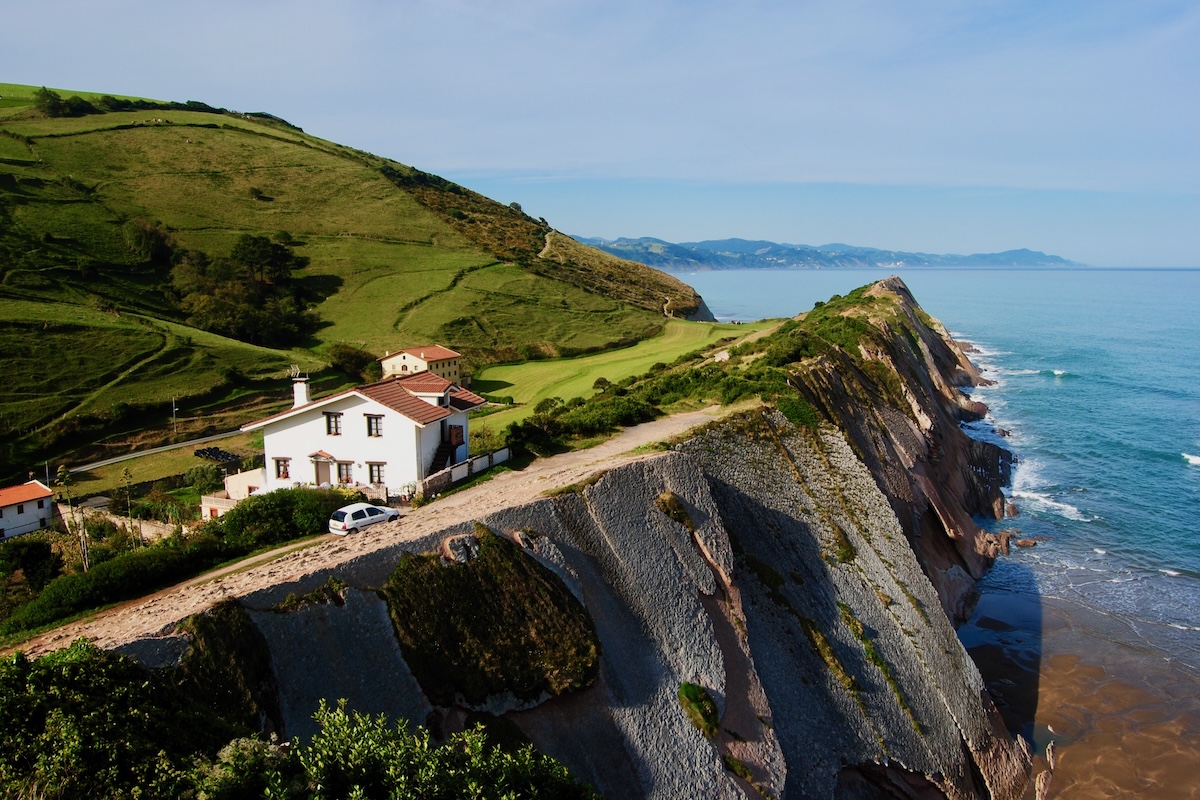
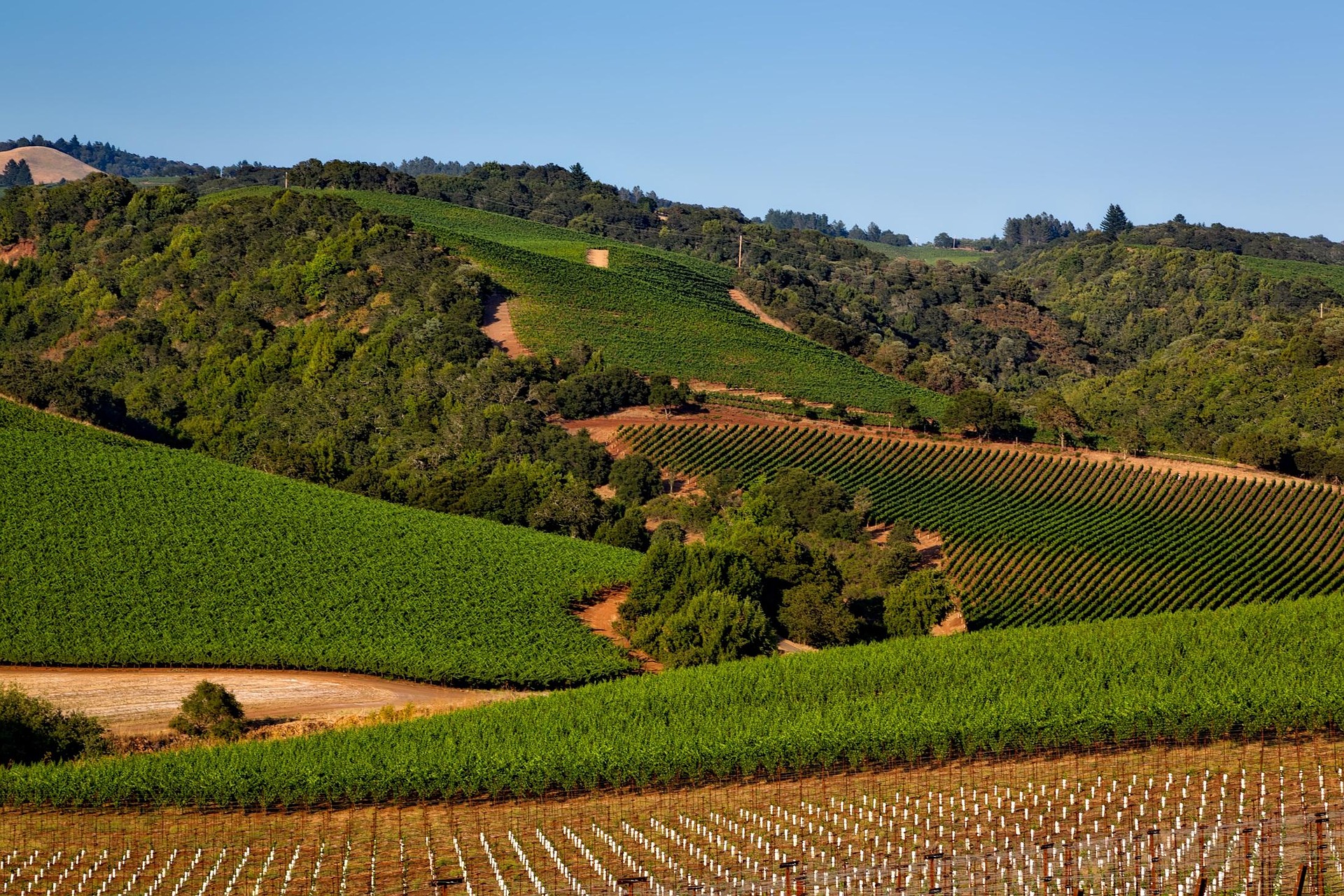
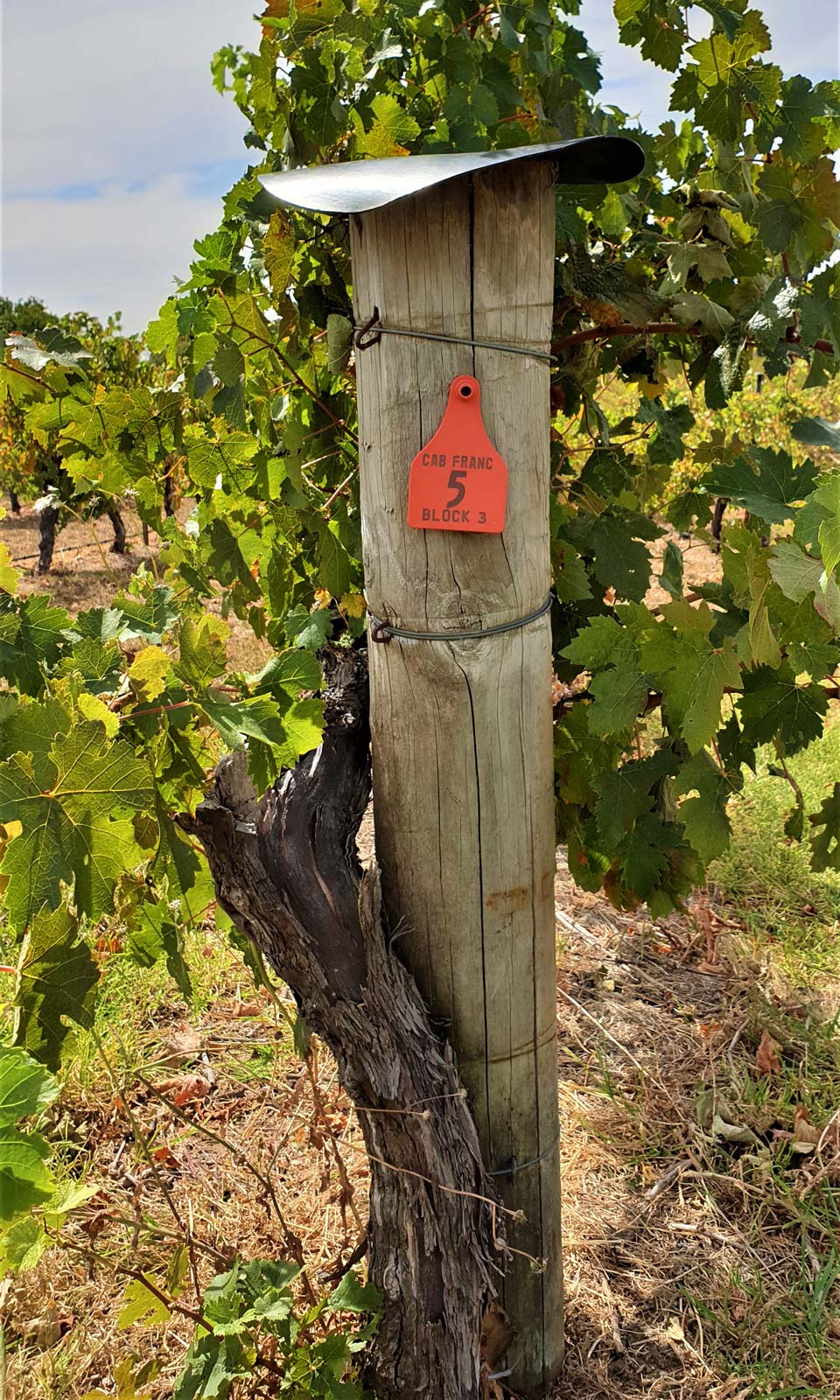
Above: Cabernet franc on the vine at Paracombe in the Adelaide Hills. Opposite: The dramatic coastline of the Basque Country in northern Spain – the likely ancestral home of cabernet franc, but absolutely not its current stronghold.
This applies to the tasting table as well as the vineyard, with cabernet franc-based wines often looking similar to cabernet sauvignon – with cassis, leaf, green pepper and tobacco notes – although on average the wines will be a little lighter, fresher, paler, and more aromatic, sometimes showing more raspberry and pepper characteristics. As such, cabernet franc-based wines often feel more discreet and subtle than cabernet sauvignon-based wines. This fact perhaps explains why the variety hasn’t always been afforded the respect you might expect it deserves, given its indisputable genetic importance – after all, its children cabernet sauvignon and merlot are, respectively, the world’s most-planted and second-most-planted wine grape varieties. Fortunately for cabernet franc, that story is starting to change.
Putting the ‘franc’ in France
Bordeaux isn’t cabernet franc’s likely home – grapevine experts Jancis Robinson, Julia Harding and José Vouillamoz argue in their reference book Wine Grapes that it’s likely to have first emerged in the Basque Country of northern Spain, which culturally spills over the border into south-western France, and this hypothesis was further reinforced by DNA testing in 2019. From here the variety travelled north, first establishing itself in Bordeaux, where it would go on to become the region’s Casanova, then landing in the Loire Valley. (Precisely when these events occurred remains a matter of conjecture, as cabernet franc is a very old variety that goes by a variety of synonyms, so tracking it through the historical record is somewhat difficult – but some argue that cabernet franc had landed in the Loire by the early 1500s.) The approach that each of these regions has to the variety to could not be more different, though. Bordelaise winegrowers have traditionally treated cabernet franc as a blending partner, with the official Vins de Bordeaux site going so far as to describe it as “always ready to slip into a blend” and “the ultimate complementary cépage” (French for ‘variety’). By contrast, in the Loire Valley sub-regions of Chinon, Saumur-Champigny, Bourgueil, and Saint-Nicolas-de-Bourgueil, cabernet franc is heroed as the sole permitted red wine variety. (Having said that, it’s not unusual to find entry-level Loire reds in Parisian bistros that blend some grolleau or gamay in with Cabernet Franc – declassified down to generic ‘vin de France’, bien sûr.) These distinctly different approaches can be explained by the fact that cabernet franc typically buds and ripens at slightly different times to cabernet sauvignon and merlot. Thus Bordelaise estates tend to view the variety as a climate hedge, able to soften the palate and add fragrance in less-warm years where cabernet sauvignon might come across as nervy, whereas its ability to ripen properly in the cooler Loire means it can take centre-stage there.
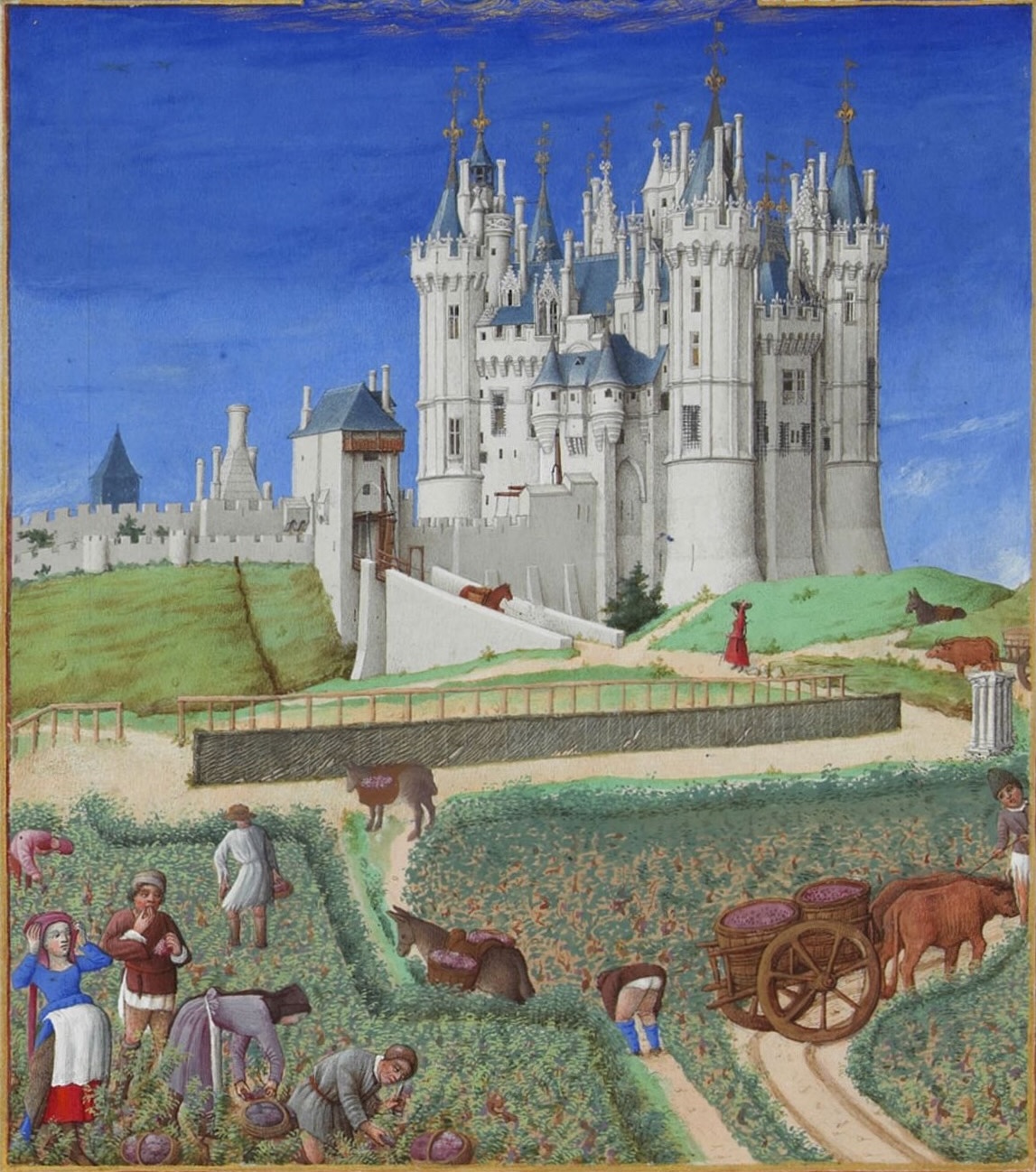
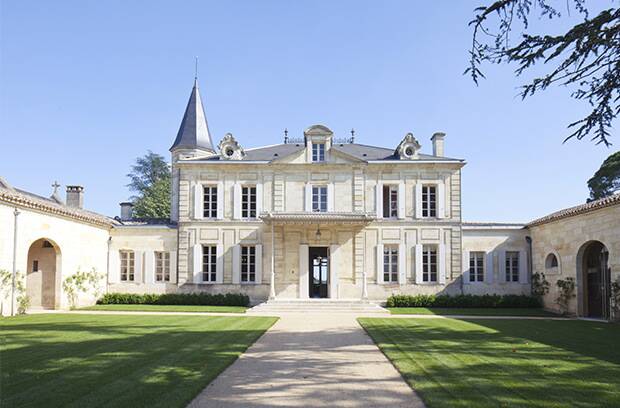
Above: Château Cheval Blanc in Bordeaux, France – one of the most prestigious producers in the region, and one that uses a large proportion of cabernet franc in its wines. Opposite: red wine grapes – possibly cabernet franc – being harvested at the Château de Saumur in the Loire Valley, as depicted in the medieval illuminated manuscript Les très riches heures du Duc de Berry (circa 1412–16).
Those 100% cabernet franc wines from the Loire – which tend to be more fragrant and herbal, with lighter structures and typically less input of oak – have historically had a somewhat mixed reputation, with the best examples praised for their fragrance and grace and the worst examples castigated for being practically undrinkable. Keith Mabry, a wine buyer at vaunted San Francisco wine emporium K&L, describes the latter as traditionally having “So many vegetal tones, rampant Brettanomyces, occasional oxidation: these wines were all over the place.” But a quality revolution courtesy of better farming, better making, and warmer seasons has seen that reputation slowly change, with figures such as the Foucault brothers of Clos Rougeard, Olga Raffault, and Romain Guiberteau of Domaine Guiberteau leading a charge that has seen the cabernet franc-based reds of the Loire become hot property amongst the global sommelier set. And the wider world is catching on, too: it’s perhaps telling that when winemaker Alecia Moore – better known to the wider world by her stage name, P!nk – was looking for a place to discreetly hone her new craft, she went to Clos Rougeard rather than any of France’s better-known properties.
“So many vegetal tones, rampant Brettanomyces, occasional oxidation: these wines were all over the place.”
Bordeaux’s take on cabernet franc hasn’t seen quite the same radical change in its reputation, although that is also slowly changing. In the 1960s the variety was as widely planted as cabernet sauvignon, but its susceptibility to spring frosts saw it, like malbec, get rapidly overtaken by merlot. The fact that it is sensitive to soil temperature means that you’re more likely to find it in the cooler soils of right bank of the Gironde estuary – in appellations such as Saint-Emilion, Pomerol, and Castillon Côtes de Bordeaux – than in the heat-retaining gravelly soils of the left bank. On the right bank, cabernet franc has, somewhat inadvertently, become a star performer. When Jonathan Maltus of Château Teyssier purchased a vineyard in Saint-Emilion in the 1990s, he was drawn to the old merlot vines. But, so the story goes, Maltus’s vineyard manager didn’t have the heart to tell him that most of the vines were actually cabernet franc, with only a small percentage of merlot. (As noted above, it’s very easy to mistake cabernet franc for its children in the vineyard.) Moving past his initial disappointment, Maltus launched his new label, Le Dôme, with what was at the time the highest proportion of cabernet franc in Bordeaux. It has since become one of the region’s most successful and enduring ‘garagiste’ wines. Meanwhile, cabernet franc continues to make the lion’s share of the plantings of legendary Saint-Emilion estate Château Cheval Blanc, and its use in Pomerol is increasing – as Bordeaux expert Jane Anson writes in her encyclopaedic guide Inside Bordeaux, here it has become “an increasingly useful counterweight to merlot, giving freshness and aromatics to the wine as harvests struggle with rising temperatures.” Despite the region’s long tradition of blending varieties, a handful of 100% cabernet franc Bordeaux wines have appeared, chief amongst them Château Trottevieille’s ‘Vieilles Vignes’ cuvée, Château de Pitray, Château Civrac, and the varietally labelled cabernet francs of upstart label B1ockOne.
Frankie goes global
If cabernet franc has a second home in the Old World, it’s Italy. There are currently approximately 4,125 hectares of cabernet franc in Italy, though some vineyards have not properly identified whether their vines are actually cabernet franc, cabernet sauvignon, or indeed carmenère – an old Bordeaux variety that was thought to be practically extinct until it was discovered to be all of Chile’s ‘merlot’. (It has since gone on become that country’s defining wine variety, much as malbec is to Argentina.) The Veneto is the Italy’s most prolific source of cabernet franc, followed by Friuli–Venezia Giulia, then a smattering in Bolgheri, on the Tuscan coast of the Mediterranean. It perhaps is accorded the most acclaim in Bolgheri, thanks to its small role in the region’s coveted Bordeaux-style ‘Super Tuscan’ blends, but good examples of varietal cabernet franc wines from the Veneto and Friuli–Venezia Giulia can be just as compelling, albeit in a very different register – fresh, bright, and easygoing, and usually aged in stainless steel for purity.
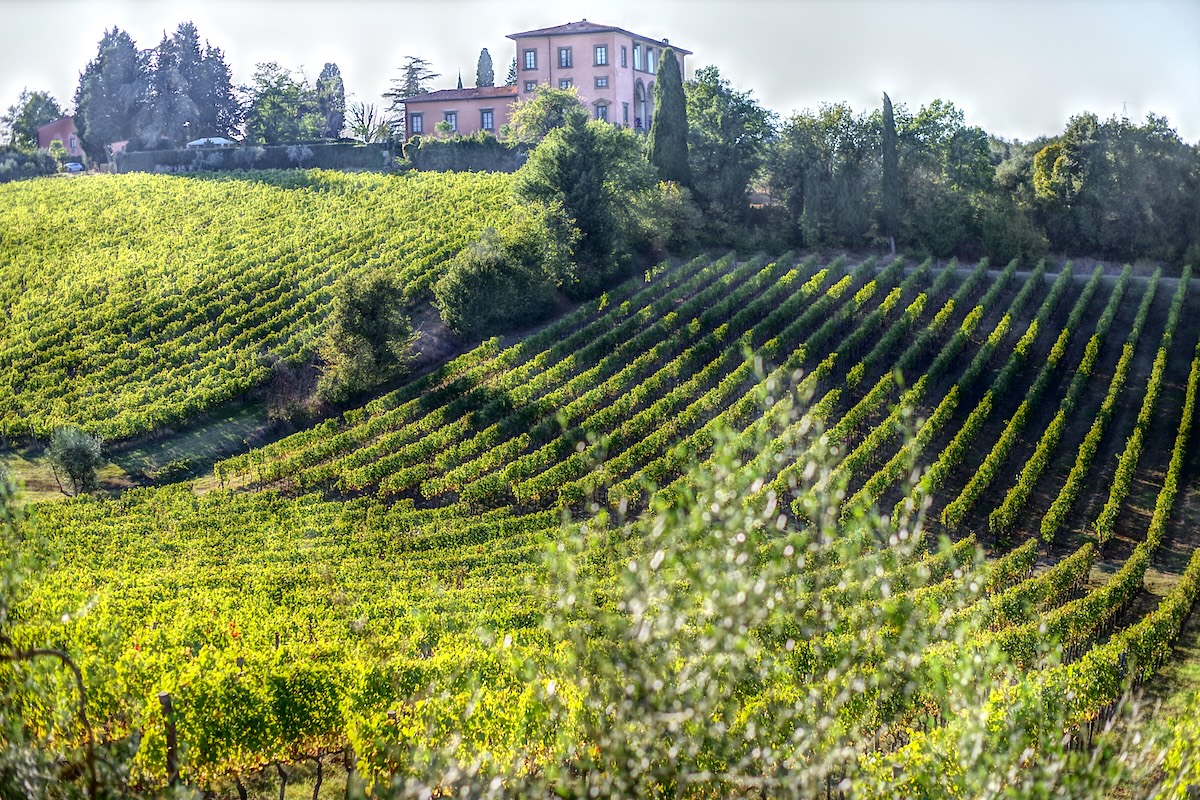
Opposite: Vineyards in Bolgheri, Tuscany – where cabernet franc sometimes plays a supporting role in the much-hyped ‘Super Tuscan’ blend. Above: The Napa Valley in California, home to some cabernet franc–heavy wines with cult status.
The Bordeaux model, from either bank, has had the major influence on planting and blending decisions in the New World – however, in the right conditions, franc is finding a singular voice. Sometimes this echoes styles of the Loire Valley, sometimes Bordeaux – and increasingly it’s as an individual expression that speaks of place and maker rather than a French benchmark. Notable examples of 100% cabernet franc wines are made in the Napa Valley, with Lang & Reed leading the way, but they are being joined by other makers. Superstar winemaker Aaron Pott has long been an advocate of cabernet franc – with distinguished stints at leading Saint-Émilion estates, this is perhaps no surprise – and while his portfolio of Pott Wines is largely based around cabernet sauvignon, his 80% cabernet franc wine ‘Space and Time’ remains quite the cult item. (Cabernet franc’s success in image-conscious Napa is remarkable given that the variety was given a verbal beatdown in the 2011 film Sideways, where the insufferable snob Miles declares “I’ve come never to expect greatness from a cab franc” – perhaps not as memorable a zinger as “I’m not drinking any fucking merlot!”)
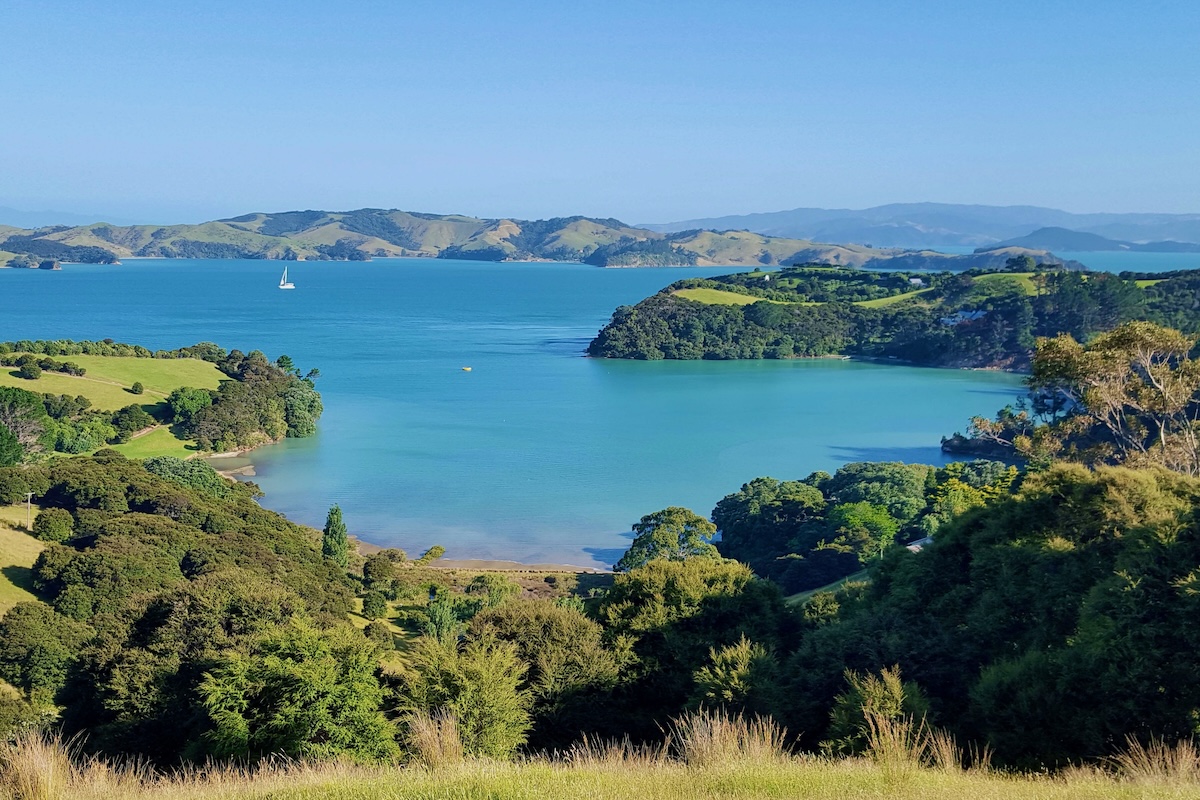
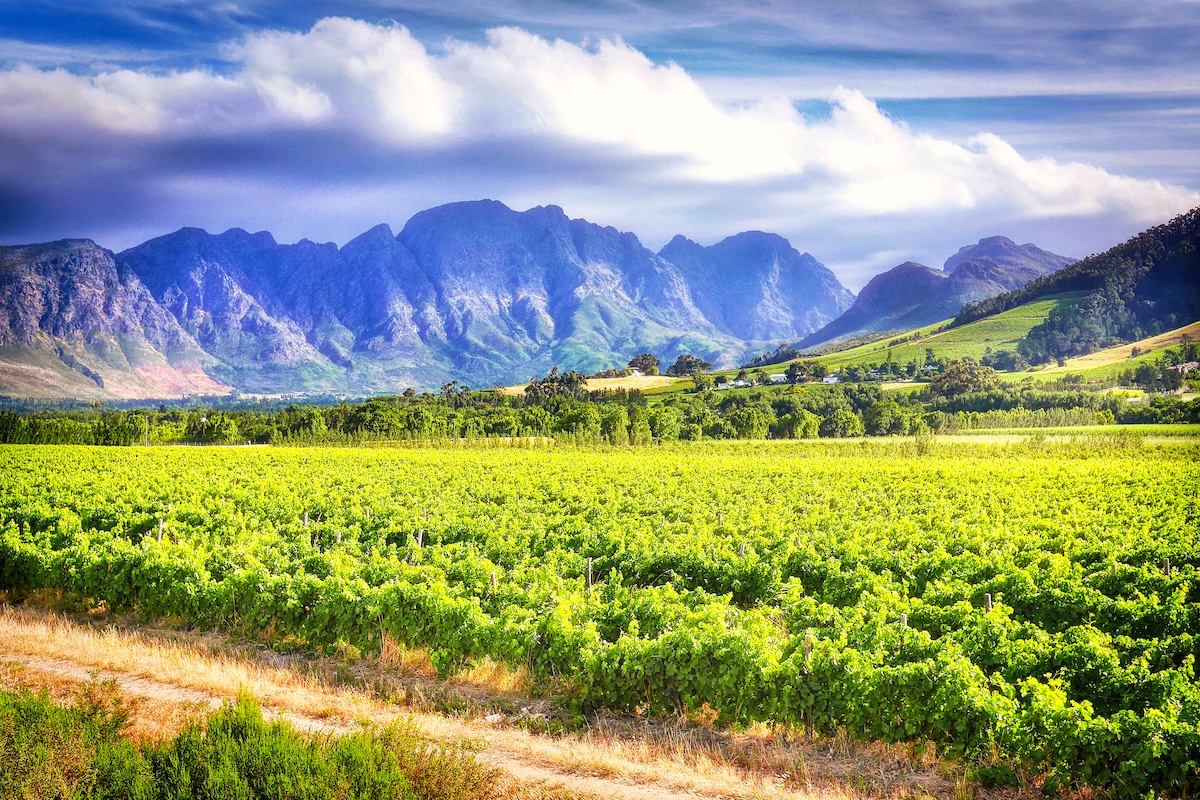
Opposite: Waiheke Island, New Zealand – where cabernet franc-based wines are emerging from the shadows of cabernet sauvignon. Above: The Stellenbosch wine region of South Africa – the cradle of that country’s cabernet franc renaissance.
Cabernet franc is also proving successful in the cooler viticultural zones of the United States, such as Virginia, Michigan and New York’s Finger Lakes – but it’s not just succeeding for its earlier ripening properties, offering a somewhat different profile to cabernet sauvignon, and one that is proving to be worth celebrating. Likewise, the variety is finding its voice in New Zealand thanks to makers such as Kennedy Point and Jurassic Ridge on Waiheke Island and North Canterbury’s Straight Eight Estate, and in South Africa thanks to Raats and Warwick Estate in Stellenbosch. Indeed, there’s a small global movement of varietal cabernet franc wines that break free of its Bordeaux-blend shackles – and the ever-more engaging reds of the Loire Valley are sketching out new possibilities that are proving inspirational in the New World.
Franking credits where credit’s due
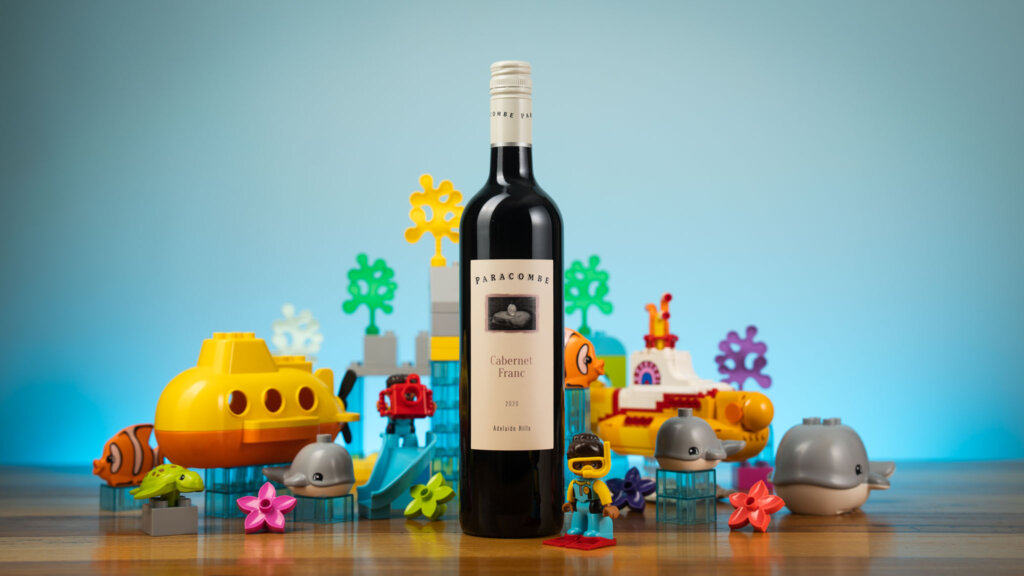
Cabernet franc first arrived in Australia as part of James Busby’s famous ‘Busby Collection’ of vines in 1832 – although its use was traditionally restricted to being a blending component, as in the Bordelaise model. And it was with blending in mind that Paul and Kathy Drogemuller first planted cabernet franc in their vineyard, now known as Paracombe, near the town of the same name in the Adelaide Hills. “It was one of the first varieties mum and dad planted when they first started in 1983,” says Ben Drogemuller, Paul and Kathy’s son, who works as an all-rounder in Paracombe’s vineyard and winery while also managing the label’s logistics and distribution. “Cabernet franc, pinot noir, chardonnay, and sauvignon blanc were the first four varieties they planted. They got asked to plant the varieties to sell originally as grapes [to other labels] and then, as things went on, they decided they would have a crack – that’s how they they started to put Paracombe forward.” It’s fair to say that the Drogemullers have come a long way since then: “We have a fair bit of chardonnay interspersed in our original patch of cabernet franc, because mum and dad didn’t realise that one was white and one was red when they started,” Ben says, laughing. As far as the initial cabernet franc goes, it was originally intended to “fill a hole” (in Ben’s words) in multi-regional blends modelled after those of Bordeaux – but the fact that the Drogemullers didn’t include other Bordelaise varieties when the vineyard was first planted meant that it made sense for them to make a 100% cabernet franc varietal wine when Paracombe launched as a wine label. “Our first release of cabernet franc was 1993, and we’ve made one every year since,” Ben says. “I don’t think there’s many other producers that have had been making it as a single-varietal wine for that long.”
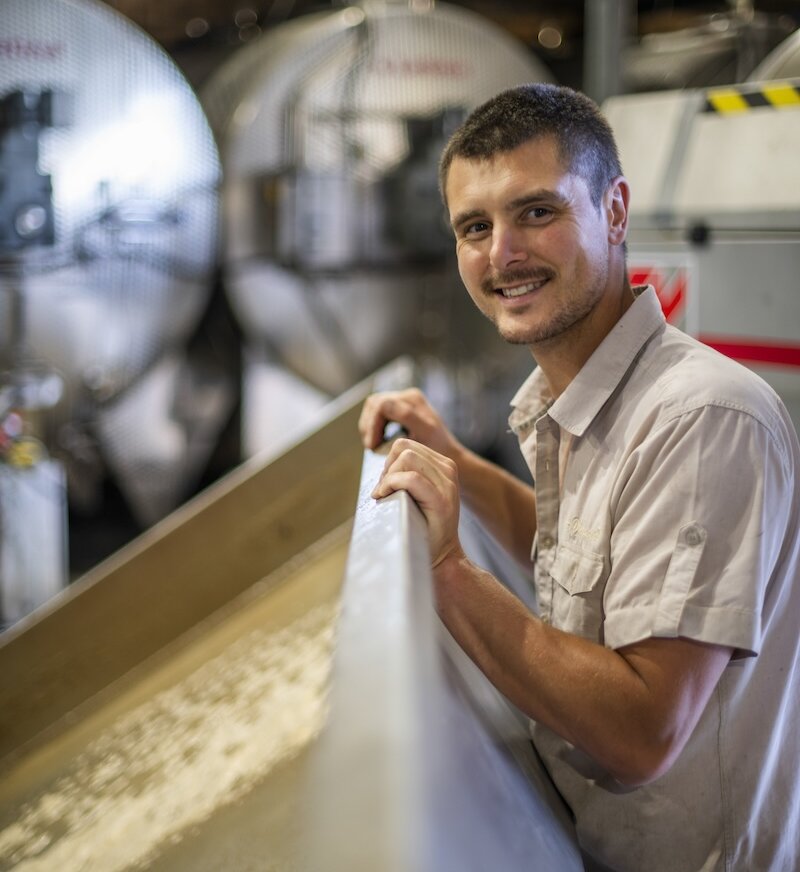
Above: Ben Drogemuller of Paracombe in the winery. Opposite: The vineyards at Paracombe – the source of (arguably) Australia's first varietally labelled cabernet franc wine.
While Paracombe don’t shout the fact loudly, that 1993 wine was arguably the first varietally labelled cabernet franc wine in Australia. (“It’s not a self-proclaimed thing,” Ben clarifies. “It’s a bit more of an industry recognition, I would say.”) The family’s long history with the variety means that it’s one that they cherish: “We’re very passionate about it, and it’s a complete labour of love – we’re lucky to get, on a very good year, a kilo of fruit per vine, because it’s just such a hard one with fruit set,” Ben says. “The flowering’s only a very short window – a couple of days at most – and if you have a couple rough days of wind, which we quite often do in spring here in our part of the Hills, it can get hammered and you won’t get much fruit … cab franc spits its flowers very, very easily.” While this viticultural difficulty means extra work for Ben and the Paracombe team, they persist because, as he says, “We love the beautiful perfumed aromatics of it – it’s got some weight to it, but it’s very much not on the heavy end for a red table wine.” He adds, “People on the sommelier side of things really love it because of its attractiveness – and it can handle quite a variation of different foods, and stand up and hold its own.”
“We’re very passionate about it, and it’s a complete labour of love – we’re lucky to get, on a very good year, a kilo of fruit per vine, because it’s just such a hard one with fruit set.”
Getting their cabernet franc to this level of polish has been something of a learning process for Paracombe, as Ben acknowledges: “We’ve put a fair bit of effort in the last ten years to focus the wine a bit,” he says. “In the early days, we were probably trying to put out a generic ‘dry red’ from the variety – but we’ve been more and more focussing on our harvest dates and not putting big oak or anything at it, because we still want to keep those beautiful varietal characters of cab franc and not just have it be another red wine.” Part of this process has been managing the variety’s notorious ‘green’ flavour characteristic, which comes from high levels of pyrazines in the fruit. “We basically harvest on taste,” Ben says. “We don’t want it to be, you know, really overly acidic and have that green character shining through the whole wine. We want it to be more as a complimentary part.” In order to minimise that greenness, Paracombe deploys some cutting-edge technology in the vineyard: “We have a machine harvester here that’s pretty state-of-the-art in terms of on-machine sorting,” Ben says. “So any leaf or stalk character is sorted on the top of the machine and it’s just a whole grape going into our hopper. We don’t crush the fruit in the winery – it comes in just off the harvester. With cabernet franc, we don’t want really any more stalk character or anything like that because the variety’s got plenty of its own herbal characters.”
A frank look at Margaret River
As at Paracombe, the cabernet franc vines at Cape Mentelle, in Margaret River, were likewise planted with the intent of using their fruit in Bordeaux-style blended wines – so much so that it’s hard to tell where cabernet sauvignon ends and cabernet franc begins. “We’ve got two blocks – one that was planted in 1974, and then another one planted in 1988,” says David Moulton, Cape Mentelle’s chief of winemaking and viticulture. “The ’74 block transitions from cabernet sauvignon – all of a sudden it just turns into cabernet franc. It took me a few years when I got here to figure out exactly where the border was – but now it’s like an old friend, you can tell the difference in canopy size and things like that.” Cape Mentelle took the step of releasing a varietal cabernet franc in the 2016 vintage owing to having some surplus fruit left over from the small amount blended into their cabernet sauvignon wine. “It was supposed to be something that was sort of fun or exciting each vintage,” Moulton says of the wine, which originally came out as ‘Walcliffe Red’. “It hatched by marketing, as most of these things can be – and we’ve done some funky blends like merlot, petit verdot and malbec over the years – but since 2020 we’ve made it as a straight cabernet franc every year and we’ve just not told marketing.” He adds, laughing, “I think they’ve finally figured it out now we’ve done six vintages in a row!”
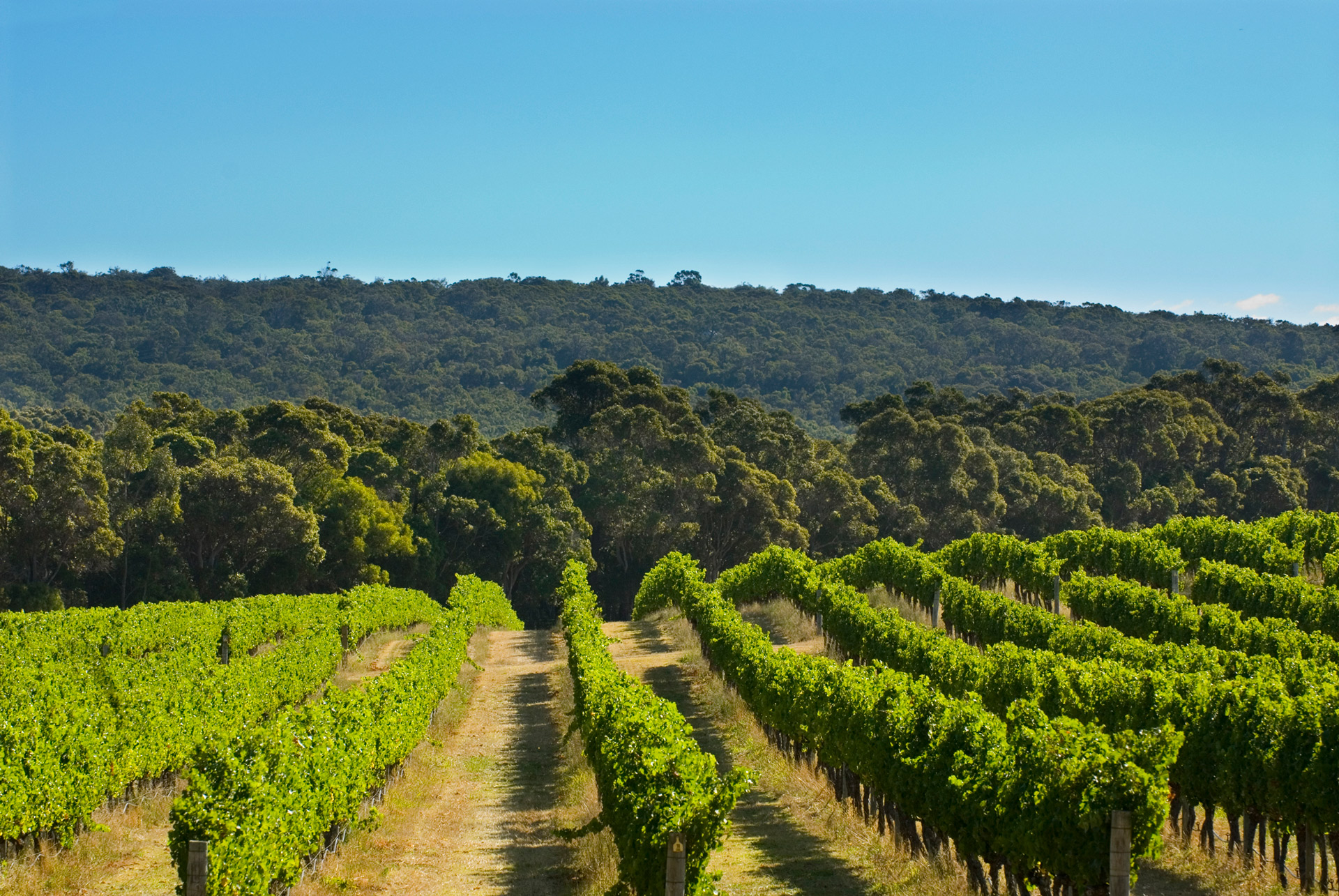
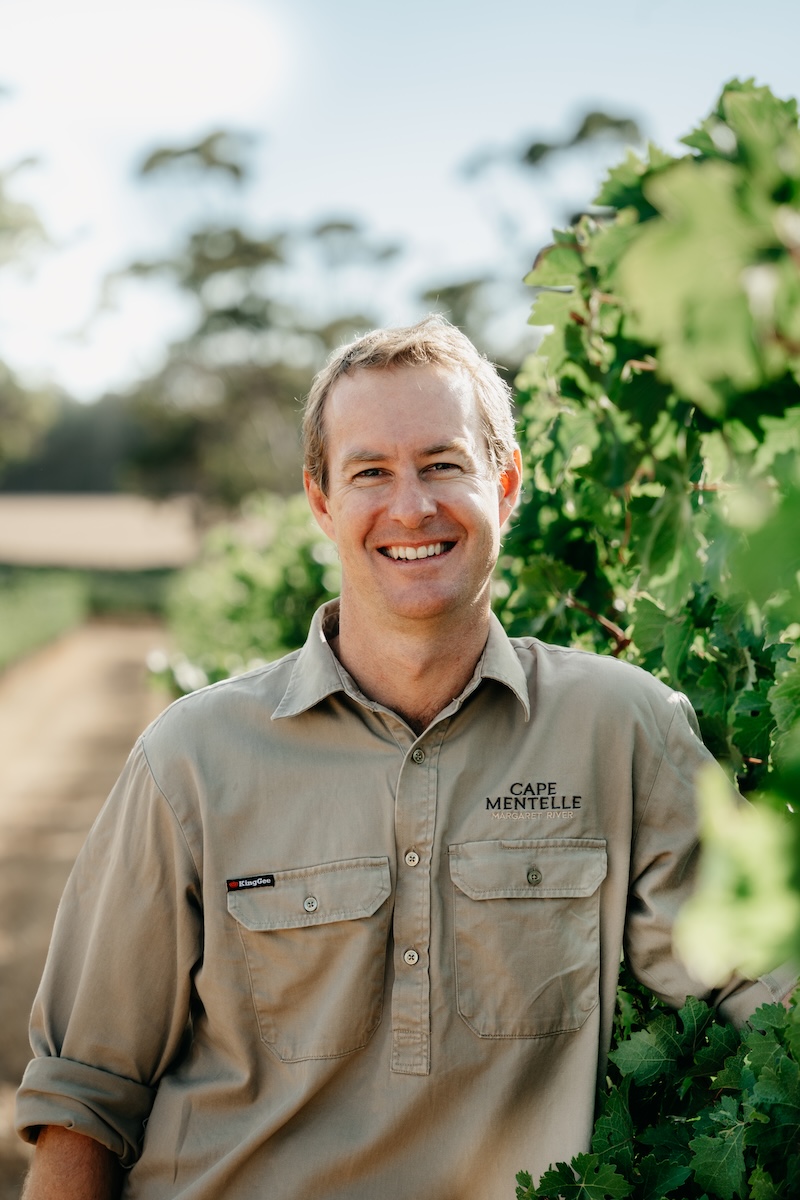
Above: David Moulton, chief of winemaking and viticulture at Cape Mentelle. Opposite: Cape Mentelle’s Wallcliffe vineyard.
Like the Drogemullers, Moulton argues that ripeness is the key to success for cabernet franc: “All the rows are east-west,” he says, “so in a cooler year, we’ll go and knock a bit of leaf off on the south side, just try and get a bit more airflow. It gets a shoot-thin and a green-bunch thin – we’re really looking to try and get that sort of tannin ripeness on the vine.” He adds, “As we see the emergence of a lot of new varieties in Australian wine – a lot of Spanish varieties and things like that – the modus operandi seems to be lighter and brighter, less extraction and earlier picking. I don’t think cabernet franc – for us, on our site – really lends itself to that. We still need that tannin ripeness. There’s nowhere to hide from sappy green tannins that are just not ready, and we’d probably rather hold our nerve and leave the fruit sitting out there than take it lean and green. Then we’d have to press it off after three or four days to make something a bit lighter and brighter – that just doesn’t work for us … we’re probably pushing into that little bit of a blue-fruit spectrum instead.” Moulton adds that the cool breezes that come off the Indian Ocean assist in achieving this desirable level of ripeness without losing freshness: “Where these two blocks are located, we’re about five kilometres, as the crow flies, from Surfers Point, where they have the World Surf League contest every year,” he says. “So we get that cooling sea breeze coming through the vines in the early afternoon, which just brings them back down – we’re not accumulating sugar by concentrating and shrivelling the berries, we’re allowing the plant to actually accumulate more flavour into the fruit, which I think really does help us not lose all that acid.”
“Everyone’s definitely looking at trying to reduce the use of oak, especially new oak – because we we don’t want to smack the fruit with expensive wine coffins.”
Once that fruit is in the winery, Moulton wants to retain that freshness, so he handles the fruit relatively delicately: “It’s all hand-picked for that wine,” he says. “It comes in, we run it through a crusher-destemmer – a Socma Cube, it’s very gentle – then it drops down into a large tub. We pick that up and we drive it around to the static fermenter and we lift it up on top and open a valve. So we don’t pump with water or anything like that from the crush pad to the fermenter – we do it with gravity.” In line with changing norms in Margaret River, Moulton is using less oak to craft the finished product each vintage, too. “As a region, I’ve never seen so many concrete and amphora fermenting vessels – and also ceramic eggs seem to be popping up everywhere at the moment,” he says. “So everyone’s definitely looking at trying to reduce the use of oak, especially new oak – because we want to see some fruit. I think that’s the reason we’re doing it – we don’t want to smack the fruit with expensive wine coffins.” He adds: “It’s an evolution. And it’s like anything else – the more good vintages and bad vintages we see with some of these blocks, the easier it gets to understand what we’re trying to do and what we’re trying to create.”
Frankly facing the future
The suitability of cabernet franc to Margaret River’s climate, as well as market trends towards lighter and fresher styles of wine, has seen Cape Mentelle leaning in to its production. “We’ve actually got some planting scheduled for 2027 of some more cabernet franc,” Moulton says. And in a market where consumption of traditionally styled red blends is plummeting, he sees the virtues of promoting varietal cabernet franc wines to make use of vines that are already in the ground and fruiting. “We can look at viticultural and winemaking techniques as a solution to many of the problems within the Australian wine industry, I think,” he says. “So if we can make a standalone cabernet franc where we can get some polish in the tannin – without having those green stemmy edges – and make a wine that’s good to drink, then why not?” He adds, “I’m not against any varieties – especially any of the new and emerging and fun ones – as long as they’re good wines, and they’ve got a sense of place, and they’re delicious. Why not? That’s the beauty of Australia versus some of the Old World wine regions – we can give it a crack if we want, then it’s up to us.”
“We can look at viticultural and winemaking techniques as a solution to many of the problems within the Australian wine industry. So if we can make a standalone cabernet franc where we can get some polish in the tannin and make a wine that’s good to drink, then why not?”
Ben Drogemuller is equally bullish about the virtues of cabernet franc. “It’s a variety that’s been around for a very, very long time – but it’s such an approachable variety that suits a lot of the Mediterranean styles of cuisine and can even handle some Asian styles of cuisine with a bit of spice or chilli,” he says. He cautions, though, that its viticultural peculiarities, especially the reduced yields owing to its fragile flowering, make it somewhat hard to work with: “I don’t think there’s really anywhere in the world that you can see it grown on a huge commercial scale because it isn’t a vine that crops massively,” he says. “And certainly we’ve seen it take quite a few years for the vines to establish themselves and hit their quality mark.” Despite this fact, Paracombe’s cabernet franc currently retails at the relatively modest price of $32 per bottle – as do most other Australian cabernet franc wines, which rarely crack the $50 per bottle mark. “I think particularly for varieties that may not be as well known, you have the barrier to entry of of price point – because you don’t want to put people off with the price tag before they’ve even tried it,” Drogemuller says. “You want it to be approachable on the shelf as well.”
“You don’t want to put people off with the price tag before they’ve even tried it. You want it to be approachable on the shelf as well.”
For both Drogemuller and Moulton, the next step is simply educating consumers about the existence of varietal cabernet franc wines – and getting those wines into people’s glasses so they can be taken by the variety’s inherent charm. “I’d love to see some more of these little things that are hidden away in people’s vineyards and on their blending benches to actually have their own time in the sun,” Moulton says. “I think that’s important.” Reflecting on his own experiences trying to showcase the variety, Drogemuller says, “So many times, you’ll pour it for someone and they’ll say, ‘Oh, I thought that was only used in blends!’ Or they’ll say, ‘What’s the franc part of this cabernet sauvignon?’ People don’t necessarily understand that it is its own variety, and that it’s been around for so long.” He pauses, then adds: “We’re trying to do our bit to make sure that it gets out there more – because it’s a wine that certainly suits a lot of palates once you do try it.”
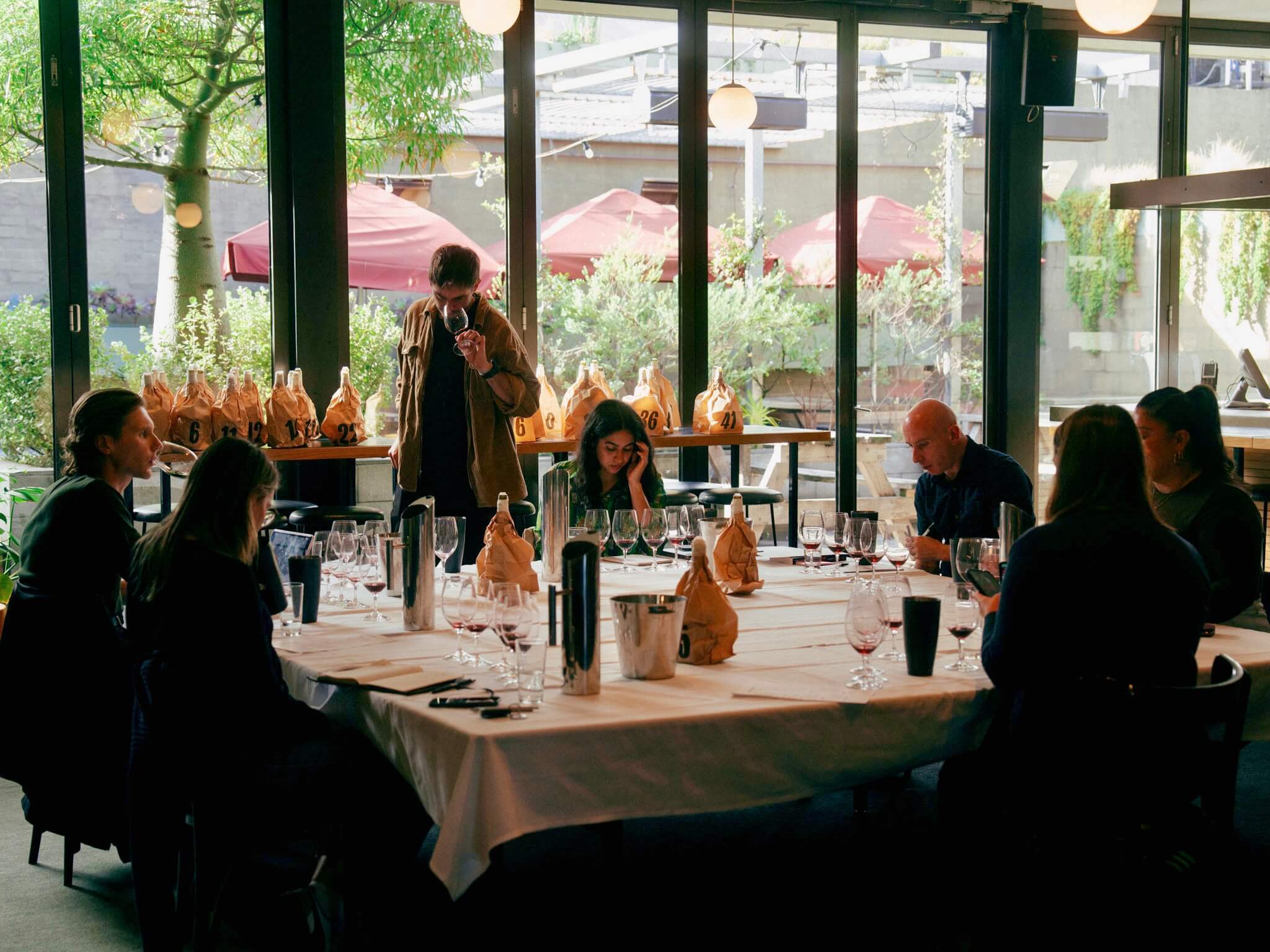
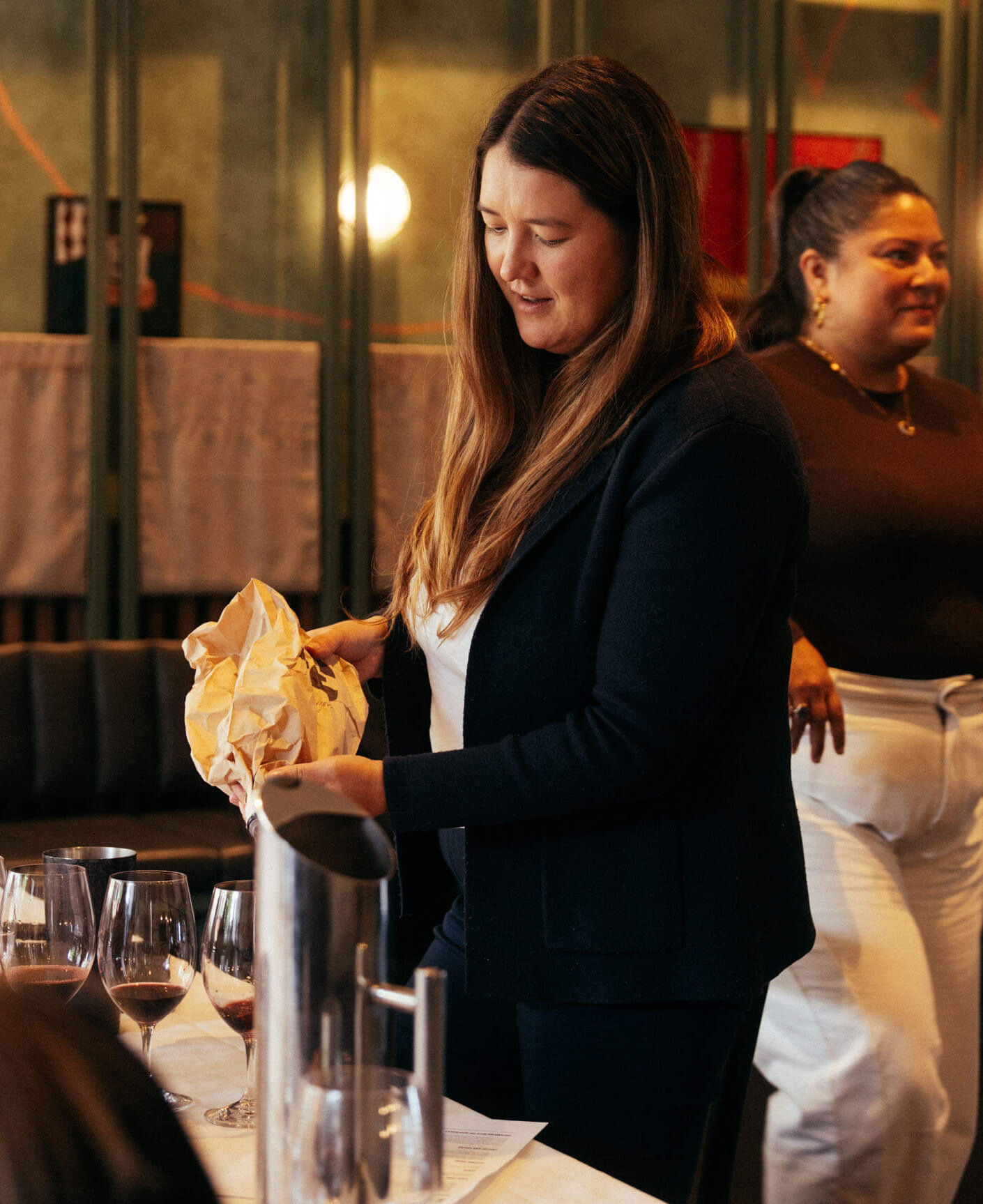
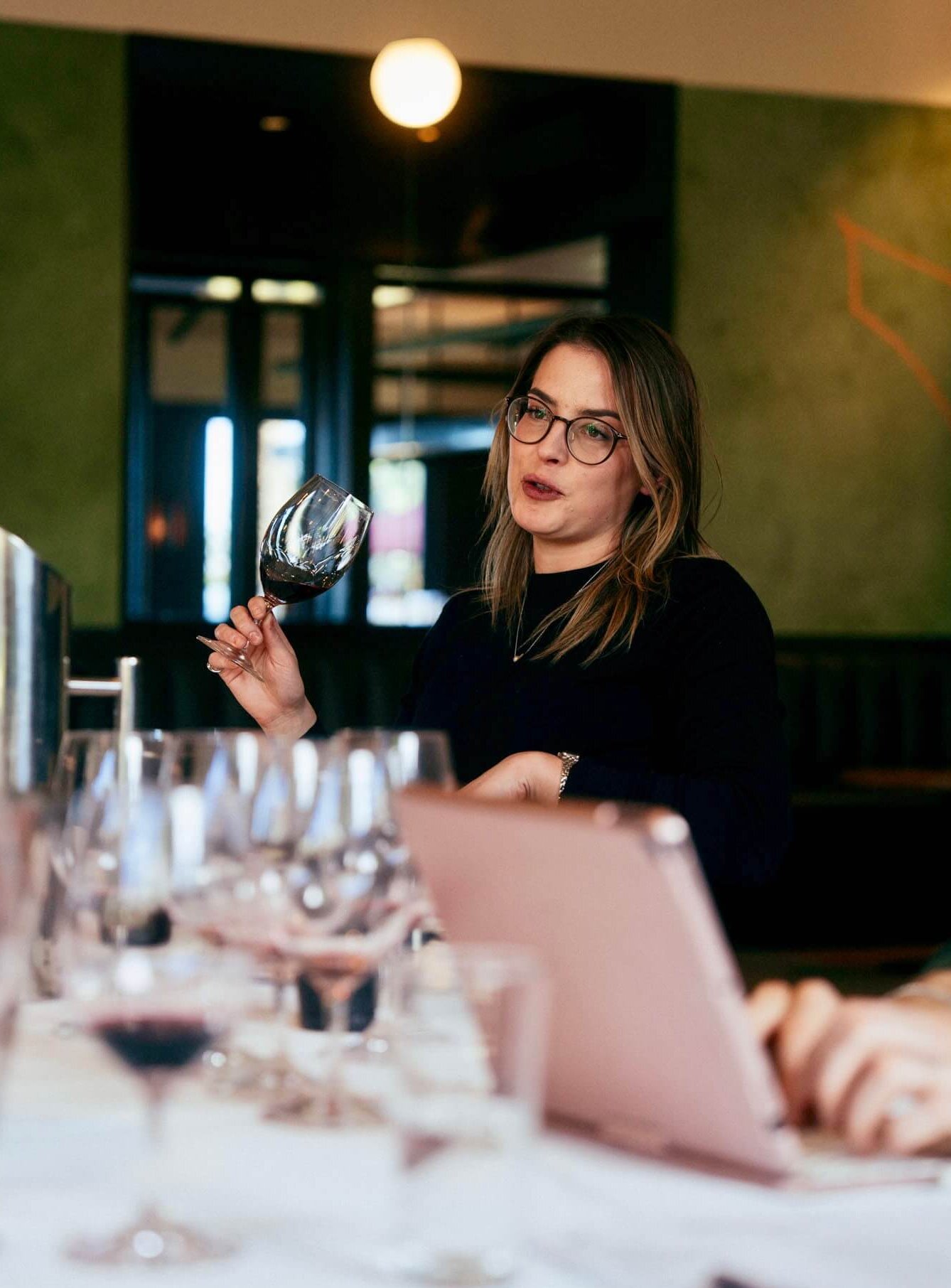
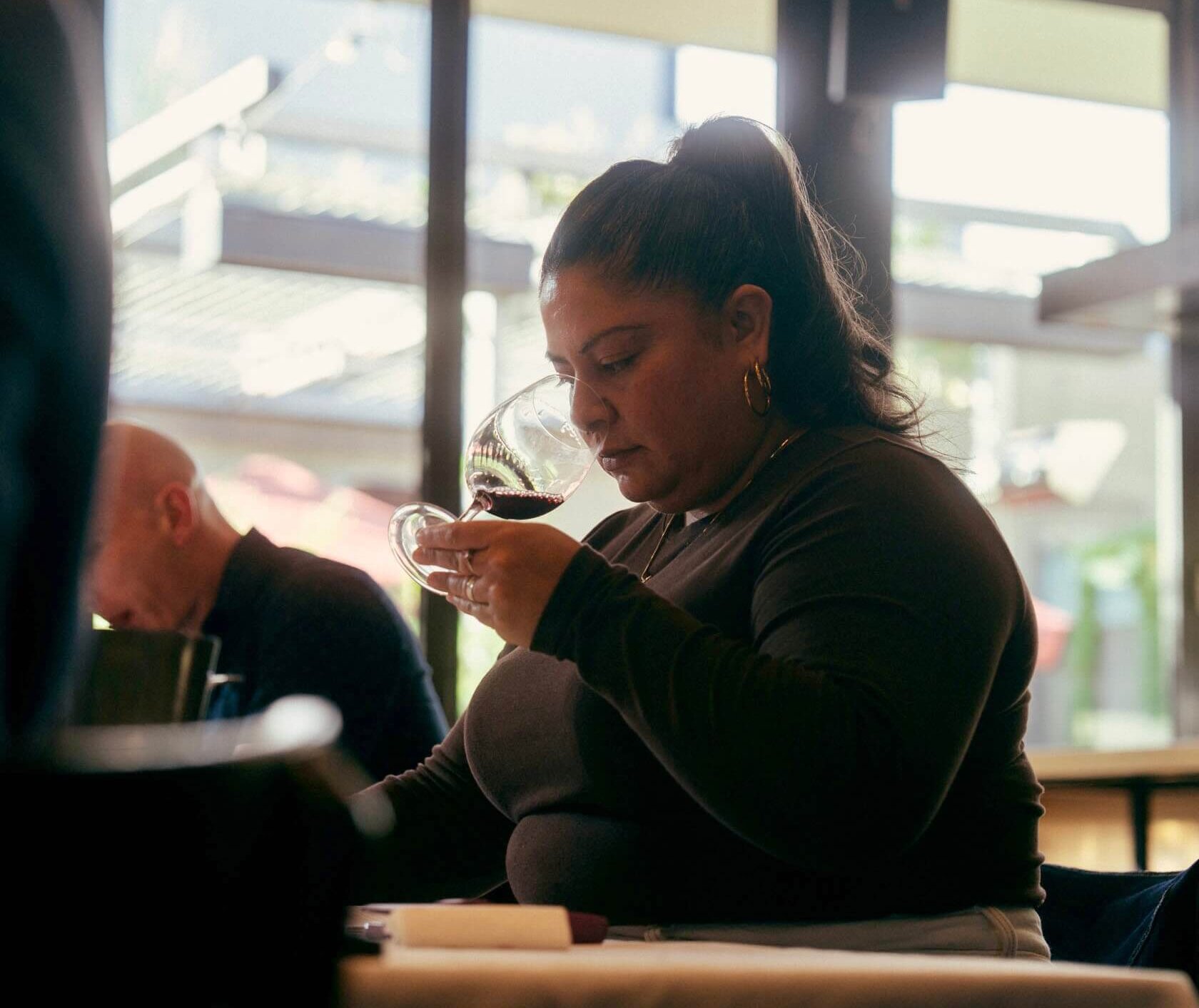
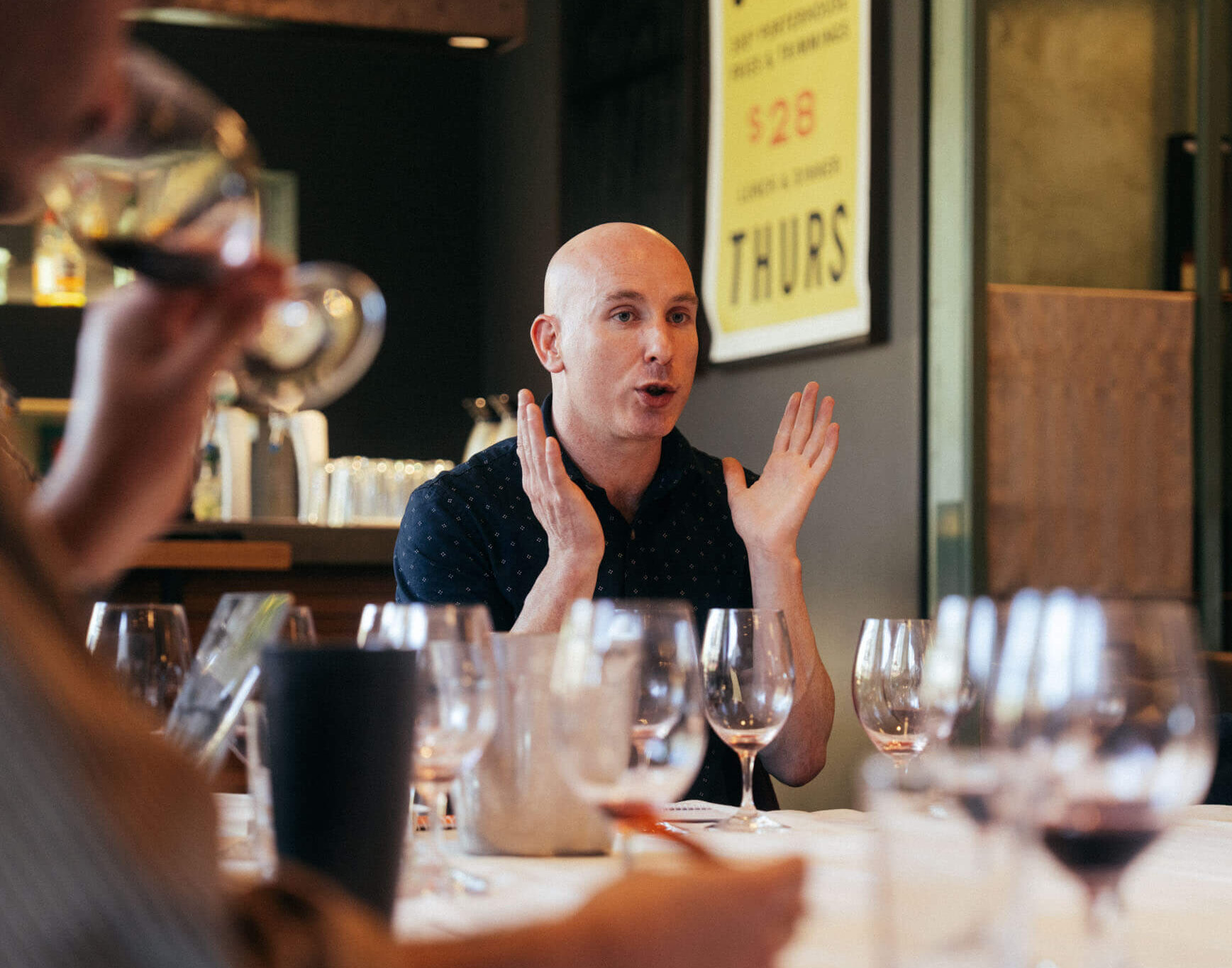
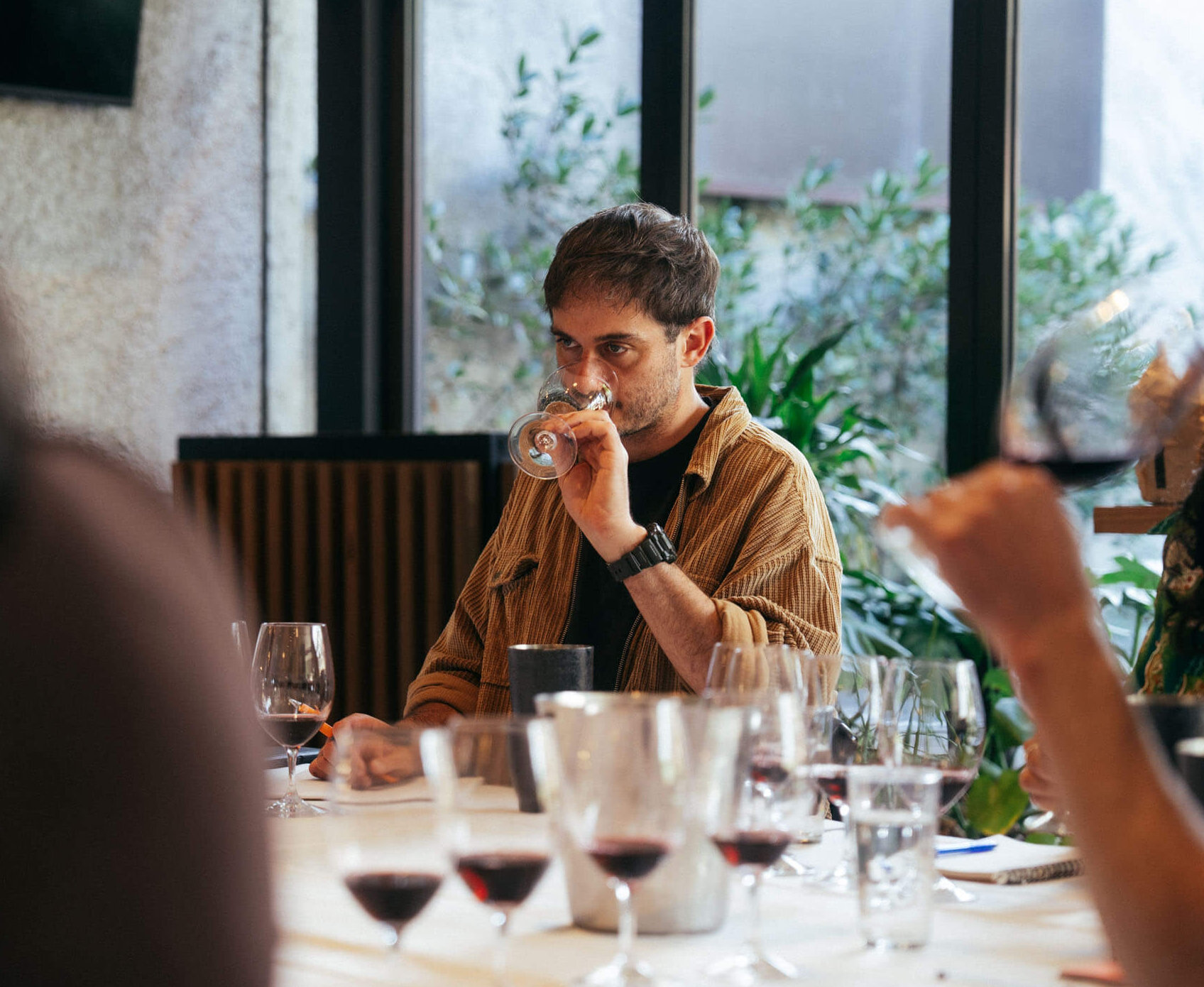
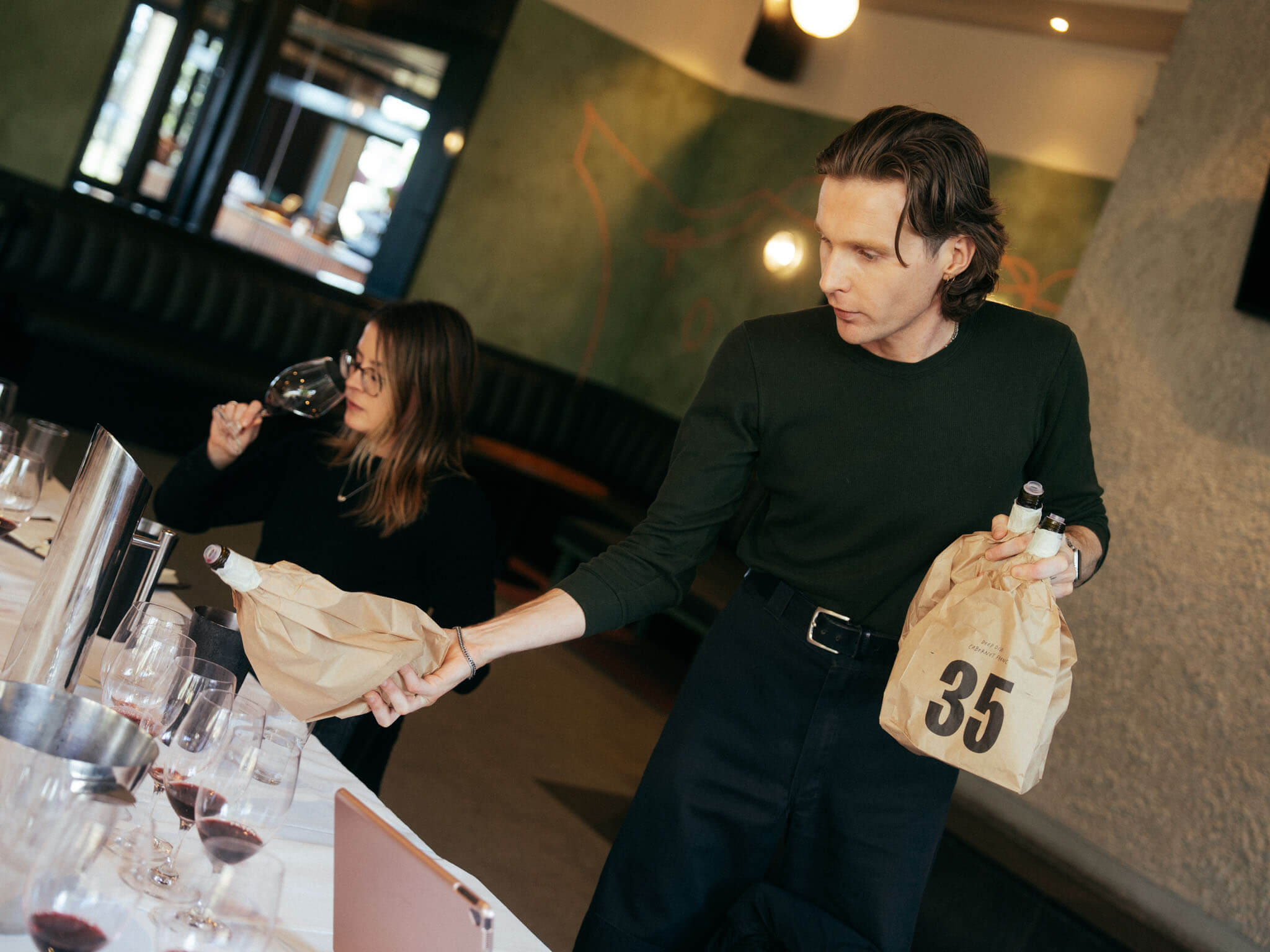
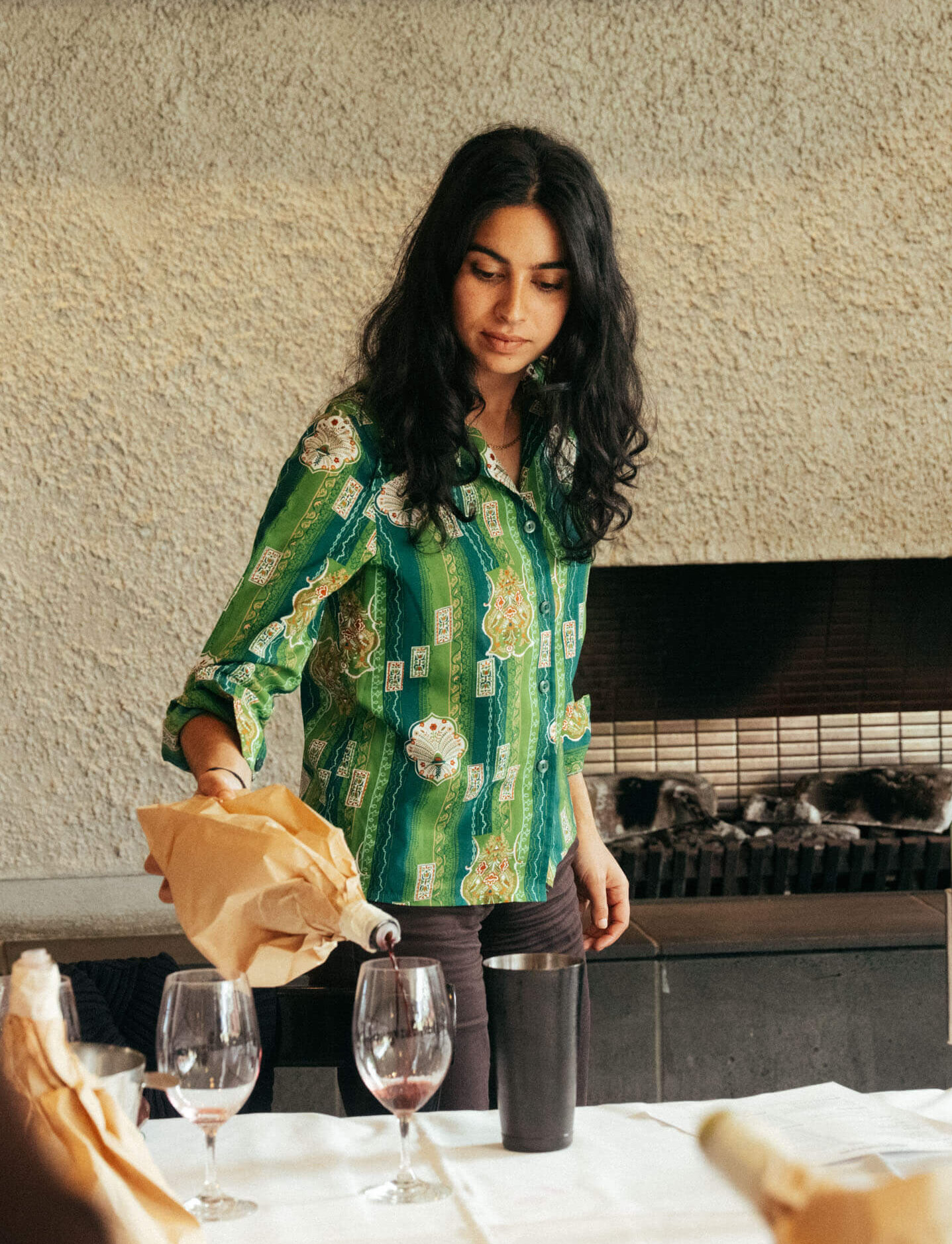
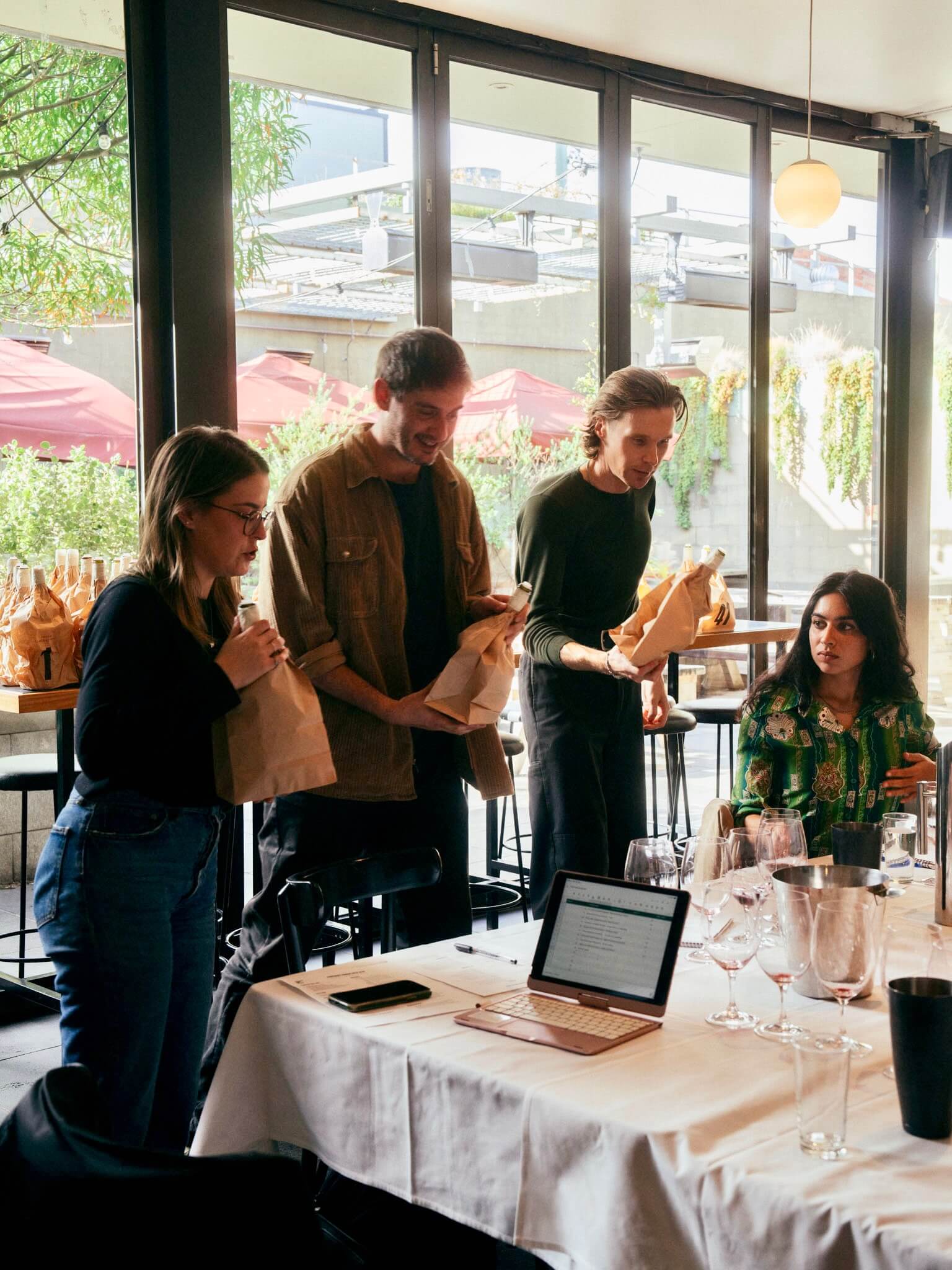
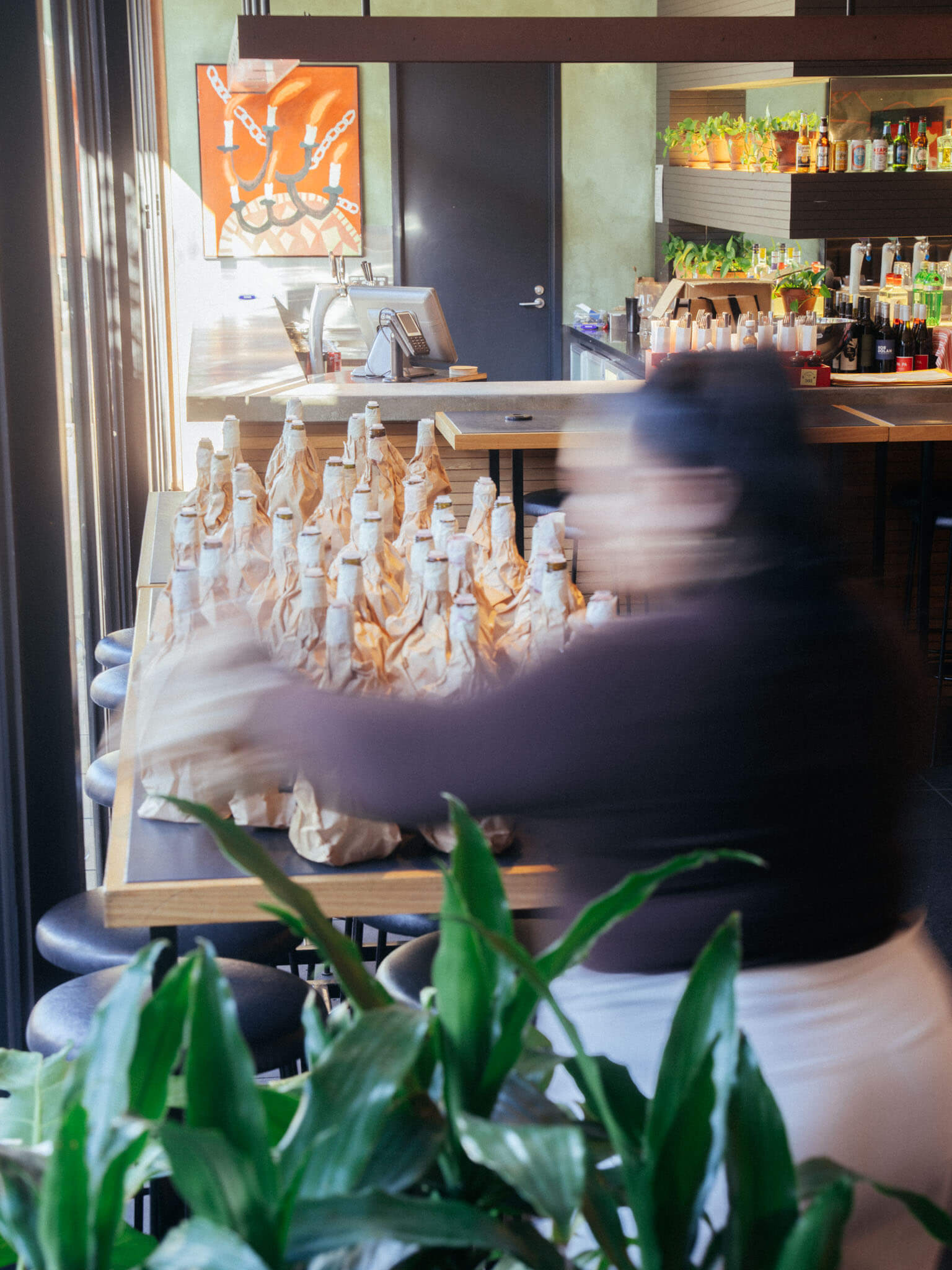
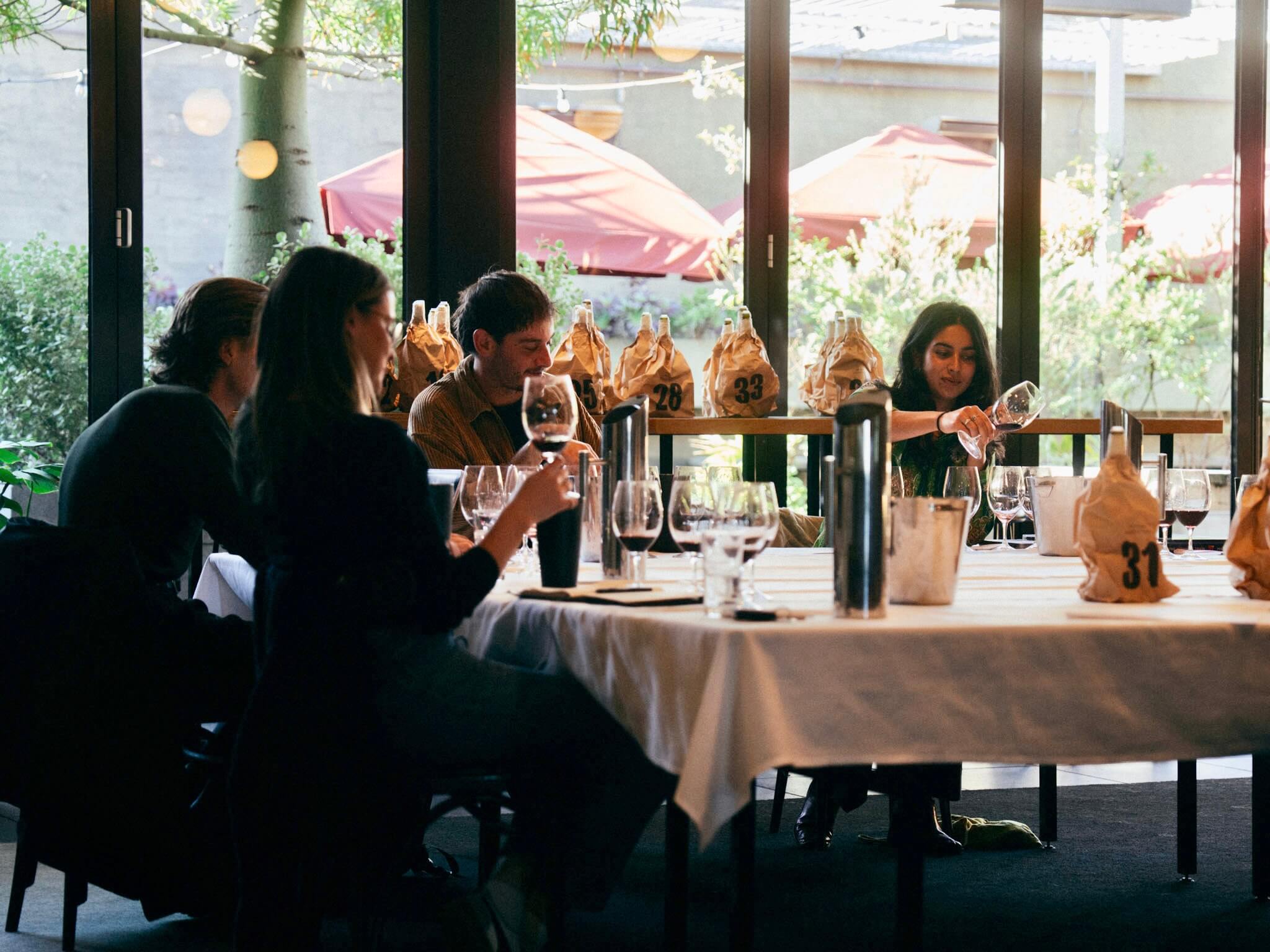
Above: Our expert panel assembled at the Bleakhouse Hotel, Albert Park (Melbourne).
Outtakes from the tasting
We gathered every example of Australian cabernet franc that we could find, and set our expert panel the task of finding the wines that compelled the most. All wines were tasted blind, and each panellist named their top six wines.
Our panel: Steffi Snook, owner and winemaker, Yayoi; Patrick Wood, vigneron, Kyneton Ridge and Harbinger Wines; Indra Nadeson, winemaker, Lethbridge; Jason Burns, sommelier and wine merchant, City Wine Shop; Terina Davies, wine merchant, Seddon Wine Store and Union Wine Store; Jordan Veltheer, wine communicator, Vino Champ; Megan Cruickshank, wine communicator, Apartment Six.
Snook kicked off proceedings by observing that the wines in the line-up were, on average, far more technically proficient than she had expected. “It’s super-exciting to be able to see so many different cabernet francs from Australia – it’s pretty rare to see them side by side like this,” she said. “It really blew all expectations. I was really expecting to see a lot more wines that were maybe on the unclean side – but all the wines showed really well today, and showed such different broad spectrums of flavour profiles. And it’s really exciting to see that in a bracket.” She clarified that when she spoke of the variety’s unclean side, she wasn’t necessarily referring to wine faults such as Brettanomyces or volatile acidity – “although I expected a bit of that,” she added – but more to the variety’s pervasive herbaceous character: “One of the main characteristics I tend to find in Australian cab francs that I’ve drunk over time is that kind of ‘greenness’, or that herbaceousness – so to not really see that represented much today was quite interesting.”
Opposite: Steffi Snook. Above: Megan Cruickshank.
This observation was swiftly co-signed by the rest of the panel, many of whom chimed in with agreement. “I expected a lot more greenery,” said Cruickshank. “What surprised me was how plushy a lot of the wines felt – I thought many of them were soft, and kind of luscious, whereas normally you get cab franc that’s super-crunchy.”
“One of the main characteristics I tend to find in Australian cab francs that I’ve drunk over time is that kind of ‘greenness’, or that herbaceousness – so to not really see that represented much today was quite interesting.”
Burns argued that this lack of greenness and abundant ripeness spoke to a distinctly Australian approach to the variety. “I feel like the winemakers weren’t trying to emulate French cabernet franc – they were making their own thing,” he said. “It wasn’t like they were trying to copy an ‘original’ because there was nothing that was reminiscent of your classics, whether that be Bordeaux styles or Saumur-Champigny.” Reflecting on the Loire Valley examples of cabernet franc that are popular items at his workplace, he added, “The French examples are more savoury – almost all savoury, hardly any fruit character – whereas these felt they were the other way around.”
Above: Terina Davies. Opposite: Jason Burns.
Davies concurred, saying, “I really thought that I was going to see nods to regions outside Australia, but it did feel like there was, across the board, a real Australian style. I really did think that they would sort of be a little bit referential towards other regions in the world – but this was definitely a very strong case for Australian cabernet franc.” Cruickshank added, “You can see the Australian creativity that comes through – some of them were more traditional than others, but there were a few that were very funky, and kinda wacky, and that’s what’s great about Australia.”
“In my head, I was expecting high tannins, blue fruits, a bit of leafiness, a bit dusty – some dusty, leafy blueberry and blackberry. A bit more like an ‘old man' wine, if you know what I mean? But everything was so fresh and bright and vibrant – the total opposite.”
Veltheer felt that the diversity of winemaking approaches on display had expanded his understanding of how the variety tastes, or should taste. “You see such a spectrum of winemaking with the one variety,” he said. “I had a preconceived version of what I think cabernet franc tastes like – and maybe two of the wines today matched that idea.” He added, “In my head, I was expecting high tannins, blue fruits, a bit of leafiness, a bit dusty – some dusty, leafy blueberry and blackberry. A bit more like an ‘old man’ wine, if you know what I mean? But everything was so fresh and bright and vibrant – the total opposite. And I’ve said this at every Deep Dive I’ve done, but I’m just so wowed by the diversity that we have in winemaking in this country – it felt very New World, very contemporary, and so cool. And cab franc’s been here forever as well!”
Above: Jordan Veltheer. Opposite: Patrick Wood.
Wood argued that despite this diversity of winemaking approaches, there was a clear varietal through-line in the tasting. “I think the integrity of variety is really strong in this bracket,” he said. “It feels like there’s a strong foundation of what people understand about what cab franc actually is.”
“You could see that leafy note, but nothing really had any sharp angles, or was really overt. It was a very balanced line-up. And there was a there was a real freshness to these wines – lots of beautiful acidity.”
Davies concurred. “There’s a real balance in the things that we would normally expect from cabernet franc, like that real sort of leafiness – that tomato or raspberry leaf note,” she said. “You could see that note – so you would be able to tell, if these were put in front of you completely blind, what the variety is – but nothing really had any sharp angles, or was really overt. It was a very balanced line-up. And there was a there was a real freshness to these wines – lots of beautiful acidity.”
Above: Indra Nadeson. Opposite: Our tasting panel in action.
Nadeson argued that this balance demonstrated an encouraging confidence with the variety from the makers represented in the line-up. “I think it just shows this actually really quite deep knowledge and understanding of the grape variety, which I wasn’t necessarily expecting – because I didn’t really have a single idea of what to expect with Australian cab franc,” she said. “But I think that, while there is a variety of different styles we should talk about, the line-up showed this real foundational understanding of what we want to express, and what we love about this grape. I think there was a real love for the variety in these wines, if that makes sense.”
“The line-up showed this real foundational understanding of what we want to express, and what we love about this grape. I think there was a real love for the variety in these wines.”
For Wood, the wines demonstrated an admirable balance between freshness and depth of flavour. “That’s such a subtle balance with this variety,” he said. “It’s very easy to pass over it in a tasting, but when you actually concentrate on that balance for what it is – it takes such finesse.” Observing the fact that several of the wines showed positive development from some time in bottle, he added, “One of the bigger challenges with a tasting like this is the fact that we’re seeing so many wines that are only just coming into their stride. I’d really love to see what all these look like in five years – what they’re going to achieve.”
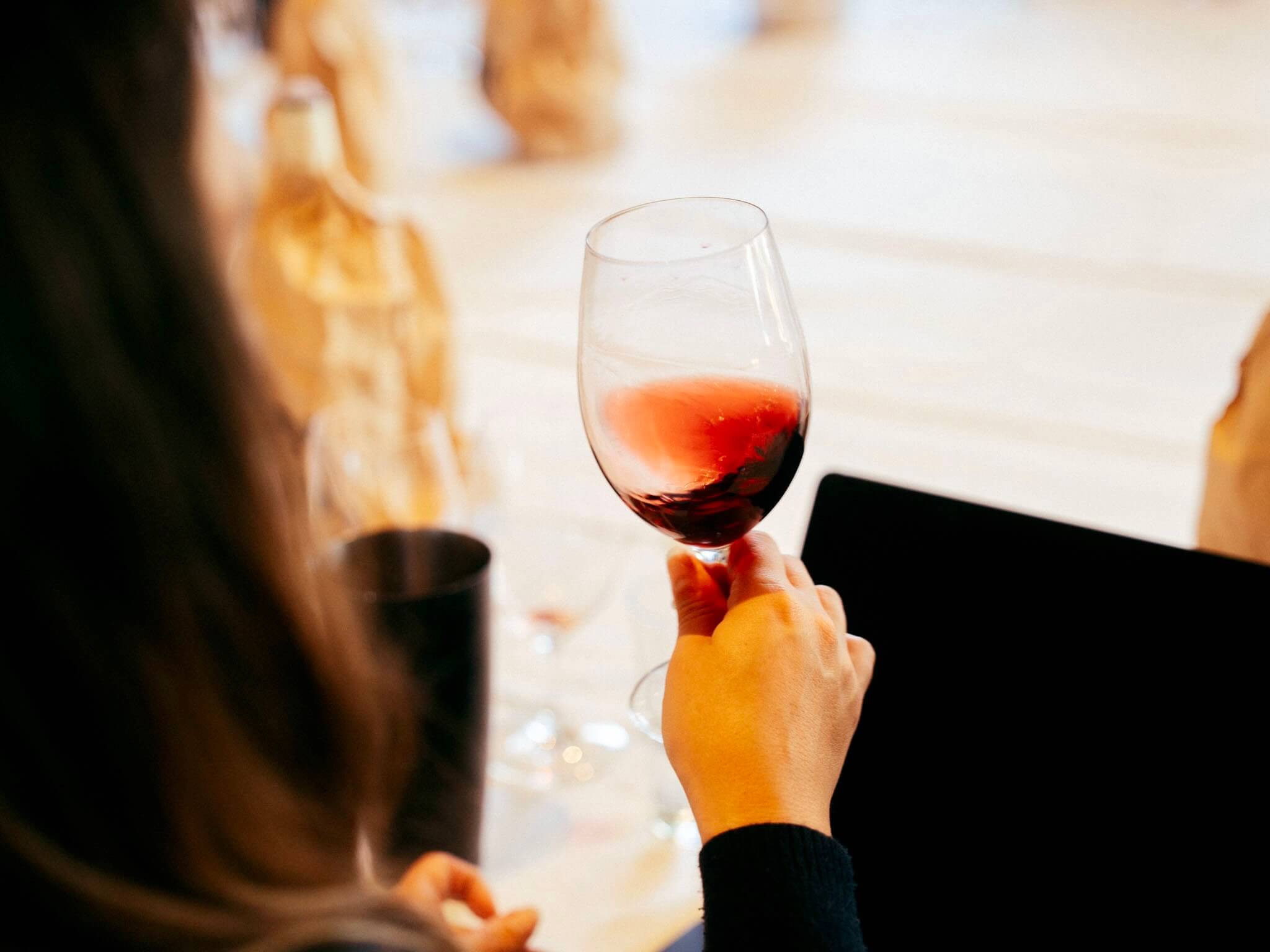
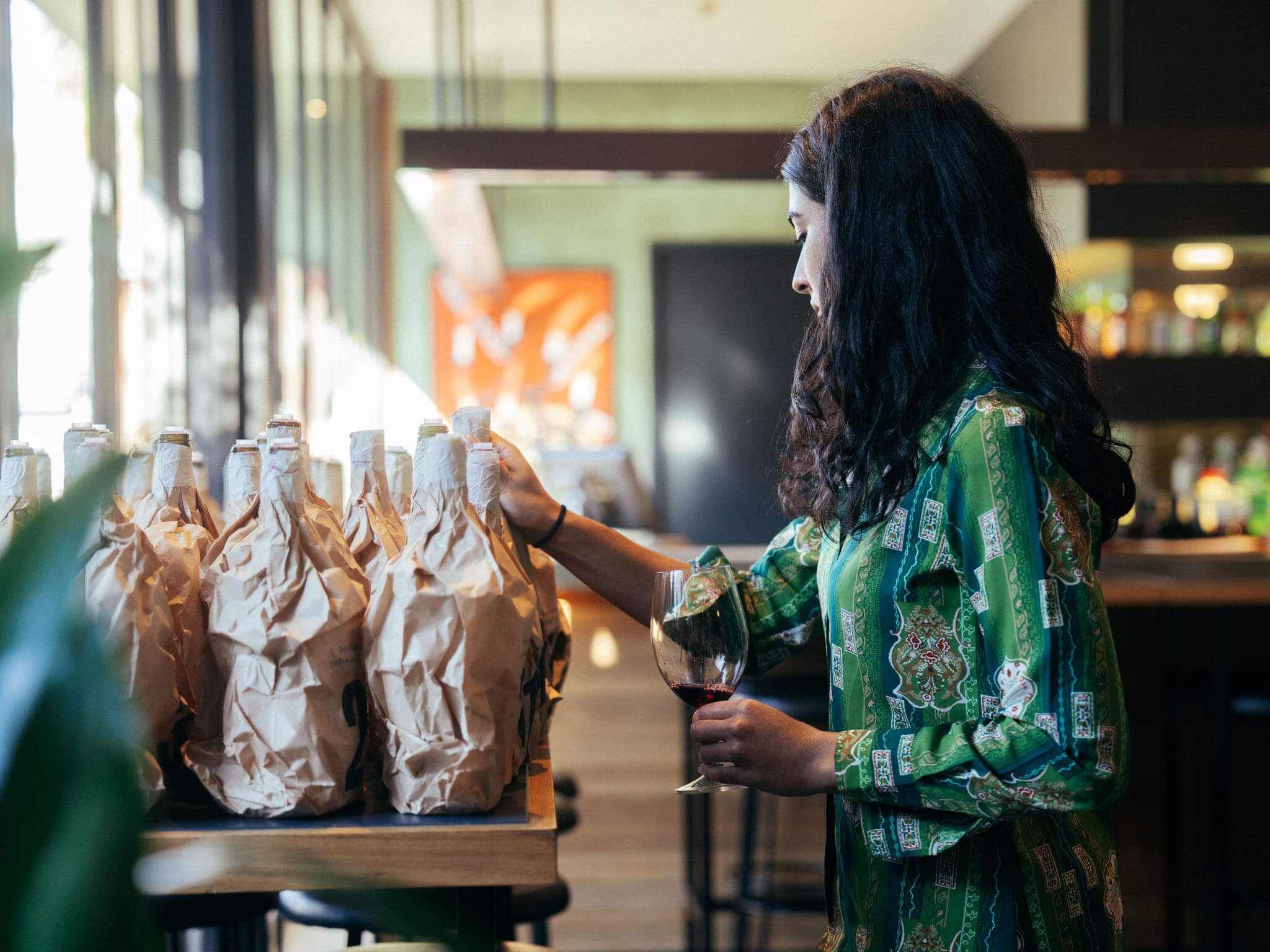
Above and opposite: Scenes from our Deep Dive at the Bleakhouse Hotel, Albert Park (Melbourne). All wines sampled ‘blind’.
Talk of cellaring these wines raised the approachability, and shifts in winemaker mindset. “We buy wine to drink now,” Snook said. “I think a lot of winemakers have had to really think about how they make wines, stylistically, and how, you know, they’re no longer able to make wines that need to be cellared, or to age for that kind of significant time.” She added that the same economic forces that made it hard for consumers to spend money on building wine cellars also affected the day-to-day operations of wineries, too. “Everything’s had to be wound back by force – like, wineries can’t afford to be using new oak the way that they used to be using it.” Nadeson agreed, adding, “It becomes an issue of cashflow for the winery – so you want the wine that you’re currently selling to be more approachable as a young wine, so that people are buying more bottles and go back for it again and again. If they’re putting it on their cellar, they’re not going to come back for that same wine.”
“We’re seeing so many wines that are only just coming into their stride. I’d really love to see what all these look like in five years – what they’re going to achieve.”
Cruickshank argued that while the economic pressures that might lead winemakers to make more supple, easily approachable examples of cabernet franc were not desirable, the resulting wines were very much in line with contemporary consumers’ palates. “I feel like we’re doing we’re doing for cabernet franc what we did for chardonnay,” she said. “Everybody hated chardonnay for a while – it was like, ‘Ugh, this is so big and disgusting.’ And then we went underground with it, and winemakers came back and they were like, ‘Actually we make an incredible chardonnay’. I feel like we’re bringing cabernet franc back to there.” She concluded: “Cab franc is cool! I’ll take that to the grave. The kids like it!”
Above and opposite: Our cabernet franc tasting in action.
The Panel
Steffi Snook is a Melbourne-based winemaker and the founder of Yayoi Wines – producing small-batch wines characterised by precision, texture, and a genuine respect for the locale. Inspired by the Loire Valley, her work blends Old World sensibilities with contemporary Australian expression, emphasising chenin blanc and cabernet franc. Her experience includes roles at Bannockburn Vineyards (Geelong), Domaine des Closiers (Saumur-Champigny, France), and Peay Wines (Sonoma, USA), along with formative years working with Ray Nadeson at Lethbridge Wines. A background in Melbourne’s top dining establishments and wine distribution further refines her perspective, connecting the viewpoints of producer, buyer, and consumer.
Patrick Wood‘s early exposure to wine at his family’s property, Kyneton Ridge Estate, and retail experience sparked an interest in travelling harvest and vintage roles, which he commenced in 2014 at Castillon in Bordeaux. Production opportunities in the Yarra Valley followed, and mentorships with the teams at Punt Road, Helen’s Hill Estate and Soumah helped shape his winemaking foundations, followed by the formal training of a bachelor degree in viticulture at Charles Sturt University. In 2022, he moved to the Macedon Ranges to take on a vigneron role, focusing on elevating the label’s wine offerings and establishing a contract winemaking operation. During this time he and his partner, Greta Darling-Filby, brought to life the concept for their own label, Harbinger Wines, from the ground up. An affinity for cool-climate viticulture, a love of Bordeaux varieties, and a focus on environmental sustainability drives his search for alternatives to convention.
Indra Nadeson is assistant winemaker at Lethbridge Wines in Geelong’s Moorabool Valley, representing the second generation at Lethbridge. Prior to joining the family business, Indra worked as a sommelier at leading fine-dining venues in Melbourne. She has completed vintages internationally at Domaine Bernard Defaix in Chablis, France, and Peay Vineyards on the Sonoma Coast in the United States, gaining valuable global perspective on the wine industry.
Jason Burns‘s hospitality experience spans many different levels and styles of service, from pubs to fine dining to wine bars and everywhere in between. He has likewise worked with very eclectic natural-leaning wine lists and very classically focused wine lists. While always having an appreciation of wine, he didn’t get into it seriously until his late twenties – and since then he has completed the Wine & Spirit Education Trust (WSET) Level 3 Award in Wines as well as the French and Italian Wine Scholar programs with the Wine Scholar Guild. He has a passion for championing alternative grape varieties, as well as an admiration for winemakers who test the boundaries, and loves to guide and teach people about wine in an unpretentious way regardless of their experience.
Terina Davies grew up in Gippsland surrounded by vineyards, sparking an early fascination with expressive wine. After completing a Bachelor of Business at RMIT, she spent formative years with the European Group before travelling and working vintages at Gaja and Taittinger, and in the dining room at Paris’s L’Arpège. Back home, Terina has held roles across top venues including Vue de Monde and wineries on the Mornington Peninsula. Now based in Melbourne, she combines her love of wine with inclusive hospitality, working at Seddon and Union Wine Stores, teaching people with disabilities, and studying for her Wine & Spirits Education Trust (WSET) Level 4 Diploma in Wines.
Jordan Veltheer has spent his entire working life around wine, from restaurants and retail to cellar doors, private appointment sales, and a vintage in the Yarra, covering every comer of the industry since he was nineteen. A Wine & Spirit Education Trust (WSET) Level 3 Award in Wines graduate, he runs Vino Champ, an Instagram wine education page dedicated to Australian wine, and Club Vino, a monthly social club helping everyday Australians learn how to navigate and buy better wine. His passion is Australian wine, full stop, and he is on a mission to tell its story.
Megan Cruickshank is the founder of Apartment Six, a Melbourne-based wine events and community platform focused on growing the next generation of young wine drinkers and connecting them with producers, regions and styles through engaging, approachable and social wine experiences. Her professional background is in marketing, design, counselling, and event production – but she was drawn to wine by its uniquely challenging intersections of agriculture, science, business, and community. Having completed the Wine & Sprit Education Trust (WSET) Level 2 Award in Wines, she is currently undertaking pinot noir winemaking training at Dromana Estate. She loves wine’s ability to bring people together, believing the best bottles are the ones that become part of a story worth retelling.
GET FIRST ACCESS TO THE NEXT WINE ICONS – DELIVERED
Over the last couple of decades, the quest for finding the best sites for chardonnay and pinot noir in Australia – as well as evolving the making to produce even more compelling expressions – has been relentless. The 2021 Young Gun Top 50 features Turon Wines, Quiet Mutiny, Alkimi Wines, Mulline and Gilbert who are all pushing the envelope in defining today’s styles. Tasting notes appear at the end of the article.
On the surface, it’s easy to compare the Geelong wine region with the Mornington Peninsula. While Mornington catches the light with a good dose of glamour, Geelong has a quieter resolve and greater subregional diversity, which makers are exploiting to exciting effect. This year’s Top 50 features Mulline’s Ben Mullen, Empire of Dirt’s Natasha Webster and Micro Wines’ Jonathan Ross.
In this fourth instalment of a seven-part series produced in collaboration with Vintage Cellars – 70 years of supporting wine in Australia – we look at Australian wine in the 1980s, the vine pull scheme, the rise of small winemakers, the start of the chardonnay boom, and the cool climate regions that started to find their feet.
Subscribe to our newsletter
Young Gun of Wine is your shortcut to cutting edge wines, the places to go, and the people behind it all.
Subscribe to be amongst the first to know of our latest discoveries in wine.
We'll bring you the inside running from the growers, the makers, the wholesalers, the retailers and the sommeliers, too.